 Job Search
September 14, 2026
12 Job Search Mistakes & How To Fix Them
Discover the most common job search mistakes and exactly how to fix each one. Learn why you can't get a job with data-backed explanations.


Have you ever found yourself submitting countless job applications, only to be met with frustrating silence? It didn’t make sense. Because you read the job descriptions, and you were a perfect fit. Why didn’t the recruiters see that, and call you in for an interview?
You're not alone. The job market is a TOUGH place to be—we feel you.
But hard as this is to hear, one of the most common mistakes people make is misinterpreting job descriptions. This can lead to them applying for roles that they’re not really a fit for… on paper at least. Then they get angry or depressed when the rejections pile up.
Even if you’re 1000% convinced that you’re qualified, the way you read and respond to job descriptions can significantly impact your success rate.
We’re here to help. In this blog post, we’ll share how to quickly and precisely decode the most important parts of a job description, so your resume syncs with what employers are truly looking for.
Which will exponentially improve your chances of landing that interview!
At first glance, job descriptions might seem straightforward. It’s just a list of responsibilities and experience needed, right?
Well, yes, and no. Simple as they seem, many people misunderstand them, leading to three big problems:
Misinterpretation of the job requirements: Many job seekers don’t fully understand what the company is actually looking for, so they apply for roles they aren’t well-suited for.
Ineffective resumes: Even when they do understand the job description, they fail to make sure their resume properly demonstrates that they’re a strong match for the role.
Assuming recruiters will read between the lines: They can’t and won’t. If your resume doesn’t effectively tell your story, or if you fall significantly short of the requirements, expecting recruiters to be nice and guess that you can do the job just won’t happen.
Read more: Discover JobLeads research on red flags in job descriptions to learn how to spot them better.
Let’s take a look at the key sections of a typical job description and explore what they really mean, so you can be sure to fully understand them the next time you’re applying.
Probably the most crucial part of any job description is the 'Essential Criteria' section (AKA 'Key Requirements' or 'Minimum Requirements'). Regardless of what it’s called, this bit contains the non-negotiables required for the role.
For example, let’s take a look at a job posting for a Customer Service Manager at a company called BritaCom.
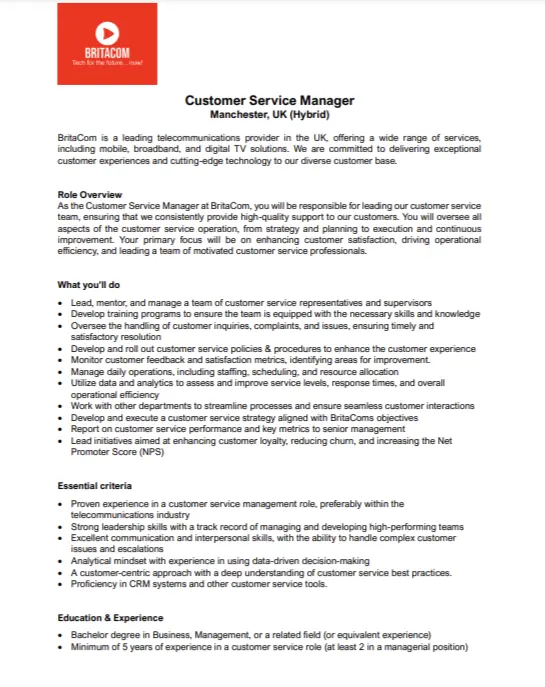
In the Essential Criteria section, the job requires:
“Minimum of 5 years of experience in a customer service role (at least 2 in a managerial position), ideally within the telecommunications industry.”
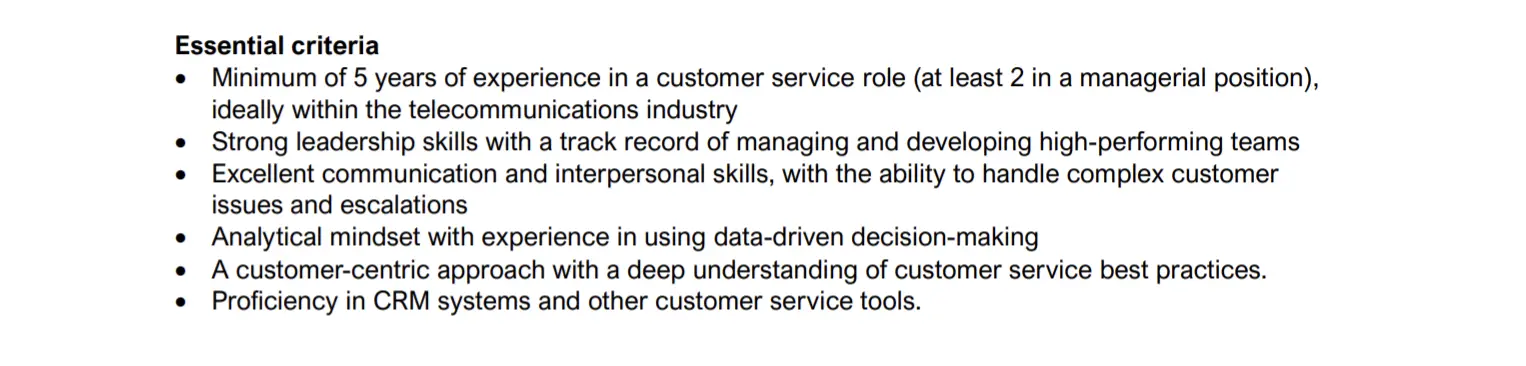
This point mentions three non-negotiables:
They also desire telecommunications experience, but they know it might be narrowing the field too much, so they’ve made this particular request an ideal requirement.
While we’re on the topic, you’ll often see a separate ‘Desirable criteria’ section (or something along those lines) as well. These are for the ideals the company would love you to have, but they’re not essential. Of course, if someone has all of the essentials and some of the desirables, they’re more likely to be interviewed. But as long as you tick the essentials criteria, you’re in the race!
Let’s take a look at the job description again:
“Bachelor degree in Business, Management, or a related field (or equivalent experience).”

Here’s where many job seekers get tripped up. A related field means something connected to business or management—such as marketing or sales. It doesn't mean an unrelated degree like biosciences or art.
The term 'equivalent experience' is often misunderstood, because it doesn’t exactly specify what ‘equivalent’ looks like to them.
The good news is, if you don’t have a degree but have several years of relevant experience, you might still be qualified to apply.
However, you need to really evaluate whether your experience truly equates to what the degree would have provided. A bachelor’s degree typically involves three or more years of dedicated study, combining both theoretical and practical knowledge.
So, ‘equivalent’ would be around three years of full-time experience. Does your work experience provide a comparable level of depth and expertise? If yes, then apply!
Read more: Check out the full guide on degree vs experience and learn what matters more for employers.
The 'What You’ll Do' section of a job description outlines the day-to-day tasks and responsibilities. These are things you’re already expected to know what to do, without training or further guidance (unless they state otherwise). For instance, the job might include:
“Develop and roll out customer service policies & procedures to enhance the customer experience.”
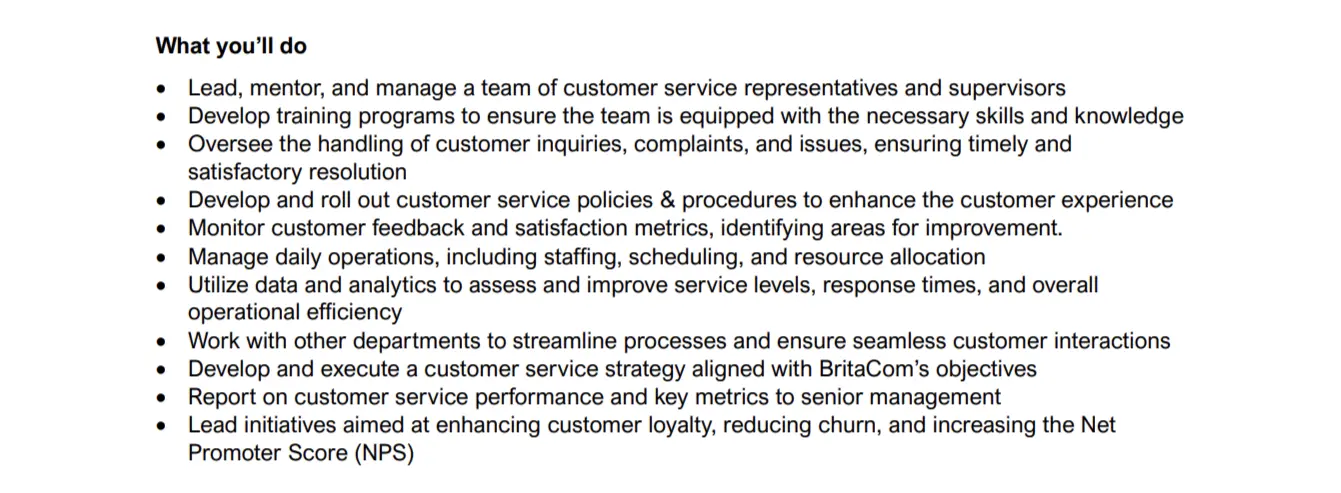
If you’ve never been involved in creating or implementing policies before, you need to ask yourself whether you’re a realistic fit for this role. Employers prioritize candidates who have a proven track record in the specific responsibilities they’ve listed, particularly at supervisor or management level.
Recruiters won’t read between the lines. If you have the experience, you need to spell it out in your resume.
On the other hand, if policy development is your cup of tea, this is your chance to shine. Highlight this experience really clearly in your resume, mirroring their phrasing as closely as possible.
Go through the entire list of responsibilities and ensure you have relevant experience for each, especially for the higher level ones towards the top of the description.
But it’s not just about ticking boxes; it’s about making sure that your resume explicitly reflects your ability to perform the tasks the company deems most important.
One of the most effective strategies for improving your chances of landing an interview is to tailor your resume for each application. At this stage, the recruiter’s task is to find the best fits on paper for the published job description. It’s nothing personal; merely logic.
And who will end up the ‘yes’ vs. ‘no’ pile for further evaluation? That’s right, the applications that appear closest to what they’re looking for.
It might sound time-consuming to edit your resume, but once you have a strong ‘master’ resume in place, it’s just a matter of quickly making a few strategic tweaks for each specific opportunity.
This means ensuring the major keywords mentioned in the job description (e.g. project management, team leadership, financial forecasting, marketing collateral, etc.) are mentioned in your resume.
The simplest way to do this is to have a headline, resume summary, and a key skills box at the top of your resume. Then all you have to do is read the description, identify the most important keywords and criteria (make this even faster by asking ChatGPT to help!), and edit your summary and key skills box to include whatever relevant experience/knowledge you have that reflects that. Like this:
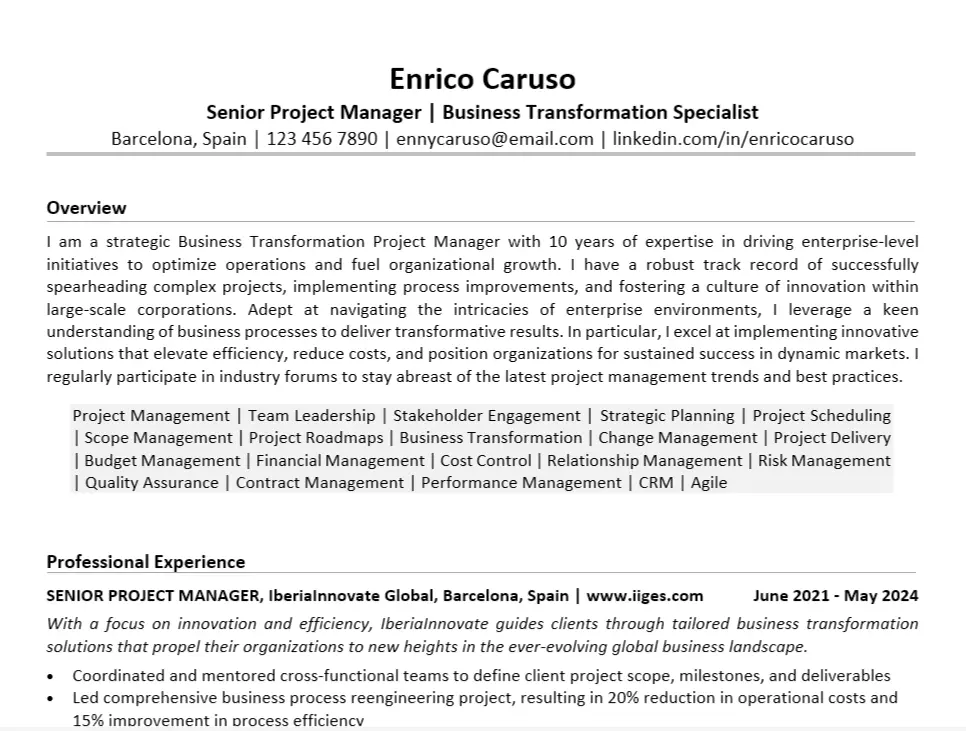
If you’ve tweaked these to reflect what they’re looking for, it will grab the recruiter’s and applicant tracking system’s attention.
Next time you’re applying for a job, hone in on the Essential Requirements, Education and Qualifications, and Responsibilities section.
Then, take what you’ve identified and use this to edit your resume to more closely reflect the ideal candidate (without lying, of course). This should take no longer than a few minutes per application.
By mastering the art of decoding job descriptions, you can avoid wasted time and energy on applications that are unlikely to succeed. Instead, you can focus your efforts on roles where you’re a strong match, increasing your chances of landing interviews and ultimately, the job you want.
If you found this advice helpful, then check out our other blog posts for more great career advice. And if you’re still confused about any part of job descriptions, feel free to ask in the comments.
Good luck with your job search!

Co-Founder and Managing Director
Jan Hendrik von Ahlen is the co-founder of JobLeads, a career platform built exclusively for job seekers. He co-founded JobLeads with Christian von Ahlen and Martin Schmidt in 2007 with a clear mission: to give candidates the tools, insights, and support they need to take control of their job search. Under his leadership, JobLeads has grown into a subscription-funded platform serving 20 million users across 40+ countries, with AI-powered job matching, a 40,000+ headhunter network, and end-to-end career support.
Job SearchDiscover the most common job search mistakes and exactly how to fix each one. Learn why you can't get a job with data-backed explanations.
 Job Search
Does a degree or work experience win in hiring? See what the data says about degree vs experience, the equivalency math, and what actually works.
 Job Search
Learn how to find a remote job. Discover the best platforms, what to put on your resume, and how to apply with no experience to get a legit remote job.