
 Job Market Trends
July 27, 2026
Red Flags in Job Postings: 55M Job Ads Analyzed–the Cringy Ones Pay Less
JobLeads analyzed 55M US job ads. The more buzzwords and clichés a listing uses, the less it pays–nearly 18% below clean postings.


JobLeads analyzed nearly 1.4M US job postings that drew at least one click from users between April and June 2026, across 11 industries. Out of that pool, 2,984 postings stood out for the wrong reason: each one attracted 10 or more clicks but not a single application.
People opened them, read them, and left. Why?
The likely explanation is unrealistic job requirements: a wish list no candidate could meet, or a heavy ask paired with low pay.
But here's the catch. Zero-apply jobs list almost exactly as many skills as the average posting, and pay almost exactly the same. What sets them apart is the kind of requirement they list, and the language they use to list them.
Are some job requirements simply unrealistic if people don't apply to them? The usual answer is that postings ask for too much, as if every employer is hunting for a unicorn candidate.
There's research behind that complaint. In a Harvard Business School and Accenture study, Fuller et al. (2021) found that most companies keep adding to old job descriptions, tacking on every skill and task the previous employee picked up along the way.
This leaves a job ad packed with "legacy requirements." In fact, of the more than 2,250 executives surveyed in the US, UK and Germany, 88% agreed that qualified, highly-skilled candidates get vetted out because they don't match the exact criteria in the job description.
So the first test was simple: do the postings nobody applies to list more skills?
They don't. Across all 10 industries, high-click, zero-apply postings list an average of 4.4 skills. The baseline – every clicked US job in the quarter – lists 4.5.
| Industry | Baseline (avg number of skills listed in requirements) | Jobs with zero applies (avg number of skills listed in requirements) | Difference |
|---|---|---|---|
| Sales | 4.5 | 4.1 | -9% |
| Consulting | 5.1 | 4.7 | -7% |
| Human Resources | 4.4 | 4.2 | -6% |
| Legal | 4.5 | 4.3 | -4% |
| IT & Technology | 5.5 | 5.3 | -4% |
| Engineering | 4.7 | 4.5 | -2% |
| Management & Operations | 4.4 | 4.5 | +1% |
| Marketing & Media | 4.9 | 5 | +2% |
| Finance | 4.7 | 4.9 | +4% |
| Bio & Pharmacology | 3.8 | 4 | +5% |
In six of the ten industries shown, the jobs nobody applies to ask for slightly less than the average posting. The biggest gap is in Sales, where zero-apply postings list 9% fewer skills.
Pay tells the same story. Median salaries for zero-apply and baseline postings differ by only 2-4%, which is too small to explain why a posting with 10-plus interested readers gets no applicants at all.
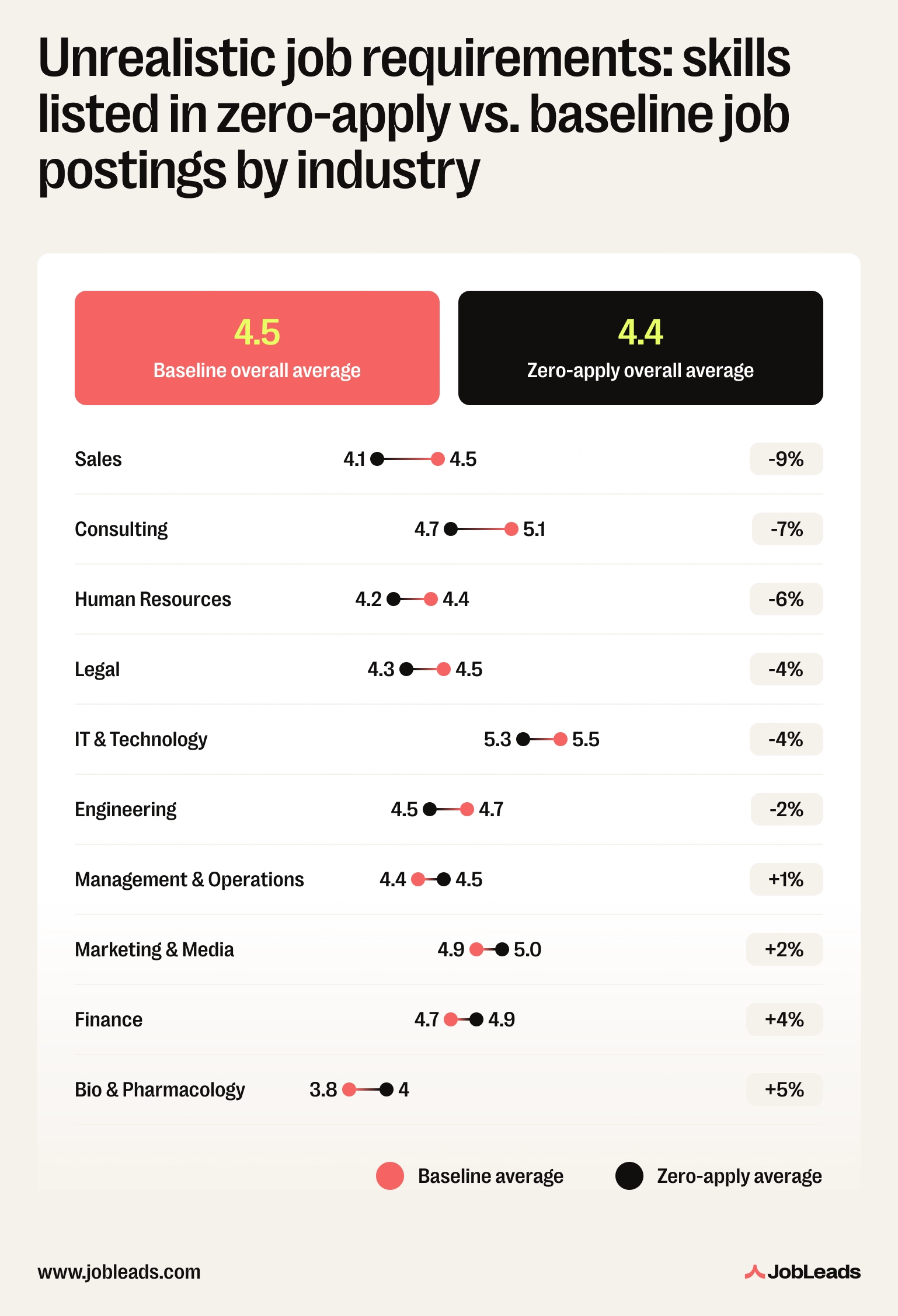
In other words, the "too many requirements, too little pay" theory doesn't hold. That doesn't make the requirements creep imaginary, as the long-running complaint about entry-level jobs requiring experience shows. It just isn't what separates the postings nobody applies to.
Quantity isn't the problem, but substance is.
When you line up the job requirement examples zero-apply postings actually use, the pattern starts to show. The terms most over-represented aren't skills a candidate can demonstrate. Instead, they often describe a personality.
The numbers below compare postings nobody applies to with the average clicked job. At 1x, a phrase appears equally often in both. At 4x, it appears four times as often in the postings nobody applies to.
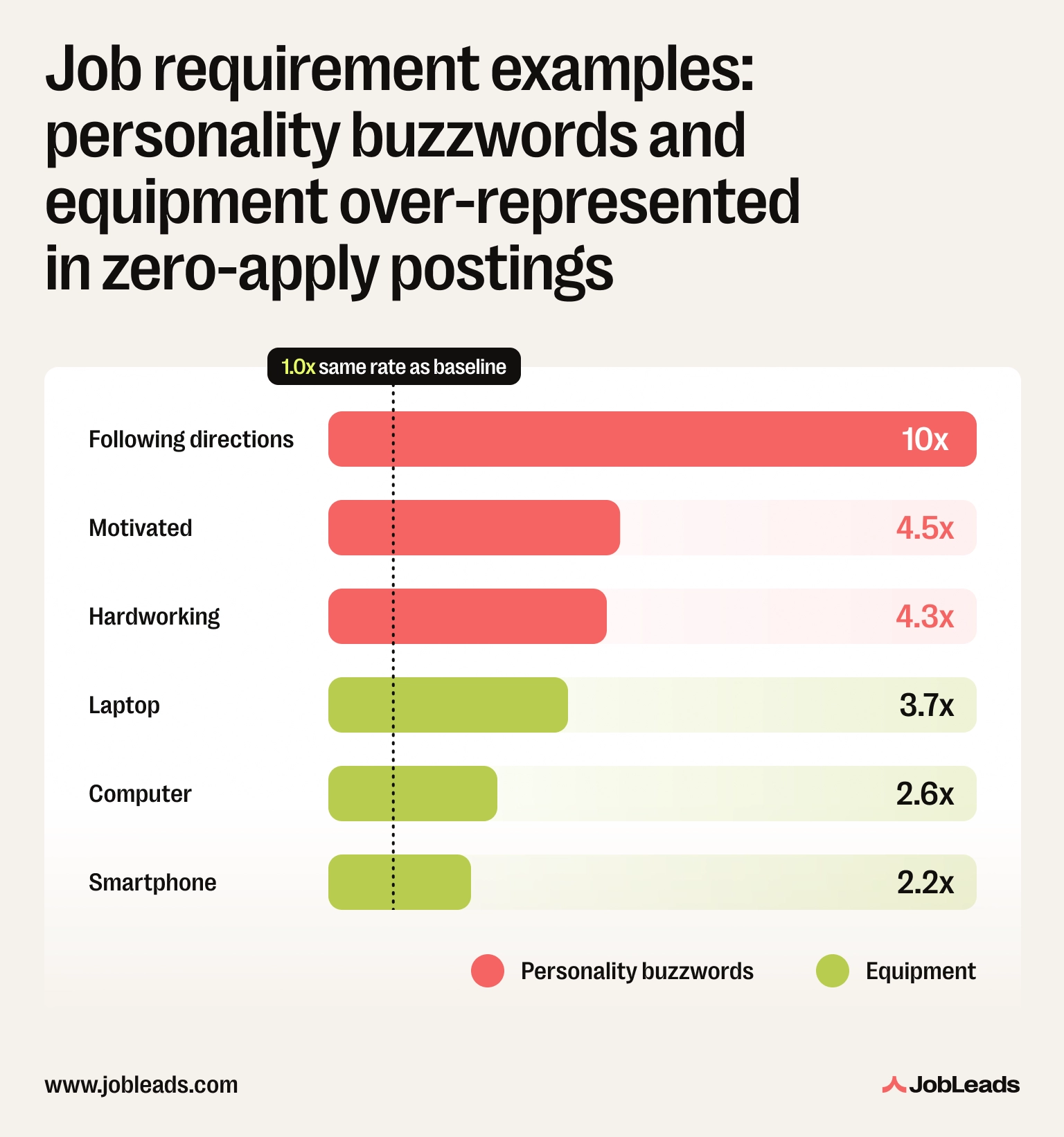
A job seeker can check whether they know Python or have run a payroll cycle. They can't check whether they are "motivated" enough–that's the difference between hard and soft skills. These phrases give readers nothing to measure themselves against, and they tend to appear in postings that feel templated rather than written for a specific role.
Wording alone can change how a job ad lands. In the Journal of Personality and Social Psychology, researchers found that when job ads used more masculine-themed wording, women found the same jobs less appealing. The drop came down to whether readers felt they would belong there, not whether they thought they had the skills.
This suggests the problem isn't that the bar is too high. It's that there's no visible bar at all.
Some context on scale: "motivated" appears in roughly 1 in 100 zero-apply postings, compared to about 1 in 450 across the baseline. At the group level, personality and work-ethic terms over-index more modestly, at 1.1x. The two groups that over-index most are caregiving language (childcare and caregiving, 2.1x) and marketing & social media (1.9x), which often shows up in the same soft, enthusiasm-led register. For job seekers, this kind of vague, trait-heavy wording is one of the more common red flags in job postings.
In the strongest job description examples, the tools section tells candidates what they'll work with. In zero-apply postings, it often lists what they'll need to own.
"Laptop” appears 3.7x more often in zero-apply postings than in the baseline, “computer” 2.6x, and “smartphone” 2.2x. As an illustration: if 1 in 100 zero-apply postings listed “laptop”, only about 1 in 366 postings across all clicked jobs would. These aren’t requirements in any meaningful sense.They're equipment, and listing them tells a reader little about the job itself. It can also be a signal that the employer won't provide basic work equipment, so a new hire may end up paying for it out of their own pocket.
Then there's the opposite extreme: highly specialized tools that appear in zero-apply postings far more often than the market average. ZBrush, a digital sculpting program, over-indexes at 16.3x. Blender, a 3D modeling suite, at 5.5x. Among skills, UI design (18.4x) and MLOps (9.1x) show the same spike. At first glance, postings like these look like a hunt for a purple squirrel.
Interestingly, these specialist outliers sit next to a broader pattern that runs the other way. As groups, the most concrete and demonstrable technical skills are under-represented in zero-apply jobs:
| Over-represented in zero-apply jobs | Under-represented in zero-apply jobs |
|---|---|
| Childcare & caregiving (2.1x as often) | DevOps & cloud infrastructure (0.6x as often) |
| Marketing & social media (1.9x as often) | Office software & productivity (0.7x as often) |
| Basic equipment & connectivity (1.2x as often) | Programming languages (0.7x as often) |
| Personality & work ethic (1.1x as often) | Data & analytics (0.7x as often) |
| Sales & business development (1.1x as often) | Leadership & management (0.8x as often) |
The two groups at the top of the list stand out for a different reason. Childcare and caregiving (2.1x) and marketing & social media (1.9x) are occupations in their own right. When they appear in postings for other roles, they may point to a second job hidden inside the first, such as an assistant role that also covers childcare or a sales role that doubles as the company’s social media manager.
Postings built around specific, checkable expertise are less likely to end up in the zero-apply group, while postings built around equipment, enthusiasm, and generic traits are more likely to. Specific requirements also give job seekers something concrete to check for a job skills gap before deciding to apply.
The pattern isn't spread evenly across the market. Compared to their share of all clicked jobs, some industries are much more likely to produce high-click, zero-apply postings.
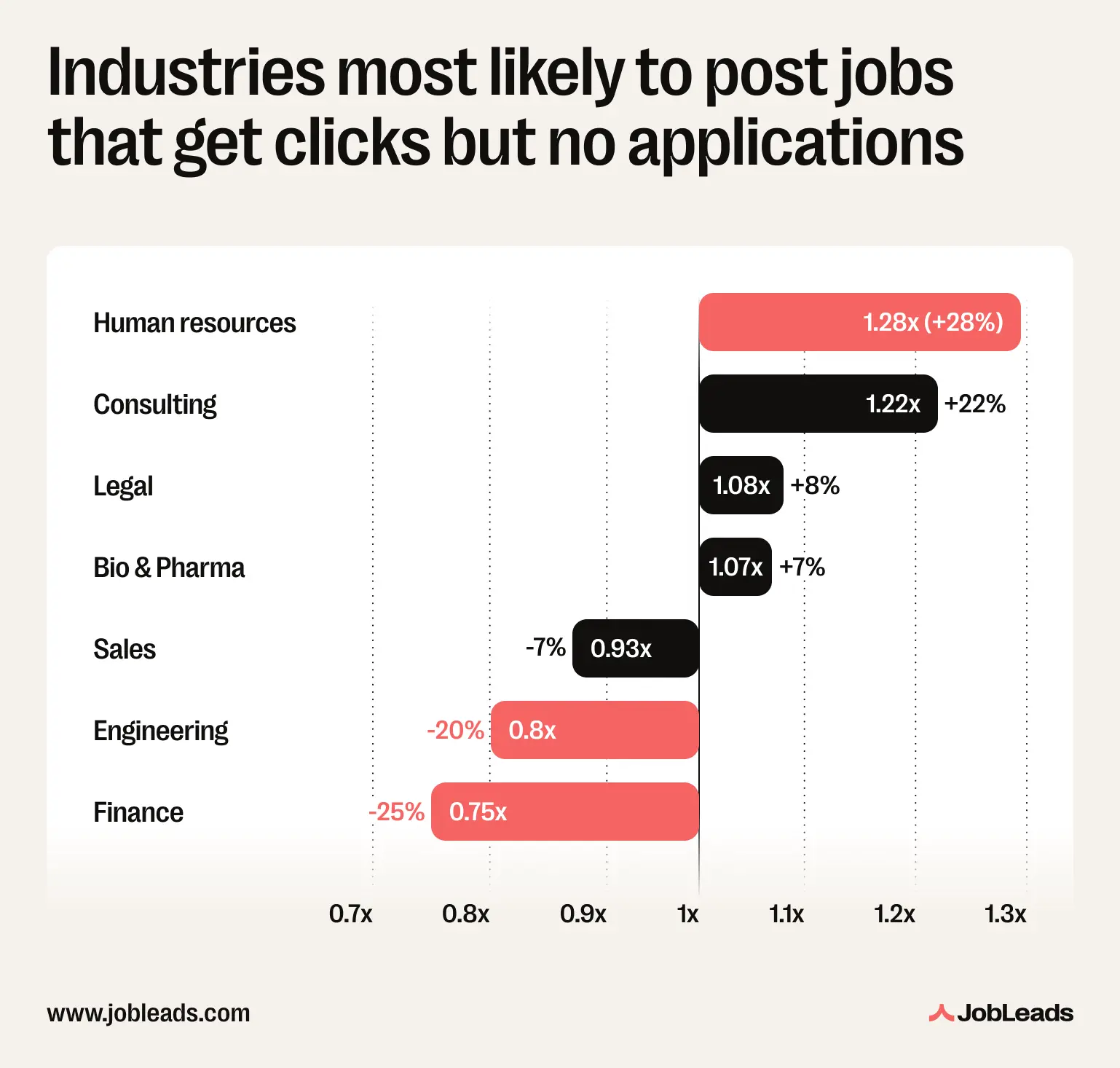
HR makes up 4.6% of clicked jobs but 5.9% of the jobs nobody applied to, which is 28% more than expected. Finance and Engineering are the opposite. Finance makes up 6.8% of clicked jobs but only 5.1% of zero-apply jobs (25% fewer than expected), and Engineering 7.6% but only 6.1% (20% fewer).
There's an irony in the top spot. Human Resources is the function most often responsible for writing job ads.
This could be because HR and consulting roles are hired on more subjective criteria, such as culture fit, and are described in the soft, trait-led language that over-indexes across the dataset. Finance and Engineering tend to name certifications, systems, and technical skills a reader can check against their own background.
In total, 2,393 companies posted at least one high-click, zero-apply job in Q2 2026. Most of them only did it once.
| Zero-apply jobs per company | Companies | Share of companies | Share of zero-apply postings |
|---|---|---|---|
| 1 | 2,128 | 89% | 71% |
| 2-4 | 230 | 10% | 19% |
| 5-9 | 27 | 1% | 5% |
| 10-24 | 7 | 0.3% | 4% |
| 25+ | 1 | <0.1% | 1% |
So the problem is mostly widespread, not concentrated: almost nine in 10 employers with a zero-apply posting had just one. But the long tail stands out. The 35 companies with five or more zero-apply postings make up about 1.5% of employers and account for 10% of all zero-apply jobs.
A candidate can check whether they know Python. They can't check whether they're "motivated" enough. When a posting has no measurable bar, serious candidates have nothing to clear, so they move on to one that tells them what the job actually is.
Jan Hendrik von Ahlen – Managing Director, JobLeads
Trimming requirements won't necessarily fix that: Sigelman, Fuller and Martin (2024) found that about 45% of firms that dropped degree requirements did so "in name only," with no real change in who they hired.
For employers, the fix is to be specific. Name the skills the role actually uses, the systems a new hire will work in, and what success looks like in the first few months. Cut the generic traits and the equipment everyone already owns, because a posting that reads like a template will be treated like one.
For job seekers, a posting full of "motivated," "hardworking," and "must have a laptop" isn't necessarily out of reach. It just tells you very little. Take it as a reason to look more closely and check for the signs of a recruitment scam. Curated job matches on JobLeads are one way to spend less time on postings that tell you nothing.
This analysis uses JobLeads platform data. JobLeads is a career platform that connects professionals with job opportunities.
Dataset: all US job postings active between April 1 and June 30, 2026 that received at least one click from a JobLeads user. Healthcare postings were excluded. Healthcare jobs list far more skills than other industries, and many of those skills are highly technical. Because this analysis focuses on outliers, including them would have skewed the sample. Healthcare job titles also follow conventions that are hard to classify consistently: a Medical Director, for example, is a specialist clinical role, not a general management one. The final baseline covers 1,368,871 clicked jobs across 11 industries. Industry breakdowns cover the 10 named industries; an "Other" catch-all is included in the overall figures but not broken out separately.
Zero-apply definition: a posting was classified as high-click, zero-apply if it received 10 or more distinct user clicks and zero applications–2,984 postings met this definition.
Requirement extraction: skills, tools, and responsibilities were extracted from job descriptions using AI parsing. The 387 distinct values found were classified into 23 semantic groups (for example, "Programming languages" or "Personality & work ethic").
Over-index: for each skill, tool, responsibility, or group, the over-index compares how often it appears in zero-apply postings with how often it appears in the baseline:
(% of zero-apply jobs with attribute X) ÷ (% of baseline jobs with attribute X)
Index of 1x means the attribute appears at the same rate in both groups, 2x means twice as often in zero-apply postings, and 0.5x means half as often.
Salary comparison: median salaries were compared between the two groups using snapshot salary data where available.
Limitations:
Ethics and privacy: All data is aggregated and anonymized. No individual user data is reported, and no companies are named.
Journalists and media organizations are welcome to reproduce charts and data from this article with attribution to JobLeads and a link to this page. Please do not reproduce the article in full without permission. If you have any questions or inquiries, please contact press@jobleads.com.

Content & Insight Writer
Beata creates content that puts job seekers first. From practical blog advice to first-hand research studies, her writing is designed to give people the clarity and confidence to find the role they deserve.
Job Market TrendsJobLeads analyzed 55M US job ads. The more buzzwords and clichés a listing uses, the less it pays–nearly 18% below clean postings.
 Job Search
Does a degree or work experience win in hiring? See what the data says about degree vs experience, the equivalency math, and what actually works.
 Job Search
Learn to identify and protect yourself from online scams & fraud on WhatsApp, email, and phone. Stay vigilant and secure with our essential tips and guidelines.