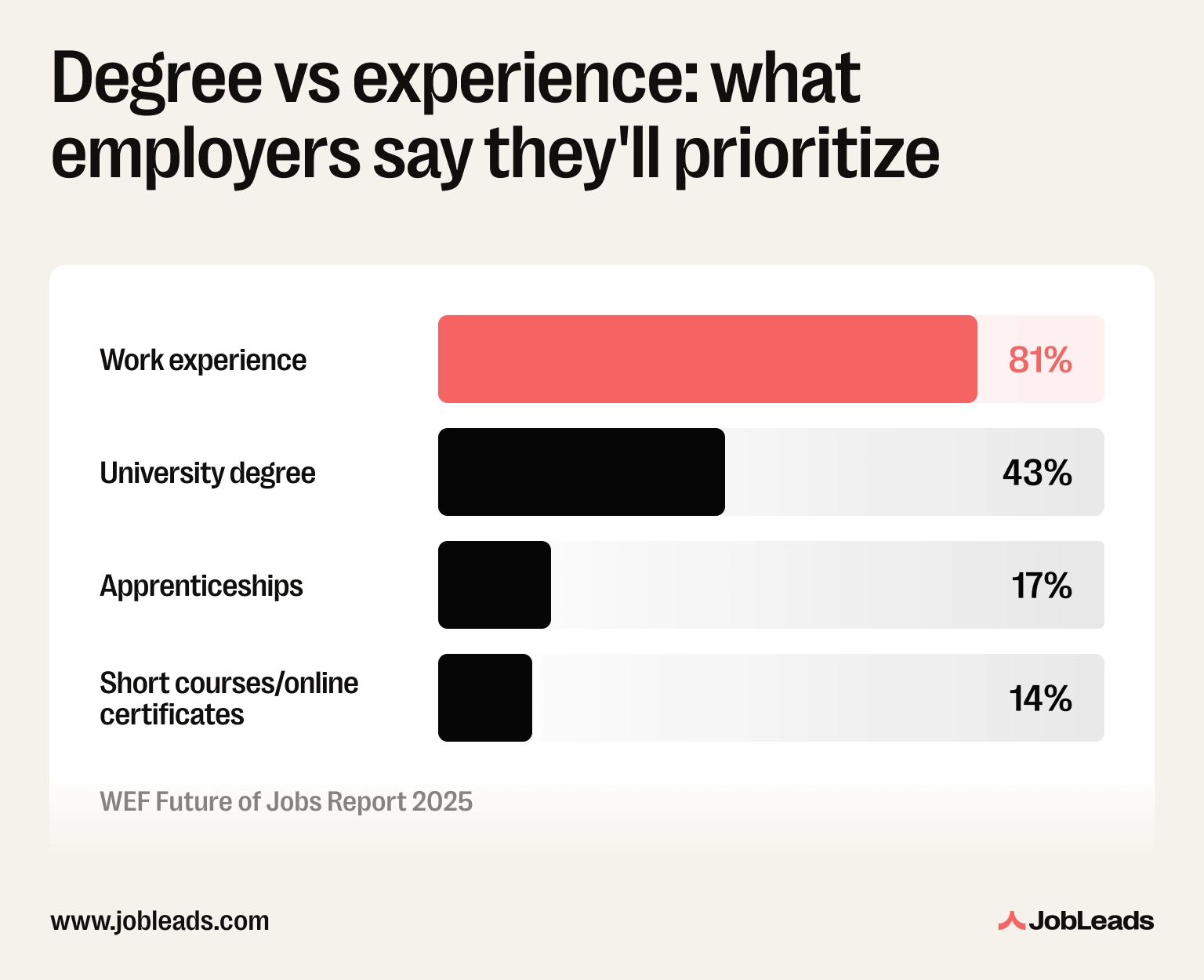
Ask employers what they care about more, and the answer is shifting fast. According to the World Economic Forum's Future of Jobs Report, 81% of employers prioritize work experience when evaluating candidates, compared to just 43% who still lean on a university degree.
That sounds like experience won. But it hasn't–at least not entirely.
The Cengage Group's Graduate Employability Report found that 71% of employers still require a two- or four-year degree for entry-level roles.
So–what does it mean for job seekers? Should you finish your degree or lean on years of hands-on experience? This guide breaks it down.
Key takeaways
About 81% of employers say they'll prioritize work experience over a degree when assessing candidates (World Economic Forum's Future of Jobs Report)
Cengage Group found that over 71% of employers still require a degree for entry-level roles, and that number is rising, not falling
Harvard Business School and the Burning Glass Institute found fewer than 1 in 700 hires were actually affected by dropped degree requirements
Commonly used guidelines treat 1 year of relevant work experience as equal to 1 year of formal education
Bachelor's degree holders still earn 66% more per week than high school graduates (BLS, 2024)
AWS-certified professionals earn about $12,000 more than uncertified peers (Global Knowledge IT Skills and Salary Report), and coding bootcamp grads see a median 56% salary lift (Course Report)
See how your experience stacks up against the job description
Get a free resume review from JobLeads and find out where your experience wins.
The degree vs experience debate isn't really either/or. It's about which signal an employer trusts more when your resume doesn't tick both boxes.
A degree signals that you completed a structured curriculum, met a baseline of academic discipline, and can be trusted with foundational theory.
Experience signals that you've already done the job, under real pressure, with real consequences.
JobLeads' own analysis of over 1.2 million US entry-level listings found that the most demanded requirements aren't academic at all. Customer service (18%), communication (16%), and attention to detail (10%) top the list, and no single technical skill appears in even 5% of postings.
Most job ads split the difference. "Bachelor's degree or equivalent experience" is now standard language in postings across tech, marketing, and operations roles. That phrase is doing a lot of work–and it's the reason two of the most searched questions on this topic are whether a degree counts as experience, and how much experience actually equals a degree.
Everything above changes depending on what field you're in. A missing degree is a non-issue in one industry and a hard stop in another, so before you bet your job search on experience alone, check where your field actually falls.
Field
Degree usually required?
Can experience substitute?
Tech / software
Often listed, frequently negotiable
Yes–strong portfolio or certifications can substitute
Skilled trades
Rarely
Yes–apprenticeships and licenses are the real credential
Not in the traditional sense. A degree lives in the "education" section of your resume, not the "experience" section, and most applicant tracking systems and recruiters treat the two as separate categories.
But for the purpose of meeting a job's minimum qualifications, many employers do let a degree substitute for a chunk of required experience–and vice versa. That's where "equivalent experience" comes in.
Degrees are used by new folks as a stand-in for experience until they get their feet grounded. But after a few years of experience, few bother looking at the education section at all... generally speaking experience is ultimately what matters.
There's no single legal or industry-wide standard here. Each employer decides for itself what "equivalent experience" means, and it varies by role, industry, and how strict the job posting is.
That said, a few guidelines show up consistently across HR practice:
The 1:1 rule: 1 year of relevant work experience is often treated as equal to 1 year of education, which puts roughly 4 years of hands-on experience in the same bracket as a bachelor's degree.
The broader range: public-sector equivalency guides typically accept 2-4 years of directly relevant work in place of a bachelor's degree, and 10+ years in place of a master's.
The stricter version: in US immigration labor certifications, a "three-for-one" rule applies–three years of documented work experience for every one year of missing academic study.
Tip
If a posting says "bachelor's degree or equivalent experience," don't self-select out. Email the recruiter or hiring manager and ask what "equivalent" means for that specific role before you decide not to apply.
Because a degree is a cheap, fast filter at scale. When a role gets 250+ applications, a degree requirement in the ATS thins the pile before a human ever looks at it.
And that filter is getting stricter, not looser. The Cengage Group's Report found that 71% of employers now require a two- or four-year degree for entry-level roles. This is up from 55% the year before. Whatever employers say about valuing experience, the requirement itself is moving in the opposite direction.
Moreover, Bachelor's degree holders earn a median of $1,543 a week, about 66% more than high school graduates at $930, and face a lower unemployment rate of 2.5%, according to the Bureau of Labor Statistics.
That earnings and stability gap is exactly why degree requirements are hard to kill, even as employers say they value experience more. A degree also signals things beyond technical skill, like sustained effort or time management. And in regulated fields like nursing, law, and engineering, it also provides a legal or licensing requirement that no amount of experience can substitute for.
On paper, yes. In practice, the gap between what companies say and what they do is enormous.
Harvard Business School and the Burning Glass Institute analyzed job postings at US firms that publicly dropped degree requirements. The results show that fewer than 1 in 700 hires were actually affected.
Bottom line–
Experience is gaining ground on paper, but a degree still gates the door at most companies in practice. The intent-impact gap is an institutional inertia: HR updates the posting, but the hiring manager down the line hasn't been trained to evaluate candidates on work history instead of credentials.
These grads have some great stuff in their foundations, but they lack the practical experience of having a 3am dumpster fire while on-call and having to figure everything out to save your office.
If you're betting your job search on experience over a degree, target employers with a real track record, not just a press release.
Harvard's research identified specific companies genuinely practicing skills-based hiring, including Apple, Cigna, General Motors, Target, Walmart, and Yelp. These are the firms whose non-degree hiring numbers actually moved.
Before you apply, research whether a company has actually hired and promoted people without degrees into the role you want. A "skills-based hiring" line in a job ad means nothing if the hiring manager reviewing your application hasn't changed how they screen.
These work best as a stack. Skip a step and the rest gets weaker: a certification with no portfolio stalls in human review, and a portfolio with no targeting lands in front of the wrong employer entirely. Here's the order that actually gets you hired.
Don't spend time on applications to companies that only talk about skills-based hiring. Look for firms with a documented pattern of hiring non-degree candidates into the exact function you're targeting.
A certificate alone rarely closes the deal. Certificate holders on hiring forums describe a consistent pattern: the credential clears the ATS screen, then stalls in human review without a portfolio behind it.
Not all credentials pay off equally. For example, AWS-certified professionals earn about $12,000 more than uncertified peers (Global Knowledge), and Google Career Certificate holders report over 70% positive career outcomes within six months. Moreover, coding bootcamp grads see a median 56% salary lift (Course Report).
The PwC Global AI Jobs Barometer found that "professionalized" roles requiring deep expertise are seeing twice the job growth and 42% faster salary growth than entry-level "democratized" roles. That's because AI raises the bar as fast as it lowers it. The same tools that let anyone fake a baseline skill also make real depth easier to spot and easier to prove.
Read more: Check out the AI skills that employers are actually searching for.
Collecting certificates without proof of work doesn't move the needle–employers see the credential and ask what you built with it. Mass-market certificates have also become saturated: when tens of thousands of people hold the same one, it stops differentiating you from every other applicant.
Pure self-teaching without any external validation hits the same wall from the other direction. You might genuinely know the material, but without a credential or work history, you're asking an employer to trust your own self-assessment. Most won't.
✅ Right:Two certifications, three deployed portfolio projects, and applications targeted at companies with a documented history of hiring non-degree candidates into this exact role.
❌ Wrong:Five certificates listed on a resume with no portfolio, no targeting, and "prompt engineering" as a headline skill everyone else lists too.
There's no universal winner here, and anyone who tells you otherwise is selling something–a bootcamp, a university, or just a hot take.
So–treat the decision as field-specific, not philosophical.
In regulated professions, the degree is the price of entry, full stop. In tech, trades, and most corporate roles, a strong portfolio and a track record can out-argue a missing diploma.
As a job seeker, you should stop reading job titles and credential requirements at face value, and start reading what the employer has actually done. That's the gap JobLeads is built to help you close–matching what you've actually done to the roles that will actually credit it, instead of the ones that just say they will.
The degree question isn't going away. But the evidence you bring to back up your experience is the part you actually control.
Find a role that values what you've actually done
Sign up to JobLeads and get matched with roles that credit your real experience.
Beata creates content that puts job seekers first. From practical blog advice to first-hand research studies, her writing is designed to give people the clarity and confidence to find the role they deserve.
Frequently asked questions
It depends on the field. In regulated professions (healthcare, law, engineering), a degree is non-negotiable. In tech, trades, and many corporate roles, demonstrated experience and a strong portfolio can outweigh a missing degree.
Sometimes. Employers who say "bachelor's degree or equivalent experience" typically accept several years of directly relevant work in place of the degree. But there's no universal standard–it's decided case by case.
A commonly used guideline treats one year of relevant experience as equal to one year of education, putting a bachelor's degree at roughly 4 years of experience. Some employers require more–up to 10 years in lieu of a degree for senior roles.
No. Degrees and work experience are tracked separately on a resume and by most hiring systems. A degree can count toward meeting a role's minimum qualifications, but it isn't logged as work experience itself.
Employers say they care more about experience. In fact, about 81% prioritize it over a degree, per the WEF. But 71% still require a degree for entry-level postings, so the stated preference and the actual filter don't always match.
For entry-level roles, a degree still matters more in practice because it's used as a filtering tool. For anyone with over 5 years in a field, demonstrated experience typically outweighs the degree in hiring decisions.
Financially, yes, on average–bachelor's degree holders still out-earn high school graduates by 66% and face lower unemployment. But "worth it" depends on the field, the cost of the degree, and whether the target industry actually rewards credentials over portfolios.



 Job Search