
 Job Market Trends
June 19, 2026
Fewer Than 1 in 10 Job Seekers Ever Talk to a Headhunter
Our survey of 43,000+ job seekers reveals why most never access the hidden job market, and the strategies that actually work to change that.


It's mid-November. Your inbox is quieter, and everyone seems to agree: "Nobody hires over the holidays. Just wait until January."
It's tempting advice. It's also mostly wrong.
So, do companies hire in December? Yes. Hiring slows down, but it doesn't stop–US employers made over 8M hires across November and December 2025 (US Bureau of Labor Statistics). And a JobLeads study of over 55M US job listings found that November is still part of the peak hiring period and December is far from a dead zone.
Many job seekers take a break, so you face less competition.
Here's how to use the quieter season.
Let's start with the main question–do companies hire at the end of the year?
They do. Hiring slows, but it never switches off.
In a JobLeads study of over 55M US job listings and 143M user interactions, the busiest hiring period ran from May through November, with only a brief pause in August. November sits at the tail end of that plateau. Listings decline, but they're still well above early-year levels.
December is the quietest month on the calendar. But it's not a dead zone. Its seasonal hiring index averages about 52 out of 100, though it swings a lot from year to year.
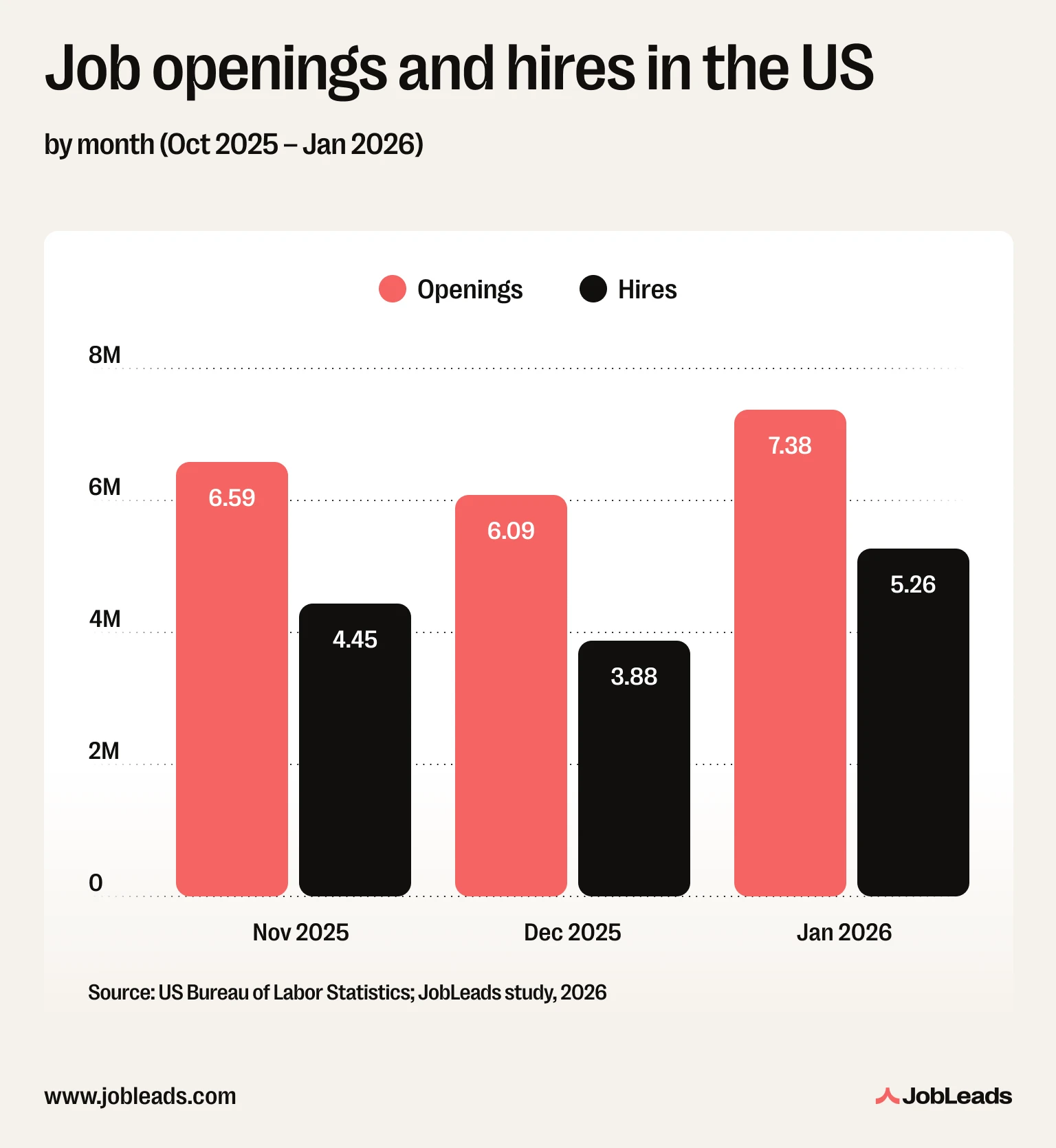
Moreover, according to the US Bureau of Labor Statistics (BLS), there were nearly 6.6M job openings in November 2025 and about 6.1M in December 2025. December was the lowest month of the year–but that's still over six million open roles.
And people did get hired. BLS data shows about 4.5M hires in November 2025 and nearly 3.9M in December.
So–is it hard to get a job in December? It can be slower. But slower doesn't mean impossible.
To understand December, it helps to see where it sits in the hiring year.
Here's the month-by-month hiring calendar from the JobLeads study:
| Month | Listing volume | What it means for you |
|---|---|---|
| January–February | Rising from a low base | Busy with job seekers, slower with new roles |
| March–April | Strong increase | Best time to start a spring search |
| May–July | Peak | Most listings but also most competition |
| August | Summer dip | Fewer roles and lots of applicants |
| September–October | Secondary peak | Roles posted with year-end urgency |
| November | Declining | Still active, with fewer job seekers |
| December | Lowest activity | Quieter, but roles still get filled |
The peak in spring and summer is driven by budgets. Most companies set headcount plans in Q4 and get final sign-off in January or February.
Here's the interesting part. The JobLeads study found that job postings lag behind the intention to hire by two to four weeks. In other words, many of the January listings you see were decided in December.
That means the hiring managers who are quiet on job boards in December are often busy planning. If your application or your name is already in front of them, you're first in line.
Read more: See the full JobLeads study on the best time to apply for a job for month-by-month and day-by-day data.
So why do companies hire less in December? A few forces come together at once.
But here's what that slowdown hides–the job seekers slow down too.
Fewer jobs sounds like bad news. But job seekers disappear even faster than job listings do.
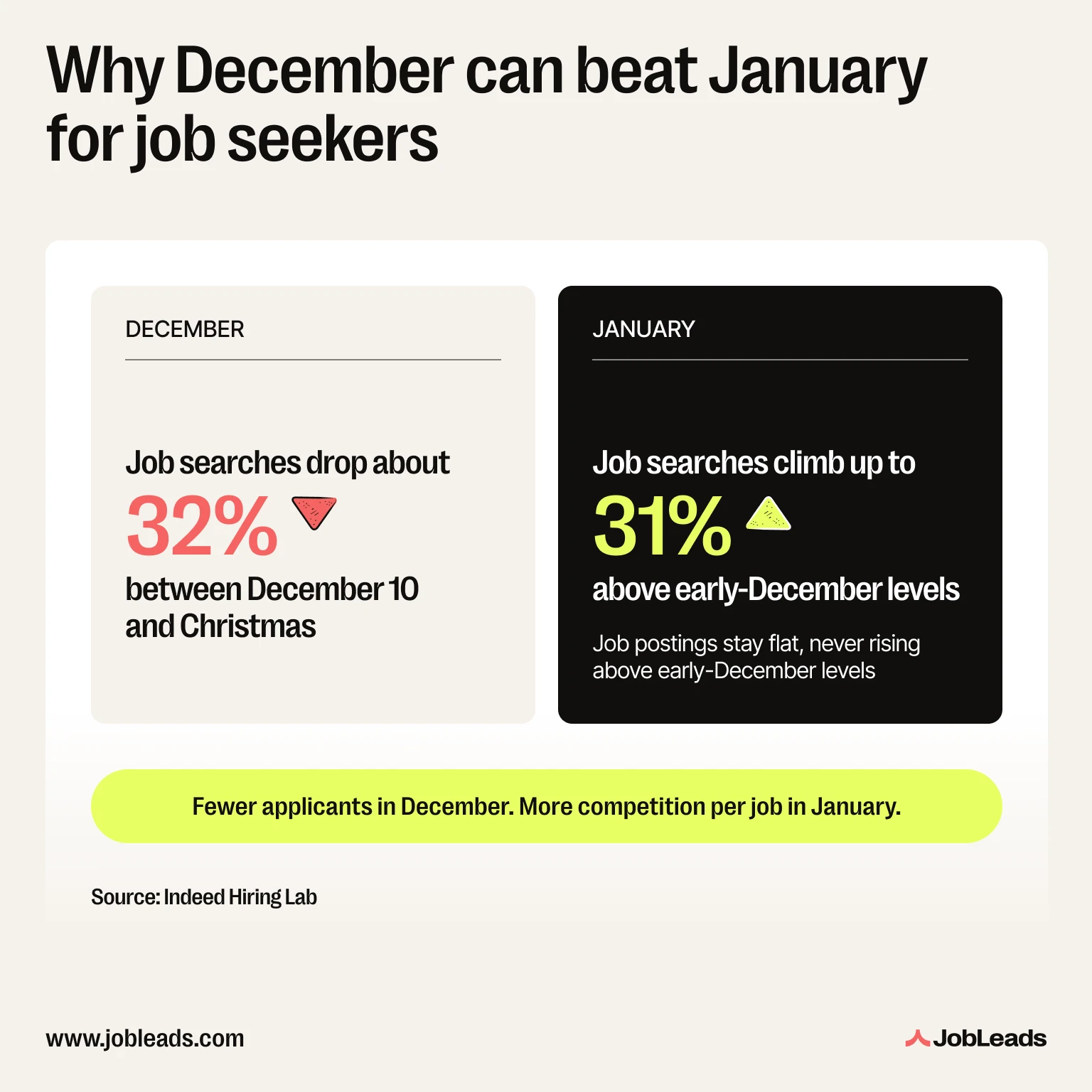
Indeed's Hiring Lab found that job searches on Indeed fell by about 32% between December 10 and Christmas Day 2024. Then they came back strong in January.
Fewer people searching means fewer applications landing on each recruiter's desk. And with Greenhouse reporting about 244 applications per job on average, any drop in competition is worth taking advantage of.
Not every company slows down in Q4. ManpowerGroup's survey found that about 43% of employers plan to increase their staff between October and December.
The top reasons? Filling roles that people left during the year, a business uptick, and new positions. Some teams also have unspent budgets they need to use before year-end. Others need someone in the seat by January 1st to hit next year's goals.
Hiring takes time. SHRM puts the median time-to-fill at about 39 days for non-executive roles, and Greenhouse data points to nearly 60 days.
So–an application sent in mid-November can turn into a start date in January. Wait until January to apply, and you might not start until March.
Do companies hire in January? Absolutely. BLS data shows about 5.3M hires in January 2026, around 35% more than in December.
But job seekers come back too. Indeed found that in January 2026, job searches were up to 31% higher than the early-December average. Meanwhile, job postings never rose above their early-December level during January.
Bottom line–in January, more people are chasing roughly the same number of jobs. In December, you're competing with far fewer of them.
November and December are often lumped together. But they behave quite differently.
| November | December | |
|---|---|---|
| Hiring activity | Still part of the hiring plateau | Lowest month of the year |
| Best for | Applying and interviewing | Networking and final-stage interviews |
| Watch out for | Thanksgiving week slowdown | Last two weeks of December |
November is a real hiring month. Budgets for the current year are still open, and many companies want roles filled before the holidays. Treat it like any other month–apply, interview, and follow up.
December is more of a two-speed month. The first two weeks are often surprisingly active, as teams push to close hires before the break. After mid-December, decisions mostly pause until January.
Pro-tip
If you're in a hiring process in early December, ask about the timeline directly. "Are you hoping to make a decision before the holidays?" is a perfectly normal question to ask in an interview–and it helps you plan your follow-ups.
Some industries barely notice the holidays. Others hire more because of them.
The holiday rush is peak season for stores, warehouses, and delivery services.
The National Retail Federation (NRF) expects retailers to hire between 325,000 and 375,000 seasonal workers for the 2026 holiday season. Challenger, Gray & Christmas forecasts about 450,000 retail jobs added in Q4 2026.
Indeed's Hiring Lab reports that seasonal job postings were about 10% higher at the end of September 2026 than a year earlier–the best start in several years.
Yes. Amazon is one of the biggest seasonal employers in the US. For the 2025 holiday season, it was hiring for a whopping 250,000 full-time, part-time, and seasonal positions. Most of that hiring starts in October, but warehouse and delivery roles often stay open into December.
The JobLeads study found that Bio, Pharma, and Health show unusual Q4 resilience. Q4 job clicks nearly matched Q3. In most other industries, Q4 drops by roughly 25–35%.
That's because much healthcare hiring is tied to clinical trials, regulatory milestones, and patient demand–not the corporate calendar.
Seniority doesn't take holidays either. And when a company needs to replace a director, urgency usually beats the calendar.
Executive searches also take three to six months from mandate to offer. So a December conversation with a headhunter may lead to a role in spring.
Here are seven job search strategies to make the end of the year work for you.
This is the single biggest lever you have, in any month. The JobLeads study found that a job's 7-day click volume is nearly 4 times higher than its 24-hour click volume. That means about 74% of first-week applicants arrive after day one.
Set job alerts, check them daily, and have a ready-to-send version of your resume, built with a reliable resume builder.
JobLeads data shows Saturday and Sunday each account for just about 11% of weekly application activity, compared to about 17% on Monday. Over the holidays, many people take weekends fully off. But you don't have to.
End-of-year parties, alumni events, and catch-up coffees are full of people in a generous mood. Use that holiday spirit. A warm introduction made in December can turn into an interview in January. Especially for the many roles that never reach a job board at all.
Right
Wrong
If you've interviewed recently, send a short follow-up before mid-December. Hiring teams often try to clear decisions before their vacation. A polite nudge can move you up the pile.
Use slower weeks to update your resume, refresh your LinkedIn profile, and draft cover letter templates. When the new year hits, you'll be ready to apply within hours, not days.
Read more: Make sure your resume gets past the filters with this guide to optimizing your resume for ATS.
Silence in late December is normal. Recruiters take time off, and decisions often wait until the whole panel is back. So, count business days, not calendar days, and allow for vacations. Slow replies aren't only a holiday issue–Greenhouse data shows the average time-to-fill has stretched to nearly 60 days.
You don't need to apply every day. A few strong, tailored applications per week is enough to keep momentum through the holidays–without burning out. So, block one or two short sessions a week for applications and follow-ups. Then close the laptop and enjoy the season.
We get it. After months of applications, the holidays can feel like a well-earned break.
And many people are tired. In a JobLeads poll, about 32% of voters said they've stopped counting their rejections this year. In another, about 39% said their job search had lasted over six months.
But stopping completely has a cost. Job searches often take months, and every pause adds weeks to the finish line. Restarting from zero in January–alongside everyone else–is harder than keeping a slow, steady pace.
As the year closes, you're also far from alone as the JobLeads survey found that 35% of job seekers are still searching at that time.
So–rest, but don't switch off. Take the days around Christmas and New Year fully off. Then keep a lighter routine for the rest of the season.

Content & Insight Writer
Beata creates content that puts job seekers first. From practical blog advice to first-hand research studies, her writing is designed to give people the clarity and confidence to find the role they deserve.
Job Market TrendsOur survey of 43,000+ job seekers reveals why most never access the hidden job market, and the strategies that actually work to change that.
 Job Search
Learn 6 strategies to maintain a life-work balance while job searching. Discover tips on setting goals, recharging, digital detox, taking breaks, and staying organized.
 Job Search
Discover the most common job search mistakes and exactly how to fix each one. Learn why you can't get a job with data-backed explanations.