You've been job hunting for months. A recruiter finally calls with a role that fits your skills. Then comes the catch: it's a "6-month contract to hire."
Is that a real way into a permanent role, or the same job without the security of a permanent contract?
If the offer looks tempting, you're not alone. When JobLeads asked job seekers how long their search lasted, nearly 39% said over six months. After that long, any path to a permanent role looks good.
This guide explains how a contract to hire works, how pay and benefits compare, and how to get converted.
Key takeaways
- Only about 14% of moves out of contract work lead to a permanent job–ask how many contractors the company converted (American Staffing Association & LinkedIn)
- The company you work for often isn't your legal employer–check whether you'll be W-2 or 1099 on the first call
- Only about 17% of temp agency workers have employer health insurance vs. about 54% of traditional workers (US Bureau of Labor Statistics)–price in the benefits gap
- The client pays the agency more than you see on your paycheck–use that gap as room to negotiate your offer
- Your contract months may not count toward 401(k) vesting–ask to have them credited when you convert
Contract to hire (C2H) is a job that starts as a temporary contract, usually for 3-12 months, with the option of a permanent, full-time offer at the end. It's a hiring model that works like an extended, paid trial period for both sides. The company sees how you work, and you see whether you want to stay.
The moment your contract turns into a permanent role is called conversion. That's the word to listen for in every conversation with a recruiter.
So what is a contract to hire job like day to day?
In practice, a contract to hire position looks a lot like a regular job. You do the same work as permanent staff, often on the same team and with the same manager.
What's different is the paperwork behind it. Your contract, your pay structure, and your benefits aren't the same as those of the colleague sitting next to you.
It's a big market, too. According to the American Staffing Association, nearly 2.2M temporary and contract employees worked for US staffing companies in an average week in 2024.
A 6-month contract to hire means the trial period lasts six months. It doesn't mean you're guaranteed a job after it. At the end, the company decides whether to make you an offer.
Here are the typical lengths:
- 3 months: common for junior or hourly roles
- 6 months: the most common length
- 12 months: usually for senior or project-based roles
One thing to watch for: some contracts get extended instead of converted. Before you sign, ask what happens on the end date.
Did you know that…
In 2025, only about 14% of job moves out of contract roles led to a permanent full-time job (American Staffing Association & LinkedIn). The figure covers all contract roles, not just ones designed to convert, so a true contract-to-hire role should do better. Still, it's a good reason to ask how many contractors a company has actually converted.
Here's the contract to hire process, step by step:
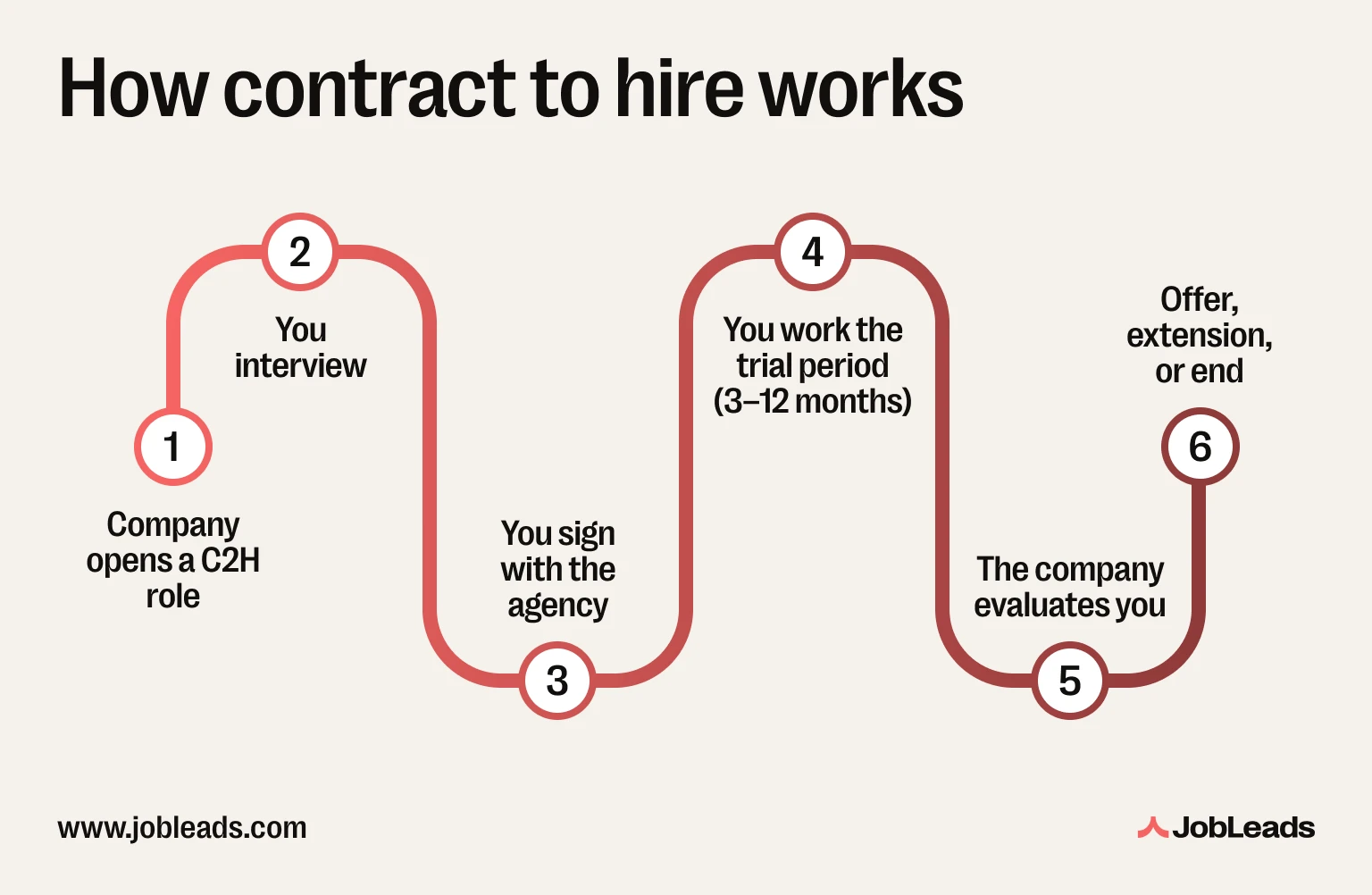
- The company opens a contract-to-hire role: it usually goes through a staffing agency but sometimes companies hire contractors directly
- You interview: the process is often shorter than for a permanent role, use it to ask about conversion, along with other questions to ask in an interview
- You sign an employment contract: it sets your hourly rate, the contract length, and the conversion terms and in most cases you sign it with the staffing agency, not the company
- You work the trial period: the agency pays you by the hour, and the team treats you much like any other member
- The company evaluates you: it looks at your performance, your culture fit and–let's be honest–its budget
- The company makes a conversion decision: you get a permanent offer, an extension, or the contract ends
That shorter hiring process is a real upside. In a JobLeads poll, about 66% of job seekers said three rounds is their maximum before they'd withdraw. Contract-to-hire roles often get you through the door faster.
This is the part most candidates miss. During the contract, the company whose office you sit in is often not your legal employer.
There are three common setups in the US:
- W-2 through a staffing agency: this is the most common contract to hire staffing setup. The agency is your legal employer. It runs payroll, withholds your taxes, and issues your W-2. When a recruiter calls a role "W-2 contract to hire," this is what they mean.
- 1099 independent contractor: you're self-employed. You handle your own taxes and insurance, including self-employment tax.
- Corp-to-corp (C2C): you invoice the client through your own business entity. It's mostly seen in IT contracting.
Pro-tip
Ask the recruiter "Will I be W-2 or 1099?" on the first call. The answer changes your take-home pay and your benefits.
How does contract to hire vs. direct hire play out in practice? The biggest gaps are in pay, benefits, and security. Here's the side-by-side view:
| Contract to hire | Direct hire (full time) |
|---|
| Employer at first | Usually a staffing agency | The company |
| Pay | Hourly, often through the agency | Annual salary |
| Benefits | Limited or through the agency | Full company package |
| Job security | Low until you convert | Higher from day one |
| Path to permanent | Possible after 3–12 months | Permanent from the start |
In short, the benefits of direct hire vs. contract-to-hire come down to stability. Direct hire gives you certainty from day one. Contract to hire gives you a faster way in, in exchange for a few months of risk.
What's the difference between a contract and contract to hire?
A regular contract role has a fixed end date. Nobody plans to offer you a permanent job when it ends. That suits people who value flexibility over security, and for some it's a first step toward freelancing.
Contract to hire is different. It's designed to turn into a permanent job if things go well.
Knowing why a company chose contract to hire tells you a lot about your chances of getting converted.
For employers, the best time to hire contract staff is when they need someone now but aren't sure about the long term. Hiring contract employees first keeps their options open. These are the four most common reasons behind it:
- Lower hiring risk: contract lets the company test new talent before committing to avoid a bad permanent hire
- Budget uncertainty: the permanent headcount isn't approved yet, so the role sits in a contractor budget for now
- Speed: SHRM's recruiting benchmarks put the median time to fill a nonexecutive role at about 39 days and staffing agencies can often fill roles much faster
- A new role or project: the company isn't sure the role will be needed long-term
The first and third reasons are usually good news for you. The second and fourth carry more risk, because the permanent job may never exist.
So how do you tell the difference? Listen to how the hiring manager talks about conversion.
"We've converted most of our last few contractors, and the headcount is already budgeted."
"We'll see how things go." No conversion criteria, no timeline, no budget.
Working contract to hire has real advantages and real trade-offs. Here's how they compare:
| Pros | Cons |
|---|
| The offer | You test the team, the manager, and the culture before signing on permanently. If the role isn't right, you keep the flexibility to move on when the contract ends | There's no guaranteed offer. Conversion depends on your performance and the company's budget |
| Hiring | Fewer interview rounds and a quicker start date | The whole contract can feel like a months-long interview |
| Pay | Contract rates can be higher to make up for fewer benefits | Health insurance, PTO, and a 401(k) may be limited until you convert |
| Career | A foot in the door at a company or industry that might not hire you directly. It's useful for career changers and people returning after a gap, and you build a network inside the company | Your team status can feel awkward. You may be left out of some meetings, perks, or training |
| Income and security | You earn and build your resume instead of waiting | Contractors are often the first to go when budgets tighten |
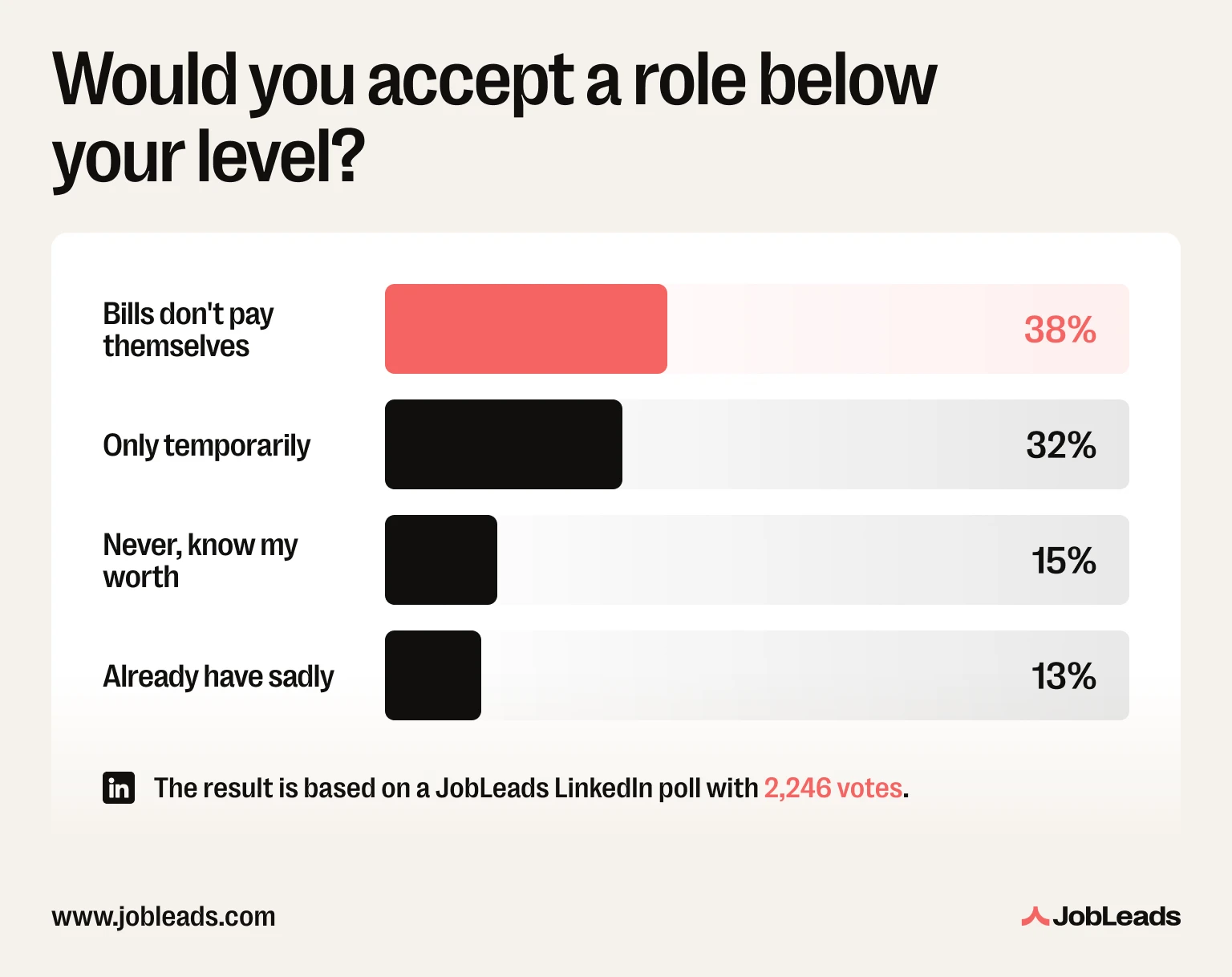
Plenty of job seekers already use short-term compromises as a bridge. When JobLeads asked whether people would accept a role below their level, about 38% said "bills don't pay themselves" and about 32% said "only temporarily". Contract to hire can be a more structured version of that bridge, with a real shot at a permanent role.
The American Staffing Association's data points the same way. Nearly 64% of staffing employees say they work in staffing to fill a gap between jobs or to help them land a job.
It also eases two of job seekers' biggest worries. When JobLeads asked about the biggest fear during an unemployment gap, about 61% said financial survival. And about 21% named the lack-of-experience catch as their biggest obstacle to changing careers. A contract role tackles both. It pays, and it helps close the job skills gap that keeps career changers out.
When people say contract to hire is bad, job security is usually the reason. Many temporary workers would rather have a permanent job. In fact, the Bureau of Labor Statistics' latest survey of contingent workers found that nearly 45% said they would have preferred a permanent job.
That matters more in a nervous market. In a JobLeads poll, nearly half of respondents expected a possible mass layoff at their company within six months. When cuts come, contractors usually carry more of that risk.
Sometimes, but usually not the same package as permanent staff. It depends on how you're employed.
- W-2 through a staffing agency: many agencies offer health insurance, but only about 17% of temp agency workers have it, compared with about 54% of workers in traditional jobs (BLS)
- 1099 or corp-to-corp: you get no benefits, you pay for your own health insurance, your own retirement savings, and your own self-employment tax.
Ask whether your contract months count toward tenure, PTO accrual, or 401(k) vesting after conversion. It matters more than it sounds. According to Vanguard, only about half of 401(k) plans (49%) give you the employer match immediately. About 22% use a vesting schedule of 5 or 6 years. If your contract months don't count, that clock only starts on the day you convert. It's a fair thing to negotiate, along with other non-salary negotiable items.
You're usually paid an hourly rate by the agency. The client company pays the agency a higher "bill rate" for your time. The agency keeps the difference, known as the markup, to cover payroll, taxes, insurance, and its own profit.
You won't always know the bill rate. But it's worth remembering that the client is paying more for you than you see on your paycheck. That gives you room to negotiate.
To convert an hourly rate to a salary, use this formula:
Hourly to annual
Hourly rate × 40 hours × 52 weeks = annual equivalent
So $40 an hour works out to $83,200 a year. This is the starting point for any contract to hire salary conversion.
But a permanent salary lower than that can still be a fair deal. That's because the benefits are worth a lot.
According to the US Bureau of Labor Statistics, benefits make up about 30% of what private employers spend on compensation. On a contract, much of that is missing from your package.
Health insurance is one of the biggest pieces. KFF's employer health benefits survey puts the average premium for single coverage at about $9.3K a year. Workers with a company plan pay only about $1.4K of that on average, and the employer covers the rest.
Should I take a contract to hire job? It's a question only you can answer. But before you say yes, get answers to these six questions:
- How many contractors in this role have been converted? Ask for a number, not a vibe.
- What are the conversion criteria? Ask about performance goals, the timeline, and who makes the decision.
- Is the permanent headcount already budgeted? If not, the job you're working toward may not exist yet. It's also worth checking the company's financial health before you sign.
- What's the conversion salary range and benefits package? Get it in writing if you can.
- What happens at the end date if there's no offer? Ask about extensions, notice periods, and whether the agency will place you elsewhere.
- Can you afford the risk? Think about your savings, the benefits gap, and any other offers in play.
That last question matters more than it sounds. When JobLeads asked how long people could cover their expenses if they were laid off tomorrow, about 32% said less than a month. If that's you, a contract with no guaranteed next step is a big gamble.
Contract to hire is a good fit if you're changing careers or returning after a gap. It also suits you if you're new to a city or industry, or you really want to join this company.
It's a poor fit if you need employer health insurance right now or have another permanent offer. The same goes if the company can't share its conversion track record.
Getting converted from contract to direct hire is partly out of your hands. Budget and headcount decisions happen above you.
But your performance and visibility are yours to control. Here's how to make the most of them.
Ask your manager what success looks like by the end of your contract. Get specific goals, not general praise. Then you both know what "good enough to convert" means.
Don't count on onboarding to tell you anything. In a JobLeads poll, about 36% said their onboarding was poor and they learned on their own. Another 20% said it didn't exist at all.
Contractors often get even less.
Don't wait for the end date to find out how you're doing. Many managers won't offer feedback unless you ask.
In a JobLeads poll, about 36% of employees said they never get regular feedback and are always guessing. So ask for a short check-in every few weeks.
Contract-to-hire workers who act like part of the team are easier to convert. Join team meetings, volunteer for projects, and build relationships across the team whenever possible. The more you feel like part of the team, the harder you are to let go.
Keep a running list of your results, with numbers wherever you can. You'll need it for your conversion conversation. The same approach you'd use to quantify your resume works here.
The halfway point of a contract to hire is a natural moment to raise it. Waiting until the last week leaves no time to fix any concerns.
"We're at the halfway point of my contract. I'd love to talk about what a permanent role could look like and what you'd need to see from me to get there."
"So… am I getting hired or not?"
Stay lightly active in your job search until the permanent offer is signed. A verbal "we'd love to keep you" isn't an offer. A few targeted job search strategies can keep your options open without taking over your evenings.
Contract to hire isn't a lesser job offer, and it isn't a guaranteed one either. It's a trial period. And it works best when you know the conversion terms before you sign.
So before your next contract-to-hire interview, prepare the essential questions. Don't sign until you have answers to at least the most important ones.
Still deciding between a contract and a permanent role? JobLeads brings both together in one place. You can compare contract-to-hire and direct-hire jobs that match your skills, then take the path that suits you.



 Job Market Trends