
 Job Search
September 26, 2025
How to Spot and Avoid WhatsApp Scams & Online Fraud
Learn to identify and protect yourself from online scams & fraud on WhatsApp, email, and phone. Stay vigilant and secure with our essential tips and guidelines.


Job scams are growing fast. Reports to the Federal Trade Commission nearly tripled between 2020 and 2024, and reported losses jumped from $90M to over $500M. The trend hasn't slowed down either–in the last quarter of 2025 alone, job seekers reported losing over $150M, with a median loss of about $2,000 per victim.
Remote roles are a favorite cover for scammers. There's no office to walk into and no in-person interview to break the illusion.
The good news: most remote job scams follow at least one of the recognizable patterns. This guide covers the 10 most common ones so you know exactly how to spot a fake remote job listing.
A remote work scam is a fake remote job offer used to extract money, personal data, or unpaid labor from the applicant, dressed up to look exactly like a normal work-from-home opportunity.
The same instinct that helps you spot toxic workplace signs before accepting a real offer is worth applying here–just tuned to fraud instead of culture fit.
Remote job scams are really just one branch of a much bigger tree. Fake job postings show up everywhere hiring happens, not only in remote roles. But the online job scams people have warned each other about for years all follow nearly identical playbooks today.
Remote roles specifically attract scammers for two structural reasons. First, there's no in-person interview or office visit to break the illusion–every interaction can happen entirely on the scammer's terms, over chat or email.
Second, while the demand for remote work is growing every year, genuine remote postings are decreasing in number, which gives scammers a large pool of targets to work through.
Did you know that…
Only about 5% of scam victims report what happened to them anywhere, according to BBB research. That underreporting is likely the main reason job scams don't seem like a big problem, even though the FTC's own figures put the losses at half a billion dollars.
Not every scam looks the same, but learning how to tell if a job posting is fake before you apply usually comes down to one of these 10 recognizable patterns. Here's the quick-reference version before the full breakdown of these common remote job scams.
| Scam type | Biggest red flag | What they're really after |
|---|---|---|
| No interview process | Hired instantly with no screening at all | Your trust, fast–before you think to verify anything |
| Immediate start date | Pressure to start "today" or "tomorrow" | To rush you past due diligence |
| Fake check scam | They mail or e-transfer you a check before you've done any work | You depositing a fraudulent check and wiring "extra" funds back |
| Interviews over chat apps only | No live call, no video, everything text-based | Anonymity–so there's no voice or face to trace |
| Awkward, script-like English | Messages read like a template, not a person | Speed–the same script is sent to hundreds of targets |
| Unusually high pay for simple work | Wages far above market rate for basic tasks | Your attention, and eventually your money or data |
| Parcel mule scam | Asked to receive and reship packages from home | Using you to launder stolen goods |
| Advance-fee scam | Any request for payment before you've been paid anything | Upfront cash for "training," "equipment," or a "background check" |
| Craigslist/eBay posting scam | Asked to post ads using your own accounts | Your identity and accounts, to scam other people |
| Cryptocurrency scam | Payment or "investment" requested in crypto | Untraceable funds, no path to recovery |
Now let's go through each one of them and check what they look like, why they work, and the specific red flags that give them away.
You're being offered a job after a single chat message or short email, with no interview or screening of any kind. It's one of the fastest ways to spot a fake job offer before you've invested any real time in it.
Legitimate employers, remote or not, screen candidates before hiring–even a fast-moving startup will want at least two real conversations. The FTC's own guidance on phony job postings lists being hired without any real interview as one of the clearest scam signals out there.
So, if an "employer" skips straight from first contact to a signed offer, it's unfortunately not because of how much they liked your resume. It's a red flag you shouldn't ignore.
Fix: Treat an instant hire with zero screening as a reason to slow down, not celebrate–ask for a live video call and check the company thoroughly before going any further.
If you're being pushed to start work–and often to hand over personal or financial details–within a day or two of first contact, don't fall for it. Even if the urgency is framed as the opportunity itself ("we need someone right away").
Urgency is one of the oldest tools in any scam playbook, and job scams are no exception. Pressure to move fast is specifically designed to get you past the point where you'd normally pause and verify. A real employer's onboarding takes days or weeks–background checks, paperwork, an actual employment contract, IT provisioning, and other steps.
Right
Wrong
Fix: Any job that can't wait a few days for you to verify it isn't one worth rushing into.
This is the scammer mailing or e-transferring you a check–often framed as an "advance" for equipment or supplies. Then the scammer will ask you to deposit it and either wire back the "extra" amount or spend the funds at a specific online store. And there is often plenty of urgency to it as they need you to fit into the window of time before the bank discovers the check is fraudulent.
For example
A new remote hire is told their employer will send a check to cover a home-office setup. The check clears initially, so the new hire wires the "leftover" amount back as instructed–only for the original check to bounce days later, leaving them liable for the full amount.
This is one of the costliest patterns precisely because it doesn't feel like fraud at that moment. As the Consumer Financial Protection Bureau explains, banks are required to make deposited funds available within a few business days–but that availability is provisional, not a confirmation the check is genuine. A forged check can take weeks to bounce, well after the money looks safely spendable, which is exactly the gap scammers exploit.
Fix: Never wire money back from a check you've just deposited or spend it at an online store you've never heard of. No matter how legitimate the employer seems–a check "clearing" in your account isn't the same as it being confirmed real.
Did you know that…
Scammers prefer payment methods that are fast and hard to reverse. In postings caught by JobLeads' quality filters, "Cash App," "gift cards," and "Zelle" are among the most common payment-related scam phrases. A legitimate employer pays you through payroll, not through an app or a gift card.
This is a hiring process that happens entirely over Facetime, WhatsApp, Telegram, or similar–with no live phone call, no video interview, and no verifiable company domain in sight.
This is common enough that the FTC has issued a dedicated consumer alert warning that an unsolicited job offer arriving by text is very likely a scam. JobLeads' own quality filters see this pattern constantly: phrases like "Join WhatsApp Group," "Join Telegram Group," and "Join WhatsApp Channel" are among the most frequent scam-language matches caught in postings submitted to the platform.
Chat-only recruiting is cheap to run at scale and hard to trace back to a real company–an invitation to leave a verifiable job board for an untraceable chat is rarely innocent.
Fix: Insist on at least one live video or phone call with someone whose identity and role you can verify. A real hiring process never happens entirely in a chat window.
This is messaging that reads like a template. This includes oddly formal phrasing, repeated stock sentences, or subtle grammatical patterns that suggest the same message is being sent to many people at once.
It's not proof on its own (plenty of legitimate international recruiters aren't native English speakers). But combined with any other item on this list, generic or copy-pasted-sounding messaging is a signal the "recruiter" is running a script, not a real conversation.
Fix: Run a Google search for a distinctive phrase from the message in quotes. If it turns up on scam-warning forums or identical posts elsewhere, that's your answer.
Here's an example
You get a LinkedIn message that reads: "Greetings of the day! Your profile has been shortlisted for a lucrative remote opportunity with our esteemed client. Kindly revert back with your updated CV and your WhatsApp number at the earliest so we can proceed further." No company name, no role title, nothing that refers to your actual experience. Search for "your profile has been shortlisted for a lucrative remote opportunity" in quotes. If it shows up word for word in Reddit threads, scam-report sites, or other people's screenshots, it's a script.
This is a listing offering pay that is well above market rate for simple, low-skill tasks–data entry, "online evaluation," or basic admin work.
An unusually generous wage for unskilled work isn't generosity–it's bait. It's designed to make the offer feel too good to walk away from before the real ask (a fee, a check, your bank details) shows up.
JobLeads' own data on red flags in job postings backs this up. In a JobLeads analysis of 55 million US job listings, ads whose only red flag was scam-adjacent language, such as "be your own boss," "financial freedom," or "residual income," claimed to pay 13% more than clean listings.
Fix: Compare the offered pay against real listings for the same task on an established job board. If it's dramatically higher, treat that as the warning sign.
Did you know that…
Task-based scams pay victims small amounts to "unlock" larger fake earnings they can never withdraw. According to the FTC's Data Spotlight on gamified job scams, reports of this type grew from about 5,000 in all of 2023 to about 20,000 in just the first half of 2024.
This scam is about being hired for a "reshipping" or "quality control" role that involves receiving packages at your home and forwarding them elsewhere. It's often framed as a logistics or warehouse job.
In reality, the packages are frequently purchased with stolen credit cards. The "employee" is acting as a money mule–a term the FBI uses for anyone who receives or forwards fraud proceeds on a scammer's behalf, knowingly or not.
The FBI is explicit that this can create real legal exposure for the person doing the reshipping, not just for the scammer running it, and directs victims to report the scheme to its Internet Crime Complaint Center (IC3.gov).
Fix: Any "job" that consists mainly of receiving and reshipping physical goods from your own address should be treated as a hard no.
Any job that asks you to pay for "training materials," equipment, a background check, or a "processing fee" before you've earned a single dollar is a red flag.
Legitimate employers cover the cost of hiring–they don't bill candidates for the privilege of being considered. You should never pay a stranger to get a job, no matter how the fee is framed.
The wording varies, but the pattern doesn't. In postings screened by JobLeads' quality filters, fee language is one of the most common scam-language clusters caught before publication: "application fee," "registration fee," "background check fee," "processing fee," and "visa fee" all appear regularly–sometimes translated into other languages to reach more victims.
An advance-fee request, however small or reasonable it sounds, flips the normal hiring relationship. That's exactly why it pays to properly assess a job offer before accepting anything.
Fix: Refuse to pay for anything–training, equipment, background checks–as a condition of getting or keeping a job, full stop.
Don't fall for anything that asks you to post advertisements using your own Craigslist, eBay, or social media accounts on the employer's behalf. This often includes vague "reselling" or "marketing" listings.
It's easy to underestimate because it doesn't ask you for money directly. Instead, it uses your identity and account history to scam other people. The same money mule dynamic the FBI warns about for parcel reshipping, just applied to ad postings instead of packages. That can get your own accounts flagged, suspended, or implicated if those listings turn out to defraud someone else.
Fix: Never post listings, ads, or content using your personal accounts on behalf of an employer you can't independently verify.
This is a job offer that pays in cryptocurrency, or asks you to "invest" crypto as part of the role. It's sometimes disguised as a trading or "digital asset management" position.
Crypto-related job scams have grown alongside task-based scams. In fact, reported cryptocurrency losses tied to job scams reached about $41M in just the first half of 2024, up from about $21M for all of 2023, according to the FTC's Data Spotlight. Crypto payments are effectively untraceable and irreversible once sent, which is exactly why scammers prefer them over a normal bank transfer.
Fix: Treat any job that pays in or requests cryptocurrency as an automatic red flag, regardless of how the role is framed.
Reporting matters more than it might seem. With only an estimated 5% of scam victims reporting what happened to them anywhere, most scam listings simply stay up and keep finding new targets. Reporting a fake listing the moment you spot it helps take it down before someone else falls for it.
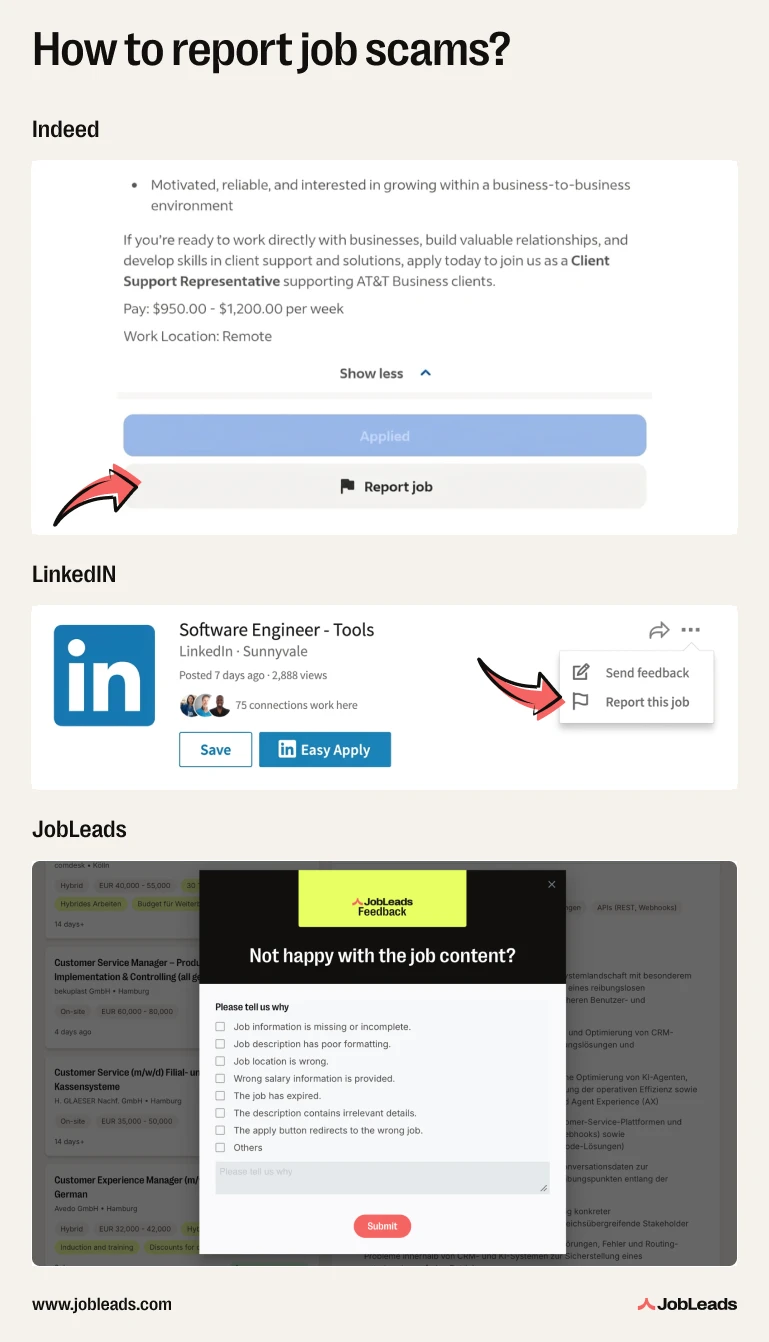
Remote job scams on Indeed, and scams on Indeed generally, are common enough that the platform built a dedicated reporting flow for them. Use the Report job button at the bottom of the listing, then select the category that best describes the problem (fake, scam, or impersonating a real company). Full steps are in Indeed's own Help Center.
Go to the job's Job Details page → More → Report this job, and choose "I think it's spam or a scam." If the scam attempt came through a direct message rather than a posted listing, report it from within that conversation instead. See LinkedIn's Help Center guidance on reporting jobs for the full flow.
The quickest way to report a job posting is directly on the job posting itself. Click the thumbs-down icon under "How do you like the content of this job?". Then in the "JobLeads Feedback" pop-up select Others and describe the suspicion in the free-text field before submitting. This goes straight to the team monitoring job quality.
Reports like these are the last line of a much bigger filter: JobLeads scans more than 400,000 job sources daily and screens listings before they ever reach a search result. What you see on JobLeads has already passed those checks–which is why a suspicious listing is the exception worth flagging, not the rule.
No, they're not all scams. If you've just read through ten ways a job can be faked, it's fair to wonder whether remote jobs are legit at all. They are, but the volume of scam reports can make remote work itself feel untrustworthy.
The patterns above are learnable, and once you know them, most fake remote jobs become obvious within seconds. The real benefits of remote work haven't gone anywhere either–scammers exploiting a good thing doesn't make the good thing fake.
The more reliable move isn't avoiding remote work–it's sourcing listings from vetted, aggregated platforms rather than the raw open web, where verification has already happened before a listing ever reaches you. Pairing that with a genuine job search strategy, rather than reactively applying to whatever crosses your feed, cuts your exposure to fake listings even further.

Content & Insight Writer
Beata creates content that puts job seekers first. From practical blog advice to first-hand research studies, her writing is designed to give people the clarity and confidence to find the role they deserve.
Job SearchLearn to identify and protect yourself from online scams & fraud on WhatsApp, email, and phone. Stay vigilant and secure with our essential tips and guidelines.
 Job Search
Discover effective job search strategies and learn how the hiring process works. Debunk myths and follow the steps that actually secure your dream position.
 Career Development
Learn how to spot red flags in job offers, from high turnover rates to poor communication, ensuring your dream job isn't a nightmare. Read our expert tips now!