
 Job Search
June 10, 2026
Ghost Jobs: What They Are, Why They Exist & How to Spot One
Learn what ghost jobs are and why companies post fake job postings. Check out how to spot a ghost job in seconds, and the best job sites to avoid them.


A job ad bursting with energy–"fast-paced," "rockstar," "go-getter"–reads like a sign of an exciting, well-paid opportunity.
Apparently, it usually isn't.
JobLeads analyzed the language of 55 million active US job listings for clichés and red-flag phrases, then matched that language against posted salaries.
What the data reveals turns the assumption on its head: the most energetic, aspirational, personality-packed ads aren't the prize they appear to be. Often, the louder a job ad shouts, the less it has to offer.
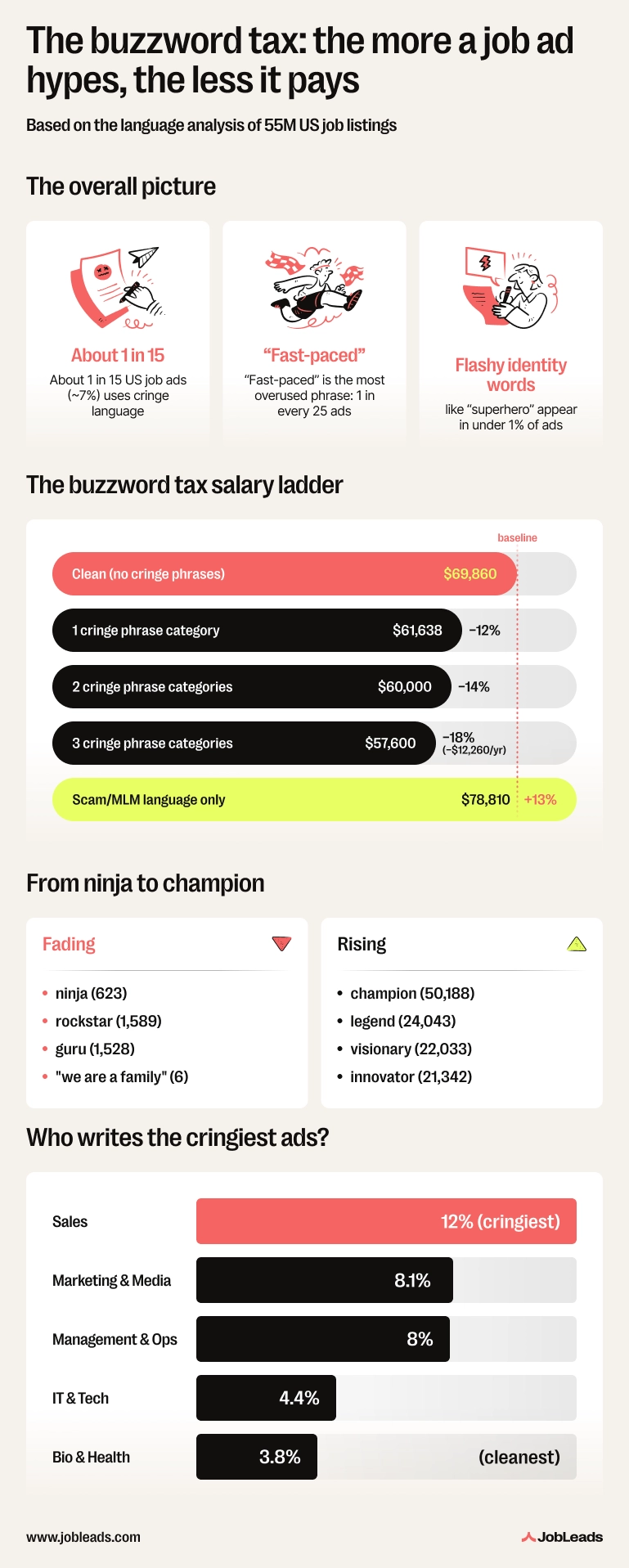
It's worth starting with a clear definition of what buzzwords are and how they can present in a job ad.
Somewhere along the way, job ads developed their own dialect that is part corporate poetry, part motivational poster, part quiet warning. Most of it sorts into three families, and learning to spot them is half the skill of reading a listing well.
The ad isn't hiring a salesperson–it wants a "sales ninja." Or it's after a "rockstar," "guru," "wizard," "unicorn," or the blander favorites like "champion," "visionary," maybe even "disruptor."
Employers reach for these to make a role sound exciting and modern. But they often signal the opposite, a company that hasn't quite decided what the job is, and is dressing up the vacancy instead of describing it in specifics.
Or a company that is too lazy to write an accurate description and prefers to attract all sorts of candidates to an ad. A "coding ninja" tells you far less than a "back-end Python developer with a background in healthtech" does.
"Fast-paced." "Dynamic." "Wear many hats." "Self-starter." "Hit the ground running." "We're a family." These feel like information but carry almost none. "Fast-paced" might mean real momentum or chronic understaffing and daily fire drills.
The trouble with a cliché isn't that it's offensive; it's that it pretends to tell you something while telling you nothing. And this vagueness has a real cost. One Milkround study found that 50% of graduates surveyed had decided against applying for a job because they didn't understand the advert. So, it's the vagueness that quietly puts good candidates off.
Here the language stops being merely lazy and turns genuinely informative, just not the way the employer intended.
"Work hard, play hard." "Not your typical 9-to-5." "Overtime expected." "Always on." "Thick skin required." "Sink or swim." "Other duties as assigned." These phrases read literally rather than aspirationally. They double as a fairly honest preview of the hours, the pressure, and the boundaries (or the lack of such).
There's also a fourth, smaller dialect we tracked on its own: the scam-adjacent pitch with things like "be your own boss," "financial freedom," "residual income". Often, these are the "too good to be true" listings. It gets its own bucket because it breaks every pattern the others follow.
To keep things fair, only the terms that are unmistakable in a job-ad context were counted–genuinely neutral words like "passionate" or "driven" didn't make the cut into the final database.
Many of the terms listed can also be defined as "corporate jargon". These are the words and phrases that are used to describe everyday tasks or decisions in a strategic-sounding way. A study by Business in the Community discovered that 66% of young applicants didn't understand job ads full of jargon and didn't feel they should apply as a result. This makes the already tough job market even worse for younger job seekers.
Info
Check out the methodology section for a more detailed overview of how we selected the terms. See the full list of terms in the annex.
If cringe has a national anthem, it's two words long. "Fast-paced" appears in 4% of all US job ads (one in every 25 listings, or more than 2.2 million postings), making it the single most overused phrase in American hiring. It's so dominant that it accounts for roughly 70% of every cliché-flagged ad in the study.
| Term | % of all listings |
|---|---|
| fast-paced | 4.0% |
| proactive | 0.82% |
| self-motivated | 0.58% |
| self-starter | 0.17% |
| champion | 0.09% |
| go-getter | 0.08% |
| legend | 0.04% |
| visionary | 0.04% |
Meanwhile, the "buzzword graveyard" is real: ninja survives in just 623 ads, guru in 1,528, jedi in 96, and "swiss army knife" in a grand total of 2.
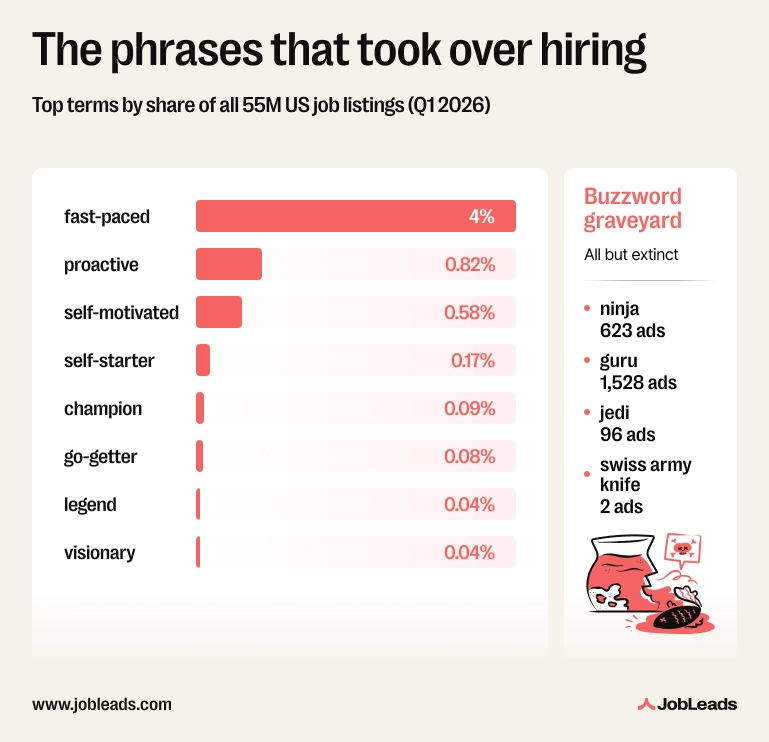
What's telling about the rest of the leaderboard is what kind of words win. The most common clichés are personality demands, like "proactive" or "self-motivated." The ads aren't describing the work so much as the worker they've already pictured: someone energetic, low-maintenance, and ready to go from day one.
Here's the reassuring part. Flashy identity words like "ninja" or "champion" show up in just 0.3% of all listings. If you've been bracing for a job market full of rockstars and gurus, you can exhale.
And the old guard really has collapsed. In 2026, "ninja" survives in 623 ads. "Rockstar" in 1,589. "Guru" in 1,528. The infamous "we are a family", the phrase that launched a thousand cautionary LinkedIn posts, clings on in just six listings in the entire database. The startup-cringe trio of the 2010s is, statistically, almost extinct.
But the hype didn't disappear. The new job ad favorite is "champion," now in 50,188 ads–more than double the next contender. It's trailed by vague terms like "legend," "visionary," "innovator." Employers swapped the loud, slightly embarrassing fantasy titles for abstract aspirational nouns that sound more grown-up. Cringe didn't die. It just got blander.
So, the words are in many job ads. The real question is whether they cost anything, and here the data stops being funny.
They cost plenty. Across the 52 million listings with both a posted salary and a named industry, the pattern is almost suspiciously clean–
The more cringe words there are in the job description, the less it pays, with every layer deepening the discount.
A "clean" listing with no buzzwords, no clichés, no red flags has a median salary of $69,860. Add a single category of cringe language and the median drops to $61,638, a penalty of almost 12%. Ads carrying two categories pay 14% less.
And the ones that go all in–a fantasy job title, an empty cliché, and a genuine red flag in the same post–pay almost 18% less, a gap of $12,260 a year.
| Cringe group | Median salary | vs. clean |
|---|---|---|
| Clean (no cringe) | $69,860 | baseline |
| 1 category | $61,638 | −12% |
| 2 categories | $60,000 | −14% |
| 3 categories (triple cringe) | $57,600 | −18% |
| Scam / MLM only | $78,810 | +13% |
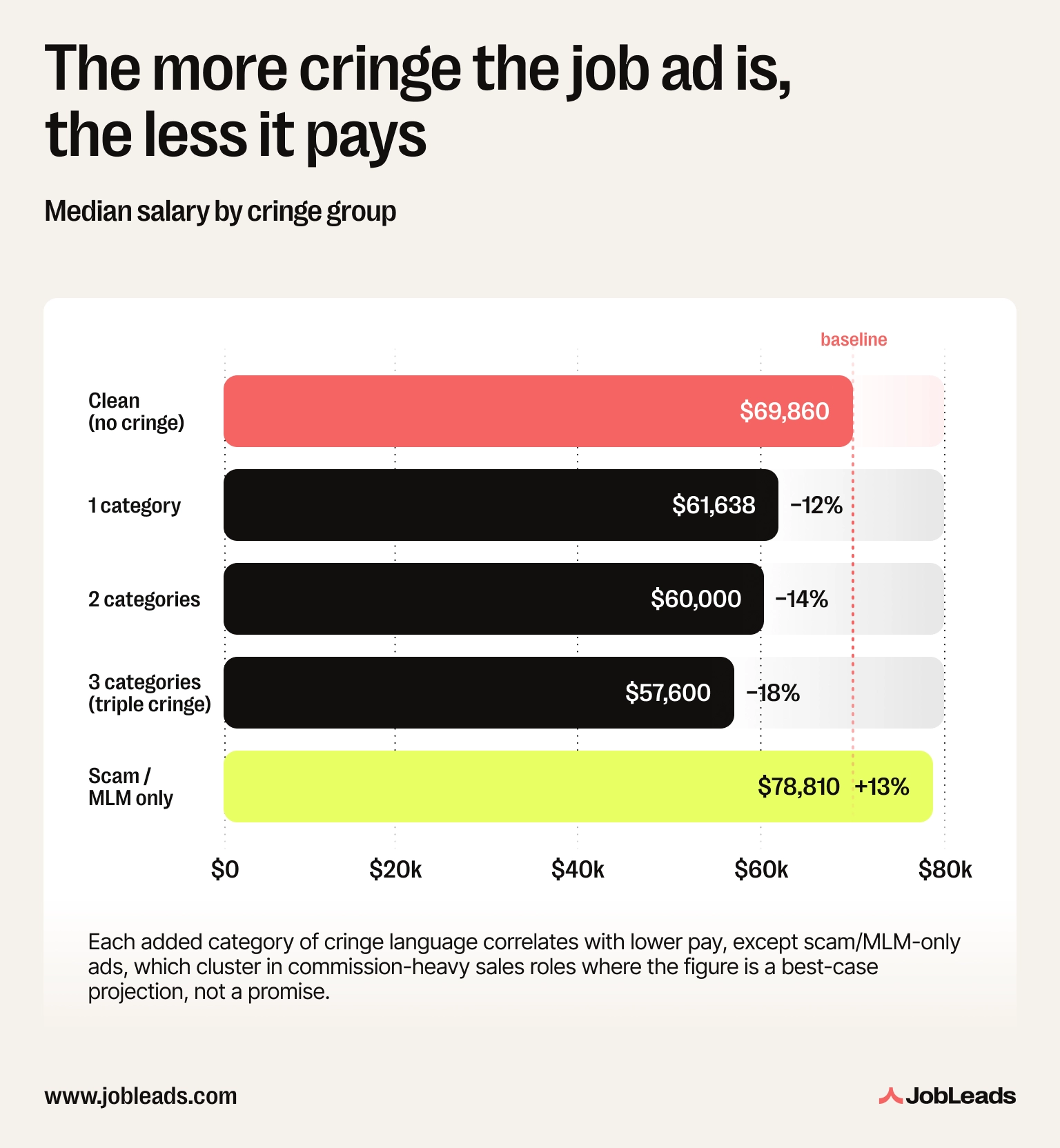
And to be clear, none of this means the words cause lower pay. The likelier story is that they just leak it. An employer confident in the role and the salary tends to describe things plainly. And the one reaching for "rockstar," "superhero," and "we work hard and play hard" is often papering over what it can't put in numbers. Language is the symptom, not the disease. But it's a symptom job seekers can read for free, before they ever click apply.
One group breaks the rule, and breaks it hard. Listings whose only red flag is scammy language, i.e. "be your own boss," "financial freedom," "residual income", don't pay less. They claim to pay 13% more than clean ads.
Before anyone reorients their job search around financial freedom: this isn't scams quietly out-earning honest work. It's a quirk of who writes that way.
Those phrases cluster in commission-heavy sales and finance roles, where the headline number is a best-case projection, not a salary anyone is actually promising. The figure is real, the certainty isn't. It's the one corner of the data where the loudest ads point up instead of down, and the reason turns out to be more revealing than the rule itself.
That brings a logical question: do job seekers care that much for specific words in job ads? Many would expect a tidy conclusion–cringe-heavy ads pay less, so surely job seekers steer clear of them. It's the satisfying version of the story, but, mostly, the wrong one.
For buzzwords and clichés, the answer is almost anticlimactic–
Clean listings drew some form of interaction 3.9% of the time but listings carrying a hype signal drew interest 4.1% of the time.
So, ads stuffed with buzzwords, like "fast-paced," "self-motivated," and "ninja" pull roughly the same engagement as clean ones.
People read the hype, shrug, and engage anyway. After years of marinating in this language, it's faded into background noise they no longer register.
Another possibility is that vague, buzzword-heavy ads may simply cast a wider net. A precise listing for a "front-end engineer" really only speaks to front-end engineers. Meanwhile, a "coding champion" wanted by a "fast-paced family" can pull clicks from back-end, front-end, and everyone in between.
So, hype language drags in a broader, less-targeted crowd. The data can't fully separate "people don't mind the hype" from "the hype just attracts a messier audience." The safest read is: cringe language doesn't repel applicants, but that's not the same as saying it works.
| Cringe group | Participation rate |
|---|---|
| Clean (no cringe) | 3.94% |
| Buzzword / cliché / red flag | 4.13% |
| Scam / MLM only | 0.47% |
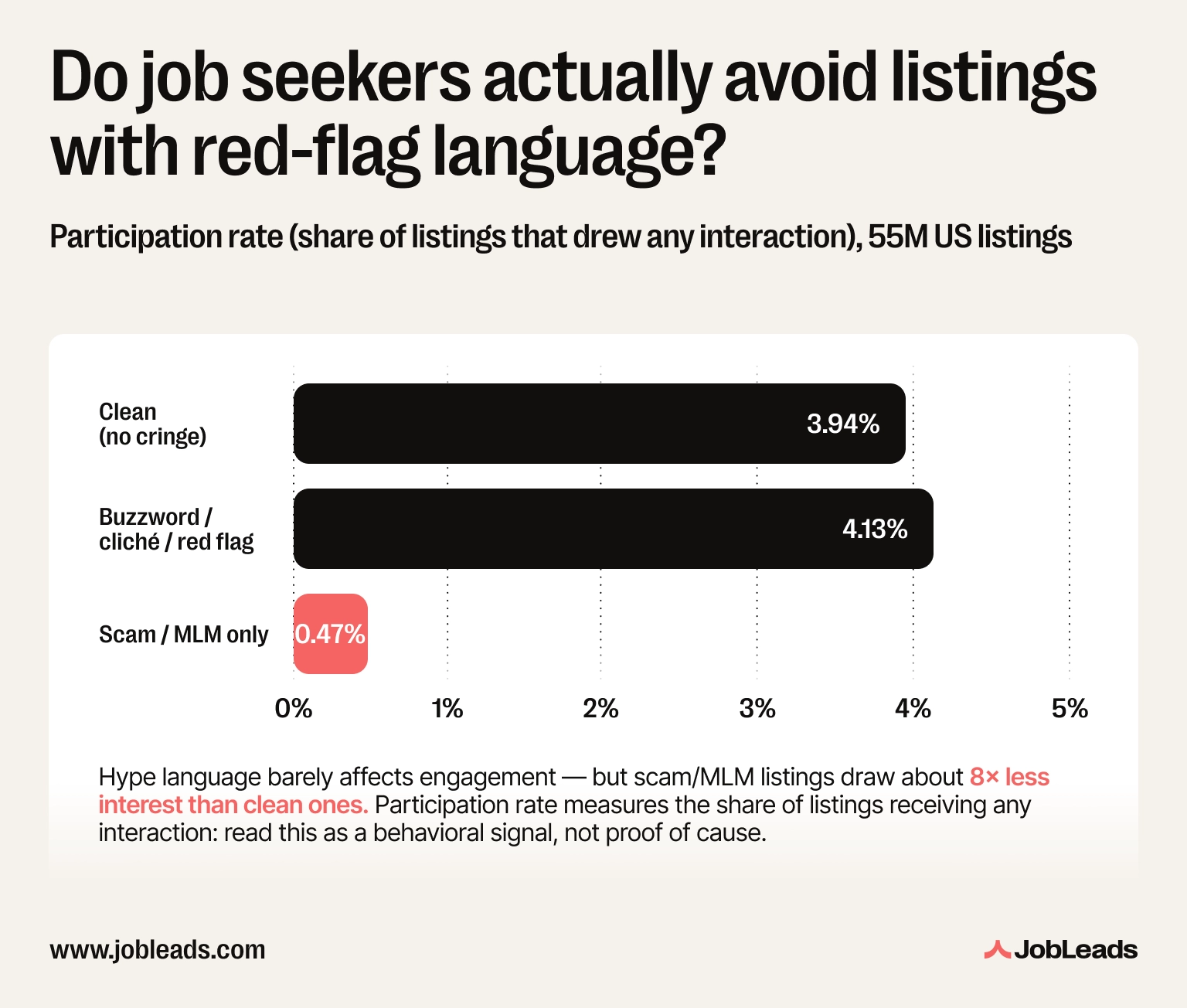
There is one exception though. Listings whose only flag is scam-adjacent language like "commission-only," "unlimited earning potential," "residual income", etc. drew interest just 0.47% of the time, roughly eight times less often than clean listings. These are the same ads claiming to pay 13% more than everyone else. Job seekers aren't biting.
And this isn't only a JobLeads pattern. A 2026 University of Guelph study tested the idea head-on: researchers rewrote job ads to strip out off-putting language (in that case, ableist). Then, they varied the salary on offer. Applicants still preferred the plainer versions, and a bigger paycheck didn't undo the effect. Which is the same lesson the scam listings teach from the other side: when language genuinely repels people, a higher number doesn't buy them back.
According to the data, some industries can barely write a listing without reaching for a slogan while others get through the whole thing just fine. And the gap between them is wide.
The worst offender, by a comfortable margin, is Sales. More than 12% of sales listings carry cringe language (more than 1 in 8 listings), which is over three times the rate of the cleanest field. That's not surprising once you picture it. Sales writing runs on energy and aspiration, and the line between "motivating" and "exhausting" can be thin.
Marketing & Media comes second at 8.1%, followed by Management & Operations at 8% sharp. So, there is a pattern here: the more a field sells, persuades, or hustles for a living, the more its job ads sound like it.
At the other end sits the field most people would have bet on losing: healthcare. Bio, Pharmacology & Health is the cleanest industry in the study, with just under 4% of listings using cringy language, despite being the single largest category, nearly a quarter of all US listings. Clinical roles are written in the language of precision, not personality.
| Industry | Any cringe % |
|---|---|
| Sales | 12% |
| Marketing & Media | 8% |
| Management & Operations | 8% |
| Human Resources | 7% |
| Finance | 6.4% |
| Legal | 5.7% |
| Consulting | 5.6% |
| Engineering | 4.8% |
| IT & Technology | 4.4% |
| Bio, Pharmacology & Health | 3.8% |
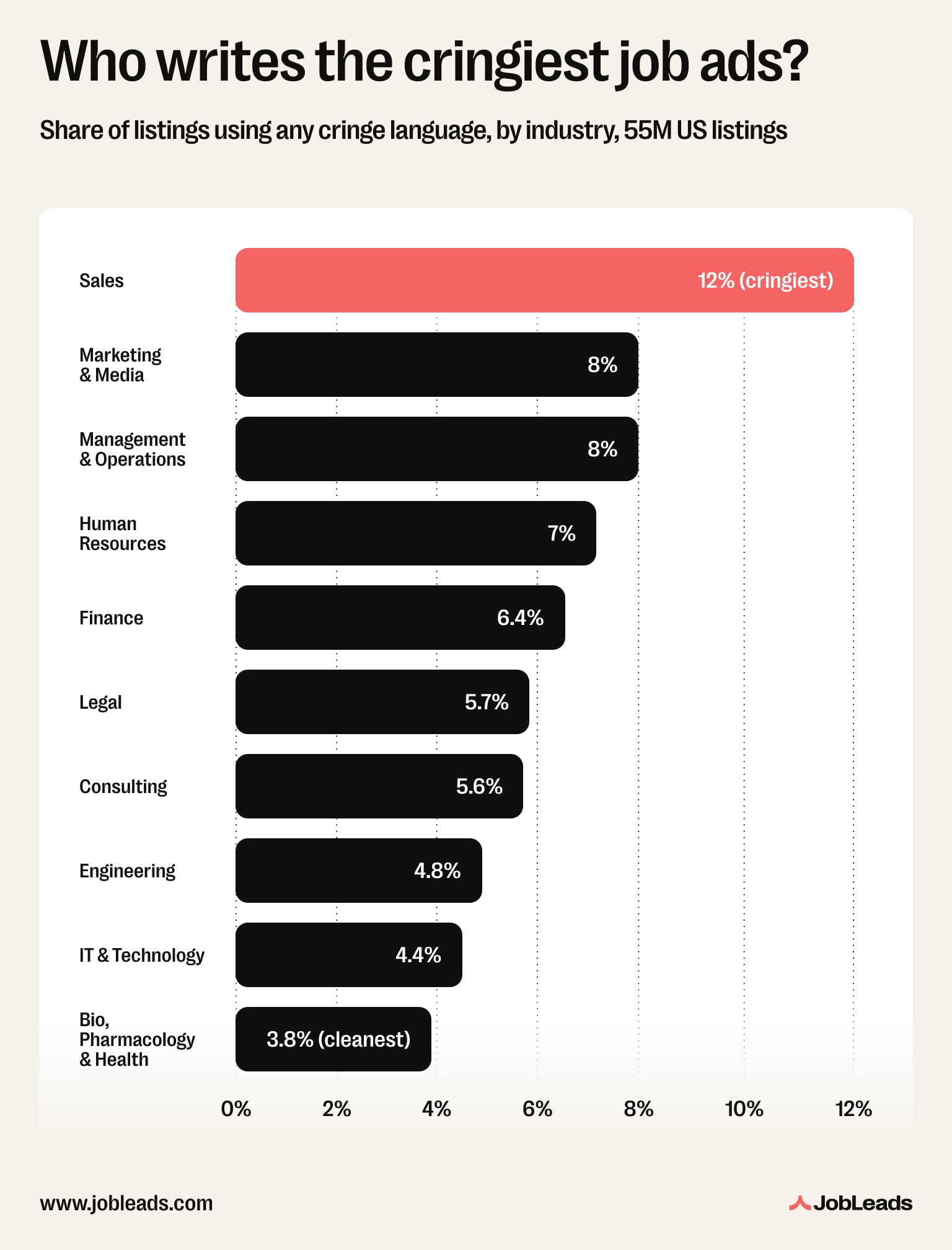
And then the stereotype-buster. The "rockstar developer," the "coding ninja,"… And the data doesn't support it. IT & Technology ranks 9th out of 10, near the very bottom at 4.4%. Tech, it turns out, has quietly grown up and its listings are some of the plainest around.
Are job listings looking for more senior professionals more restrained?
Often quite the opposite–
The peak is right at the top. Managing Director listings are the cringiest of any level, with 9% carrying hype language, and the buzzword gap is where it gets almost comical. Managing Director ads often reach for fantasy-title language ("visionary," "champion," "innovator") at 1.7%, roughly 8.5 times the rate of specialist roles (0.20%). The more senior the seat, the grander the word choice.
But then, if you go even higher up the career ladder, the hype disappears. The most restrained job ads when it comes to hype language in the data set are those hiring Vice Presidents, with the lowest overall cringe rate of any level at 4.7%. VPs actually use more identity buzzwords than most (0.90%, second only to MDs), but they drop the operational clichés almost entirely. It's a different register: polished, identity-driven, allergic to "fast-paced." Where the Managing Director wants a visionary, the VP just wants the job done and writes like it.
| Seniority | Buzzword % |
|---|---|
| Specialist | 0.2% |
| Project Manager | 0.24% |
| Team Leader | 0.33% |
| Head of Department | 0.6% |
| Vice President | 0.9% |
| Managing Director | 1.71% |
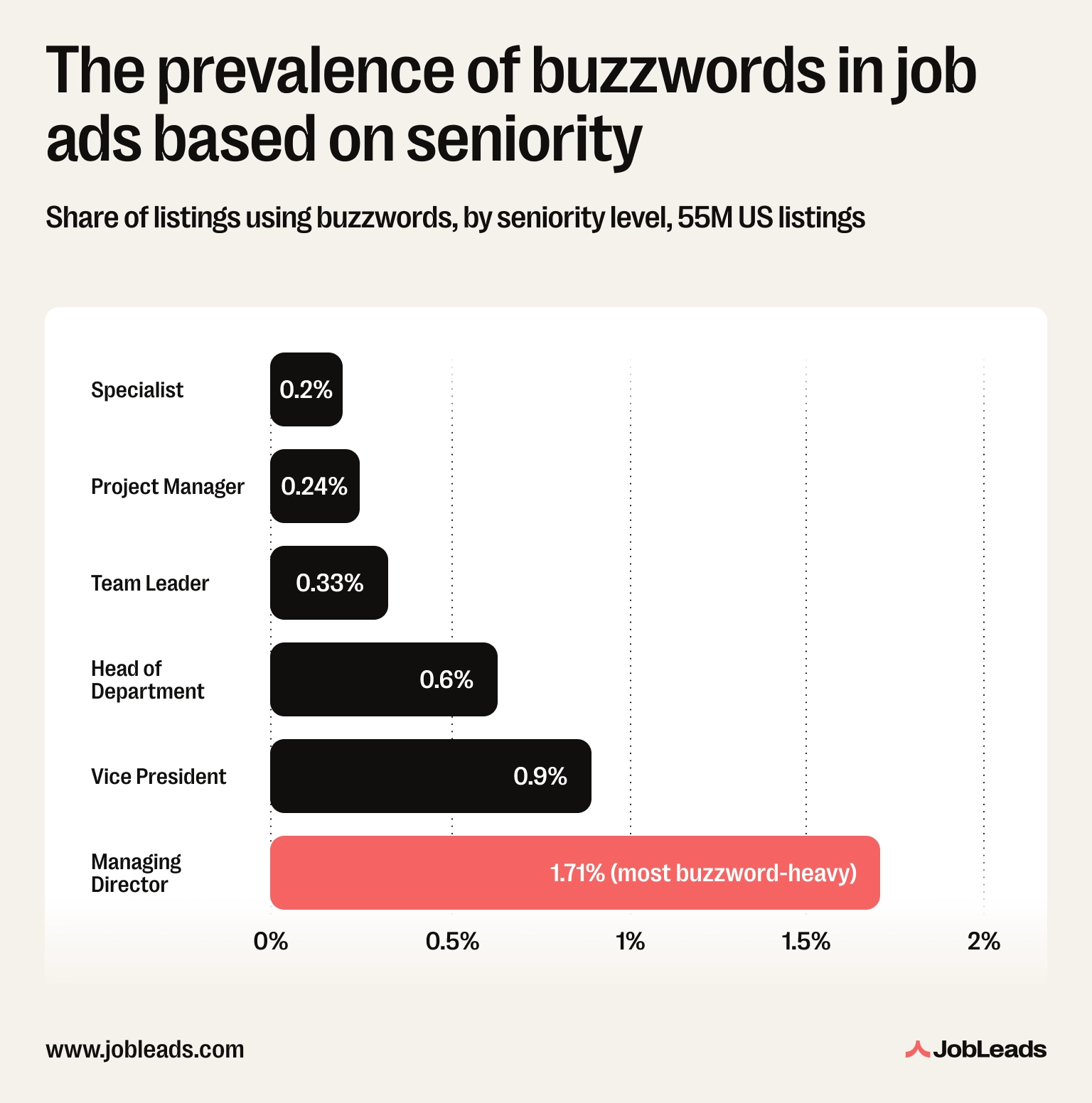
And at the bottom of the ladder, where most of the hiring actually happens, the cringe is quieter but heavier in a different way. Specialists (81% of all listings) carry the most red flags of any level (0.6%). The aspirational language thins out down here and what's left is the blunt stuff: "on-call," "extended hours," "demanding role."
So what should job seekers actually do with all this? It's important to start reading job ads the way you'd read a dating profile: the adjectives tell less about the role than about the person who wrote it. Here's how to translate.
Treat hype as a (weak) signal, not a verdict. When an ad leans hard on personality slogans, it's not proof of anything. But the data is clear that the louder a listing shouts, the less it tends to pay. So, let the language raise an eyebrow, then go check the things that matter, like the actual salary, the actual perks and benefits, the actual scope. If the ad is all adjectives and no specifics, that absence is the real tell.
Read the red flags literally. "High-pressure environment." "Always on." These aren't usually just throwaway colors. They're overwork expectations disclosed right in the job ad, written by someone who assumed you'd read them as enthusiasm. Take them at face value instead so you know what you are applying for.
Trust your scam radar. If a posting promises "financial freedom," "residual income," or the chance to "be your own boss," that's probably a scam, no matter the salary promised. The reassuring part: you already know this. It's the one kind of language job seekers reliably steer clear of. That instinct is worth keeping.
The thread running through all of it is simple: the words are a proxy, and a noisy one. The fix is to insist on the facts they're standing in for.
Search JobLeads for roles that lead with the salary and the scope, not the slogans.
What was analyzed. This study draws on 55,094,395 active US job listings posted in Q1 2026, i.e. the full set of US postings in the JobLeads database for that period, not a sample. Every figure in this article comes from JobLeads' own first-party data.
How "cringe" was flagged. Each listing's description was scanned, using an automated keyword classifier, against five curated phrase lists built specifically for this study:
Flagging is binary: a listing either contains a term or it doesn't, regardless of how many times the term appears. Matching is case-insensitive and works on substrings, so "fast-paced" also catches "fast-paced startup." A few phrases deliberately sit in more than one list. To keep the analysis honest, genuinely ambiguous words like passionate, driven, weekend were left out entirely; only language that's unmistakable in a job-ad context made the cut.
The cringe score. Each listing gets a score from 0 to 3, counting how many of the three core categories (buzzword, cliché, red flag) it triggers. A listing scoring 3 is what counts as "triple cringe." Fraud and MLM signals are tracked separately and kept out of the cringe score, because they behave so differently from the rest.
Cleaning the fraud and MLM numbers. Raw keyword matching badly overcounts scam language: phrases like "guaranteed income," "commission-only," and "unlimited earning potential" are everywhere in legitimate sales and finance roles. Those flags were therefore audited term by term. The raw counts (848,950 fraud flags and 196,946 MLM flags) collapsed on inspection to 445 genuine fraud listings and 22,755 genuine MLM-style listings. That gap is a finding in itself: automated scam-detection in job ads is mostly false positives unless the terms are checked by hand.
The salary comparison. Salary figures compare the median pay of each cringe group against a "clean" baseline (no buzzwords, clichés, red flags, fraud, or MLM signals). To stop a handful of extreme listings from skewing results, salaries were capped at the 95th percentile within each industry. The comparison covers roughly 52.4 million listings; about 2.7 million were excluded for missing salary data or an unnamed industry.
The engagement comparison. To test whether job seekers actually avoid flagged ads, listings were matched to Q1 2026 interaction records, measuring the share of each language group that drew any click or application.
A few caveats are worth stating plainly, because they shape how far the numbers can be pushed:
Data period: Q1 2026, United States. Analysis completed June 2026.
The data, charts, and findings in this report are free to share and republish for editorial purposes, provided JobLeads is credited as the source with a link back to this page. Higher-resolution graphics, additional breakdowns, and expert commentary are available on request via press@jobleads.com.
Every listing was scanned against five phrase lists. Below is each term that returned at least one match across the 55 million US ads, in order of how often it appeared. Fraud and MLM terms are shown as raw matches, before the validation cleanup described in the methodology–most are ordinary sales and finance language rather than genuine scams.
Buzzwords–identity hype: champion, legend, visionary, innovator, grinder, unicorn, genius, catalyst, hacker, rockstar, guru, evangelist, virtuoso, ninja, rock star, hustler, maverick, wizard, growth hacker, trailblazer, superhero, disruptor, a-player, jedi, culture champion, rainmaker, mastermind, jack of all trades, force multiplier, prodigy, change maker, culture carrier, polymath, swiss army knife.
Clichés–disposition demands: fast-paced, proactive, self-motivated, self-starter, go-getter, entrepreneurial spirit, entrepreneurial mindset, thrive under pressure, salary commensurate, can-do attitude, close-knit team, startup culture, tight-knit team, no two days are the same, high growth, hungry for success, winning attitude, thrive in ambiguity, hypergrowth, change the world, startup mentality, hit the ground running, many hats, roll up your sleeves, out-of-the-box, fast paced (no hyphen), think outside the box, move fast, we are a family.
Red flags–coded overwork language: on-call, long hours, high-pressure environment, demanding role, extended hours, high-performance culture, culture of accountability, overtime required, overtime expected, meritocracy, always available, above and beyond, always on, whatever it takes, results over hours, no hand-holding, highly demanding, thick skin, startup salary, radical transparency, below market rate, not for everyone, unpaid trial, bar raiser, not for the faint of heart.
Several of the loudest phrases people associate with bad job ads returned zero matches and so don't appear above: "sink or swim," "trial by fire," "brutally honest," "startup hours," "grind mentality," "not your typical 9-to-5," "only the best survive," "up or out," and "grow or go." Their near-total absence is itself telling–the bluntest toxic phrasing is the most likely to be softened out of a condensed listing, which is why the red-flag estimates run conservative.
Fraud signals (raw, before validation): six-figure income, guaranteed income, guaranteed earnings, registration fee, no interview required, easy money, passive income opportunity. After validation, just 445 listings carried genuine fraud signals, and the rest were legitimate employment language, mainly "guaranteed income" and "six-figure income" in real sales and finance roles.
MLM signals (raw, before validation): commission-only, unlimited earning potential, financial freedom, unlimited income potential, residual income, life-changing opportunity, be your own boss, residual earnings, you control your earnings, join our movement, ground floor opportunity, purely commission-based, own your own business, be your own CEO, get in on the ground floor, recruit your own team. After validation, around 22,755 listings carried genuine MLM-style language; the four highest-frequency terms ("commission-only," "unlimited earning potential," "unlimited income potential," and "financial freedom") were excluded as false positives common in legitimate commission-based roles.

Digital PR & Content Marketing Manager at JobLeads
Maryia leads digital PR and outreach at JobLeads. Her work has earned coverage in Fast Company, AOL, Forbes, Fortune, Quartz, and ZDnet—and she specialises in building the systems that make that happen at scale.
Job SearchLearn what ghost jobs are and why companies post fake job postings. Check out how to spot a ghost job in seconds, and the best job sites to avoid them.
 Job Search
Discover effective job search strategies and learn how the hiring process works. Debunk myths and follow the steps that actually secure your dream position.
 Job Market Trends
JobLeads study on 811K job postings and 245K professionals reveals the differences in workers' salary expectations and wages offered by employers.