
 Job Market Trends
January 19, 2026
US Remote Work Statistics and Trends [2026 Study]
Understand the state of remote work in the US in 2026 with JobLeads data on hiring demand, industry trends, regional patterns, and worker preferences.


JobLeads survey found that 74% of professionals would take a remote job even if it paid less than their in-office position. That's the demand-side of the remote market in one stat.
On top of being extremely popular, remote roles are what most professionals actively prefer even at a discount.
Which means the competition is fierce.
So, knowing where to look for remote jobs is essential. But just knowledge is not enough: you also need to filter ruthlessly from the start and customize your search.
This guide cuts through the noise and covers the step-by-step process for how to find remote work.
JobLeads surfaces remote roles that match your profile so you can stop scrolling and start applying.
Most people search for remote jobs the same way they searched for office jobs. They scroll a board, hit "easy apply", repeat. That's the reason it takes so long to land anything. But to get a remote job in a market this saturated you need more precision.
Below is the 7-step process that actually works:
Before you open a single job board, get specific about what kind of remote setup you want. The word "remote" hides at least four very different working models.
"Remote" can mean:
Decide before you search. Otherwise you'll burn hours filtering listings that don't fit your lifestyle.
Info
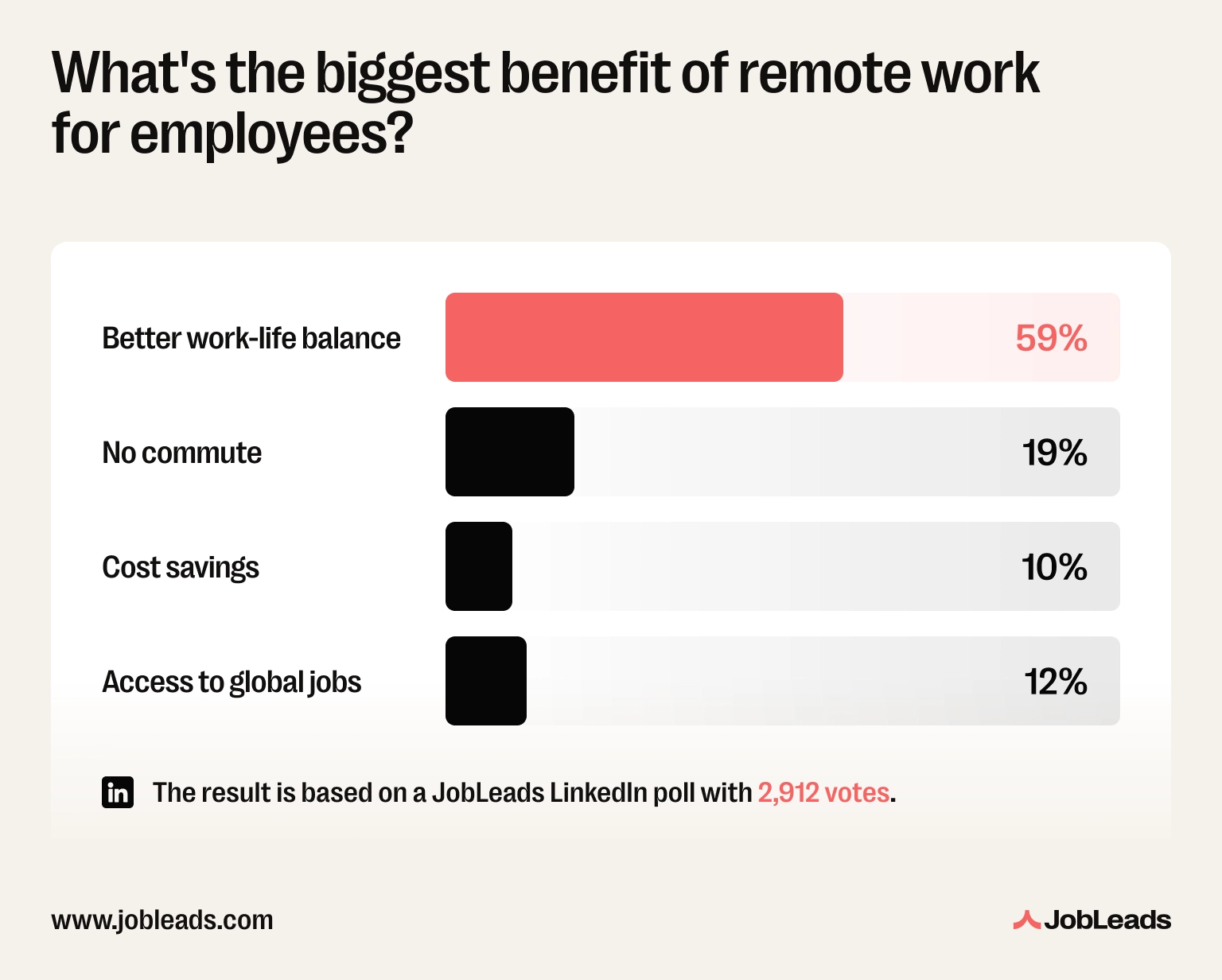
JobLeads survey found that better work-life balance is the biggest benefit of remote work. And if balance is the goal, you'll want fully remote with async flexibility, not hybrid-in-disguise.
Once you know what you want, your resume needs to prove you can do it. Remote employers screen for things that might matter less in-office. These include written clarity, self-direction, and proof you can deliver outcomes without supervision. And keep in mind that more often than not, generic CVs get filtered out before a human reads them.
What to highlight:
✅ Right: "Led async product launches across 3 time zones, coordinating 8 stakeholders via Notion and Loom to ship 14 days ahead of schedule."
❌ Wrong: "Worked with an international team. Strong communicator."
Read more: See our guide on how to optimize a resume for ATS and not get filtered out by a software.
Your resume gets you through the application. Your LinkedIn is what makes recruiters come to you. And at remote-first companies, that's where most senior roles start.
Quick fixes:
Read more: Check out the top tips from recruiters to land more interviews and offers.
The candidates who land the best remote roles don't apply to just whichever posting. They flip the model and pick the companies first, then wait for the right opening to appear. It's a slower start, but a much higher hit rate. This is genuinely the best way to find a good remote job at organizations that don't always advertise widely.
How to build the list:
Note
Example: Maria wanted a remote marketing manager role at a SaaS company. Instead of applying to 80 generic listings, she built a list of 20 remote-first SaaS companies. She set up alerts and applied to 5 roles per week with tailored cover letters. She landed an interview within 6 weeks at a company that hadn't even posted the job publicly when she first reached out.
This is where most remote job searches go wrong. Candidates fire off 50 generic applications a week, hear nothing back, and assume the market is broken. The truth is–the market isn't broken–but the approach is.
Five well-tailored applications per week will outperform 50 spray-and-pray submissions. That's because recruiters at remote companies say they can spot a templated application in under 10 seconds.
What "tailored" actually means:
Tip
The fix is writing more specifically. One sharp paragraph that proves you understood the role beats a 600-word generic cover letter every time.
A lot of the best remote roles never make it to a public job board. They fill via referrals, private Slack groups, or a quiet message from someone who already knows the hiring manager.
Finding remote work online often happens through warm intros instead of cold applications. A lot of people trying to find online jobs miss this hidden layer. They stay stuck on the public boards. If you're not networking, you're only fishing in the visible part of the pond.
How to plug in:
Read more: Learn how to tap into the hidden job market and how to find a headhunter in your field.
Remote interviews look like regular interviews except they're actually a working interview for the role itself. How you show up on video, handle tech failures, and talk about async work are all signals being scored. Treat the interview like a sample of how you'd actually work.
Get these three right and you'll outperform most candidates:
Read more: See our full guide on remote interview tips for the prep checklist, model answers, and recruiter-side tips.
Most candidates use the terms interchangeably. They're close, but not identical. Searches for how to find work from home jobs return different inventory than searches for fully remote roles.
"Remote" usually means a permanent, distributed-team setup but fully integrated with the company. "Work from home" historically meant flexible side income, freelance, or pandemic-era arrangements.
Info
JobLeads surveyed fully remote professionals asking "How much more salary would your employer need to pull you back into an office?" Over 47% said at least 20% more, another 23% said they'd refuse to go back, regardless of money. That's the value of what you're searching for.

Not all "remote job boards" are equal. Some are dominated by recruiters reposting the same listings. Others gatekeep behind paywalls. And a few consistently surface roles you won't find elsewhere. Below are the best places to find remote jobs with information on what each one does well, and where each one falls short.
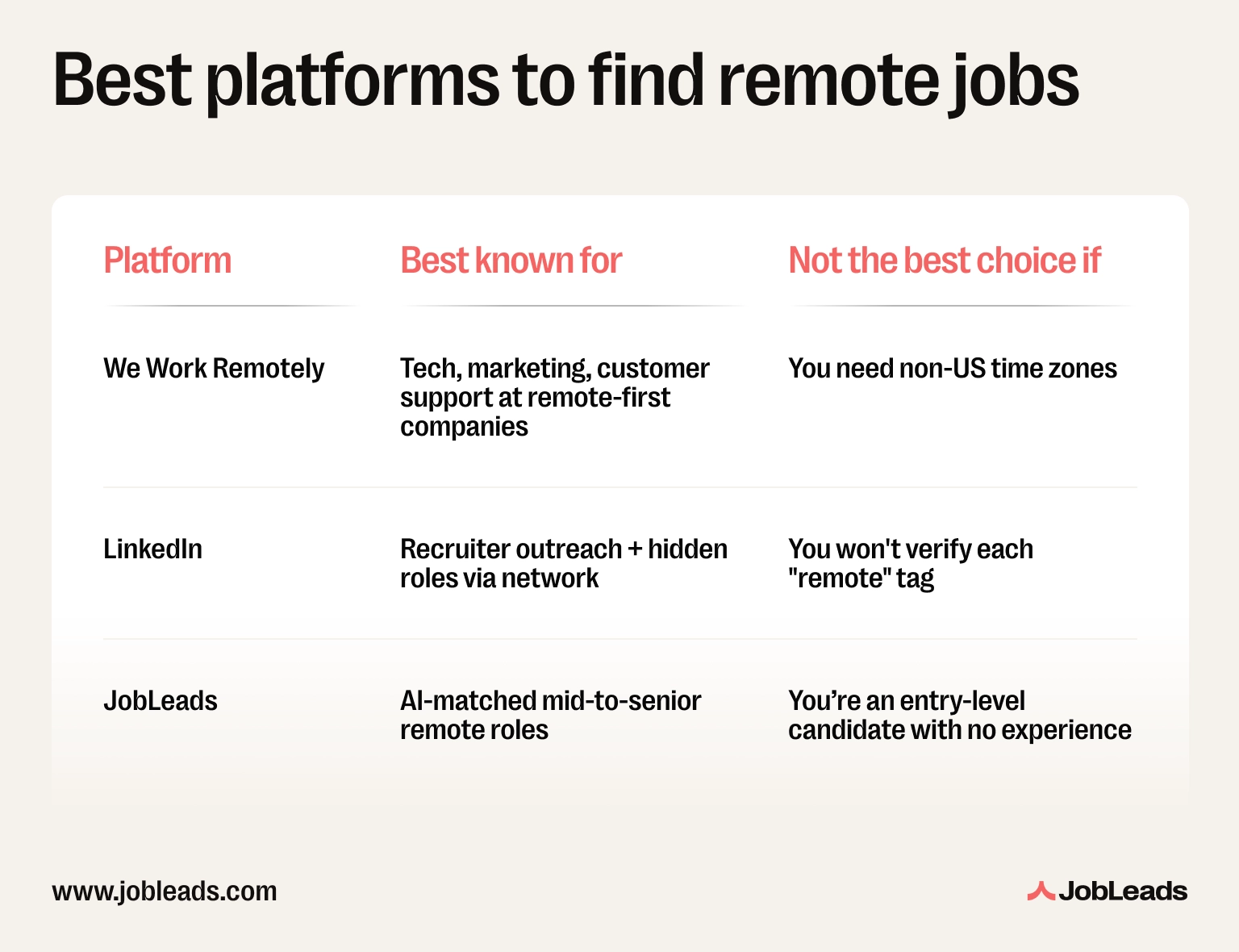
We Work Remotely is the go-to board for tech, marketing, and customer-support roles at established remote-first companies. The volume is high and it's free for candidates to search.
LinkedIn isn't a dedicated remote board. But the volume of remote-tagged roles plus its recruiter network make it impossible to ignore. The trick is to use the filters aggressively. And verify every "remote" tag in the job description.
JobLeads is built for mid-to-senior professionals who want roles matched to them, not the other way around. The AI works like a personalized remote jobs finder. It pulls from multiple sources, filters by your specific criteria, and surfaces remote roles a generic search would bury.
Read more: Read more: Check out this guide into remote onboarding to impress your new employer.
The flip side of remote work's popularity is that scammers know it too. Job scams have exploded over the past three years. Remote and "work from home" listings now dominate the fraud reports, and the Federal Trade Commission tracked $501 million in losses to business and job opportunity scams in 2024 alone. That's more than triple the figure from 2020. Which means knowing how to find a legit remote job is now half the battle.
The good news is that most scams share the same fingerprints. Learning how to find real remote jobs in a sea of fake listings comes down to pattern recognition. Once you know what to look for, you can spot them in seconds.
Here are the red flags of a remote job scam:
❌ Wrong (scam pattern): "You're a perfect fit! We'd like to skip the interview and get you started right away. Just complete the attached form with your bank details and a copy of your ID so we can set up payroll before your first day."
✅ Right (legit pattern): "We'd like to schedule a 30-minute video call with the hiring manager next week. Equipment and onboarding details will be covered after the offer."
Beyond scams, there's another problem: ghost jobs. These are listings that are technically real but were never meant to be filled. Companies use them to gather resumes, test the market, or keep pipelines warm.
Tip
If a recruiter contacts you out of nowhere with a remote role that "fits perfectly", check whether they have a complete LinkedIn profile with mutual connections. An empty profile means that you should probably move on.
No remote experience is one of the most common reasons people self-disqualify from remote roles. But it's the wrong frame. Almost every office job contains hidden remote experience.
Self-managed projects, written reports, working across locations are all remote-relevant. So is fluency with Slack, Zoom, Notion, Asana, and other tools remote teams live in. The work is to relabel what you already have, quantify the outcomes, and put the right vocabulary on your resume.
You can also manufacture remote experience faster than you'd think. Take on freelance projects on Upwork or Contra. Volunteer for distributed open-source or non-profit projects. Document one async project on your LinkedIn as recruiters love evidence.
From there, skip generic job boards and start on We Work Remotely, Wellfound for startup roles, and JobLeads for AI-matched filters.
Finding a remote job isn't easy. The competition is global, the listings are few, and scams are everywhere.
But the playbook isn't complicated. Filter ruthlessly from the start and pick the platforms that screen for legit roles. Then, build a target company list before you start applying and tailor every application like the recruiter will read it twice.
Bottom line–
Most remote job searches don't fail because the candidate isn't qualified. They fail because of avoidable strategy errors and the wrong platform mix. Fix those two things, and the timeline shrinks from 6 months to weeks.
You already have most of what you need. The rest is staying consistent and using the right tools to do it.

Content & Insight Writer
Beata creates content that puts job seekers first. From practical blog advice to first-hand research studies, her writing is designed to give people the clarity and confidence to find the role they deserve.
Job Market TrendsUnderstand the state of remote work in the US in 2026 with JobLeads data on hiring demand, industry trends, regional patterns, and worker preferences.
 Career Development
Based on 7,700+ survey responses, here are the biggest benefits of remote work for employees and employers, and what people would give up to keep working remotely.
 Career Development
Discover the pros and cons of working from home. Learn how employees and employers benefit from remote work and the challenges they encounter.