
 Job Search
May 12, 2026
2026 Job Search Strategy: How to Win Over ATS & Recruiters
Discover effective job search strategies and learn how the hiring process works. Debunk myths and follow the steps that actually secure your dream position.


You spend hours on a job application. The posting looks real.
Then–nothing.
Six weeks later, the same role is back online.
That role might be a ghost job. And you're not alone in applying for it. According to a JobLeads poll, nearly 80% of professionals have applied to a job they suspect was never real and almost 60% say it's happened multiple times.
Industry data confirms it: between 18 and 22% of jobs posted on Greenhouse are ghost jobs in any given quarter. Companies post them on purpose, every day, on every major job board.
But why and how to avoid them? This guide explains it all.
Let's start from the basics.
A ghost job is a job posting where the role is already filled, cancelled, or may have never existed. But the listing stays live and collects applications week after week.
Fake job postings exist for the company, not for you. Every ghost application you send fills a database. It justifies a budget line and pressures an internal employee. But it never fills a real role.
So, to answer the question "are ghost jobs real?"–
Yes, painfully so. Greenhouse found that as many as 3 in 5 candidates suspect they've encountered a ghost job during their search. In fact, the percentage of ghost jobs has climbed every year and currently sits in the 18-40% range across recent studies.
Read more: Most real hires don't happen on job boards at all. They happen through the hidden job market.
Here are the main reasons companies post ghost jobs:
So, to answer the question "why do ghost jobs exist?" plainly–
The incentives reward it and nothing forces companies to stop. None of these reasons require bad intent. They just require a system where candidates have no power to push back.
Which raises the obvious question: should ghost jobs be illegal?
Many job seekers think yes and calls to ban ghost jobs outright keep showing up in policy debates. They argue ghost jobs should be illegal because they waste candidates' unpaid time at scale.
Are ghost jobs illegal today? In most countries, no. Some regions have started to require posted salary ranges and posting expiry dates. That chips away at the practice. But until the law catches up, knowing how to spot them matters most for job seekers.
Read more: Ghost listings aren't the only way your details get collected. See what free job boards do with the personal data you upload.
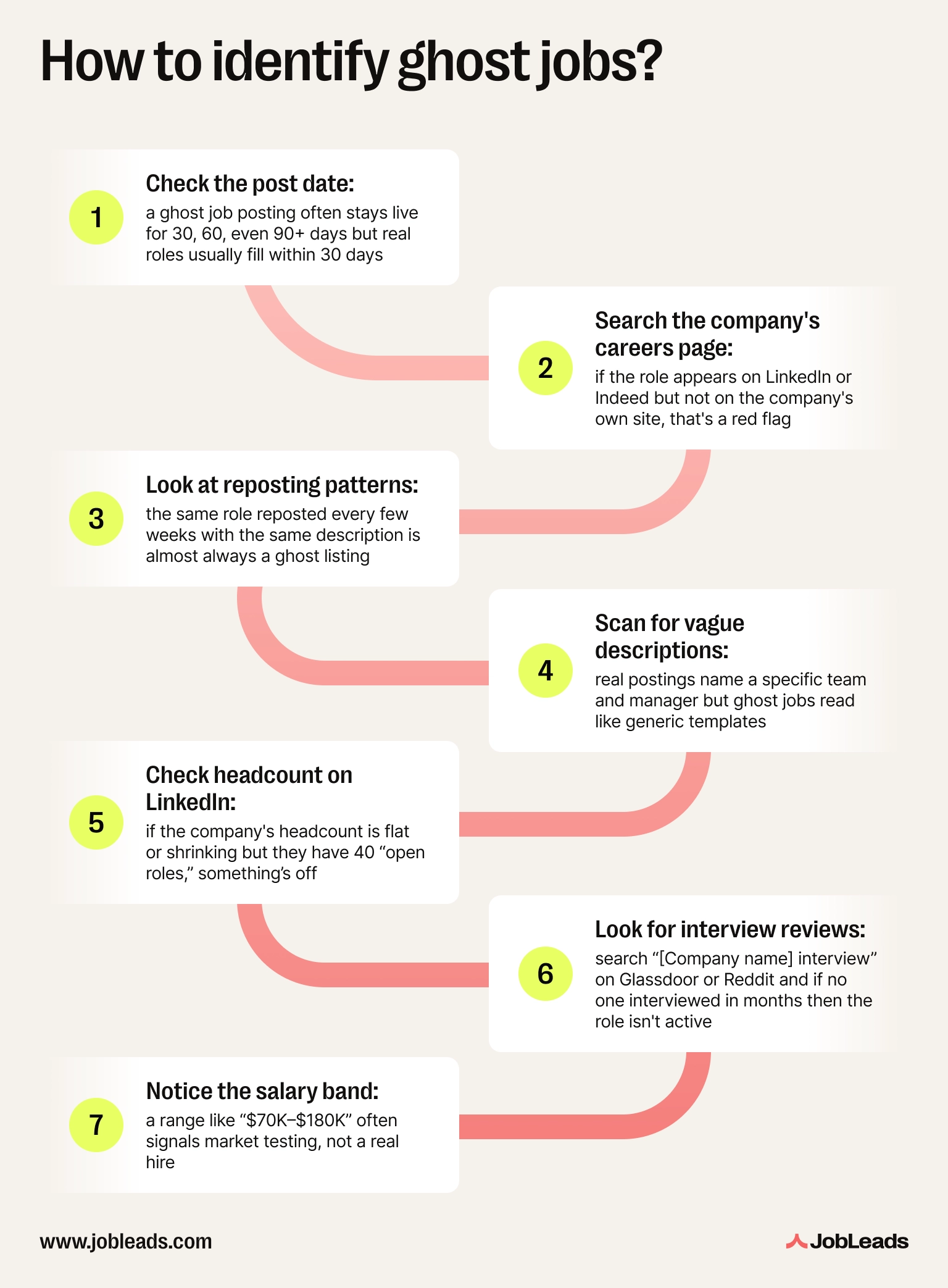
Ghost job detectors come down to pattern recognition as the signals stack up fast.
Here's how to identify ghost jobs before you waste an afternoon on the application:
The ghost job situation is incredibly frustrating right now. I completely stopped applying to anything that has been posted for more than 48 hours. If a listing has been sitting there for weeks, it is usually just a data-harvesting ghost job or they already have a thousand unopened applicants. To actually catch the real openings, speed is the only thing that worked for me.
asanders791 – Reddit user
✅ Right: Posted 9 days ago. Listed on the company careers page. Specific team named. Salary band within 15%.
❌ Wrong: Posted 74 days ago. Only on aggregator sites. No team named. "$60K–$160K DOE."
Did you know?
JobLeads surveyed professionals to check which job-posting red flag would make them immediately move on, over 40% said "no salary range." Wide or missing salary bands aren't just annoying–they're the single biggest trust-killer in a listing.
Read more: For more spotting hacks straight from the source, see our tips from recruiters on how to filter listings before you apply.
The hard truth about companies that post ghost jobs is that it's not a fringe practice. According to ResumeBuilder, as many as 40% of companies posted at least one fake job listing in the past year. Almost 1 in 3 have an active fake listing right now.
Companies posting ghost jobs tend to share a few traits:
Companies posting fake jobs rarely admit it out loud. But when ResumeBuilder asked hiring managers directly, nearly 80% of firms that posted a fake listing in the past year still had one active.
Ghost remote jobs deserve a special callout as a JobLeads study found that only 6% of open roles are fully remote. At the same time, more than 29% of job seekers want a remote or hybrid setup.
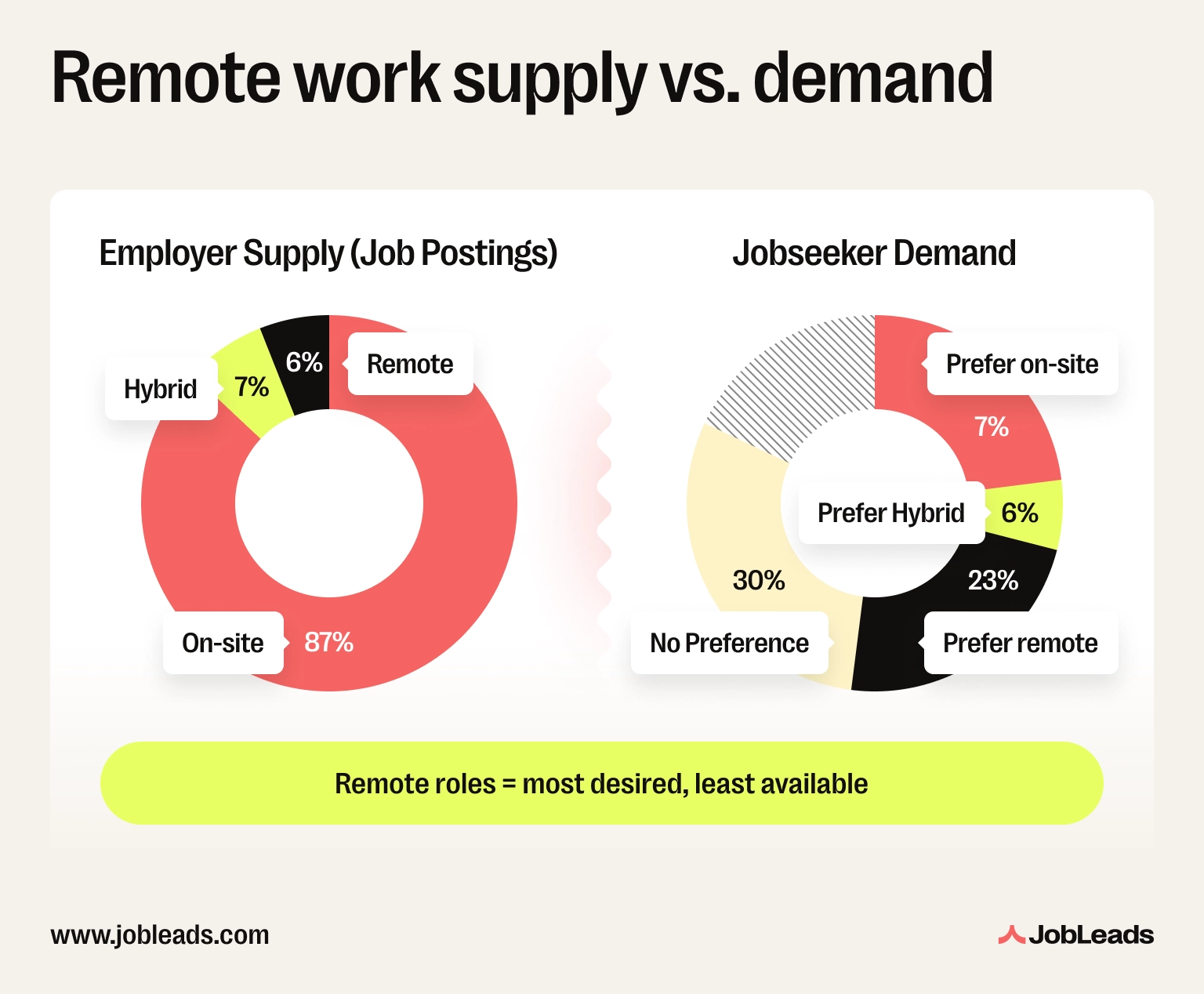
That supply-demand gap is exactly why ghost remote jobs are the most cost-efficient pipeline for a company. A single fake remote posting pulls in resumes from every time zone. That makes the rare remote role the most likely category for ghost jobs on LinkedIn or Indeed.
The pattern is easy to spot once you know it. A role stays posted for 3 to 6 months. The company runs sporadic interviews. The role never gets filled. The company isn't actually hiring. It's testing the market or building a pool.
So–where can you actually find roles that are being filled?
The best job sites to avoid ghost jobs have three things in common. Strong employer verification, fresh postings, and direct employer relationships. Job sites without ghost jobs don't fully exist as every platform has some. But the ratio varies a lot.
| Platform type | Ghost job risk | Best for |
|---|---|---|
| Aggregators (Indeed, ZipRecruiter) | High–Indeed ghost jobs are common as listings auto-import and rarely expire | High volume: verify every listing |
| Professional networks (LinkedIn) | Medium–ghost jobs exist but they're easier to spot via the "Hiring" badge and recruiter activity | Networking and warm intros |
| Curated executive boards (e.g., JobLeads) | Low–roles are vetted and time-bound | Senior, salaried roles with active hiring |
| Company careers pages | Low–unless the company is large and decentralised | Verified, source-of-truth listings |
You can't dodge every ghost job–they're too common and too well-disguised. But you can cut your exposure dramatically with a few habits that take less than a minute per role.
The goal isn't to apply to fewer jobs. Rather, it's to apply to fewer dead ones.
Here's how to avoid ghost jobs in practice:
Pro tip
Set your search filter to "Posted in the last 24 hours." This one move cuts your ghost-job exposure by more than half.
Done right, these habits help you stop sending applications into the void and start spending your hours on roles that someone, somewhere, is actually trying to fill.
Read more: Learn why you’re not getting interviews and best practices to change that.
Ghost jobs aren't about you. They're about a hiring system that treats candidates as endless and disposable. Companies post them because they can and because the power balance allows it.
Ghost jobs aren't a glitch in the system. Rather, they're a feature of a system that was never built for the job seeker. The fix isn't to apply harder. It's to apply where the incentives are actually on your side.
Jan-Hendrik von Ahlen – Co-Founder & Managing Director, JobLeads
But knowing the patterns changes your strategy. You stop waiting for closure that isn't coming. You start spotting the warning signs early and spend your time on roles that are real.
The companies that post ghost jobs are telling you who they are. So listen closely.

Content & Insight Writer
Beata creates content that puts job seekers first. From practical blog advice to first-hand research studies, her writing is designed to give people the clarity and confidence to find the role they deserve.
Job SearchDiscover effective job search strategies and learn how the hiring process works. Debunk myths and follow the steps that actually secure your dream position.
 Job Search
Identify and fix job skills gaps before applying. Use ChatGPT to enhance your resume, gain new skills, and fast-track your career. Read our step-by-step guide!
 Job Search
Learn 6 strategies to maintain a life-work balance while job searching. Discover tips on setting goals, recharging, digital detox, taking breaks, and staying organized.