
 Job Search
June 10, 2026
Tips From Recruiters: 9 Things That Actually Get You Hired
Get recruiter tips straight from the source. From tailoring your resume to following up after interviews, here’s what hiring managers actually want to see.


Finding the right headhunter can transform your job search–especially if you operate in a specialized industry or senior-level role.
Industry-specific headhunters not only know where the opportunities are but also who’s hiring behind the scenes. According to Management Consulted, around 70% of jobs are never publicly posted, meaning companies could be hiring for your dream role right now without you ever seeing a listing.
Headhunters help you access this hidden job market, where many executive and high-value positions get filled before they ever reach public job boards. The key is knowing where to look and how to make those connections effectively.
Below are ten proven ways to locate and partner with the right headhunters in your field, coming from career coaches and employment experts.
Headhunters are external talent specialists working with employers to identify, approach, and assess qualified candidates for roles that are often specialized and hard to fill. Unlike in‑house recruiters, they represent client companies across the market and proactively source candidates, many of whom are not actively applying.
How do headhunters work? Most common types of engagement include:
Headhunter vs. recruiter at a glance:
| Aspect | Headhunters | Recruiters (in-house) |
|---|---|---|
| Who they represent | Multiple client companies across the market | One employer/company |
| Typical focus | Hard‑to‑fill, specialized, leadership roles | Roles across departments/levels |
| Compensation | Retained fees or contingency per hire | Salary (plus potential bonuses) |
| Access to roles | Hidden and confidential opportunities | Publicly posted and internal requisitions |
| Candidate relationship | Proactive outreach and market guidance | Process management for specific openings |
What hiring a headhunter to find a job means for candidates:
Did you know…
The hidden job market refers to roles not publicly advertised. They are often filled through networks, direct approaches, and specialized recruiters, giving well‑positioned candidates earlier, faster access to high‑value opportunities.
Despite the outsized influence headhunters have on hiring decisions, JobLeads’ research of over 43,000 job seekers found that only 26% know the most important headhunters in their industry, and fewer than 10% stay in regular contact with one. That gap is exactly what limits most candidates' access to the hidden job market–and it's fixable.

Now, let’s dive into the tips to help you find a headhunter for your job search.
JobLeads offers direct access to a network of more than 40,000 verified headhunters for job seekers worldwide. Unlike traditional employer-focused job boards, JobLeads is built entirely for professionals who want to take control of their own career path.
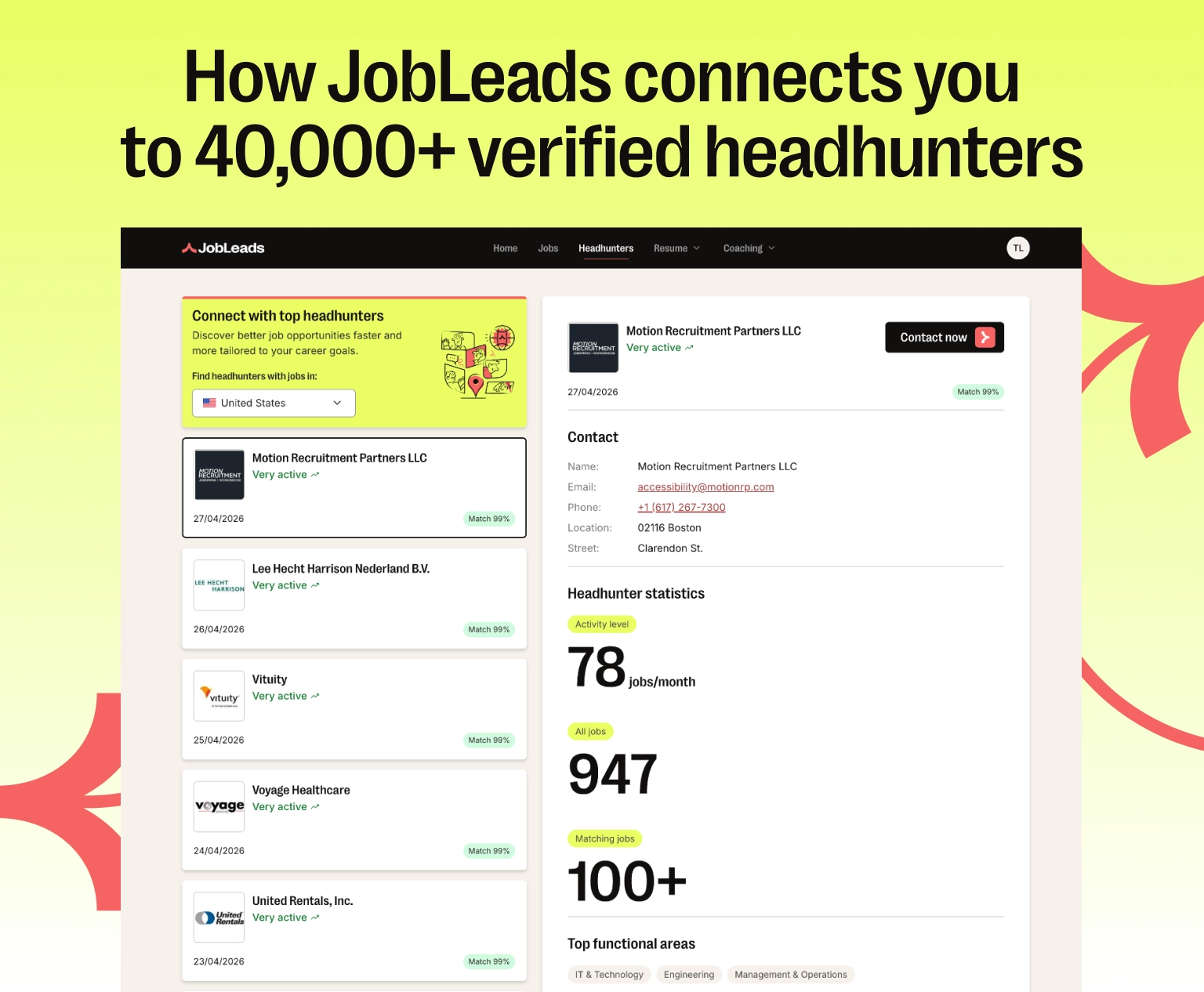
Members gain personalized exposure to industry-specific headhunters through an AI job‑matching system that recommends the most relevant connections. This visibility increases the likelihood of discovering hidden job opportunities–roles filled through networking and recruiter referrals rather than public postings.
Additional platform features such as free resume review, ATS optimization, and tailored cover letter guidance help ensure candidates are not just noticed but remembered. Through JobLeads, professionals go beyond passive applications toward a proactive, targeted job search strategy powered by transparent insights and real recruiter access.
A smart starting point for finding headhunters is to use executive search directories. These are professional headhunter services where firms are screened by industry, geography, and reputation. These lists help you identify vetted professionals bound by strict ethical standards.
Organizations like the Association of Executive Search and Leadership Consultants (AESC) maintain directories of accredited firms specializing in sectors from finance to technology. To build a shortlist as a candidate, identify consultants who regularly place talent at your level. Then, visit their firm profiles to submit your resume, join talent communities, or email the relevant partner with a concise, results‑focused summary.
This method keeps your focus on qualified experts with proven results.
| Directory | Focus area | Global coverage | Review standard |
|---|---|---|---|
| AESC | Executive and Board roles | Worldwide | Ethical accreditation |
| Clutch | Professional services | Worldwide | Client-rated projects |
| Headhunters Directory | Industry-specific headhunters | North America & Europe | Open review process |
Retained search firms are best suited for executive, director, and C-suite roles. These firms operate on a partnership model where clients pay an upfront fee securing exclusive, end-to-end service.
For candidates, the playbook is to get on their radar: tailor an achievement‑rich leadership resume and align your narrative to the mandates they handle. Understanding what employers really want from job descriptions gives you the language retained firms respond to. And definitely make sure to ask for warm introductions through trusted contacts in common.
Because retained headhunters work closely with company boards, they gain deep insight into organizational culture and leadership expectations. The process may take longer but delivers precision with fewer mismatches and stronger long-term fits.
Remember
Candidates should never pay fees to retained firms. They should focus on fit, discretion, and availability for exploratory conversations.
Boutique headhunters are smaller firms or independent teams that concentrate on specific industries or functions. Many are led by recruiters with direct experience in the sectors they serve–engineers recruiting engineers, or marketers recruiting marketers.
Working with a boutique firm offers closer relationships, tailored communication, and faster response times. They’re often tapped into niche talent pools and know where the specialized opportunities are before they go public. To find them, run LinkedIn Boolean searches pairing your industry (e.g., “biotech” or “cloud computing”) with terms like “headhunter” or “executive search,” then reach out with a short value proposition and a one‑page career brief.
Independent recruiters bring speed and adaptability, making them especially perfect for urgent or short-term opportunities. They typically work on contingency (paid by the employer when a hire is made) or hourly/retainer models with their client companies. As a candidate, you should not be billed, so be cautious of any request for payment.
To find them, check independent recruiter networks like NPAworldwide or Top Echelon, which list members by sector and location, and track which names recur on job postings in your niche–those are the recruiters with live mandates worth contacting first.
Because they manage their processes end-to-end, independents can respond quickly, customize their searches, and access localized networks larger firms may overlook. This agility makes them appealing for emerging companies or candidates targeting fast-moving markets such as tech or renewable energy.
LinkedIn remains one of the fastest ways to identify and connect with headhunters.
Follow this quick process to connect with recruiters on LinkedIn:
Headhunters and recruiters are more likely to respond when they sense genuine interest and alignment with their area of focus.
Warm introductions from your professional network and alumni communities are among the most direct ways to reach trusted headhunters. The math backs this up: a referred candidate is roughly 7 times more likely to get hired than a candidate from a job board, according to research done by Pinpoint. Alumni directories, chapter events, and shared connections create built-in credibility and shorten response times.
Leverage your network by identifying mutual contacts who know recruiters in your target sector. Ask for a brief email intro referencing your niche and location, as well as target roles. Include a crisp, value‑focused bio or one‑pager to make the handoff easy. This will help you bypass generic submissions and gain access to decision‑makers who influence specialized searches.
Pro tip
Reconnect with former managers, mentors, and classmates–people who can credibly vouch for your strengths and open otherwise hidden recruiting channels.
AI-powered sourcing tools streamline your search by automatically identifying and prioritizing headhunters who focus on your function, seniority, and geography. These systems analyze databases and social networks to surface relevant recruiter profiles in minutes, so you can personalize outreach at scale. Examples of the platform you can use include Apollo.io, ContactOut, or RocketReach.
Set filters for industry, seniority, and location, then let the platform suggest tailored messages and track reply rates to refine targeting over time. Candidates often see faster responses when outreach is highly relevant. JobLeads’ AI-driven matching follows the same principle–using data intelligently to connect you to headhunters who align precisely with your goals.
Recruitment process outsourcing (RPO) firms manage large portions of hiring on behalf of employers, often across multiple divisions or geographies. For job seekers, the practical move is to connect with RPO recruiters who staff roles for several client companies at once.
The RPO category itself has been expanding rapidly in recent years. Researchandmarkets’ analysis projects double‑digit compound annual growth through 2030, reflecting employers’ increasing reliance on scalable recruiting partners.
Search for RPO recruiters on LinkedIn, join their talent communities, and apply via RPO-hosted career portals to get into active pipelines. Treat them like agency recruiters: keep your profile current, share target roles and constraints, as well as respond quickly to screening requests. Keep in mind that you should not pay fees–RPO services are funded by the employer.
Specialized job boards and professional events offer concentrated access to recruiters working exclusively in defined sectors. Platforms like Dice (IT), eFinancialCareers (Finance), or Behance (Creative) are populated by headhunters seeking immediate hires in those fields.
Beyond online boards, conferences and trade shows remain highly effective. Recruiters attend to meet active candidates and assess talent firsthand. Join panels or workshops to build authentic connections as face-to-face visibility still matters when developing professional relationships.
Examples of niche job boards and events:
By bringing these strategies together, you can quickly surface the right headhunters for your industry, seniority, and geography. This allows you to position yourself for warm introductions into the hidden job market. Prioritize verified partners and align with firm types that match your goals to reduce time-to-offer and improve fit.
If you want a faster, more targeted start, JobLeads provides AI-matched access to 40,000+ verified headhunters. JobLeads also offers tools like resume reviews, ATS optimization, and tailored cover letters–so you’re not only discovered, but remembered.

Digital PR & Content Marketing Manager at JobLeads
Maryia leads digital PR and outreach at JobLeads. Her work has earned coverage in Fast Company, AOL, Forbes, Fortune, Quartz, and ZDnet—and she specialises in building the systems that make that happen at scale.
Job SearchGet recruiter tips straight from the source. From tailoring your resume to following up after interviews, here’s what hiring managers actually want to see.
 Job Search
Struggling with job applications? Discover how to decode job descriptions and tailor your resume to boost your chances of landing an interview.
 Job Search
Unlock job search success with clear personal branding, effective networking, adaptability, strategic time management, and resilience. Learn the secrets of top job seekers.