
 Job Interviews
September 23, 2024
How to Decode Interview Feedback to Smash the Next One!
Discover the hidden meaning behind interview feedback! Learn how to turn rejections into valuable lessons and ace your next interview with our expert tips.


The interview is winding down. The hiring manager leans back:
"So, do you have any questions for me?"
Your mind goes blank. Not because you're unprepared. It's because the last 25 minutes already covered everything.
That blank moment is more common than it may feel.
But, here's what most career advice won't tell you: you don't have to force a question just to fill the silence. Sometimes a confident, professional close is just enough. But if you want to be on the safe side, keep reading.
The rule exists for a reason. It's just been applied too rigidly.
From the employer's side, your questions are one of the few moments where you control the conversation. Everything else is reactive–they ask, you answer. So, your questions send a raw signal about what you care about.
Someone who asks about the team's biggest challenge says something different than someone who asks only about vacation days. And both say more than someone who asks nothing at all.
Interviewers also use questions as a proxy for preparation. A candidate who has read the job description and researched the company asks questions a cold applicant simply can't. That's the logic behind the advice.
The problem is that the advice mutated into the idea that you must always hold a clever question in reserve. And that failing to produce one on cue is an automatic strike.
It isn't. Context matters more than the ritual.
Already interviewing? Make sure it's for a role that's actually worth these questions.
Some interviews are genuinely thorough. A good hiring manager walks you through the role, the team, the challenges, the growth path, and next steps. All without you needing to extract any of it. If you arrived with five questions and all five got answered, forcing a sixth just to tick a box backfires. Interviewers can smell a hollow question from across the table.
The trick is how you say you have no questions.
Compare these:
❌ Wrong: "No, I think I'm good."
✅ Good: "I came in with a few questions, mainly about how the team splits ownership and what the first six months look like, but you covered both in detail. I'm even more interested in the role now than when I walked in."
Same content. Completely different signal.
The strong version proves three things at once. You prepared questions. You listened closely enough to notice they were answered. And you're still engaged. That's everything the "always ask a question" rule was designed to test.
One caveat: this only works in a late-stage or in-depth interview. In a 20-minute screening call, where almost nothing was discussed, "all my questions were answered" doesn't hold up.
Did you know that…
JobLeads survey found that most candidates (66%) would withdraw from consideration if there were more than three rounds of interviews.
The best questions to ask during a job interview share one trait: they get you information you'll actually use to decide whether to take the job. Here they are, grouped by what each type reveals.
| Question type | Question | What it reveals |
|---|---|---|
| Role | What's the most immediate problem you'd want the person in this role to solve? How has this role changed since it was last filled, or is it new? | Whether success is even defined |
| Team | Who would I work with most closely day to day? How does the team handle disagreements about priorities? | Your actual daily life |
| Growth | Where have people in this role moved internally? How does the company support skill development, formally or informally? | Whether promotion is real or a slogan |
| Culture & management | How do you prefer to give feedback, and how often? Can you tell me about someone who's thrived on this team, and what made them successful? | What reporting to them will feel like |
These separate the job as advertised from the job as it exists:
The first question is quietly powerful. If the interviewer can't describe what success looks like, the role itself is probably poorly defined. And you'll be the one stuck absorbing that confusion.
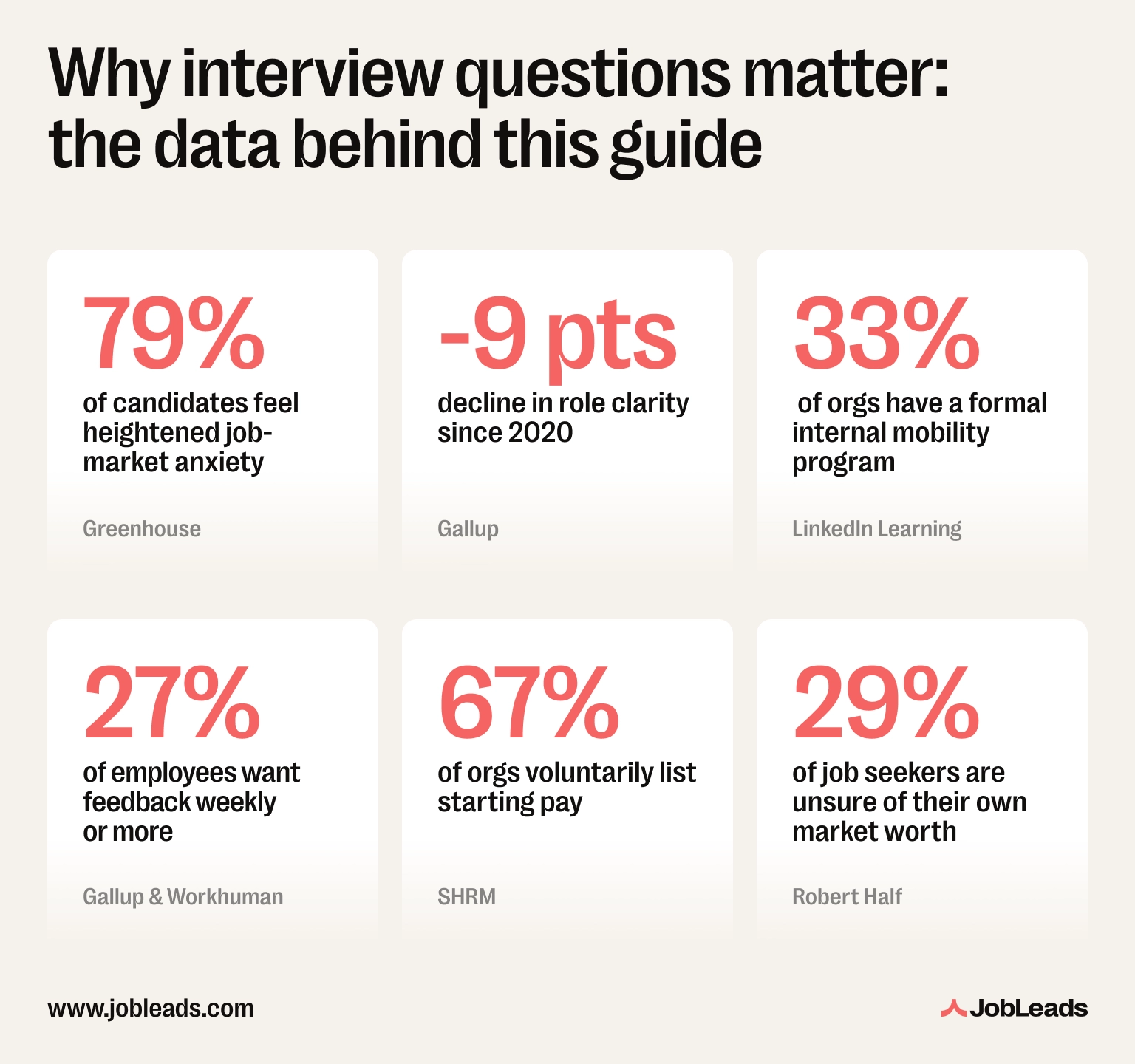
This isn't a small risk: role clarity has fallen further than any other item since 2020 in Gallup's employee engagement tracking–down nine points as of 2025. If a hiring manager can't explain what success looks like before you're hired, there's a good chance that confusion follows you in.
Job descriptions describe tasks. They don't describe your daily life but these questions do. Even one good question to ask the interviewer about team dynamics can surface more than an hour of scripted small talk.
For example:
Listen for specifics. A manager who can name the bottleneck honestly sees their team clearly. Beware of vague, defensive, or overly polished answers. That's often the difference between a healthy team and a red-flag workplace.
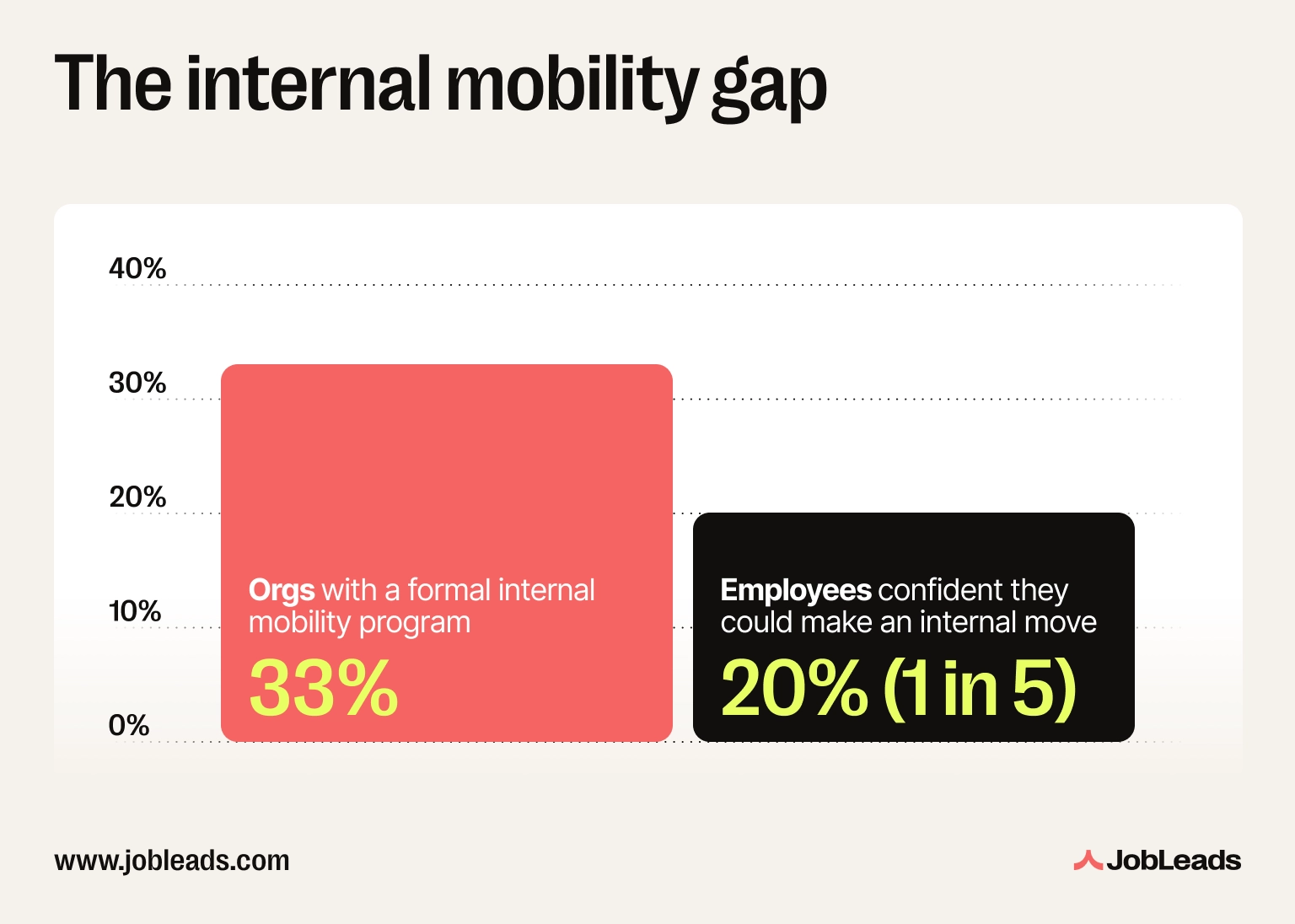
Internal mobility is more talk than practice at most companies. In fact, only 33% of organizations have a formal internal mobility program, according to LinkedIn's Workplace Learning Report. And just one in five employees feel confident they could actually make an internal move.
Questions to ask:
That last one is deliberately concrete. "We believe in growing our people" is a slogan. A recent, specific example is evidence.
Save these for your hiring manager rather than a recruiter. Recruiters rarely have visibility into internal promotion history.
Never ask "what's the culture like?" You'll get the brochure answer that will seem like your perfect culture fit on paper. Ask questions that force description over adjectives instead.
These are some of the best questions to ask an interviewer, precisely because they're hard to fake. This is also where you screen for a toxic boss before you get stuck with one.
That final question is bold. Only use it with a manager who seems open. And watch the reaction closely–whether they laugh, deflect, or answer honestly. This tells you a great deal about what reporting to them will feel like.
The feedback question is worth pressing on. Gallup and Workhuman's research found employees are far more engaged when they get feedback from their manager multiple times a week. Yet only 27% of employees say they'd even want feedback that often. Most people underestimate how much frequent feedback would help them.
Pro-tip
Prepare five questions to ask during an interview, expect two or three to get answered naturally. What survives is your shortlist.
However you handle it, closing the interview matters more than most candidates realize. It's the last thing the interviewer remembers. Both paths below work:
| Situation | How to close |
|---|---|
| You have questions left | Ask your best one or two, then thank them and confirm next steps |
| Your questions were answered | Name the questions you had, note they were covered, restate your interest |
| You're unsure about the role | Ask the question that would resolve your doubt, honestly |
| Short screening call | Ask at least one logistics or process question, even if brief |
Whatever the path, end with two things:
Think of it as a closing pitch–the same instinct behind a good elevator pitch: brief, specific, confident. "What are the next steps, and when should I expect to hear back?" is always appropriate. It's a real question you actually need answered.
Honesty requires the flip side. There are situations where an empty-handed close is more likely to work against you:
In short: the more senior the round, the more weight your questions to ask a recruiter need to carry.
It's not a small risk, either. In a JobLeads survey, 45% of professionals named "underselling myself in an interview" as the single job search mistake that cost them an opportunity–more than double any other cause, including networking gaps or taking the first offer out of desperation. A weak close is exactly this kind of underselling.
The safety net is simple: keep one process question and one forward-looking question in your back pocket. "What does the rest of the hiring process look like?" and "If I were starting Monday, what's the first thing you'd want me working on?" fit almost any interview, at any stage. Neither ever feels forced, so they're a reliable default for what to ask in an interview when nothing else comes to mind.
The "always ask a question" rule was never really about the question.
It was about proving engagement, preparation, and judgment. Ask great questions in an interview, chosen for what they reveal. Or close with a specific, confident acknowledgment that the conversation already gave you what you needed.
JobLeads career advisors see this pattern constantly–candidates who treat the closing minutes as a real conversation, not a test, come across as both more confident and more hireable.
Don't fake curiosity–aim for it.

Content & Insight Writer
Beata creates content that puts job seekers first. From practical blog advice to first-hand research studies, her writing is designed to give people the clarity and confidence to find the role they deserve.
Job InterviewsDiscover the hidden meaning behind interview feedback! Learn how to turn rejections into valuable lessons and ace your next interview with our expert tips.
 Job Interviews
Easily master the 3 stages of salary negotiation. Learn to strategically research, benchmark, and ace discussions. Plus, bonus tips!
 Job Interviews
AI is screening, interviewing, and rejecting candidates before a human sees them. Here's how recruiters use AI interviews and why job seekers say it feels dystopian.