As career coaches, we often work with job seekers who are eager to land their dream jobs. We absolutely love helping them! It’s an enormous privilege to guide and support someone on their career journey.
Many times, they come to us excited about a job opportunity they believe they are a perfect fit for. They’ve found a job posting that aligns with their aspirations and are ready to apply.
However, when we sit down to review the job description and their resume, we often discover gaps between what the job requires and what their resume reflects.
This mismatch typically points to two scenarios: either the job seeker possesses the necessary skills and expertise, but hasn’t effectively showcased them on their resume. Or they don’t yet have the specific skills, but hope that their enthusiasm and transferrable skills will compensate for the lack.
Unfortunately, neither approach works well. Recruiters need to see clear evidence of the required skills and experience on your resume. Without it, they can’t confidently consider you for the role.
In this blog post, we’ll guide you through a quick exercise we use a lot to identify the skills and expertise you need to bridge this gap. Whether you need to update your resume with existing skills, or pursue new training and experience, this exercise will set you on the right path.
We’ll leverage ChatGPT for this purpose—it’s quick, easy, free, and remarkably accurate.
Let’s dive in!
First things first, ensure your resume is up-to-date. It should accurately reflect your current skills, experience, and accomplishments. This is super important, because the analysis provided by ChatGPT will be based on the info you share. Highlight your strengths and any relevant experience that aligns with the job you want. Don’t hold back—showcase your abilities confidently!
Next, find a job posting that closely matches your dream job (or perhaps you have one in mind already). Look for a detailed job description outlining the skills, qualifications, and experience required. This job posting will serve as a benchmark for comparison against your resume. The more specific and comprehensive the job description, the more precise the analysis from ChatGPT will be.
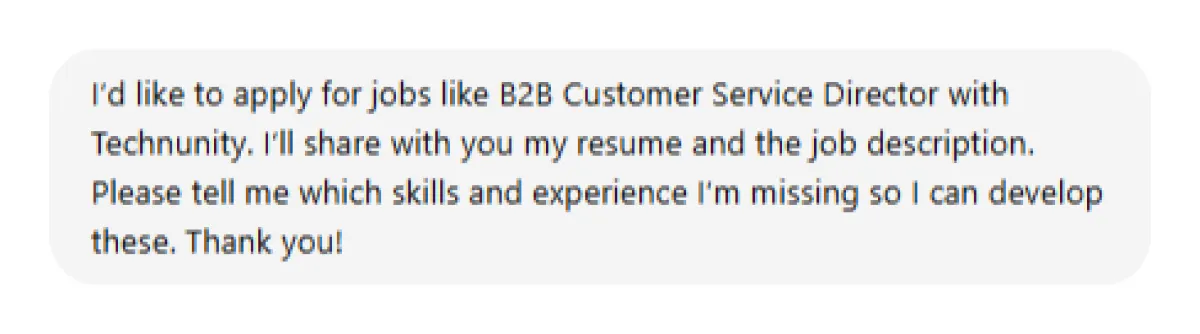
Here’s where ChatGPT truly comes into play. What you’ll do now is enter a specific prompt into ChatGPT, so it knows what you want it to do. For example, you could say:
"I’d like to apply for jobs like B2B Customer Service Director with Techunity. I’ll share with you my resume and the job description. Please tell me which skills and experience I’m missing so I can develop these. Thank you!"
This prompt provides ChatGPT with the context it needs to compare your resume against the job requirements. It will then ask you to go ahead and share your resume and the job description.
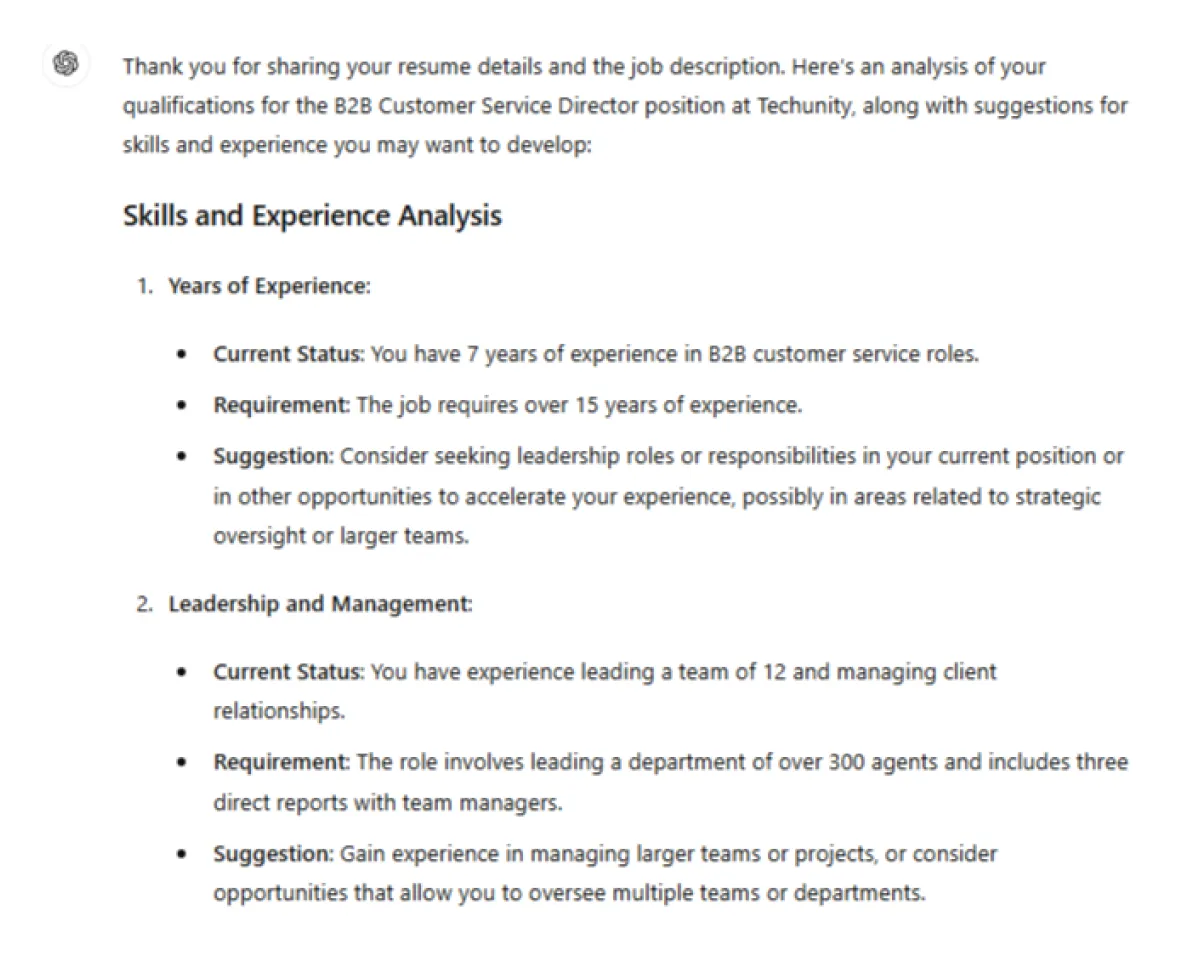
Once you’ve entered the prompt and shared your resume and the job posting, ChatGPT will generate a detailed analysis .
First of all, it will highlight areas where your resume falls short in terms of specific skills, qualifications, and experience. This personalized feedback is fantastic for understanding how to bridge the gap between your current qualifications and your dream job.
For instance, ChatGPT might point out that you’re missing certain AI literacy skills, or that you need more experience in a particular area.
As an added bonus, it will also suggest ways to gain these skills and experience, such as taking online courses, attending workshops, or seeking out certain projects in your current job.
Armed with this information, it’s time to take action to fill those gaps!
If you already have the skills and experience identified by ChatGPT, now’s the time to update your resume to reflect these. Make sure to highlight them clearly so that recruiters can easily see your qualifications.
If you don’t yet have the necessary skills, start looking for opportunities to acquire them. For example, consider enrolling in online courses, attending workshops, or participating in training programs. Many resources are available online, often for free or at a low cost. Organizations rely on employee training software to deliver structured learning paths that make it easier to track progress and close skills gaps systematically.
We recommend platforms such as Coursera, edX, OpenLearn, Udacity, LinkedIn Learning, Pluralsight, and FutureLearn. Don’t forget to also check out local universities, colleges, and professional institutes for learning opportunities.
Additionally, seek out tasks in your current job that will help you develop the expertise you need. For example, if you’d like to gain project management experience, find out if there is a project you can get involved in at a lower level, so you can gain the foundational skills. If not, perhaps you could suggest a project that you could lead yourself? Keep your mind open to possibilities.
To further accelerate your career growth, take advantage of expert career resources. Shameless plug: career enhancement platforms like JobLeads offer a wealth of on‑demand video courses, career performance guides, resume writing services, webinars, and career coaching resources to help get you where you’d like to be, faster. For those exploring formal education paths, check out UND Academic Programs as a way to expand your credentials and open new career doors.
Hop on over to JobLeads.com and register now to tap into additional support and guidance as you work towards your career goals.
As obvious as it sounds, identifying and addressing your skills and expertise gaps is a crucial step to progressing in your career.
By using tools like ChatGPT, you can quickly and easily gain valuable insights into what’s missing from your resume, and take concrete steps to acquire the necessary skills and experience.
Taking a proactive approach will bring you closer to landing your dream job, sooner than you can imagine.
Remember, with the right tools and a bit of effort, that amazing job opportunity is within reach.
- This article provides a step-by-step guide to identifying and addressing job skills gaps before applying for a new job, to enhance your chances of landing your dream role.
- Ensure your resume is current, and accurately reflects your skills, experience, and accomplishments relevant to your dream job. If the info isn’t there, how will the recruiter know?
- Use ChatGPT to compare your resume against the job description of your ideal job. It will help you identify missing skills and experience Tip: Use the prompt provided to set the context.
- Don’t just review – act! Analyze ChatGPT's feedback to understand the gaps in your resume and take concrete steps to fill these.
- If you lack necessary skills, seek out online courses, workshops, and training programs to acquire them. The skills won’t come to you on a platter – you must be proactive about gaining these yourself.
- Take advantage of career enhancement platforms like JobLeads for additional support, resources, and guidance as you work towards your next career move.
- By identifying and addressing skills gaps early, you can avoid wasting time and get closer to landing your dream job faster.
For more insights, tips and strategies related to this topic, be sure to read our other articles: What's an elevator pitch - and how will it land me great jobs? & How to Write Resume Accomplishments Using ChatGPT - Quick Guide & How to Use ChatGPT to Write The Perfect Cover Letter & How to Prepare for Job Interviews with AI - Questions & Prompts


 Job Search