
 Job Interviews
June 25, 2024
Money Talks - Master the 3 Stages of Any Salary Negotiation to Win
Easily master the 3 stages of salary negotiation. Learn to strategically research, benchmark, and ace discussions. Plus, bonus tips!


You finally get the offer. You like the role and the people you'd work with. Then comes the catch–the salary is lower than you hoped, and the recruiter says it's final.
If you're tempted to just say yes, you're not alone. In a JobLeads poll, nearly 45% of professionals said they'd taken an offer below their worth because they couldn't afford to keep searching.
But a fixed salary doesn't mean a fixed offer. Non-salary negotiable items like remote days, a sign-on bonus or extra vacation are often still on the table.
So what can you ask for, and how do you ask without putting the offer at risk? Here are 10 non-salary benefits to negotiate and what each one is worth.
Non-salary negotiable items are the parts of a job offer other than base pay that you can ask to change. They include flexibility, time off, perks like bonuses or equity and growth options like a professional development budget. Together with your salary, they make up your total compensation package.
Most of them fall into four groups:
| Group | What it covers |
|---|---|
| Flexibility | Remote work, home office setup |
| Money that isn't salary | Sign-on bonus, 401(k) match, relocation, rewards programs, equity |
| Time | Vacation days |
| Growth and connection | Training budget, travel and team events |
Not every benefit is up for discussion. Some, like your health insurance plan, are usually fixed company-wide. But the non-salary benefits to negotiate in this list tend to have room to move. Many come out of a separate budget or cost the employer little up front.
Did you know that…
About 55% of professionals accepted their initial offer without negotiating at all (Resume Genius). That's a lot of perks left on the table.
Wondering what to negotiate in a job offer besides salary? Here are the 10 with the most room to move, plus what to say when you ask.
Remote work flexibility can mean a fully remote role, a set number of hybrid days, a flexible schedule or a few "work from anywhere" weeks a year. If the company hesitates, negotiate in steps–for example, two remote days now with a review after six months.
The data backs you up. In a trial published in Nature, Stanford economist Nicholas Bloom and colleagues gave employees two work-from-home days a week. Quit rates dropped by about a third, with no difference in performance reviews or promotions.
Interestingly, flexibility has the clearest price tag for job seekers. When JobLeads asked how important remote work is, about 16% called it non-negotiable. Another 45% or so said it was very important.
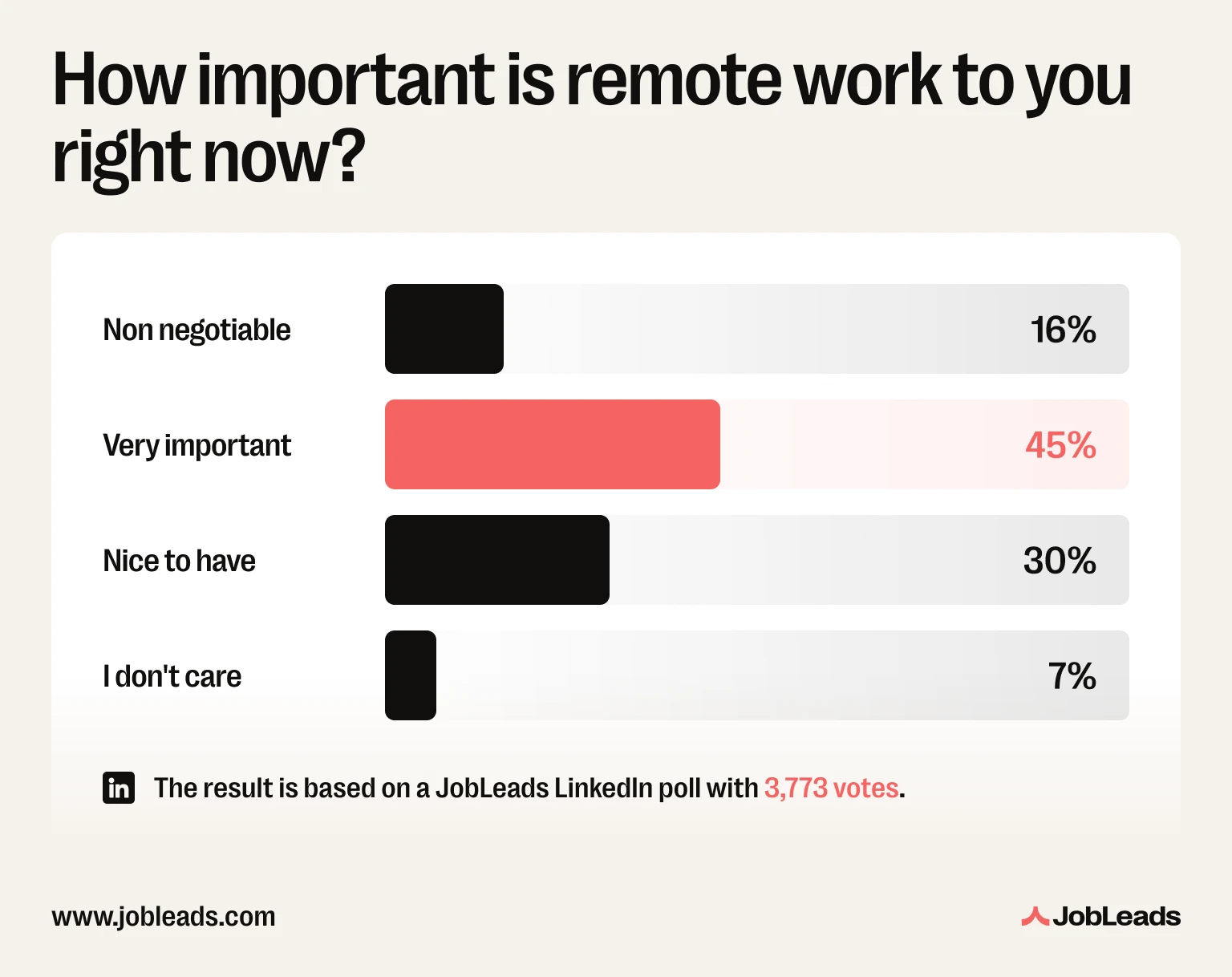
In another poll, nearly 47% said they'd want 20% more pay to return to the office full-time. About 23% said they'd refuse at any price.
Read more: Not sure which setup suits you best? Check out this guide to remote work pros and cons and the full list of remote work benefits can help you decide what to ask for.
If you'll work from home even part of the week, your setup matters. You can ask for a laptop and monitor, an ergonomic chair, a one-off setup stipend or a monthly internet or co-working allowance.
This ask pairs naturally with remote flexibility. Once remote days are agreed, the equipment ask is a small next step.
Asking for a proper setup doesn't make you look demanding. It shows you're planning to do the job well. A second monitor or a decent chair is a small cost next to a hire who's comfortable and productive from week one.
Nathan Putsey – Talent Acquisition Manager at JobLeads
Pro-tip
Ask for the allowance as a fixed amount, not "reasonable expenses." A specific number is easier for a manager to approve.
Read more: Once your desk is sorted, see the best remote work tools to round out your setup.
A sign-on bonus is a one-time cash payment for joining, and one of the most valuable non-salary benefits to negotiate. It's the classic fix when the salary band is maxed out. This way the company can pay you more without changing its pay structure. It's also the cleanest way to cover a bonus you'd give up by leaving your current job early.
Just read the terms. Many sign-on bonuses come with a clawback clause. If you leave within a set time, often 12 months, you pay some or all of it back.
For example, Maria is leaving her marketing job two months before her annual bonus of $6,000 pays out. Instead of pushing for a higher base salary, she asks the new employer to match that bonus as a one-off sign-on payment. They agree, with a 12-month clawback.
How to ask: "I'd be giving up a $X bonus by leaving before year-end. Would you consider a sign-on bonus to bridge that?"
You can ask for extra PTO days or the right to carry over unused days. You can also ask the new employer to honor a pre-booked holiday or offer unpaid leave. It's also one of the easiest asks to win because it costs the employer little up front.
It also matters most if you're mid-career. The US Bureau of Labor Statistics shows that workers at small private firms get an average of 10 paid vacation days after one year. After five years, they get about 14. At large employers, that rises from about 14 days to 18. Switching jobs often resets you to the bottom of that ladder.
While perks like unlimited PTO sound exciting, it's just as important to make sure the fundamentals are part of your package. Statutory sick pay, which is a legal entitlement ensuring employees are paid when illness prevents them from working, offers a layer of protection that complements more flexible leave options.
Pro-tip
If you already have a trip booked, mention it at the offer stage, not in your second week. It's an easy yes before you sign and an awkward conversation after.
How to ask: "In my current role I have 20 days after five years. Could we match that so I'm not starting over at the entry-level allowance?"
Your 401(k) match is the share of your pay that your employer adds to your retirement account when you contribute. Vanguard's report puts the average promised employer match at about 4.6% of pay. The most common formula is 50% on the first 6% you contribute.
The match itself is usually set plan-wide. That makes it one of the harder non-salary negotiable items to move. The vesting schedule is where you have more room. Vesting decides when the employer's money is actually yours. Vanguard found that only about half of plans vest the match immediately–the rest make you wait, sometimes up to six years.
Small differences add up fast. On a $70K salary, an extra 2% match is $1,400 a year. Over 10 years, at an assumed 7% average annual return, that's roughly $19,300 in extra savings.
Note
401(k) plans are US-specific. If you're outside the US, ask about the employer's pension contribution instead.
A training budget can cover an annual learning allowance, certifications, conference tickets, tuition reimbursement or protected study time during work hours. It usually comes from a separate learning budget. That makes it easier to approve than a raise.
It also works in the employer's favor. In a LinkedIn report, nearly 88% of organizations said they're worried about keeping employees. Their No. 1 fix is offering learning opportunities. That's a strong argument to bring into the room.
At smaller or early-stage companies, perks like this often depend on the employer's scale. Many small businesses use a PEO for startups to access the kind of enterprise-grade benefits packages, including learning stipends, that they couldn't negotiate or administer alone.
Pro-tip
Tie your ask to a skill the role actually needs. That turns it from a perk into a business case.
How to ask: "I'd love to get [certification] in my first year–it maps directly to [responsibility]. Is there a training budget that could cover it?"
Team travel is one of the job benefits to ask for that people often forget. It covers company offsites, team trips, travel perks and budget for in-person meetups if your team is spread out. It's especially valuable for remote hires, who can go months without seeing a colleague face to face.
And plenty of people feel that gap. JobLeads asked if remote work had made it harder to bond with colleagues. Nearly 37% said yes–online isn't the same.
In-person time makes a measurable difference. Atlassian tracked its own team gatherings and found they boosted team connection by about 27% on average. New hires and recent graduates saw the biggest gains.
If the job means moving cities, ask about a relocation package. It can cover movers, temporary housing, house-hunting trips or a single lump sum. Check how it's paid–a lump sum and expense reimbursement can be taxed differently, so ask HR or a tax advisor before you choose.
Relocation also tends to have more room to move than people assume. An Atlas Van Lines survey found that nearly 64% of companies had an employee turn down a move. The top reasons were safety concerns, family ties and a lack of support for a spouse or partner. That gives you leverage–if a partner is moving with you, ask for job-search support or an extra house-hunting trip.
Right
Wrong
Rewards programs include performance bonuses, commission plans for sales roles, recognition programs, wellness stipends, commuter benefits and employee discounts. You can't always change the program itself. But you can often negotiate your eligibility, like joining this year's bonus cycle even if you start mid-year.
Wellness is a good angle too. When JobLeads asked whether employers offer any formal mental health or mindfulness support, about 65% said they had nothing. If that's your situation, a wellness allowance is a fair non-salary benefit to ask for.
Equity gives you a share in the company. It usually comes in one of three forms:
The vesting schedule matters as much as the number of shares. The startup standard is four years with a one-year cliff. You get nothing if you leave before your first anniversary. After that, the rest vests monthly or quarterly. According to Carta, fewer than 10% of startup employees actually stay long enough to fully vest.
Pro-tip
At startups, equity is often the most flexible of all non-salary negotiable items. But ask what percentage of the company your grant represents, not just the share count–10,000 shares can mean very different things.
These 10 aren't the only job benefits to ask for. Depending on the role, you can also negotiate your:
A better job title costs the company nothing and can shape your next salary. An earlier performance review gives you a faster route to a raise.
Here's a quick summary of what each non-salary negotiable item is worth, based on the data above:
| Benefit | What the data shows |
|---|---|
| Remote work | Hybrid work cut quit rates by about a third |
| Sign-on bonus | Only about 3% of US job ads mention one |
| Vacation days | About 10 days after 1 year at small firms vs. about 18 after 5 years at large ones |
| 401(k) match | Average promised match of about 4.6% of pay |
| Training budget | Nearly 88% of employers worry about retention and use learning as fix No. 1 |
| Team events | In-person gatherings lift team connection by about 27% |
| Relocation | Nearly 64% of companies had relocation offers turned down |
| Rewards | Well-recognized staff are about 45% less likely to quit |
| Equity | Fewer than 10% of startup employees fully vest |
Salary is just one number in a much bigger package.
When the base pay won't move, non-salary benefits like flexibility, time off and growth perks are often easier to win than a raise. They come from different budgets, they cost the employer less up front and many of them pay off for years.
So before your next offer call, write down your top three non-salary negotiable items and put a number on each one. Then ask for all of them in the same conversation.

Content & Insight Writer
Beata creates content that puts job seekers first. From practical blog advice to first-hand research studies, her writing is designed to give people the clarity and confidence to find the role they deserve.
Job InterviewsEasily master the 3 stages of salary negotiation. Learn to strategically research, benchmark, and ace discussions. Plus, bonus tips!
 Job Market Trends
JobLeads study on 811K job postings and 245K professionals reveals the differences in workers' salary expectations and wages offered by employers.
 Career Development
Discover the pros and cons of working from home. Learn how employees and employers benefit from remote work and the challenges they encounter.