
 Resume
June 18, 2026
15 Best Resume Builders in 2026 [Review of Free & Paid Tools]
JobLeads tested paid and free tools to pick the best resume builders available on the market. Here are the top resume generators for your job search and career level.


Someone told you to "add numbers" to your resume. So you searched "how to quantify a resume," opened your own, stared at your bullet points.
And froze.
That's normal. You know it matters, but you don't know where the numbers are supposed to come from, or how to phrase them once you find one.
This guide gives you both. You'll get a framework for locating numbers you already have access to and a way to quantify your resume even when you genuinely don't have exact figures.
Starting from the basics–
Quantifying your resume means replacing a vague duty statement with a specific, measurable result. It's the difference between describing what your job was and proving what you did with it.
❌ Wrong: "Responsible for managing customer accounts and improving satisfaction."
✅ Right: "Managed 45 customer accounts and raised satisfaction scores by 18% in six months."
Both bullets describe the same job. But only one of them tells a hiring manager something they can actually evaluate. Adding measurable results to a resume–a dollar figure, a percentage, a headcount–is what turns a duty statement into an accomplishment.
That's why quantifying is the cherry on top of a well-written resume. It's what makes a resume readable in the few seconds a person or an ATS actually gives it.
Info
About 47% of hiring professionals spend just 30 seconds to a minute reviewing a resume, according to a ResumeGo survey. In that window, a number does more work than a sentence.
Every job, including yours, produces data in four areas. You just haven't been looking at your work through this lens yet. Whether you're wondering how to include metrics in your resume for the first time or just refreshing an old one, the same four categories apply.
| Category | Look for | Example bullet |
|---|---|---|
| Money | Budgets managed, revenue generated, costs saved, sales handled | "Managed a $120,000 marketing budget across four campaigns" |
| Time | Hours or days saved, early delivery, faster turnaround | "Cut client onboarding time from 10 days to 4" |
| People & scale | Team size, people trained, customers served, users reached | "Trained 12 new hires across two office locations" |
| Rate & change | Percentage growth, before-and-after shifts, superlatives | "Grew repeat customer rate by 27% year-over-year" |
Together, these four categories cover almost every metric on a resume. You just have to know which drawer to open.
Think about anything with a dollar sign attached to it, even if you never touched the money directly. Did you manage a budget, generate revenue, cut costs, or process a sales volume? "Oversaw $80,000 in annual vendor contracts" is a money metric, and you don't need to have been the one signing the checks to claim it.
Time metrics are about speed and efficiency: hours or days saved, deadlines beaten, turnaround times reduced. If you ever made a process faster than it used to be, that's a bullet. For example, "reduced invoice processing time from 5 days to 2" works great. This is often the easiest way to add metrics to a resume when you don't have sales or budget numbers to point to.
This category covers anyone your work touched, including a team you managed, people you trained or mentored, customers you served, or users you reached. "Mentored 6 junior analysts" or "Supported a customer base of 3,000+ users" both work here, whether or not you had formal management authority.
This is the category for movement: percentage growth, before-and-after comparisons, and superlatives like "first," "fastest," or "highest." If something got measurably better after you got involved, like a conversion rate, an error rate, a ranking, that's a rate-and-change metric.
Read more: Learn how to optimize your resume for ATS to ensure your application gets in front of the human.
Once you've found a number, you still need to turn it into a bullet that a recruiter will actually read as an accomplishment. This is crucial–Jobscan found that measurable achievements are what 58% of recruiters say makes a resume stand out most. That's what this formula is for:
Action Verb + Project + Result = Accomplishment
For example: "Launched the publication's first mobile app, growing monthly readership by 22% in the first quarter."
✅ Right: "Negotiated vendor contracts, cutting supply costs by 14% across the fiscal year."
❌ Wrong: "Handled vendor negotiations."
Now try it with one of your own duties. Take a task you'd normally write as "Responsible for X" and run it through the same three slots:
Tip
If you've tried an AI resume generator and gotten generic, copy-paste output, this formula does the same job manually with far more control over accuracy.
If you're still staring at a bullet with no obvious number in sight or searching how to quantify achievements on a resume when your role genuinely doesn't feel metric-driven, run it through this self-audit.
Answer these role by role, not just once for your whole resume:
Most people answer at least one of these with a real number they haven't thought to put on their resume.
Tip
Do this exercise for every job on your resume, not just your current one–old roles often have metrics you forgot you had access to.
Another part is how to quantify a resume without numbers. Maybe the data was confidential, maybe you never tracked it, maybe you left the company two years ago and no longer have access to the dashboard.
You're not alone in this gap, either. An analysis of more than 125,000 resumes found that 36% of job seekers included zero measurable metrics, and only 26% had five or more (Cultivated Culture). So even an approximate number already puts you ahead of most applicants.
The answer isn't to leave the bullet unquantified. It's to add measurable results to your resume using a defensible approximation instead of an exact figure.
✅ Right: "Supported a customer base of approximately 2,000 accounts across three regions."
❌ Wrong: Leaving the bullet as "Supported customer accounts" because you don't have the exact count.
Tip
If a hiring manager asks how you arrived at a number in an interview, "I estimated based on X" is a completely acceptable answer as long as your estimate is genuinely defensible, not invented.
Seeing the formula applied across different roles makes it easier to apply it to your own job. Use these as resume metrics examples to model your own bullets on, not templates to copy word-for-word.
Keep in mind that small rewrites like this compound: a field experiment on nearly 500,000 job seekers found that better-written, more specific resumes increased their odds of getting hired by 8% (Van Inwegen, Munyikwa & Horton).
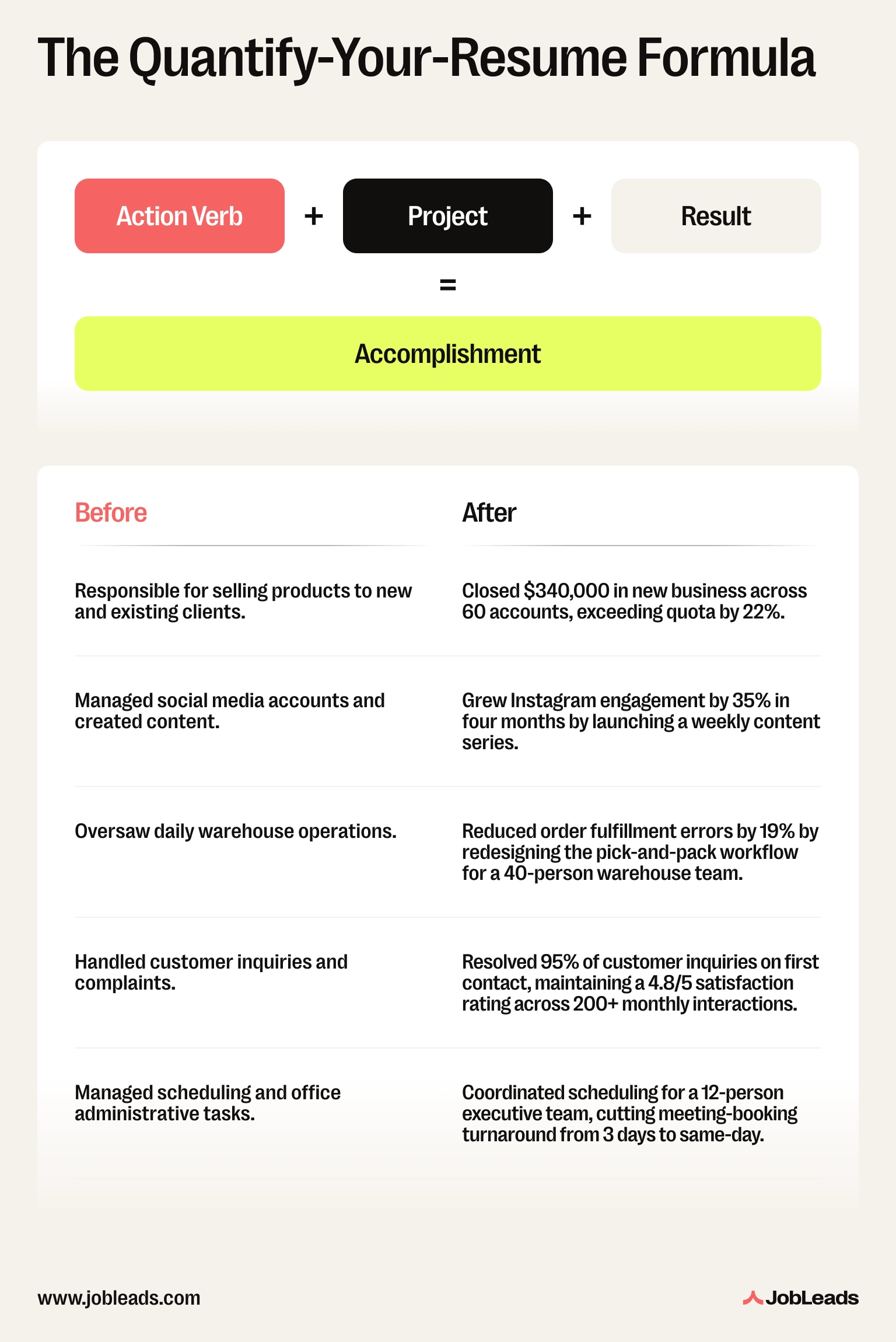
Sales is the easiest role to quantify because the numbers already exist–they're sitting in your CRM the moment you close a deal. Revenue closed, quota attainment, deal size, and account count are tracked automatically by your company. The only work left is pulling them out of the dashboard and onto the page.
❌ Before: "Responsible for selling products to new and existing clients."
✅ After: "Closed $340,000 in new business across 60 accounts, exceeding quota by 22%."
Marketing generates numbers constantly: engagement rate, click-through rate, campaign lift, follower growth. But they usually live in a monthly report, not a resume. Go back to whatever you already report on weekly or monthly (Google Analytics or the platform's native insights) and pull the specific percentage change tied to something you personally launched or changed. A number with a timeframe attached is more credible than a number alone, because it shows the result was driven by an action, not a trend.
❌ Before: "Managed social media accounts and created content."
✅ After: "Grew Instagram engagement by 35% in four months by launching a weekly content series."
Operations is where people insist their job "isn't a numbers job," because the work is invisible when it's done well. When nothing breaks, nothing gets noticed. But invisible doesn't mean unmeasurable. Error rates, cycle time, cost per shipment, and team size are all sitting in the systems you already touch every day.
❌ Before: "Oversaw daily warehouse operations."
✅ After: "Reduced order fulfillment errors by 19% by redesigning the pick-and-pack workflow for a 40-person warehouse team."
Note
Example: Take Priya, an operations coordinator at a 40-person logistics company. She'd always written her resume duty by duty: "oversaw shipping schedules," "coordinated with vendors", because nothing in her role felt like a "number job." When she ran her role through the four categories, she found her time metric: the workflow change she'd pushed through actually cut fulfillment errors by nearly a fifth. That's the bullet above.
Even roles built around soft skills, like customer service or admin, produce hard, quantifiable numbers once you know where to look. First-contact resolution rate, CSAT or NPS score, average response time, ticket volume–most support teams are measured against them internally. The resume rarely reflects that. Pull the number from whatever dashboard your team lead already reviews, and pair it with volume so the achievement reads as consistent, not a one-off.
❌ Before: "Handled customer inquiries and complaints."
✅ After: "Resolved 95% of customer inquiries on first contact, maintaining a 4.8/5 satisfaction rating across 200+ monthly interactions."
Admin roles get written as a list of tasks because the work is process, not output. But process has a "before" and "after" that can be measured. How many people did you support? How long did a task take before you changed it, and how long after? A turnaround-time number quantifies exactly the kind of role that usually gets reduced to "managed scheduling."
❌ Before: "Managed scheduling and office administrative tasks."
✅ After: "Coordinated scheduling for a 12-person executive team, cutting meeting-booking turnaround from 3 days to same-day."
Quantifying your resume isn't about inflating what you did. Instead, it's about giving a recruiter, or an ATS, a faster way to register your impact.
In a hiring process where resumes are read in seconds, specificity is a competitive advantage worth building into your broader job search strategy.
And remember: you don't need perfect numbers. You need defensible, specific ones and now you have a formula and a framework to find them.

Content & Insight Writer
Beata creates content that puts job seekers first. From practical blog advice to first-hand research studies, her writing is designed to give people the clarity and confidence to find the role they deserve.
ResumeJobLeads tested paid and free tools to pick the best resume builders available on the market. Here are the top resume generators for your job search and career level.
 Resume
Applicant Tracking Systems (ATS) - your job-hunting BFF! We rip apart the myths, show you how to optimize your resume, and boost your chances with smart tips.
 Resume
How long should a resume be? Learn how many pages a resume should be for an entry-level position vs for someone with over 10 years of experience.