A common narrative nowadays is that job hopping pays more than staying with the same employer and moving up internally.
Is this really the case, though?
JobLeads surveyed 600 US workers and analyzed 46.2 million active US job postings from Q1 2026 to answer that question.
The results show that there's not much difference in the gains. Just 31% of workers say an internal promotion delivered their single biggest pay jump, against 27% who say an external switch did. This is close to a coin flip once "about the same" (25%) is counted too.
Key takeaways
- About 61% of US workers say changing jobs often is just how careers work now, versus 39% who see it as a fading trend
- Only 9% switched employers three or more times in the past five years
- About 31% of workers say an internal promotion delivered their single biggest career pay jump, compared with 27% who say an external switch did
- Pay raises of 30%+ are nearly twice as common among people who'd switched more than 3 times in five years as among those who hadn't switched at all
- Ironically, those who stayed put to dodge the "job hopper" label regret it the most, at least 90% of them do
- The market pays disproportionately more for the second tier jump: 51% average salary increase for a Mid to Senior move, versus 14% for Entry to Mid
Job hopping means switching employers often and repeatedly, not moving up a level once in a decade. That distinction matters, because the two sometimes get run together, but they can be different stories–especially when it comes to finance.
JobLeads study found that 52% of US workers changed employers at least once in the past five years. Another quarter did it twice and just 9% did it three or more times–the group closest to what "job hopper" actually means.
The average person in that 9% is also noticeably younger (average age 39) than someone who hasn't switched at all in five years (average age 49). Millennials and Gen Z respondents were up to 13 times more likely to have switched three-plus times than Gen X or Boomer respondents.
| Generation | 0 switches | 1 switch | 2 switches | 3+ switches |
|---|
| Gen Z (18–29) | 31% | 14% | 29% | 26% |
| Millennial (30–45) | 38% | 32% | 20% | 11% |
| Gen X (46–61) | 61% | 27% | 9% | 2% |
| Boomer (62+) | 64% | 33% | 0% | 3% |
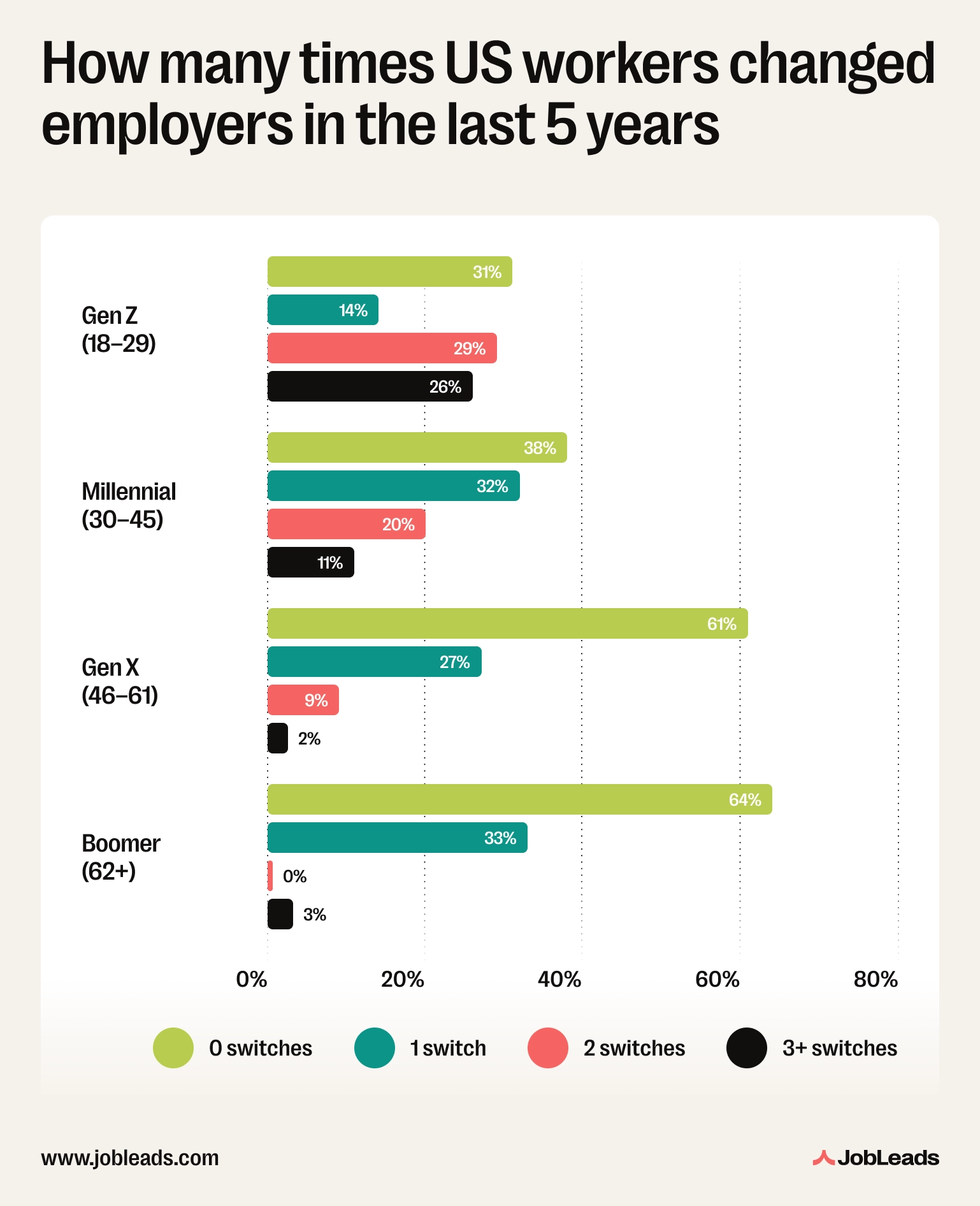
That 9% is a much smaller group than the conversation around job hopping implies. Around 61% of people say frequent job changes are just how careers work now, versus 39% who call it a passing trend. The stigma has faded faster than the behavior has caught up to it.
Ask workers directly what delivered their biggest career pay jump–an internal promotion or switching employers–and the answer is close to a coin flip. Roughly 31% point to an internal promotion, 27% to an external switch, and another 25% say the two were about the same. Only 16% have never been promoted internally and can't compare.
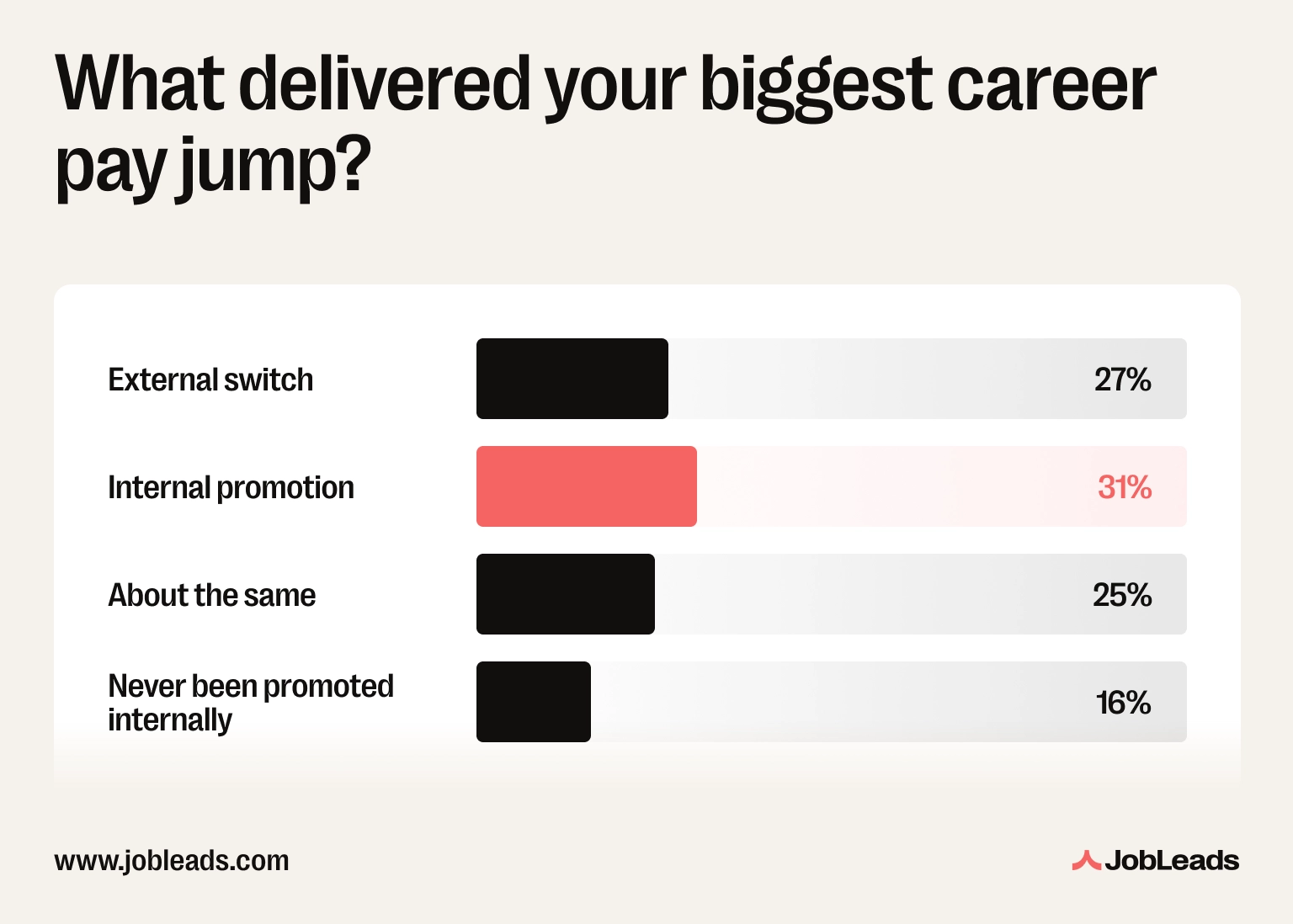
That undercuts the assumption that leaving is always the higher-paying move. Getting promoted delivered a bigger raise for slightly more people than switching employers did.
The raises themselves were also more modest than the "job hopping pays huge premiums" narrative suggests. As many as 69% of workers who changed employers got a raise of 15% or less the last time they switched, and a jump of 30% or more happened for only 10% of switchers overall.
Switching isn't a shortcut. In the numbers, it's roughly an even bet against staying and getting promoted.
That toss-up shows up outside our own data too.
A 2026 study by University of Chicago Booth and NBER economists found that 34% of people who switch jobs take a pay cut. Even though only 12% describe the move as a downgrade in overall job quality once non-wage factors like flexibility and perks are counted. The same study found that pay changes alone overstate the real change in job value by roughly a factor of two.
Salary is the number job seekers can see before they apply but it's only one factor of whether a hop is a step up, not the whole answer.
The picture changes with frequency. Large raises cluster around people who switch often: a 30%+ salary jump on the last switch was nearly twice as common among workers who'd changed employers three-plus times in five years as among those who hadn't switched at all (12% vs. 7%).
Frequent switchers also negotiate harder without leaving. Workers who'd switched twice in five years were the most likely of any group to have used a competing offer or market-rate research to renegotiate their current pay in place–49%, versus 20% of those who hadn't switched at all. Across the whole sample, 26% have tried this tactic, and it worked for 81% of the people who did.
Repeated switching, in other words, doesn't just move people between employers. It also changes how much leverage they bring to the employer they're already with.
The JobLeads posting data shows a separate pattern. Whether an external hire or an internal promotion takes the job, it's about what employers advertise to pay for the tier itself. Ranked by total salary climb from Entry to Senior, here's a table with the increase of pay when jumping the levels:
| Industry | Entry→Mid | Mid→Senior | Total Entry→Senior |
|---|
| Bio & Pharmacology & Health | +$8,000 (11%) | +$68,670 (86%) | +$76,670 |
| Finance | +$16,120 (21%) | +$42,990 (47%) | +$59,110 |
| Management & Operations | +$9,063 (15%) | +$47,974 (68%) | +$57,037 |
| Sales | +$5,380 (8%) | +$48,272 (67%) | +$53,652 |
| Human Resources | +$14,506 (23%) | +$33,817 (44%) | +$48,323 |
| IT & Technology | +$3,580 (4%) | +$42,990 (46%) | +$46,570 |
| Marketing & Media | +$3,580 (5%) | +$41,200 (56%) | +$44,780 |
| Engineering | +$14,330 (19%) | +$28,660 (32%) | +$42,990 |
| Legal | +$13,678 (20%) | +$27,512 (33%) | +$41,190 |
| Consulting | -$2,667 (-3%) | +$33,371 (36%) | +$30,704 |
Consulting is the outlier worth pausing on. It has the highest Entry floor of any industry ($94,930) and the lowest total career gain ($30,704). Moreover, the move from Entry to Mid is actually a pay cut, and the real financial reward in Consulting is backloaded almost entirely into the Mid→Senior move.
Across the 11 industries analyzed, the average Entry→Mid hop carries a 14% premium, while the average Mid→Senior hop carries a 51% premium–3.7x difference. This pattern holds beyond national averages, too: extending the same comparison to the 20 largest US metro areas. In fact, 94% of the 220 metro-industry pairings (207) follow the same backloaded pattern.
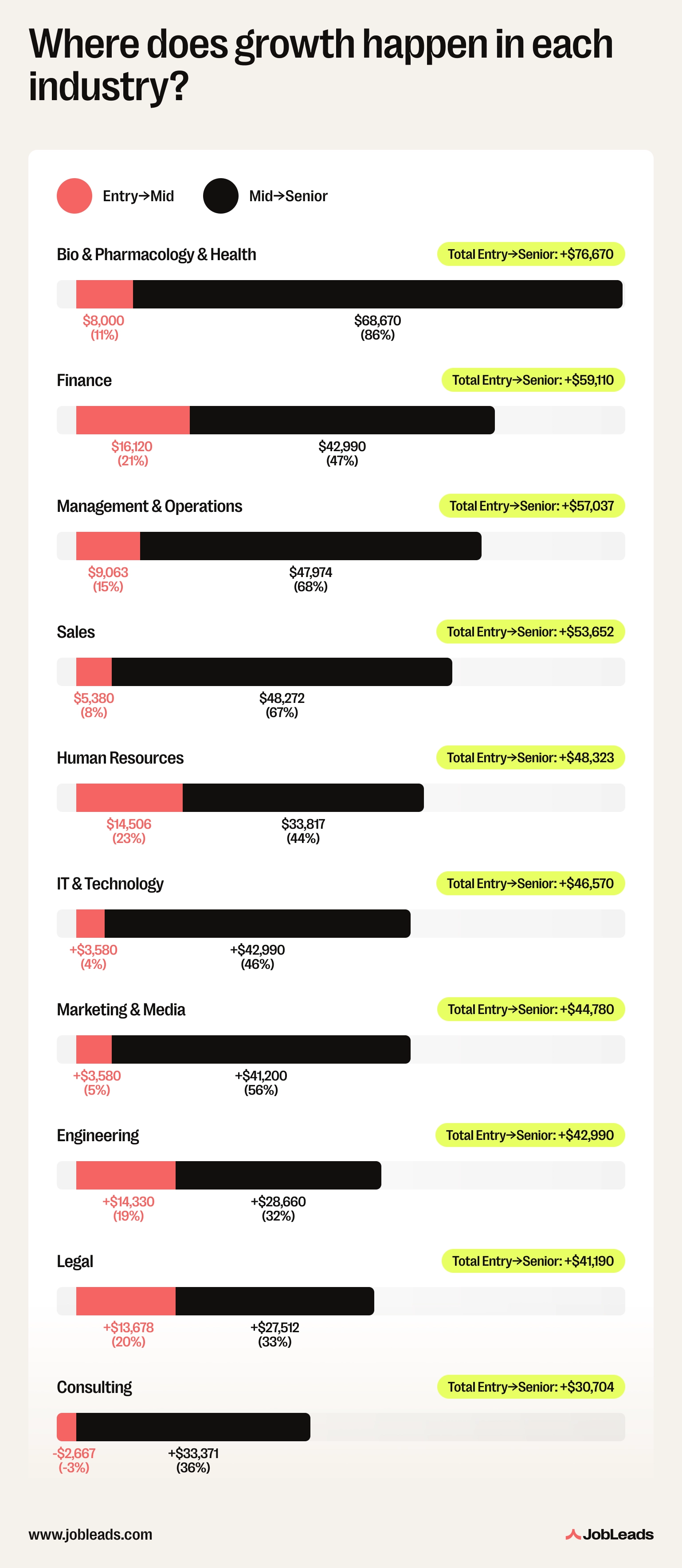
Here's the mismatch: our survey shows people who switch jobs often skew younger and earlier-career, while the biggest tier-based reward in the posting data sits at the later, Mid→Senior transition. The workers switching most often aren't necessarily the ones positioned to capture the largest jump.
Moreover, the Bank of America Institute found that in Q1 2026, Millennials who switched jobs saw earnings grow at nearly twice the rate of Millennials who stayed. And Gen Z switchers saw more than four times the wage growth of Gen Z stayers.
On the other hand, Gen X and Baby Boomer switchers saw flat or declining pay in the same quarter, while their peers who stayed saw steady increases.
Two competition signals move in opposite directions as seniority rises. We define "interaction" here as any click, save, or apply-click on a posting.
Senior listings draw proportionally more of it–over 8% of Senior postings receive any interaction, compared with 3% of Entry postings. But engaged candidates convert far less often at the top: only 43% of people who interact with a Senior listing go on to click apply, down from 57% at Entry.
| Tier | Engagement rate | Apply-click rate |
|---|
| Entry | 3% | 57% |
| Mid | 5% | 49% |
| Senior | 8% | 43% |
Read alongside the pay data, this suggests the biggest tier jump also carries the most hesitation. Part of that is likely the size of the decision–a 51% average pay jump is worth investigating even when someone isn't sure they'll apply.
But it's also simpler than that: Senior roles carry more niche requirements and specific qualifications than Entry roles, so fewer of the people who click through will actually be a fit, whatever the pay would be.
Only 17% of workers have ever turned down a job move because they worried it would look like job hopping to future employers. Among people who've stayed with one employer for three-plus years, just 6% say avoiding the job-hopper label is the main reason. Over 69% cite pay as well as stability, and 23% cite job satisfaction instead.
Staying anyway, specifically to dodge the label, doesn't pay off in how people feel about it later:
| Reason for staying 3+ years | Strong regret about staying too long | Any regret about staying too long |
|---|
| Job-hopper stigma | 65% | 90% |
| Pay & stability | 40% | 66% |
| Role satisfaction | 40% | 60% |
People who stayed mainly out of fear of the label regret it more than any other group, and by a wide margin. The stigma that's supposed to be protecting a resume ends up costing the person who took it most seriously. Sometimes causing the opposite reaction of job hugging.
Job hopping isn't the only way that the market shows up in someone's paycheck. About 26% of workers have used a competing job offer or market-rate research to negotiate a raise with their current employer without actually leaving. Moreover, it worked for 81% of the people who tried. Another 37% have considered using a competing job offer to negotiate their salary but haven't done it yet.
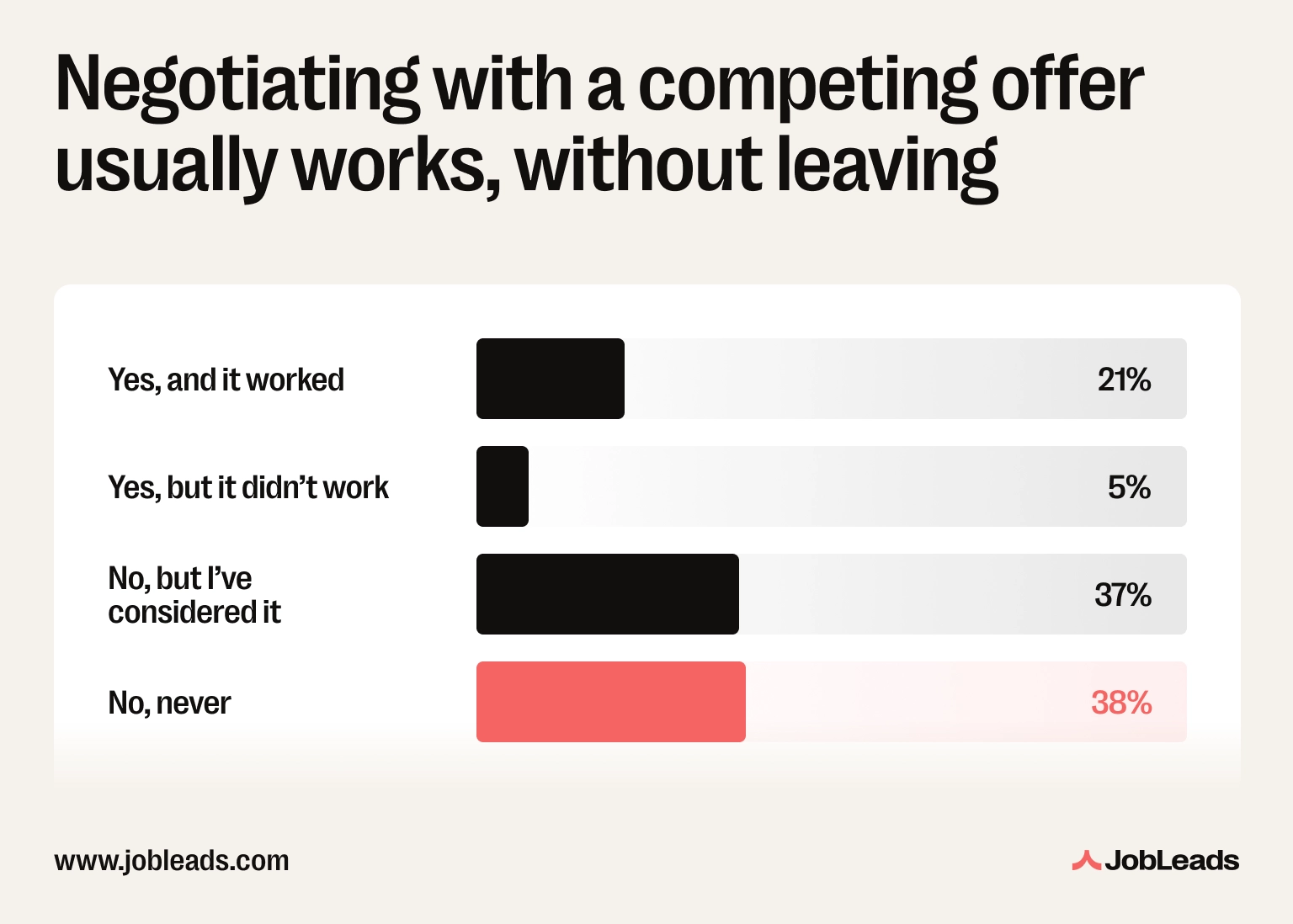
That's a lower-risk version of the same leverage a job hop provides: bringing market-rate evidence to the table, without having to change employers to do it. The downside of this is that you can only play this card once with your employer.
Three things follow directly from this data.
First, don't assume switching employers automatically beats staying and getting promoted. It's close to a toss-up and internal promotion edges it out slightly. The bigger factor is whether a real seniority-tier change happens at all, not whether you had to change jobs or earn a promotion to get there.
Second, if a tier change is on the table, timing changes the math. The market pays roughly 3.7 times more for a Mid→Senior move than an Entry→Mid one. Younger, more frequent switchers should know they're often moving at the smaller end of that gap.
Third, staying to avoid a "job hopper" label that barely exists anymore is the version of this decision most likely to backfire. Use market-rate data either way–to negotiate in place, or to know what a move should actually be worth.
The real question isn't "will switching make me look like a job hopper." It's "what is this role, at this tier, actually worth–and does staying or leaving get me there?"
This analysis draws on two separate datasets.
JobLeads posting data: This covers roughly 46.2 million active, full-time US job postings collected across Q1 2026 (January-March), analyzed by seniority tier (Entry, Mid, Senior) and industry (11 categories, one of which, "Other", was excluded from the ranked industry table).
A parallel metro layer applies the same window to the 20 largest US metro areas by population (US Census 2020), using full Metropolitan Statistical Area definitions rather than principal-city boundaries only.
Filters: full-time contract type only; industry field populated; country = US; posted salary present and greater than zero. Extreme outlier salaries were removed using standard statistical trimming before computing averages used anywhere in this article; medians and percentile ranges elsewhere reflect the untrimmed distribution.
JobLeads survey: A survey of 600 employed and recently employed US adults, fielded via Pollfish on August 11, 2026, and weighted to US demographic benchmarks. Respondents were asked about employer-switching frequency over the last five years, the outcome of their most recent switch, how switching compares to internal promotion, attitudes toward the "job hopper" label, and negotiation behavior.
Limitations: Posting-data salary figures reflect advertised compensation in job ads, not negotiated offers or confirmed hires, and cannot track one individual's real salary before and after a job change. The tier "premium" is inferred by comparing posted salary bands at a point in time, not by following real people through real transitions. Legal's mean and median posted salaries diverge by roughly $13,000, more than any other industry analyzed, suggesting a heavier skew than the rest of the dataset.
Survey answers are self-reported and retrospective, which introduces recall bias, particularly for salary-increase percentages from past job changes. Generational breakdowns in the survey (Gen Z, Boomer) and the "stayed to avoid the job-hopper label" subgroup (n=27) draw on smaller subsamples and should be read as directional rather than precise.
Feel free to share the findings, statistics, and graphics from this study for editorial and non-commercial purposes. All we ask is that you credit JobLeads with a link back to this page, so readers can see the full methodology and context. For questions, additional data, or interview requests, contact press@jobleads.com.



 Job Market Trends