
 Job Interviews
June 25, 2024
Money Talks - Master the 3 Stages of Any Salary Negotiation to Win
Easily master the 3 stages of salary negotiation. Learn to strategically research, benchmark, and ace discussions. Plus, bonus tips!

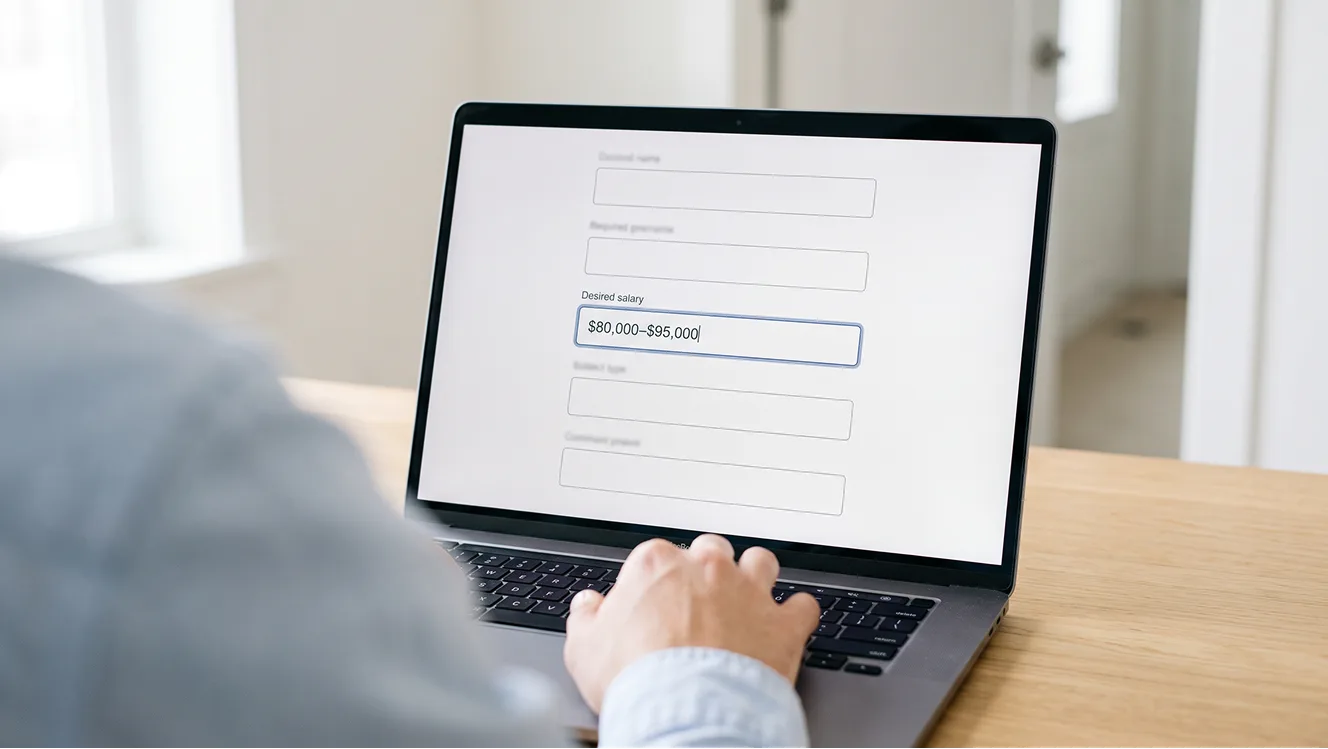
You're ten minutes into an online application when a required field stops you: "Desired salary." Aim too high and you risk getting filtered out. Aim too low and you've just capped your own offer.
Most people lean toward the second mistake. In a JobLeads poll of 2,457 professionals, about 78% said they'd accepted a job offer below their worth–nearly 45% because they simply couldn't afford to keep searching. And JobLeads data on 2.5M job seekers shows the least confident ones aim for roles paying over $13K less. This guide shows you what desired salary means, how to set your number and what to say on forms and in interviews–with good and bad examples.
Desired salary is the pay you'd like to earn in the role you're applying for, usually stated as a yearly figure before tax. It isn't your current salary, and it isn't your dream number. It's a realistic figure for this job, in this location, at your level.
The question can feel like a trap. So why do companies ask for a desired salary so early? Usually for four practical reasons:
Budget fit is a real issue. JobLeads research found that a whopping 99% of applicants expect more than the market offers–so recruiters want to spot a mismatch early. Employers feel that gap too. In a Robert Half survey of more than 2,500 US hiring managers, nearly half (48%) said meeting candidates' salary expectations is one of their biggest hiring challenges.
The good news is that you often get a head start. A growing number of US states, from California and New York to newcomers like Virginia and Maine, now require employers to show a pay range in job postings. Many states and cities also ban questions about your salary history. Asking for your desired salary is still legal everywhere. Just keep in mind that a vague "competitive salary" in a posting doesn't always mean market pay.
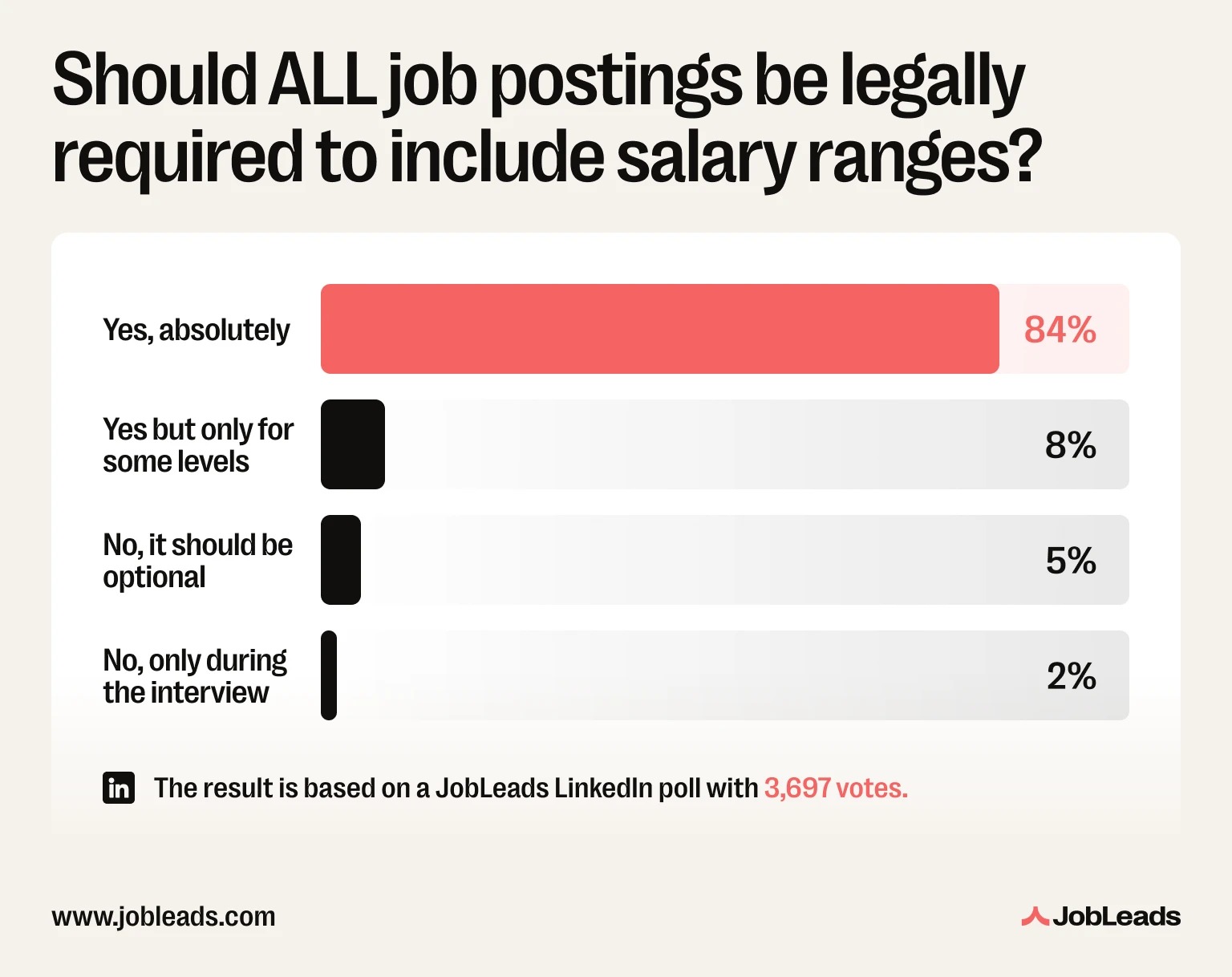
Job seekers want that transparency everywhere. In a JobLeads survey, nearly 84% of professionals said all job postings should be legally required to include salary ranges.
Applications use different labels, and each one asks for a slightly different number. Read the label before you type. Here's a little cheat sheet to the different terms:
| Term | What it means | What to enter |
|---|---|---|
| Desired salary | Yearly pay before tax | Annual figure or range, e.g. $65,000–$72,000 |
| Desired annual salary | Same as above, stated explicitly | Annual figure |
| Desired base salary | Fixed pay only, no bonus or commission | Annual base figure |
| Desired compensation / total compensation | Base pay plus bonus, commission, equity and benefits | Total package value, or base + "open to discussing the full package" |
| Desired hourly rate / rate of pay | Pay per hour before tax | Hourly figure, e.g. $24/hour |
| Desired wages per week | Weekly pay before tax (common in retail, hospitality and shift work) | Hourly rate × expected weekly hours |
Yearly for salaried roles, hourly for hourly roles. If the form doesn't say, match how the job posting lists pay.
Some forms combine both in one field, like "What is your desired salary/hourly rate?" or "What is your desired salary annually or hourly?" Again, use the unit from the job ad. And if the form asks "What is your desired rate of pay?", it wants a figure per hour.
Need to switch between the two? Multiply your hourly rate by 2,080 (40 hours × 52 weeks) for a rough annual figure. So $16 an hour works out to about $33K a year, $20 an hour to about $42K and $25 an hour to about $52K.
This is the amount you want to earn in a typical week, before tax. You'll mostly see it in retail, hospitality and shift work, where pay is quoted by the hour but hours vary. So multiply your hourly rate by the hours you expect to work. At $19 an hour and 32 hours a week, that's $608 a week.
The desired compensation meaning is broader than salary. It's the whole package you want, not just the paycheck. That includes base pay plus bonuses, commission, equity, health insurance, retirement contributions and paid time off.
Those extras add up. According to the US Bureau of Labor Statistics (BLS), benefits make up almost a third (about 32%) of total compensation costs for civilian workers.
So if a recruiter asks "What is your desired compensation?", a good desired compensation answer names your base and leaves the rest open:
Example: "I'm targeting a $70,000 base, and I'm open to discussing the full package."
Read more: See how perks shape job choices in the JobLeads study on total compensation.
Before you answer, you need to find your number. If you're asking yourself "what should my desired salary be?", these six steps show you how to calculate the desired salary for any role and stop guessing.
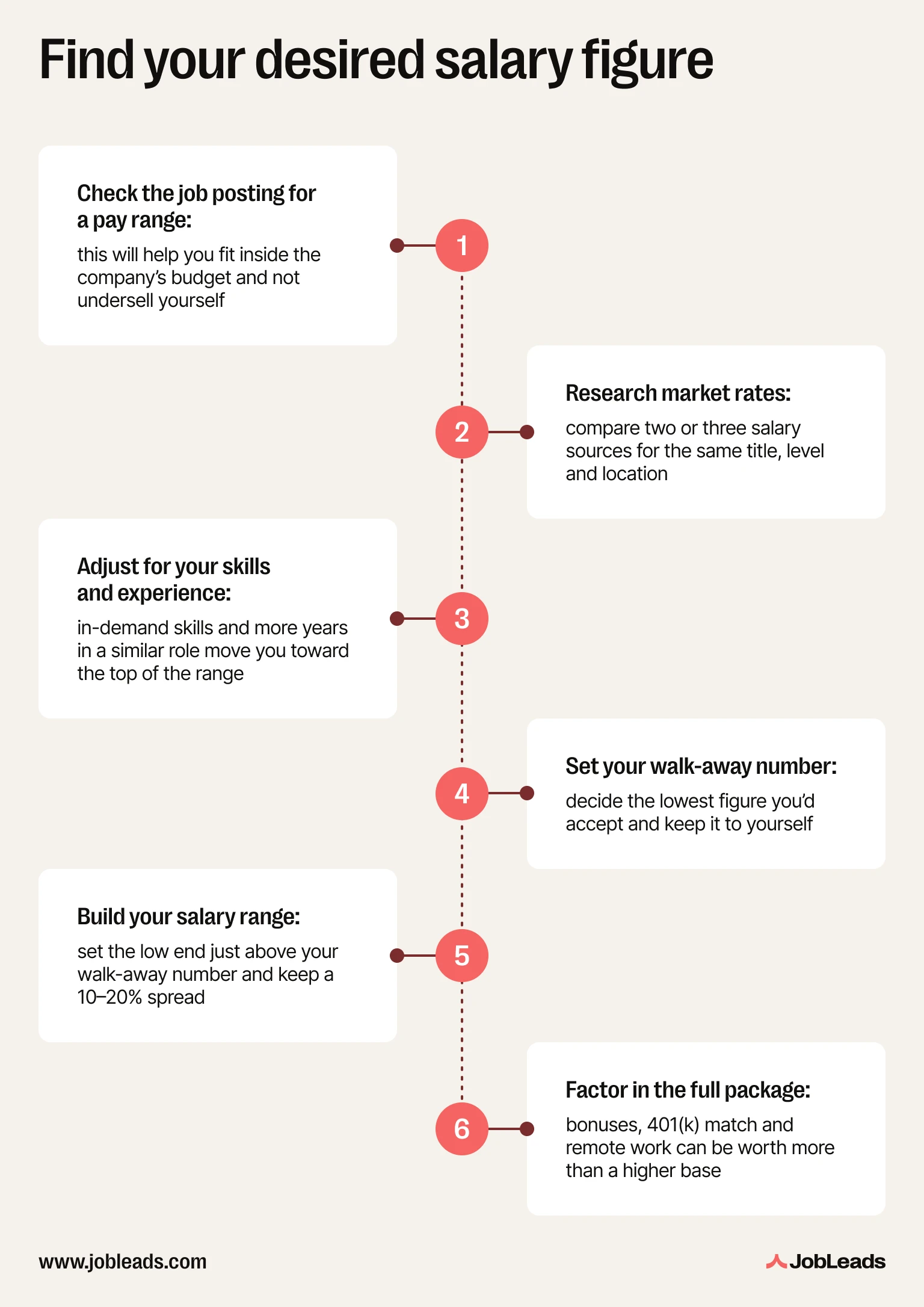
If the posting lists a pay range, that's your best data point for your desired salary. It tells you what the employer has budgeted, so you can place yourself inside it instead of guessing.
No range at all? You're not the only one frustrated. When JobLeads asked which job posting red flag would make people move on immediately, about 41% picked "No salary range". If you still want the role, the next step is your own research.
Compare two or three salary sources for the same job title, level and location. The BLS Occupational Employment and Wage Statistics data is a solid free baseline. Glassdoor and Payscale add company-level detail, and Levels.fyi is useful for tech roles.
Look for a pattern across sources, not one perfect number. That pattern becomes the backbone of your desired salary range.
Don't count on people to fill the gap. In a JobLeads survey, only about 18% of professionals said they openly discuss pay with coworkers at the same level–while nearly 40% don't know what their peers earn but want to. For most people, salary tools and posted ranges are the most reliable data they have.
Read more: Check out the state of the job market in your city with new postings per salary band, seniority, and more.
Market data gives you a band. Where your salary expectations sit in it depends on you. Certifications, in-demand niche skills and more years in a similar role move you toward the top. Being newer to the field or missing a core requirement puts you nearer the middle.
Base this on the work you actually do, not just your job title. In a JobLeads research, nearly 59% of professionals said they do more than their job title implies. If that's you, research the accurate pay for all the responsibilities you've held.
Your minimum desired salary is the lowest figure that makes the move worth it. Keep it to yourself–it's your floor, not your opening offer.
Setting it in advance protects you when money gets tight. When JobLeads asked whether people would accept a role below their level, about 38% answered "Bills don't pay themselves", and another 13% said they already had. A clear walk-away number helps you decide on purpose rather than under pressure.
Set the low end of your desired pay range slightly above your walk-away number. That way, even if the employer lands at the bottom of your range, you still come out ahead.
Then set the high end at the top of the market data for your profile. Keep the spread realistic–about 10-20% between the low and high end is usually enough to leave room for negotiation without looking vague.
For example, Tom is a marketing coordinator in Denver with five years' experience. The posting doesn't list pay. He finds a market range of $55K-$68K, sets his walk-away at $58K and decides on a desired salary range of $62K-$68K. His low end sits safely above his floor, and his high end is still backed by the data.
A lower base with a strong bonus, a generous 401(k) match or a fully remote setup can beat a higher base. Decide which extras matter most to you before the conversation starts.
Why does researching your desired salary matter so much? Because underselling is far more common than overreaching. JobLeads research on job seeker confidence found a gap of over $13K in salary aspiration between the most and least resume-confident job seekers in the US. Less confident people simply aim lower–before an employer has even seen their name.
Did you know that…
A JobLeads survey found that about 45% of professionals say underselling themselves in an interview was the biggest job search mistake that cost them an opportunity.
Here's the thing: some ATS setups rank complete applications higher, so if the posting shows a pay range, entering a figure inside it is low-risk. So, it's best to not leave it blank.
If the field accepts text, write a range like "$62,000-$68,000, depending on the full compensation package"–not "Whatever you think is fair". A range shows you've done your homework. Some forms call this field "salary expectations" instead, but what to put for salary expectations on application forms is exactly the same.
If the field only accepts numbers, put one number–usually the midpoint or upper-middle of your range, or your full range if the form has a minimum and maximum pair. Never type 0, 1 or 999999: ATS filters may read it literally and screen you out, and recruiters see it as dodging the question.
You can also put "negotiable" for desired salary in a text field–especially when the posting has no pay range. But "negotiable" on its own can read as a non-answer, so pair it with a figure: "$65,000, negotiable".
If the posting asks for salary requirements in your cover letter, add one closing sentence with your range. Here's a salary requirements example you can adapt: "Based on my experience and current market rates for this role, my salary requirements are $62,000-$68,000, and I'm open to discussing the full compensation package."
In an interview, you have more room to steer the conversation. Whether the recruiter asks "What is your desired salary?" or "What compensation are you seeking?", here's how to answer without underselling yourself:
Asking for an increase pays off more often than you'd think. A Pew Research Center survey found that most US workers didn't ask for more pay the last time they were hired. But among those who did, about two in three got more than the first offer.
Pro-tip
If you're asked about your current salary, redirect to what you're looking for. Many states and cities ban employers from asking about your pay history, but there's no need to make it confrontational. Try: "I'd rather focus on what this role is worth. Based on my research, I'm targeting $70,000-$78,000."
Read more: If your salary is above their budget, ask whether there's flexibility elsewhere–a sign-on bonus or extra PTO. Check out this guide to non-salary negotiable items that covers what you can ask for. Also, learn salary negotiation examples to help you handle each stage.
Even well-prepared job seekers trip up on the desired salary question. Here are five common mistakes, each with a bad and good desired salary example.
A single figure in a screening call leaves you no room to move. If it's below their budget, you've just lowered your own offer.
Right
Wrong
Fix: Give a range and keep the low end above your walk-away figure.
It feels safe. It isn't. A low number doesn't make you more attractive–it just tells the employer you value your work less. And underselling yourself will most likely be a mistake you'll regret later.
Right
Wrong
Fix: Base your desired salary on the market rate for your experience, not the lowest number you'd accept.
Typing a weekly figure into an hourly field (or an hourly rate into an annual one) makes you look wildly off-market–and an ATS won't know what you meant.
Right
Wrong
Fix: Match the unit in the job posting and use the 2,080-hour conversion when you need an annual figure.
Your rent, loans or childcare are real–but they aren't the employer's reason to pay you more. Market data and your skills are.
Right
Wrong
Fix: Anchor your desired salary in market research and the value you bring.
A $5K higher base can easily disappear if the other offer has better health coverage, a stronger 401(k) match or a bonus.
Right
Wrong
Fix: Compare offers on total compensation, not base pay alone.
The desired salary field isn't a trap if you've done the research. Knowing what to put for desired salary on job application forms, and what to say in interviews, comes down to three things: what the label is asking for, your range and your walk-away number.
Before your next application, write down your range and your walk-away figure for that exact role and location. Then, whether it's a form field or a recruiter on the phone, you'll have an answer ready.

Content & Insight Writer
Beata creates content that puts job seekers first. From practical blog advice to first-hand research studies, her writing is designed to give people the clarity and confidence to find the role they deserve.
Job InterviewsEasily master the 3 stages of salary negotiation. Learn to strategically research, benchmark, and ace discussions. Plus, bonus tips!
 Job Market Trends
JobLeads study on 811K job postings and 245K professionals reveals the differences in workers' salary expectations and wages offered by employers.
 Career Development
The salary is final, but the offer isn't. Here are 10 non-salary negotiable items to ask for in a job offer, from remote work to a sign-on bonus.