
 Job Market Trends
April 21, 2026
The Salary Gap: 99% of Applicants Expect More Than Market Offers
JobLeads study on 811K job postings and 245K professionals reveals the differences in workers' salary expectations and wages offered by employers.


JobLeads analyzed 21,514,121 US job postings from Q4 2025 to test a single hypothesis about salary transparency: is the phrase "competitive salary" a polite way of saying below the market? It's the kind of language job seekers learn to distrust as it's vague and conveniently free of a number.
But the data proved it wrong.
Across every industry, every contract type, and almost every seniority level, postings that say "competitive salary" actually pay more than postings that don't have that statement.
So, it appears that the phrase job seekers have been trained to roll their eyes at is, on average, a signal of higher pay, not lower.
Here's what the data tells us.
Here is what the numbers actually show. Out of 21.5M US job postings, roughly 2.5M used the phrase "competitive salary" in their description. The median annual salary of those postings was higher than non-phrase postings in every single industry segment JobLeads ran.
| Industry | Standard median | Median of "competitive salary" jobs | Premium |
|---|---|---|---|
| Management & Ops | $69,161 | $83,133 | +$13,972 |
| Engineering | $77,020 | $89,560 | +$12,540 |
| Other | $48,645 | $60,900 | +$12,255 |
| Finance | $78,810 | $89,560 | +$10,750 |
| Marketing & Media | $72,217 | $82,390 | +$10,173 |
| Sales | $64,480 | $74,051 | +$9,571 |
| Bio & Pharma & Health | $72,000 | $80,600 | +$8,600 |
| Legal | $85,000 | $92,858 | +$7,858 |
| Human Resources | $65,826 | $71,650 | +$5,824 |
| IT & Technology | $91,350 | $96,720 | +$5,370 |
The smallest gap (+$5,370 in IT) sits inside the highest-paying segment. IT jobs with "competitive salary" mentioned already advertise a median of $96,720, so there is less ceiling to push against. The largest gap (+$13,972 in Management & Ops) appears in a mid-band industry where the spread between standard and high-paying employers is wider.
If "competitive salary" pays more, why does it feel like the opposite to so many job seekers?
The most plausible explanation, supported by the seniority data, is that the phrase is used disproportionately by employers who already pay well. The premium persists at every job level in our seniority analysis and only disappears at Managing Director, where individual negotiation eclipses any posting language.
This suggests that "competitive salary" functions less as a description of the pay and more as a filter on the employer. Companies confident in their compensation use it as shorthand for we are not the cheap option. Companies that genuinely underpay tend to either omit salary information entirely or use even softer language ("DOE," "negotiable," "depending on experience").
But–and this is a genuine job-seeker frustration–the phrase still does not tell you what you will be paid. A +$13,972 median premium does not help an individual applicant evaluate the specific job. The signal is informative at the dataset level, not at the offer-letter level.
So, the phrase isn't deceptive. It's just useless for negotiation. Real compensation transparency requires a number, not a euphemism.
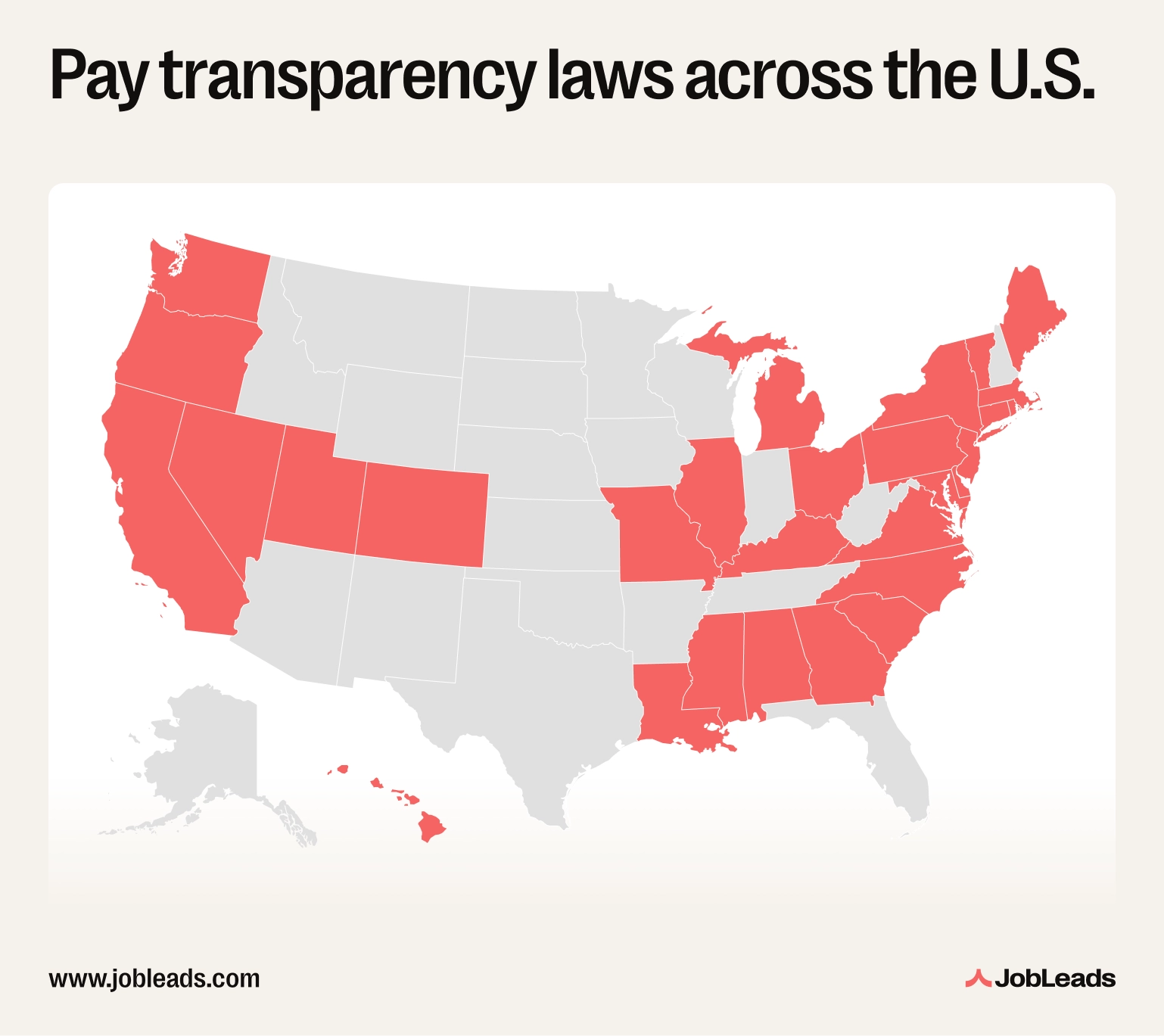
Fifteen US states plus DC now have pay transparency legislation on the books. These wage transparency laws require employers to post salary ranges, but contrary to the logic, they don't actually require those ranges to be useful.
JobLeads analyzed nearly 3.8M salary ranges from states with pay transparency policy and 3.4M from non-transparency states. The spread metric measures how wide a posted range is relative to its floor and was calculated with the following formula:
spread % = (max − min) / min × 100
| State group | Share spanning >50% of minimum |
|---|---|
| Transparency states | 26% |
| Non-transparency states | 29% |
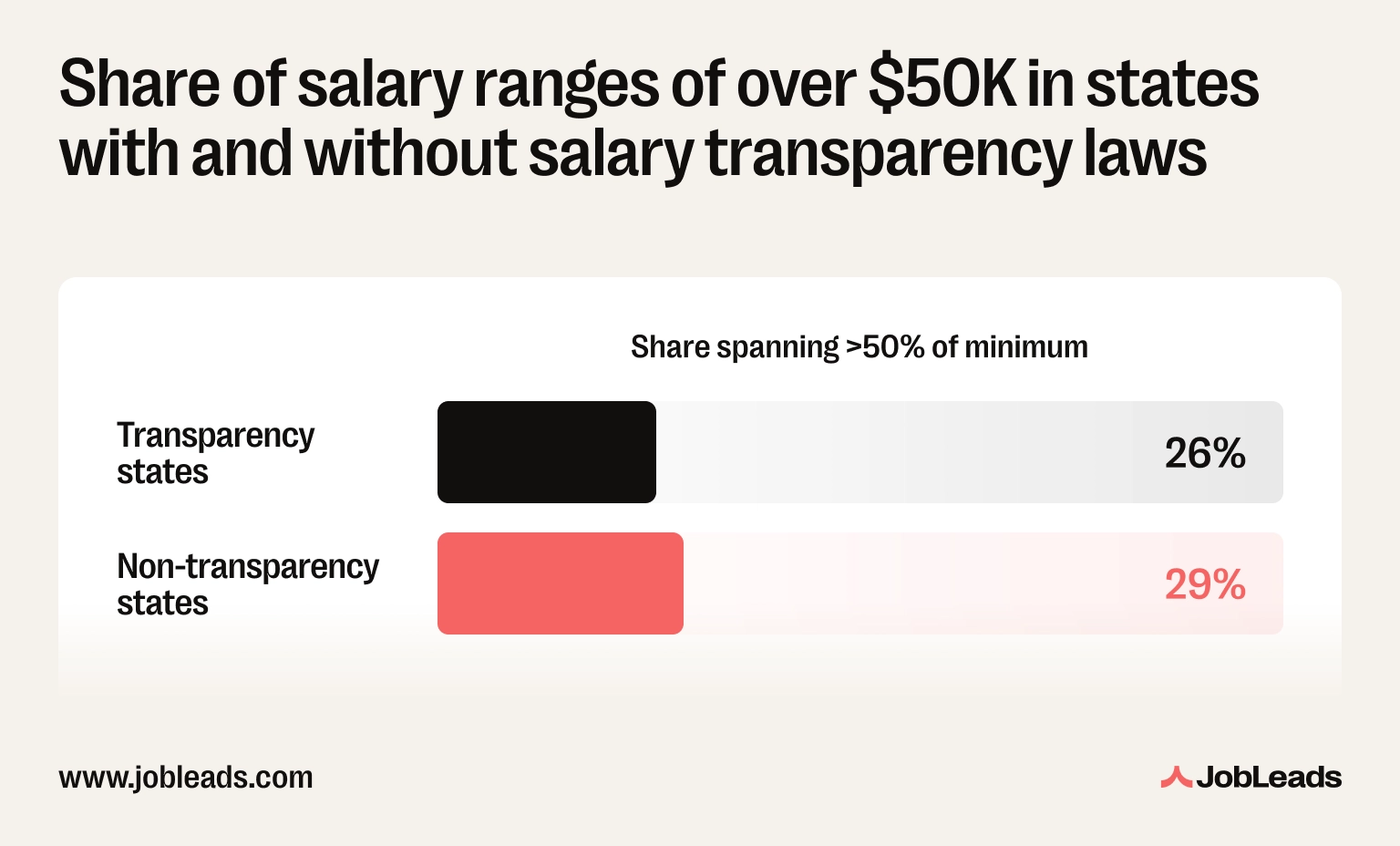
Transparency laws do tighten ranges but only modestly. The median range in a transparency state spans 30% of the minimum, compared to 33% in non-transparency states. And 1 in 4 transparency-state postings still publishes a range so wide it cannot be used to evaluate an offer.
The $50K-$150K problem is real. A range that wide tells a candidate absolutely nothing about the real amount on their future paycheck.
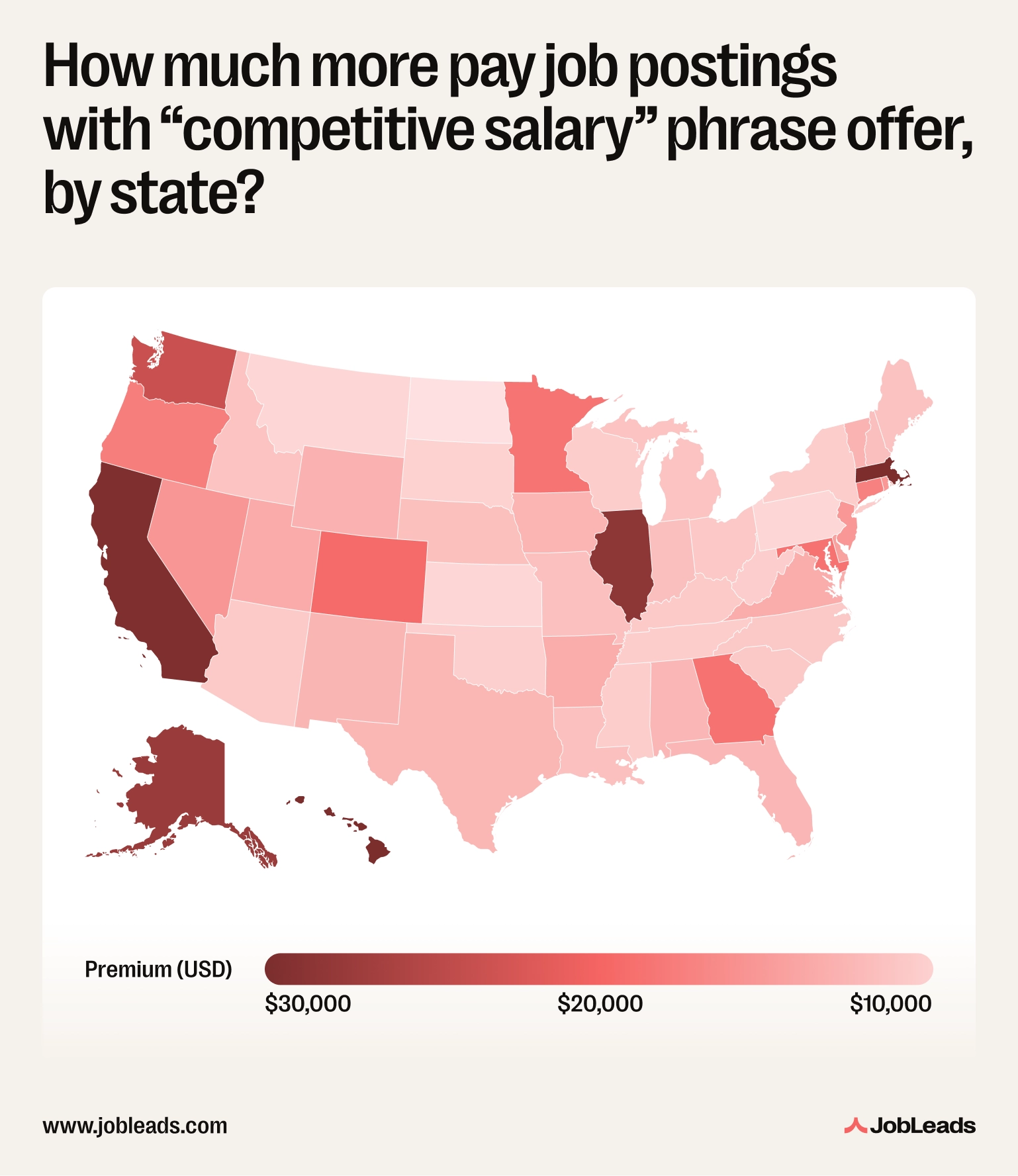
At first glance, the data looks like a ringing endorsement of pay transparency laws. "Competitive salary" job median in transparency states is $95,934, whereas in non-transparency states it's $77,544. That's a gap of +$18,390.
But the numbers don't mean what they appear to be.
Pay transparency states (CA, NY, WA, IL, MA, etc.) are not just states with stricter rules, they're also states where high-paying industries cluster. Legal, IT, Consulting, and Finance jobs are disproportionately based in transparency markets. When those industries also have the highest rates of "competitive salary" phrasing (Legal: 20%, Consulting: 19%, IT: 18%), the result is a composition effect, not a legislative one.
In plain terms–
The transparency-state premium reflects who is hiring there, not what the laws are doing. Pay transparency laws by state vary widely in design–some require ranges in every posting, others only on request. They are still valuable for other reasons (range disclosure, gender pay equity, negotiation leverage), but they're not, by themselves, the reason "competitive salary" job pay is higher.
On the JobLeads platform, "competitive salary" postings outperform standard listings on engagement by a wide margin. "Competitive salary" jobs receive 79% more clicks per posting and 76% more applications per posting. The apply-to-click conversion is virtually identical, 39% vs. 40%.
What this means is that candidates don't penalize "competitive salary" once they have clicked. The phrase just pulls more clicks and it's likely because the underlying jobs are higher-paying employers and higher-profile companies. Once on the page, applicants convert at the same rate as any other listing.
Job seekers are not avoiding the phrase. They're over-investing in it.
For job seekers, two things follow from the data, and they pull in opposite directions.
First is to stop treating "competitive salary" as a red flag. Statistically, it's the opposite. And if a posting uses the phrase, the employer is more likely than not to pay above the segment median.
Second, and this is where the contradiction comes in: you shouldn't treat the phrase as informative either. A more than +$10,000 median premium across millions of listings tells you nothing about your specific offer. The only number that matters in negotiation is the one tied to the role you're interviewing for. Use the phrase as a signal that the employer is probably above-average while also checking the external salary data to figure out by how much.
For companies, the clearest takeaway is that vagueness is no longer protecting anyone. If your "competitive" jobs are pricing in line with the +$5K to +$14K premium, naming the number costs you nothing and signals confidence. If they are not, the phrase is doing the heavy lifting on candidate expectations that the offer letter will not support, and that becomes a churn problem at the last stage of the hiring process.
Transparency without specificity is still opacity.
Try JobLeads, where every job posting comes with a stated salary range.
This study analyzed 21,514,121 US job postings with indicated salary ranges active in Q4 2025 (October 1 to December 31, 2025) on the JobLeads platform. JobLeads is a global job-search platform aggregating job postings and applicant behavioral data across the US, EU, and APAC markets.
Phrase detection: "Competitive salary" was detected using a case-insensitive LIKE match on the short-summary field of each posting.
Salary normalization: all salaries were converted to USD annual equivalents. Hourly rates were annualized by × 2,080 (40 hours/week × 52 weeks) for range-spread analysis only.
Outlier handling: P95 outlier capping was applied per industry to control for extreme high-end postings (executive search, equity-heavy roles). The pay gap is reported as the median of phrase postings minus the median of standard postings, never the median of per-row differences.
Transparency-law state group: California, Colorado, Connecticut, DC, Hawaii, Illinois, Maryland, Massachusetts, Minnesota, Nevada, New Jersey, New York, Rhode Island, Vermont, and Washington. All other US states and territories are coded as non-transparency.
Limitations:
Ethics: all data are anonymized and aggregated at the segment level; no individual posting, applicant, or employer is identifiable in the published results.
Journalists and media organizations are welcome to reproduce charts and data from this article with attribution to JobLeads and a link to this page. Please do not reproduce the article in full without permission.

Content & Insight Writer
Beata creates content that puts job seekers first. From practical blog advice to first-hand research studies, her writing is designed to give people the clarity and confidence to find the role they deserve.
Job Market TrendsJobLeads study on 811K job postings and 245K professionals reveals the differences in workers' salary expectations and wages offered by employers.
 Job Market Trends
JobLeads analyzed behavioral data from 881,776 U.S. job seekers to better understand how the gender pay gap develops throughout the job search process. The study finds that women ultimately earn 83 cents for every dollar men earn, but that difference is shaped long before a paycheck is issued.
 Job Market Trends
Is remote work costing you thousands? JobLeads' study of 42 tech roles reveals who wins and loses in the remote salary game–and how to minimize the cuts.