
 Job Search
July 21, 2026
Degree vs Experience: What Actually Gets You Hired in 2026?
Does a degree or work experience win in hiring? See what the data says about degree vs experience, the equivalency math, and what actually works.

You’re reading this because you can’t find a job. Or you’re about to start looking, and want to be as smart as possible about your job search approach.
Great decision! This article will get you there faster.
Here at JobLeads, we’ve worked with thousands of job seekers over the past 15 years. 99.9% of the time, our no-nonsense, easy-to-implement fixes based on years of expert insights help them to get their job search back on track in no time.
So - are you ready to join them? Keep reading to discover 8 things to stop doing right now, and 11 things to start doing now to land that dream job ASAP.
An Applicant Tracking System (ATS) is a recruitment software that streamlines the recruitment process for companies. They speed up the ‘best fit’ identification process by drawing attention to top-ranking applicants. This means low-ranking resumes may not be double-checked by a human. Over 90% of medium- to large-sized organizations use ATS. ATS can ‘read’ a high volume of applications, filtering out those which don’t match the job requirements, while flagging up those that do. ATS use algorithms to read and rank applications based on how closely they match any pre-set keywords and criteria by the recruiter. This usually includes major hard skills and knowledge areas, education, and years of experience. If you don’t understand how ATS work, you run the risk of not being considered. Many companies rely on custom software development services to build or enhance their ATS platforms, ensuring the system aligns closely with their specific hiring workflows and talent acquisition strategies.
What you can do about it Most ATS are designed to read resumes left to right, line-by-line. So that means a clean, simple style works best. Avoid creative resumes as these aren’t always ATS-friendly. No columns, no text boxes, no graphics to avoid ATS ‘reading’ errors. In fact, 21% of resumes submitted through an ATS include graphics or charts that are unreadable to the software. And another thing: ATS can’t see information that’s not there (or embedded in graphics/text boxes). As they are designed to look for pre-set keywords and criteria, it’s important to tweak your resume for every role you apply for.
A high proportion of jobs are filled through professional or personal connections. Headhunters also play a significant role, because they’re gatekeepers to exclusive and better-paid positions. In other words, you can’t access all opportunities by just applying online. Not only that, many people stick to 1 or 2 job boards only, which narrows their odds considerably. After all, there are thousands of job sites out there, from the global ones to your local online classifieds. Yet, even if you’re on 100 job boards, the basic fact remains: a significant number of jobs are filled through connections, headhunters, or resources you hadn’t thought about.
What you can do about it
Instead of solely relying on 1 or 2 job sites to find opportunities, add several other methods to your job search plan. For example, consider:
Blanket applying means applying to any and every job, regardless of if you’re a good fit or not. It might seem like you’re increasing your odds by applying for more jobs and saving yourself the time needed to review job descriptions and tailor your resume. But you’re just increasing the odds of rejection. While job descriptions are generally ‘ideal wish lists’ rather than inflexible absolutes, you should still meet at least 80% of the essential and desirable requirements.
What you can do about it If you’re applying to jobs you don’t truly qualify for on the off-chance a recruiter will say, “Yes!”, then you’re almost certainly wasting everyone’s time and increasing your rejection rate.
Many people facing financial pressure fall into the trap of applying to every role that looks remotely suitable, hoping something sticks. While the urgency is completely understandable, this approach rarely speeds up employment. Instead, focus your energy on positions where you meet most of the key requirements and can clearly demonstrate your value. That focused approach not only improves your odds of landing a role faster, but also puts you on a more stable financial path long-term. Read the job description carefully. If you meet a high percentage of the requirements, then ensure that’s reflected clearly in your resume and cover letter.
When posting a job online, most sites (including the company’s own site or ATS) require an expiry date. This prevents ads from remaining online forever. The hiring manager can always renew or delete the posting at that time.
What you can do about it Even though there may be a deadline listed, it may not be the actual deadline. The general rule of thumb: if the job is still online and is reasonably young ( <2 months), send in your application anyway.
Career pivots or even complete career changes are very common these days. Unlike a decade or two ago when it was expected for people to stay in the same career for their entire working life, moving around every few years and changing your career path are generally viewed positively. However, sometimes job seekers are so afraid of how they’ll be perceived, that they don’t edit their job descriptions to showcase synergies, or lop off certain experiences altogether.
What you can do about it It’s important to explain your motivation for changing paths, and show how this builds upon your previous experiences. Use your resume summary and cover letter to positively (and briefly) focus on synergies. Tailor your resume to highlight transferable skills and experience so it’s easier for the recruiter to envision you in the role. Where relevant, explain that you’re pursuing qualifications or training in your new field.
Every job description outlines essential and desirable requirements. Major keywords (e.g. project management, team leadership) and necessary criteria (e.g. minimum 4 years’ experience, or a certain degree) are clearly indicated. Recruiters and ATS use these as a way to standardize and speed up the filtering process, by comparing your resume to the job description wording. If you send in your resume without customizing it for a specific opportunity (incorporating the major keywords and criteria, where relevant), then you drastically reduce your chances of being considered.
What you can do about it For each job you’d like to apply for, firstly go through and underline the main keywords and responsibilities (this will get faster, the more often you do it). Focus on hard skills (e.g. scheduling, program development) rather than soft skills (e.g. time management). Then, if you have this knowledge, make sure these are authentically sprinkled throughout your summary, key skills section, job tasks, and accomplishments. Don’t overdo it, as some ATS can detect keyword stuffing and will flag your resume accordingly.
If you’ve searched online for current resume styles, you may have noticed an increasing trend for creatively designed resumes. These are resumes that use graphics, icons, color, columns, text boxes, and so on to liven up the traditional plain black & white format. Fans claim that a creative resume will stand out and is more likely to score you an interview. Yes… and no. These are great for roles requiring creativity, such as graphic design or the fashion industry. They can also work well if you’re applying for jobs with small companies (e.g. start-ups), which are more likely to manually review your resume or find unique looks appealing. Unfortunately, not all of us are good at resume design. Or picking out existing designs that won’t give the impression that we’re just out of college. And as we mentioned earlier, many ATS struggle with anything other than clean, simple styles. o in general, a creative design can be a big resume mistake and it’s best to avoid..
What you can do about it Unless there’s a specific reason otherwise, use a clean, simple style:
Around 90% of employers check your social media and/or online presence to learn more about you and to see if you’re a good culture fit for their organization. Fact. Sometimes they do this before even contacting you for an interview. If they find anything questionable (for example, extreme religious, political, cultural, or other views), there’s a high likelihood that your application will end up in the rejection pile. For example, one new hire had their contract cancelled when HR belatedly did a social media search and found racist comments by that person (made even worse by the fact that they were working in a multicultural team).
What you can do about it Is your personal social media visible? If yes, you may want to make it private. Will anyone find unflattering articles or posts by you online? If yes, either take these down, or be prepared to explain if asked. Ask a friend to search online for you as well, to make sure nothing is missed. Conversely, ensure your LinkedIn profile (if you have one) is up-to-date, professional, and complete. Highlighting experience with productivity tools, collaboration software, and CRM platforms demonstrates that you can solve workflow challenges, especially when paired with metrics like time saved, percentage improvements, or lead growth. This can help to enhance the recruiter’s positive impression of your application.
These are just some of the many common mistakes that people make when they’re searching for a job, and what they can easily do to fix things right now.
We’ll throw in 3 more pieces of advice to help slash your job search journey time:
Be flexible: Just because something worked for you the last time you looked for a job, that doesn’t mean it will again. Times change, and so do technology and sources. For example, we’ve coached many clients who are resistant to tweaking their resume for ATS, because they don’t understand how it works. Or job seekers who are reluctant to tap into their extensive network because they don’t know how to ask, instead relying on 1-2 job boards instead of seeking quality referrals.
Have a plan: It might sound like a bit of hard work to put together a job search plan, but actually, that hour (or less) that you spend creating one, will knock hours, days, or even weeks off your job hunt because you’re not rambling down random paths. At its simplest, a job search plan lists all the places you’d look for opportunities (e.g. online job boards, JobLeads, your network), how long you’d like to spend on each activity per day, and space to take status/action point notes to keep track of everything.
Don’t be afraid to ask for help: If you’re not sure if your resume is up to scratch, ask a resume professional to polish it for you. If you’re uncertain about your next job move, a coaching session with a career counsellor can give you a sense of direction. Reach out to your network (LinkedIn is a fantastic resource for this) to ask for referrals at dream companies. If you’re struggling with your job search, remember that you’re not alone. There is always a solution if you look for one.
We hope these top tips will help you to refine your job search strategy and find a better job faster.
If you want to learn more about other common job search faux pas, check out our Ultimate Guide to Job Hunting Mistakes. We share 95+ common mistakes + what you can do about it, including advice on your job search, job descriptions, resumes, cover letters, interviews, virtual interviews, and job offer stumbling blocks.
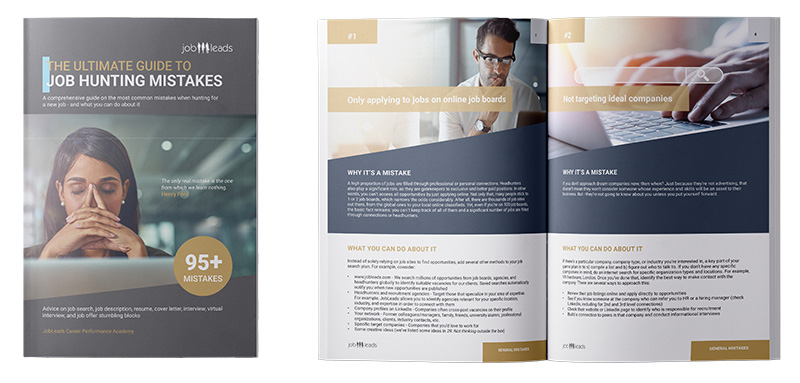
Download The Ultimate Guide to Job Hunting Mistakes
Good luck – we wish you happy job hunting!
For more insights, tips and strategies related to this topic, be sure to read our other articles: Applicant Tracking Systems – Your Best Friend or Worst Enemy? & 6 Effective Ways to Follow a Targeted Job Search Strategy

Career Support Consultant, Career Counsellor, and Interview Coach
Career Support Consultant with over two decades of rich exposure across diverse industries.
Job SearchDoes a degree or work experience win in hiring? See what the data says about degree vs experience, the equivalency math, and what actually works.
 Job Search
Learn how to find a remote job. Discover the best platforms, what to put on your resume, and how to apply with no experience to get a legit remote job.
 Job Search
Find out when is the best time to apply for a job based on data from 55 million US listings. Discover the best months to apply, best day to submit, and peak hiring season insights.