
 Job Interviews
July 30, 2026
Why Am I Not Getting Interviews? 8 Ways to Change That
Go through an eight-step diagnosis on why you're not getting interviews. Discover ways to improve your strategy and win more job interviews.

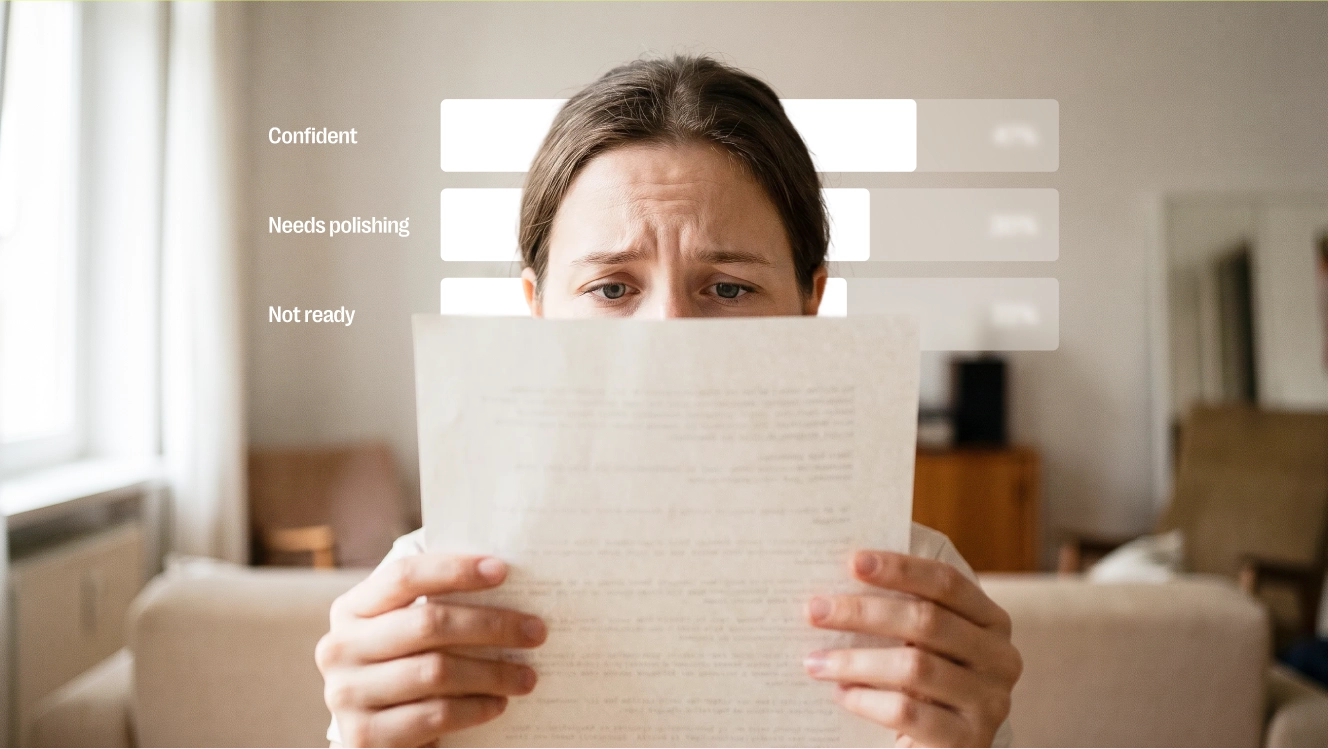
How many job seekers actually think their resume is good?
More than you might expect, and that confidence, or the lack of it, turns out to shape job search behavior in ways that go far beyond the document itself.
To understand the relationship between resume self-belief and real job search activity, JobLeads analyzed data from 2.5M job seekers and nearly 1.9M unique job listings, tracked throughout Q4 2025. What the data reveals isn't just a confidence gap–it's a behavioral one, with measurable consequences for how many roles people apply to, and the salaries they're willing to pursue.

Let's dive deeper into the findings.
What people think of their resume matters both at the very start of the job search and in the long run. It affects how they apply, what their target jobs are, and what salaries they are aspiring to.
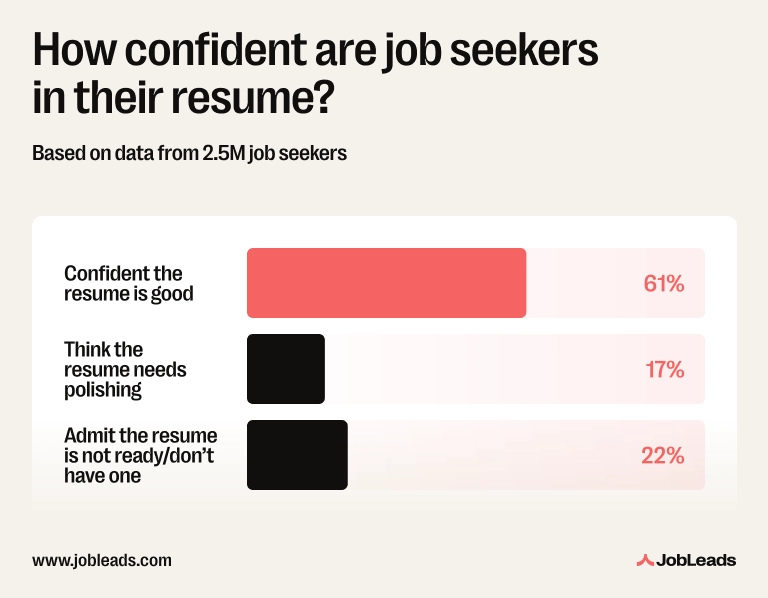
Across 2.5 million job seekers, the majority (61%) feel good about their resume. That's a reassuring headline. A further 17% know their resume needs work and acknowledge it, while 22% (nearly 1 in 4) don't have an up-to-date resume at all. That means almost 4 in 10 job seekers are entering the market with a document they privately know isn't ready, or with no document at all.
| Confidence level | Share |
|---|---|
| Confident the resume is good | 61% |
| Think the resume needs polishing | 17% |
| Admit the resume is not ready / don't have one | 22% |
The stakes of that gap are higher than many job seekers may realize. According to a report by StandoutCV, on average, a candidate has to send out 51 resumes to secure a job, and up to 75% of resumes are rejected by ATS systems before a recruiter ever sees them. So, starting with a resume that they know isn't ready already puts these candidates at a disadvantage.
And as the rest of the data shows, job seekers who know their resume is not ready target lower-paying roles, gravitate toward more competitive remote listings, and browse more without converting. In other words, the resume readiness gap spills into every behavior that follows.
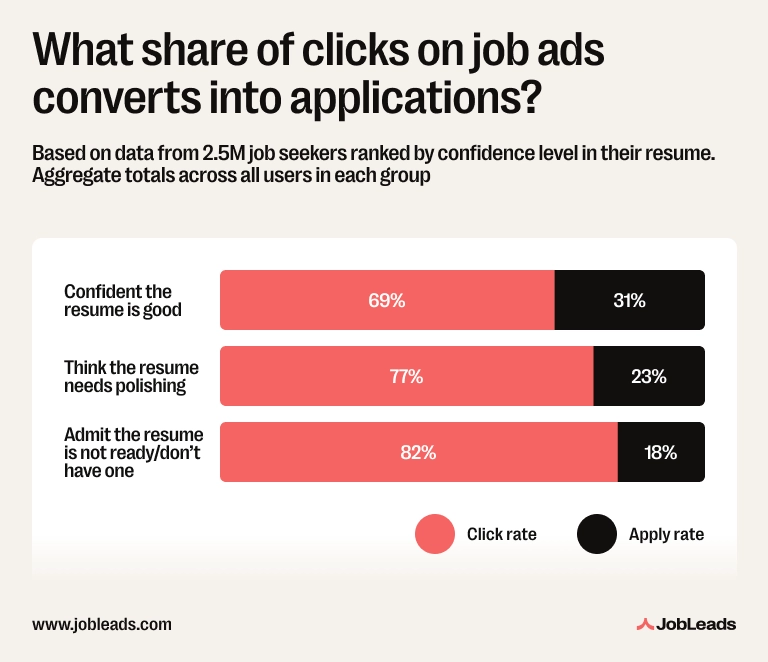
The gap between clicking on a job and actually applying for it is where resume confidence shows up most clearly in the data. Among job seekers who feel good about their resume, 31% of job ad views result in an application. Among those without a ready resume, that figure drops to just 18%, meaning more than 4 in 5 job views end without action.
| Confidence level | Click rate | Apply rate |
|---|---|---|
| Confident the resume is good | 69% | 31% |
| Think the resume needs polishing | 77% | 23% |
| Admit the resume is not ready / don't have one | 82% | 18% |
Zoom out to application behavior per user and the picture is consistent: confident job seekers apply to 47% of the jobs they click on, compared to just 22% for those without an up-to-date resume.
The gap isn't entirely surprising. National Institute of Health research on job search self-efficacy (the belief that one can successfully navigate the application process) shows that confidence is one of the strongest predictors of job search intensity and follow-through. What's new here is the scale of the behavioral difference: a more than two-to-one gap, drawn from millions of real interactions.
| Confidence level | Apply rate |
|---|---|
| Confident the resume is good | 47% |
| Think the resume needs polishing | 30% |
| Admit the resume is not ready / don't have one | 22% |

What makes this finding particularly significant is the context job seekers are operating in. According to statistics compiled by StandoutCV, only 1 in 4 job seekers feel confident their resume will make it past automated screening systems, while less than 3% of resumes sent actually result in an interview.
In a market that already filters aggressively, applying less often isn't a neutral choice. For job seekers without an up-to-date resume, the odds compound. Lower confidence leads to fewer applications, which means fewer opportunities to beat the numbers, regardless of how qualified they are.
This 10% salary gap driven purely by self-perception is a meaningful finding. It suggests that resume confidence doesn't only change how people search, but it also changes what they believe they're worth.
This aligns with a well-documented pattern in salary research done by Pew Research Center among other organizations: more than half of job candidates don't try to negotiate their salary at all, with lack of confidence cited as a primary reason. And those who do negotiate receive an average increase of nearly 19% from their original offer. In other words, the confidence gap has a price tag long before the negotiation conversation even begins.
So, what people initially think of their resumes has real consequences in the long run. Less confident job seekers aren't just negotiating less, they're starting from a lower baseline, browsing roles that pay less to begin with. The financial cost of resume under-confidence doesn't start at the offer stage–it starts at the very beginning of the search.
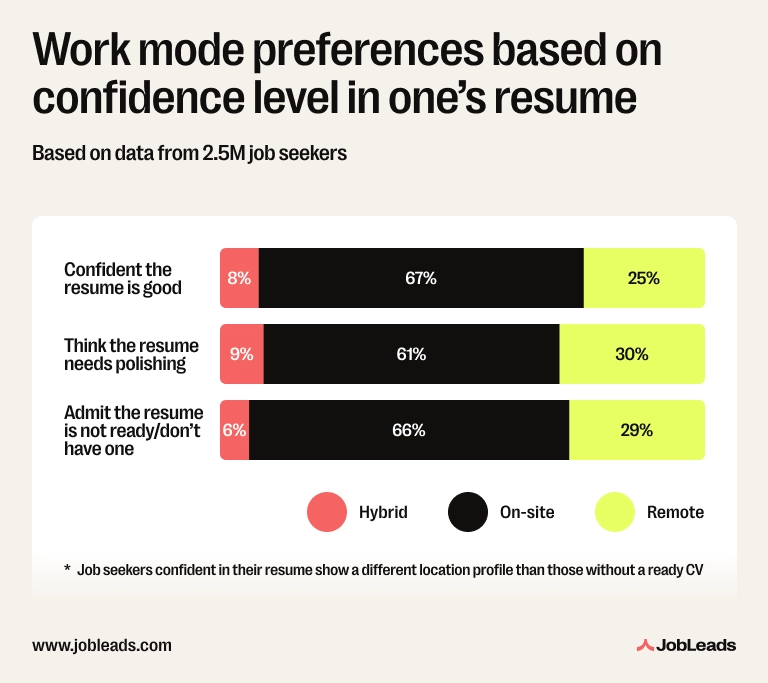
The pattern is subtle but telling. Job seekers who know their resume needs work are gravitating toward remote roles at a higher rate than their confident counterparts. The likely mechanism here isn't fully logistical but psychological. Remote roles and especially remote interviews feel safer–less exposed, less reliant on the kind of in-person impression a polished resume is supposed to precede.
| Confidence level | Hybrid | On-site | Remote |
|---|---|---|---|
| Confident the resume is good | 8% | 67% | 25% |
| Think the resume needs polishing | 9% | 61% | 30% |
| Admit the resume is not ready / don't have one | 6% | 66% | 29% |
What makes this worth paying attention to is the supply reality those job seekers are running into. According to JobLeads' own analysis of over 5 million US job postings, only 6% of newly posted roles in the United States are fully remote, while 23% of job seekers say remote work is their top preference. That's a demand-to-supply ratio of nearly 4:1, making remote roles among the most contested openings in the market.
Job seekers who are already less confident in their resume are effectively self-selecting into the hardest pool to crack. The avoidance pattern that feels like a workaround ends up increasing, not reducing, the competition they face.
Whether you have a job or are in need of one can affect many spheres of your life. It also shapes how you feel during the job search. When it comes to resume confidence, employment status data has brought some surprising findings.
This is arguably the most counterintuitive finding in the entire dataset. The assumption most people would make is that losing your job naturally affects your confidence, including your confidence in your resume. The data says otherwise. Unemployed job seekers who are actively looking report higher resume confidence (63%) than people simply browsing with no urgent need to move (48%).
Urgency, it turns out, appears to sharpen self-belief rather than erode it. When a job search becomes a necessity, job seekers are more likely to have actually updated their resume, sought feedback, or taken concrete steps to prepare, and that action itself builds confidence. Passive browsers, by contrast, are dipping into the market without any real pressure to be ready, which may explain why nearly 35% of them describe their resume as not up to date at all.
| Job search status | Confident | Needs polishing | Not ready / no resume |
|---|---|---|---|
| Employed and actively looking to switch | 68% | 18% | 15% |
| Employed and just browsing for opportunities | 48% | 17% | 35% |
| Unemployed and actively looking | 63% | 16% | 21% |

If urgency explains why the unemployed outperform passive browsers, the employed switchers take that logic one step further. At 68% confident, they sit above both other groups, and the reason becomes clear when you consider their position. They're searching from a place of strength: current role, recent achievements, no desperation pushing them to apply before they feel ready.
That combination of motivation without pressure appears to be the sweet spot for resume confidence. It also reframes what the passive browser gap is really about. The 20-point spread between employed switchers and passive browsers isn't primarily about employment status–it's about engagement. The job seekers who feel most ready are the ones who have actively done something about it, regardless of whether they currently have a job or not.
Job seekers operate in different contexts and come from different backgrounds. Naturally, they won't have the same approach to resume-writing and job applications. Let's take a look at some of the most interesting geographical findings from the dataset.
Interestingly, resume confidence isn't evenly distributed across the world. The UAE leads all major markets at 72%, followed closely by Qatar (71%), Saudi Arabia (70%), and the US (70%). France (69%), Canada (68%), and Great Britain (67%) are not far behind.
At the other end of the spectrum, the picture shifts dramatically. Cuba and Haiti are the only two countries in the dataset where more than half of job seekers say their resume isn't ready, and 16 of the 20 least-confident markets are in Sub-Saharan Africa.
The full global spread amounts to around a 40-point confidence gap between the most and least confident major markets. Whether that reflects structural differences in career support, access to resume tools, or cultural attitudes toward self-assessment is hard to say, but it's likely all three combined. What it does suggest is that resume confidence isn't just a personal trait unique to the job seeker–it's shaped by the job market environment people are navigating.
Top 10 most resume-confident countries
| Country | Confident | Needs polishing | Not ready |
|---|---|---|---|
| United Arab Emirates | 72% | 12% | 16% |
| Qatar | 71% | 11% | 18% |
| Saudi Arabia | 70% | 11% | 19% |
| United States | 70% | 16% | 14% |
| Brazil | 69% | 16% | 15% |
| Mexico | 69% | 16% | 15% |
| France | 69% | 15% | 16% |
| Canada | 68% | 17% | 15% |
| Bahrain | 68% | 13% | 19% |
| Kuwait | 68% | 11% | 21% |
Top 10 least resume-confident countries
| Country | Confident | Needs polishing | Not ready |
|---|---|---|---|
| Cuba | 33% | 13% | 54% |
| Haiti | 33% | 14% | 53% |
| Cameroon | 35% | 22% | 43% |
| Togo | 38% | 17% | 45% |
| Madagascar | 39% | 17% | 44% |
| Republic of Congo | 40% | 19% | 41% |
| Venezuela | 40% | 21% | 39% |
| Nepal | 41% | 14% | 45% |
| Burkina Faso | 41% | 19% | 40% |
| Syria | 41% | 13% | 46% |
Narrowing the data to unemployed job seekers specifically, the group with arguably the most at stake, the country ranking shifts in a striking way. France moves to the top at 78%, ahead of the UAE (77%), Switzerland (76%), and Qatar (76%). The US, which ranks 4th overall among all job seekers, drops to 19th place among the unemployed at 68%. That's a meaningful slide, and it suggests that in the US, losing a job appears to take a bigger toll on resume confidence than it does elsewhere.
The French result is the most counterintuitive. France has one of the more generous unemployment support systems in the world, including structured state-backed reemployment programs that provide career coaching and CV support to job seekers. It might be that this safety net translates directly into self-belief–unemployed French job seekers aren't just financially cushioned. They're more likely to have had their resume reviewed and validated before they even start searching. Hence, only 9% of unemployed French job seekers think their resume is not ready or don't have one, while 13% admit it needs polishing.
Top 10 most resume-confident countries among unemployed job seekers
| Country | Confident | Needs polishing | Not ready / don't have one |
|---|---|---|---|
| France | 78% | 13% | 9% |
| UAE | 77% | 12% | 11% |
| Switzerland | 76% | 12% | 11% |
| Belgium | 76% | 14% | 11% |
| Qatar | 76% | 10% | 15% |
| Brazil | 73% | 16% | 12% |
| Austria | 73% | 11% | 16% |
| Italy | 73% | 11% | 17% |
| Saudi Arabia | 72% | 11% | 16% |
| Canada | 72% | 16% | 12% |
🇺🇸 United States ranks 19th among unemployed job seekers at 68% confident.
The broader pattern across the top of the unemployed ranking–France, UAE, Switzerland, Qatar, Belgium–suggests that where institutional support is stronger, confidence doesn't collapse when employment does. For the US, where that infrastructure is thinner, the confidence dip among the unemployed may be both a psychological and a practical gap worth closing.
The US shows the sharpest salary aspiration gap in the entire dataset. Resume-confident job seekers browse roles paying roughly 17% more than those without an up-to-date resume. The US has the largest confidence-to-salary spread across the five major markets analyzed, which also include Great Britain, India, Italy, and South Africa. In every one of those markets, the direction is the same: higher resume confidence consistently correlates with targeting higher-paying roles. The US just takes it furthest.
What makes the US figure particularly striking is the middle group. Job seekers who know their resume needs polishing browse roles paying closer to the confident tier than to the "not ready" group. It's the "not ready" floor that drags the gap wide. These are job seekers who appear to have adjusted their entire salary ambition around their resume, gravitating toward lower-paying roles before a single application has been sent. The salary gap, in other words, starts at the search bar.
The data tells a consistent story: resume confidence isn't just a feeling. It's a behavioral driver that shapes where you search, how often you apply, and what you believe you're worth.
And the most actionable insight is actually the smallest one: 18% of job interactions result in an application among job seekers who know their resume isn't ready. Less than 1 in 5 clicks becomes an application, and in a job market where the average candidate sends 51 resumes to land a single offer, that conversion gap has real consequences.
A few things worth taking away from this study:
Having a ready resume changes your behavior before you send a single application. The confident group browses differently, targets higher-paying roles, and shows stronger intent across every interaction. The resume is more than just a document: it's a signal to yourself about what you're willing to go after.
Urgency helps, but it's not enough on its own. Unemployed job seekers outperform passive browsers on confidence, likely because necessity pushes them to actually update and prepare. But employed switchers outperform everyone, because they combine motivation with a sense of stability. The sweet spot is readiness without pressure.
The salary gap starts at the search bar. A $13,428 difference in targeted salary between the most and least confident job seekers in the US is a true aspiration gap. Less confident job seekers are filtering themselves out of higher-paying roles before a hiring manager has even seen their name.
Remote work won't solve a confidence problem. Less confident job seekers gravitate toward remote roles at a higher rate, likely because they feel safer this way. But with only 6% of US job postings fully remote and nearly 1 in 4 job seekers competing for that pool, remote-only job searching compounds the odds against them.
The clearest practical conclusion from this data is that working on your resume isn't just about passing ATS filters. It changes what you apply to, what you aim for, and ultimately what you get.
Get a free expert resume review from JobLeads and see exactly how your resume reads to a recruiter.
This study is based on behavioral data collected from the JobLeads platform during Q4 2025 (1 October - 31 December 2025). The dataset covers 2,496,452 registered job seekers across 136 countries, with nearly 1.9M unique job listings tracked over the same period.
Resume confidence classification. Resume confidence was measured through a single onboarding question asked to all new users during platform registration: "Are you convinced your resume ticks all relevant boxes?" Responses were grouped into three tiers: Confident ("I have a great resume"), Needs polishing ("It might need some polishing"), and Not ready ("I don't have an up-to-date resume"). All confidence data is self-reported and reflects users' own perception of their resume at the time of sign-up.
Behavioral data. Job interactions, including clicks and applications, were drawn from platform event tracking across the full Q4 2025 period. Apply rate is calculated as total applications divided by total clicks. Salary figures represent the average advertised salary of jobs each confidence group interacted with, not salaries accepted or negotiated. All salary data was converted to USD and extreme outliers were capped at the 95th percentile per country to reduce the effect of anomalous listings.
Geographic analysis. Country-level findings require a minimum of 500 users to be included in general rankings. For the unemployed-specific country analysis, the threshold is lowered to 200 users. Countries below these thresholds are excluded from geographic comparisons.
Limitations:
JobLeads encourages the free sharing of this data. If you would like to use or reference the findings from this study, you are welcome to do so for non-commercial purposes, provided that you include a visible credit and a link back to this page as the original source. Any reproduction of charts, tables, or infographics should attribute JobLeads and link directly to this article. For any inquiries, please contact us directly at press@jobleads.com.

Digital PR & Content Marketing Manager at JobLeads
Maryia leads digital PR and outreach at JobLeads. Her work has earned coverage in Fast Company, AOL, Forbes, Fortune, Quartz, and ZDnet—and she specialises in building the systems that make that happen at scale.
Job InterviewsGo through an eight-step diagnosis on why you're not getting interviews. Discover ways to improve your strategy and win more job interviews.
 Job Market Trends
JobLeads study on 811K job postings and 245K professionals reveals the differences in workers' salary expectations and wages offered by employers.
 Resume
The 8 most common resume mistakes to avoid, from generic resumes to ATS keyword mismatches. Learn exactly how to fix each one before you apply.