
 Resume
July 15, 2026
15 Best Free Resume Builders Compared [2026]
Compare the 15 best free resume builders. Learn pros, cons, and pricing of each to pick the right tool for your needs.


The hiring benchmark has changed–
An average corporate job posting now draws in 244 applications, up 111% since 2022, according to Greenhouse's hiring benchmark. And only a small fraction of those candidates ever make it to an interview.
Most rejections have nothing to do with being unqualified.
They come down to the same handful of common resume mistakes, repeated over and over: a missing number, an untailored bullet, or an unexplained gap.
This guide walks you through the most common resume mistakes to avoid, why each quietly costs you interviews, and exactly what to fix before you hit submit.
Get a free expert resume review from JobLeads and find out exactly what to fix before you apply.
A resume mistake rarely sinks a candidate on its own. In fact, the most common mistakes made on a resume are smaller and quieter than that.
But it's still crucial to avoid them as the average total review time is only 20 seconds before a recruiter decides whether to keep going (Yale's Office of Career Strategy). You don't want to give them a reason to pass on your application because of a spelling mistake that was easy to avoid.
Take Elena, a project manager who built her resume with a polished two-column template to save space. It looked sharp until she ran it through an ATS resume checker and found her most recent job title had been parsed into the wrong section entirely. The system had read down the left-hand column, then the right, instead of across each row. This scrambled her strongest, most recent role into an unreadable fragment.
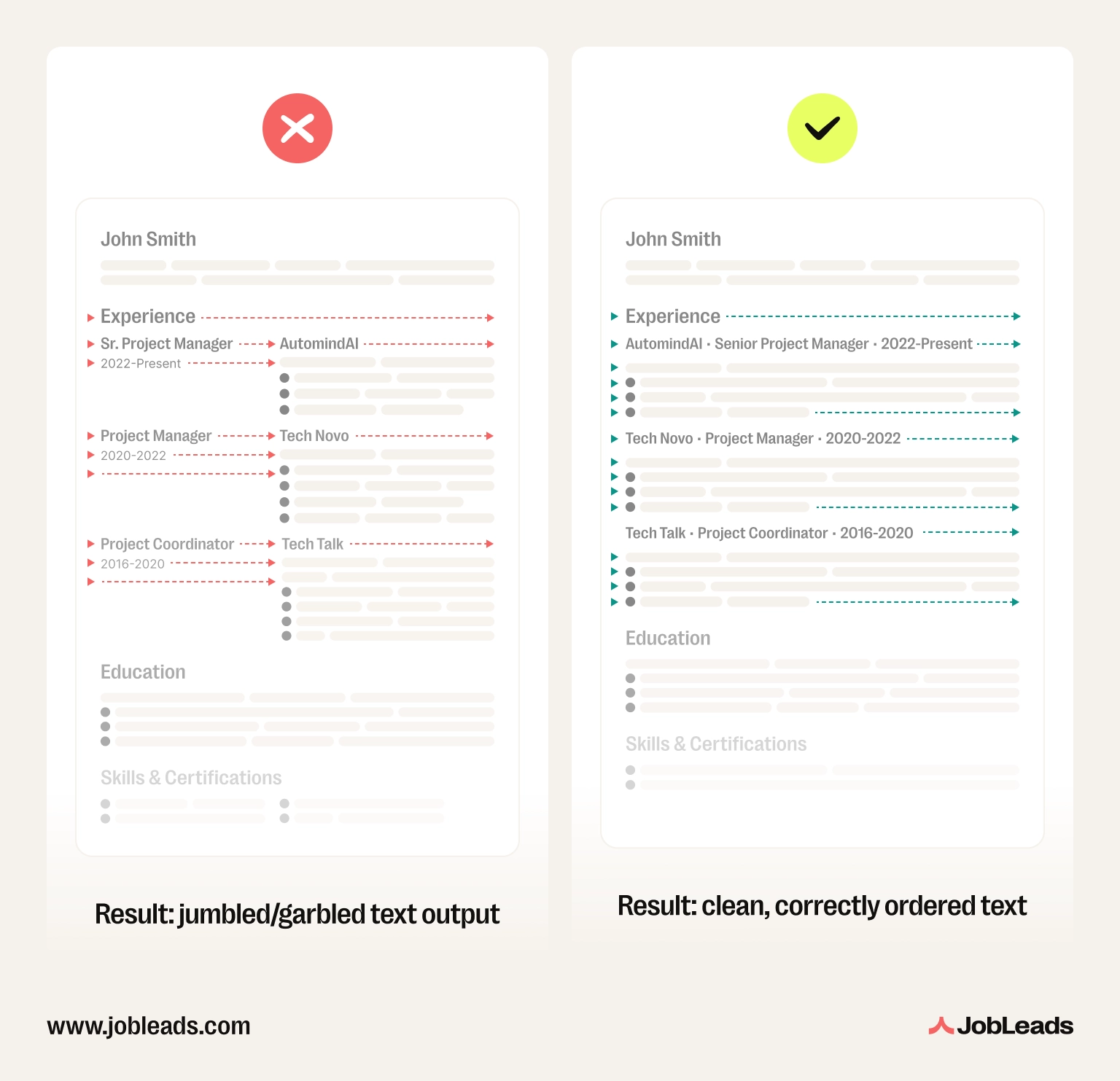
That's the mechanism behind several of the mistakes below: formatting, keywords, and generic content can all get filtered out by the applicant tracking system. And those systems are used by 98% of Fortune 500 companies, according to Jobscan's ATS usage report.
The cost isn't just interviews. According to JobLeads' research, low resume confidence quietly lowers the salaries people aim for — confident applicants convert 47% of job clicks into applications vs. just 22% for those who feel unprepared.
These are the most common mistakes on resumes we see across industries and experience levels.
Using the same resume for every application feels efficient. The truth? It's usually the single biggest reason a qualified candidate never hears back.
A generic resume misses the specific keywords, skills, and priorities named in the job description, which matters more than most job seekers realize. So, keep in mind that tailoring your resume to each posting can boost your interview-to-offer conversion rate by 115%–from around 3% to 6%–according to a Forbes study.
That gap shows up on the applicant side too. A JobLeads poll found that just 42% of job seekers update their CV before every application, while 44% only update it "when they have to." This means that you might be sending your resume for roles that it wasn't written for.
Note
Example: Tom's been sending the same resume to 15 job postings a week for a month with almost no responses. Then, he changed his strategy. He started spending 10 minutes per application matching his bullet points to each job description. This doubled his response rates within two weeks.
Fix it: Before you apply, read the job posting and mirror its exact terminology anywhere it's true of your background–job titles, tools, and required skills. It only takes minutes but helps you get more interviews almost instantly.
"Responsible for managing social media accounts" describes a job. It doesn't tell a recruiter whether you were good at it.
Duty statements are the default because they're easy to write–you're just describing what your role involves. But they skip the numbers and results that actually show your impact: revenue generated, time saved, team size, budget managed, and more.
That gap matters because of what employers say they're actually screening for. NACE's Job Outlook survey found that nearly 90% of employers are looking for evidence of problem-solving ability, and nearly 80% for demonstrated teamwork. Neither of those a duty-only bullet can show. And most resumes aren't showing it as only 26% include five or more measurable results, and a striking 36% include zero measurable metrics at all (Cultivated Culture).
✅ Right: "Grew social media following by 40% in 6 months, driving a 15% increase in inbound leads."
❌ Wrong: "Responsible for managing social media accounts."
The same gap shows up anywhere. Compare "Handled customer inquiries and resolved issues" to "Resolved 45+ support tickets per week with a 96% first-contact resolution rate, cutting average response time from 6 hours to 90 minutes." Same job, same seniority level–only one version gives a hiring manager something to act on.
Fix it: For every bullet point, ask "so what happened because I did this?" If the answer is a number, a result, or a change, put it in the bullet. You don't need exact figures for every line. A defensible estimate like "roughly 20%" beats no number at all.
Typos are the resume mistake recruiters bring up more than any other. Even one can be enough–Resume Genius's Hiring Trends Report shows that 42% of hiring managers flagged typos as a resume red flag.
Note
Example: Raj is an operations manager candidate whose top bullet read "Managed a team of 15 employes." The typo took two seconds to make. The hiring manager later told him she'd stopped reading right there–she had 40 other resumes to get through that afternoon and no reason to give him the benefit of the doubt.
In 2026, with free AI proofreading tools everywhere (Grammarly, Hemingway App, even LLMs), recruiters have even less patience for these mistakes. A typo now reads as carelessness, not a slip.
Fix it: Run your resume through a grammar checker. Also read it aloud, then have one other person read it. Typos hide from the writer far more easily than they hide from a fresh set of eyes.
This is where you'll find some of the most common ATS resume formatting mistakes to avoid. Ironically, it's also where job seekers least expect to lose points. Mixed fonts, inconsistent spacing, cluttered layouts, or overly "creative" designs can confuse the ATS parsing your resume, scrambling your work history or dropping sections entirely.
Also, remember to include the keywords recruiters are searching for. As many as 76% of employers use the skills filter as their primary way of narrowing applicants inside the ATS (Jobscan). So, it's a big mistake to not add the keywords from the description into your resume.
Most ATS parsers read left-to-right, top-to-bottom across the full page–not down one column and then the other. So the system pulls the job title and dates as one disconnected fragment and the bullets as another, sometimes losing the link between them entirely.
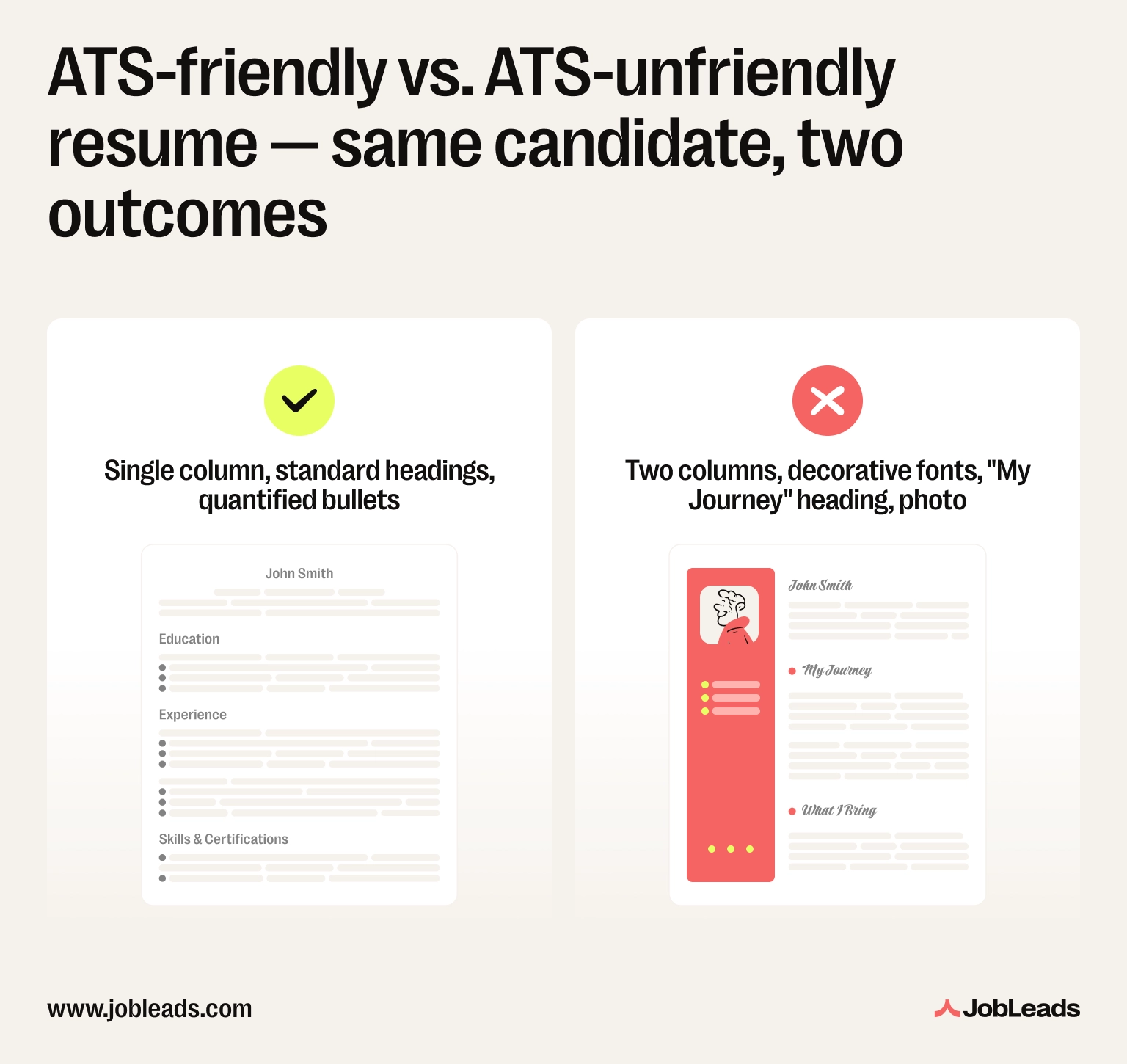
Poor formatting is a bigger deal to recruiters than most job seekers assume. The top three resume red flags include a disorganized layout, an obscure font, or a missed spell-check (Resume Genius). These stood alongside AI-generated content and frequent job-hopping.
| Formatting choice | ATS-friendly | Risky |
|---|---|---|
| Font | Standard (Calibri, Arial, Georgia) | Decorative or script fonts |
| Layout | Single column, standard headers | Multi-column, tables, text boxes |
| File type | .docx or simple PDF | Image-based PDF, Canva export |
| Section titles | Standard ("Experience," "Education") | Creative labels ("My Journey") |
Fix it: Optimize your resume for ATS, keep your layout simple–one column, standard section headers, a common font. Then, save it as instructed in the job posting (usually .docx or PDF).
So, how long should your resume be?
Unfortunately, there isn't one universal "right" length, and that's exactly why this mistake is so common. Padding a resume with irrelevant early-career jobs makes it too long but cramming 20 years of experience onto one page makes it unreadable.
Note
Example: A financial analyst with 12 years of experience had compressed her entire history onto one page in ten-point font to "keep it simple." But after expanding to two pages–with room to actually quantify her roles instead of cutting them down to a line each–her interview requests more than doubled within a month.
The data supports a length that scales with experience, not a fixed one-page rule. On average, job seekers get 2.3x more callbacks with a two-page resume than a one-page one. The effect is strongest for managerial-level candidates, at 2.9x (ResumeGo).
That's despite most hiring professionals saying they generally prefer one page. The two-page version wins on callbacks when there's enough senior-level experience to fill it, not as a default.
Fix it: Early career (0-5 years): one page. Two pages once you have 10+ years of relevant experience to justify it. Either way, cut anything that doesn't support the job you're applying for.
"Seeking a challenging position where I can grow" tells a recruiter what you want, but it says nothing about what you'd bring to their team. And that's the problem.
Objective statements are widely considered an outdated resume device and can even make a candidate look out of touch with current hiring norms. A brief professional summary of 2-3 sentences highlighting your strongest, most relevant achievements does a much better job from the employer's point of view.
✅ Right: "Marketing coordinator with 4 years of B2B experience, known for growing organic social reach by 40%+ and launching campaigns that drove measurable pipeline growth."
❌ Wrong: "Seeking a challenging marketing position where I can grow and develop my skills."
Fix it: Replace your objective with a 2-3 sentence summary that leads with your strongest, most quantified achievement instead of your career goals.
Every job since your first part-time role in high school, a skills section listing "proficient in Microsoft Word," or an unprofessional email address–all of it dilutes the sections a recruiter actually needs to see.
Note
Example: Daniel is an IT support specialist. His resume still listed his summer job as a lifeguard from eleven years earlier, a skills section entry for "Proficient in Windows XP," and an email address left over from college: xXgamerdan92Xx@yahoo.com. None of it disqualified him outright–but all three lines were taking up space that could have gone to his two most relevant roles, the ones actually worth a recruiter's attention.
It also runs counter to what recruiters say actually drives their decision. In SHRM research on applicant evaluation, 84% of recruiters cited years of relevant experience and 83% cited type of experience as the top factors in their initial review. Only 35% weighted education level heavily.
Fix it: Cut roles older than 10 years unless directly relevant. Also, remove outdated or assumed-baseline skills. Moreover, use a simple, professional email address (firstname.lastname@) format, not a decades-old handle.
An unaddressed resume gap, or dates and titles that don't match your LinkedIn profile, raises a red flag a recruiter doesn't have time to investigate on your behalf. So they often just move on.
Unexplained employment gaps lower your interview chances by 45%, while gaps that get even a brief explanation see a 60% higher callback rate (ResumeGo).
✅ Right: "Personal leave to care for a family member (Jan 2023-Aug 2023). Returned to work with an updated project management certification."
❌ Wrong: Leaving an unexplained blank between two jobs with no context at all.
Fix it: A one-line explanation is almost always enough. You don't owe a detailed account, just enough context that the gap stops looking like a red flag.
Before you hit submit, run your resume against this checklist one more time:
None of the top resume mistakes on this list are hard to fix on their own.
What makes them costly is that most resumes have three or four of them at once. For example, a generic resume with no metrics, a slightly-too-long layout, and a keyword mismatch, all stacked together before a recruiter's even decided to keep reading.
Fix them one at a time using the checklist above, and you're no longer competing with a stack of similarly-generic resumes. Yours is the one that actually reads like it was written for the job.

Content & Insight Writer
Beata creates content that puts job seekers first. From practical blog advice to first-hand research studies, her writing is designed to give people the clarity and confidence to find the role they deserve.
ResumeCompare the 15 best free resume builders. Learn pros, cons, and pricing of each to pick the right tool for your needs.
 Resume
Learn what an ATS-friendly resume is with the format and fonts that pass parsing. Check out real examples and how to check your ATS score before applying.
 Resume
Looking for an AI resume builder to help with your CV? Compare the best AI resume writing tools, paid and free, based on the main features and top use cases.