
 Job Market Trends
October 02, 2026
The Best Cities for Young Professionals [US Ranking]
JobLeads ranked the 50 biggest US cities for graduates by what's left after rent, not headline pay. See where a starting salary stretches furthest.


JobLeads analyzed 33,390,075 US job ads first indexed on the platform between January and June 2026. Each ad was matched to six school subjects (Mathematics, Physics, Chemistry, Biology, Computer Science and Economics) using the US Department of Labor's O*NET ratings of how important each subject is to an occupation.
Ahead of National STEM Day on November 8, the findings show that there's a paradox. The STEM careers students picture, such as physicists, software developers and aerospace engineers, make up some of the smallest slices of that market.
STEM subjects open far more doors than the classroom posters show, just rarely the ones on the poster.
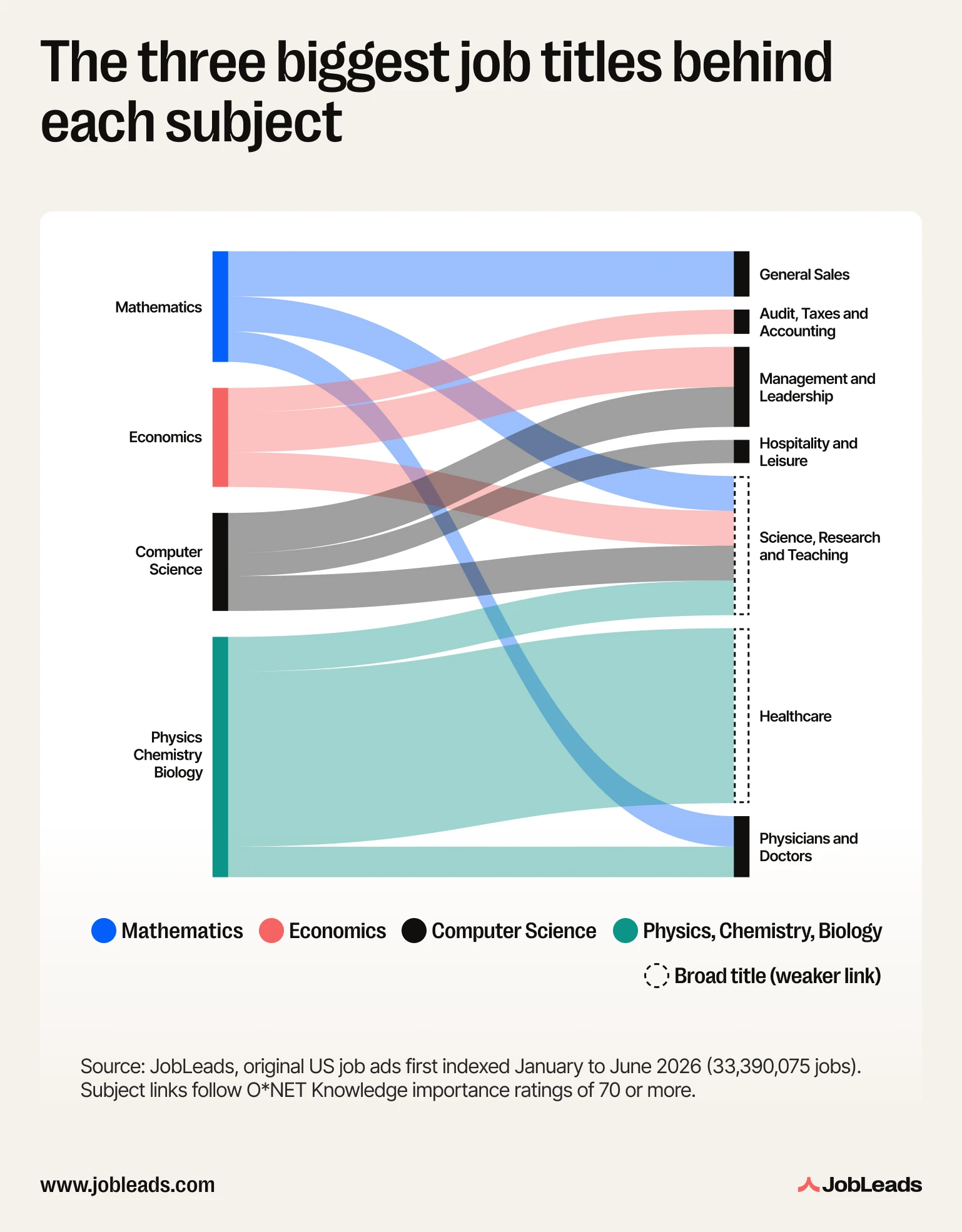
Of 33,390,075 US job ads, 70% sit in careers where at least one of the six subjects is rated important by O*NET.
| Subject | % of all US job ads |
|---|---|
| Mathematics | 35% |
| Physics | 31% |
| Chemistry | 30% |
| Biology | 30% |
| Computer Science | 28% |
| Economics | 18% |
| Any of the six | 70% |
Many careers draw on more than one subject, so the subject shares overlap and add up to more than 70%. A healthcare role, for example, is counted under Physics, Chemistry and Biology. The 70% total counts each ad only once.
Now–compare that with official STEM jobs, such as software developers, engineers, mathematicians and scientists. The US Bureau of Labor Statistics counts STEM occupations as just 6% of US employment in 2025. In other words, STEM subjects matter in far more jobs than STEM job titles cover. Keep in mind that the two figures measure different things: BLS counts workers by occupation, while this study counts job ads by the subjects they draw on.
A note on framing: Economics isn't one of the four letters in STEM. It's included because it is a quantitative school subject that students weigh up alongside Math and the sciences. The US Department of Homeland Security also lists Econometrics and Quantitative Economics on its STEM Designated Degree Program List. Engineering, the E in STEM, isn't tracked as a separate school subject here as its foundations sit in Math and Physics.
Throughout this article, "STEM-linked career" is shorthand for a career linked to at least one of the six subjects.
Mathematics is the most widely used subject in the US job market. It links to 35% of job ads, about one in three.
The largest single destination isn't finance, data or engineering. It's General Sales, followed by Education, and then Medicine.
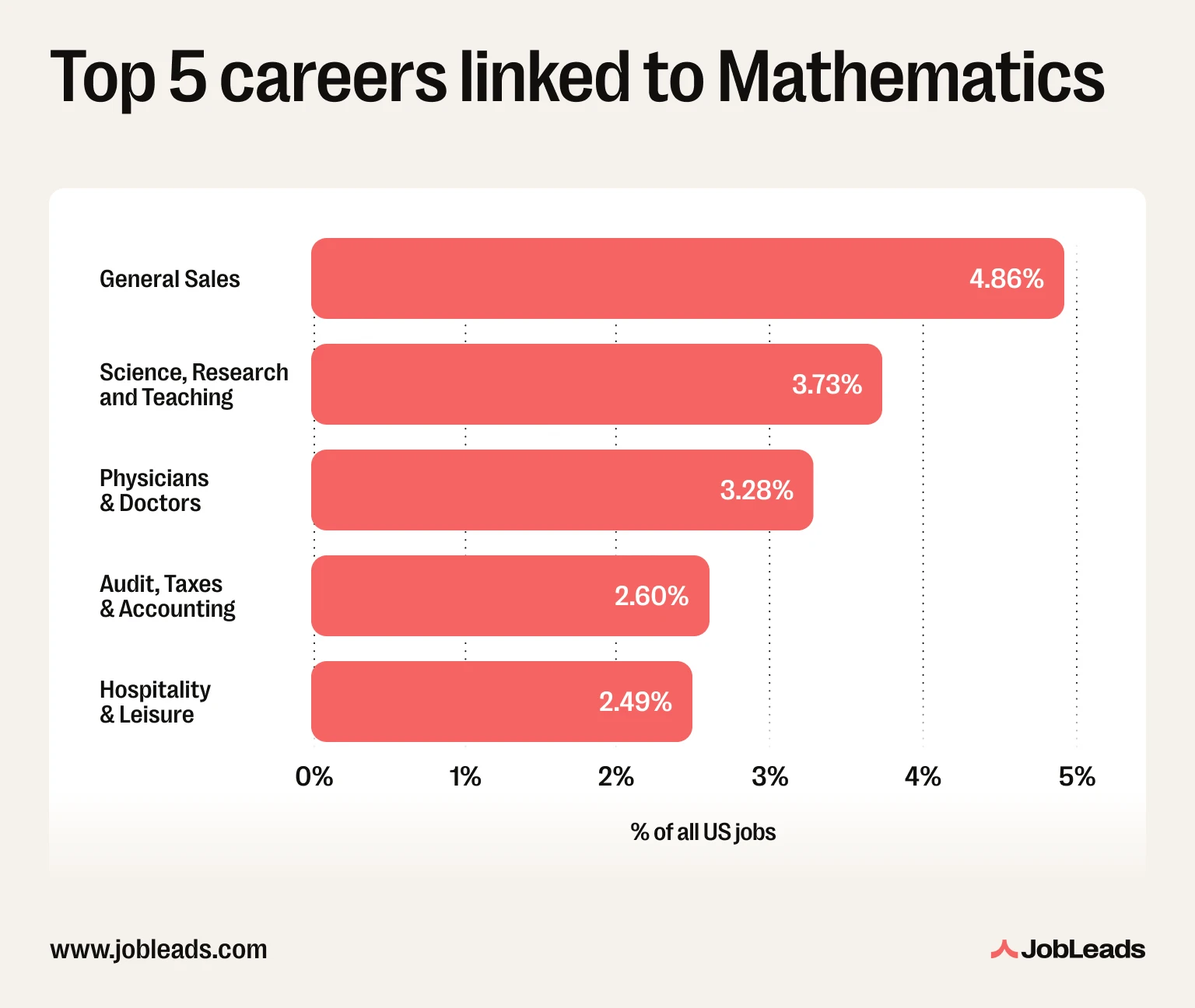
That doesn't mean every sales job needs math. The link runs through wholesale and manufacturing sales representatives, an occupation where O*NET rates Mathematics at 74 out of 100 for importance. The work involves pricing, margins, volume discounts and forecasts, so a sales rep may use more math day to day than a lot of jobs with "analyst" in the title.
From there, math-linked jobs spread across 47 career areas, more than any other subject.
Looking at those numbers Math looks more like a portfolio than a single career.
Ask students where Physics and Chemistry lead, and the lab is the usual answer. Biology might bring medicine to mind, but mostly as a route to becoming a doctor. The job market says it's the hospital, and well beyond the doctor's office.
Healthcare is the largest career for Physics, Chemistry and Biology alike, with 19% of all US job ads. Lab science (Biology, Biotech & Chemistry) accounts for less than 1% of all US jobs.
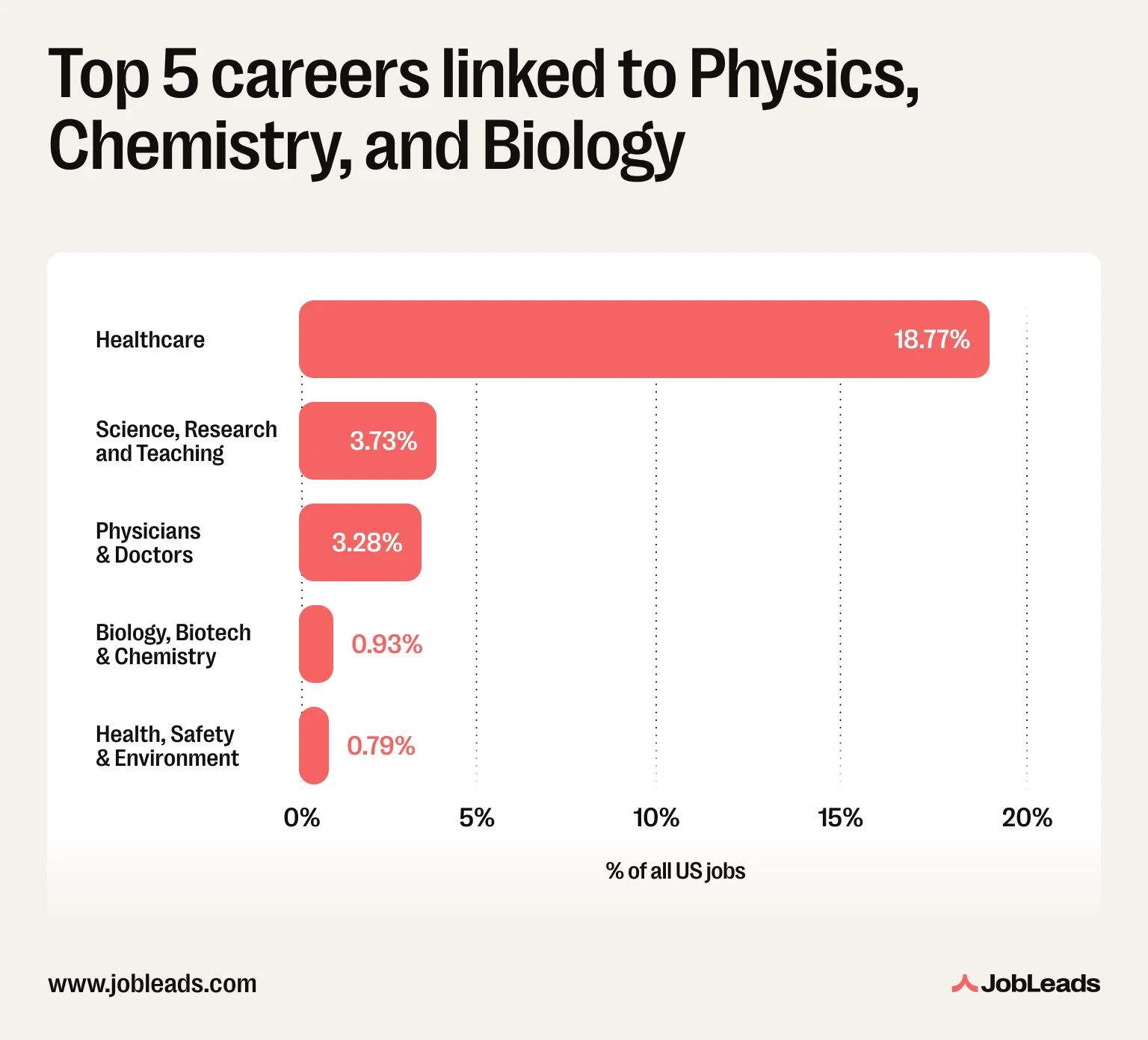
The evidence sits in specific occupations. For Physics, it's diagnostic medical sonographers and radiologic technologists, who use the physics of sound waves and radiation every shift. For Chemistry, it's nurse anesthetists and clinical lab technologists.
One caveat: Healthcare is a broad category in this dataset, covering everything from nursing to imaging. Some of those jobs lean on science much more heavily than others, so 6,268,807 is the size of the career area, not a count of jobs where Physics or Chemistry is used every day.
But the direction is clear. A science subject is far more likely to lead to patient care than to a research bench.
The largest career for Computer Science isn't Software Development, it's Management & Leadership, with 4% of all US jobs. Software Development has just over 1% and ranks 8th of 31 career areas.
Hospitality & Leisure and Installation, Maintenance & Repair also outrank Software Development. The links run through lodging managers, who run booking and revenue systems, and through repairers of computers, office machines and electronic equipment.
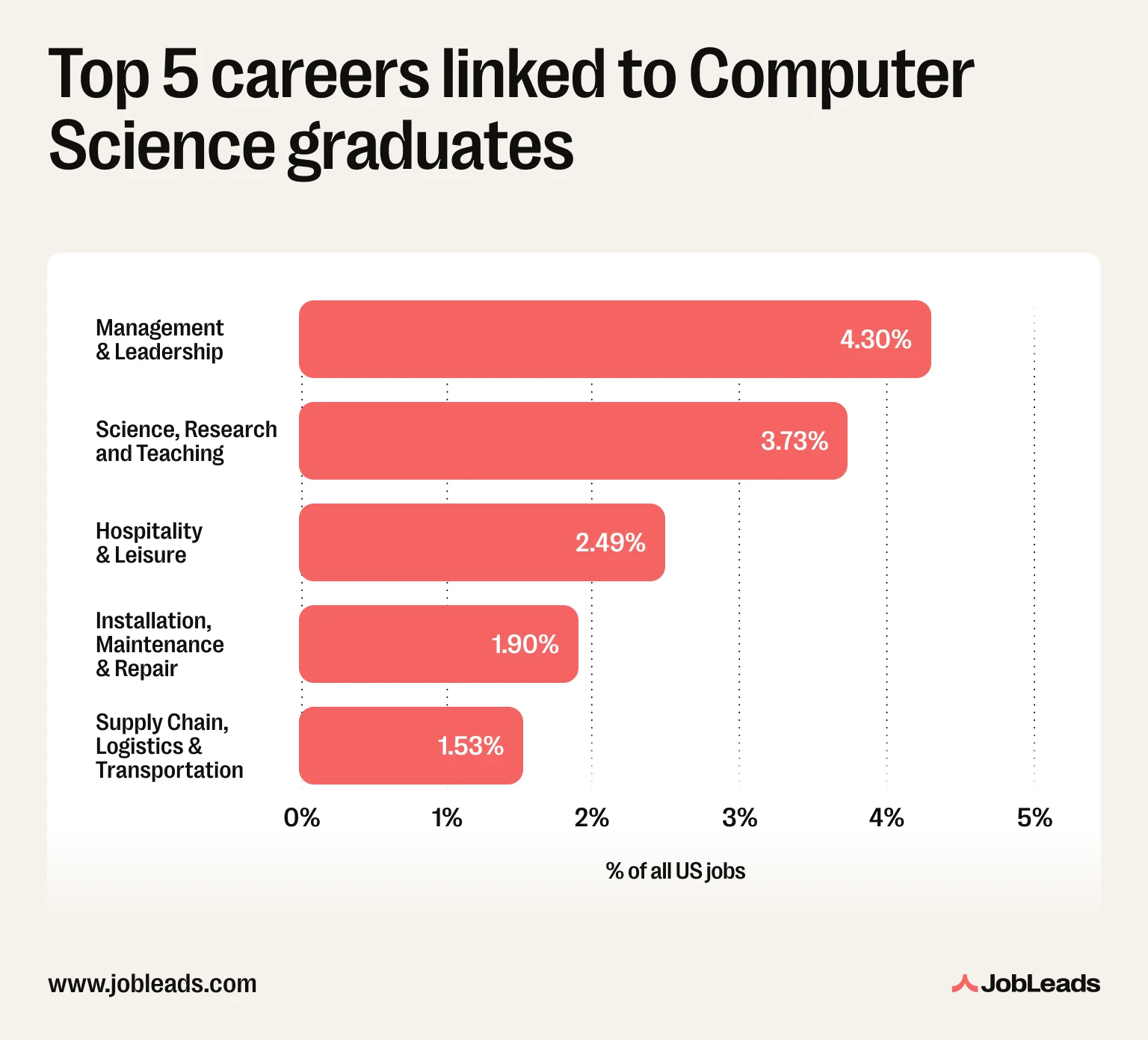
One caveat: the Management figure rests on a single role, chief executives. O*NET rates their computer knowledge at 71 out of 100. So the figure shows how big the career area is, not how many managers use computer science every day. O*NET's measure, "Computers and Electronics", also covers more than coding.
In other words, digital skills now sit inside non-tech jobs, not only next to them. The technology students learn in a computer science classroom ends up running hotels and fixing equipment as often as it ends up in code.
National STEM Day events and school resources usually feature the same few STEM careers: the physicist, the coder, the rocket engineer, the quant. In this data, those are some of the smallest destinations their subjects lead to.
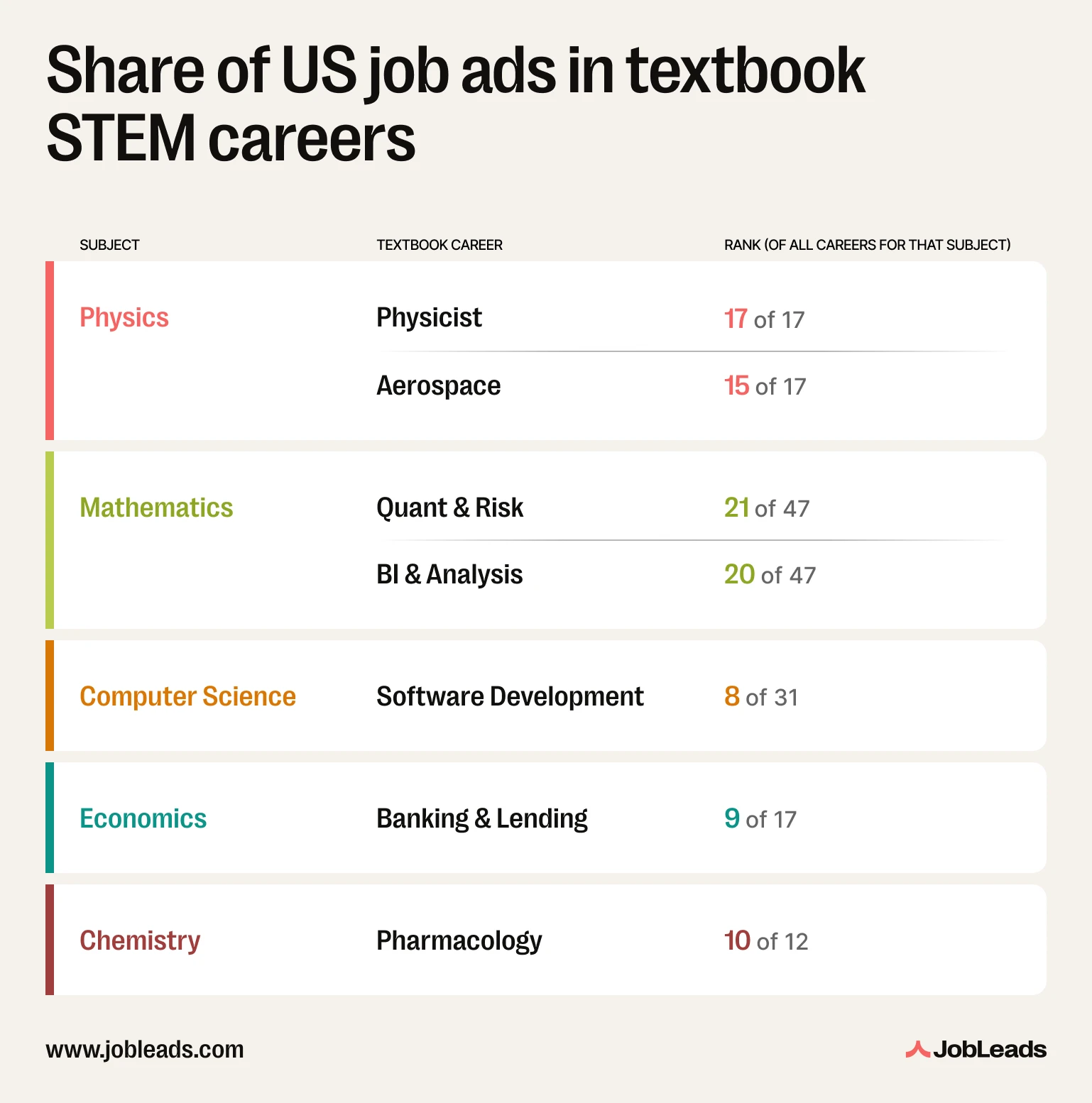
Physicist roles account for 12,717 jobs, last of the 17 careers Physics leads to. Despite being the face of STEM Day, none of these textbook careers holds more than 2% of US job ads.
Graduates already live this gap. Sociologist John D. Skrentny finds that as many as 70% of STEM graduates opt out of STEM work.
But–there's one exception. Lab science ranks 4th for both Chemistry and Biology, so the lab does stay close to the top for those two subjects, even if it's far behind Healthcare.
Location changes where STEM subjects lead. In West Virginia, nearly 76% of job ads are in STEM-linked careers, the highest share of any state. Washington, DC has the lowest at 65%.
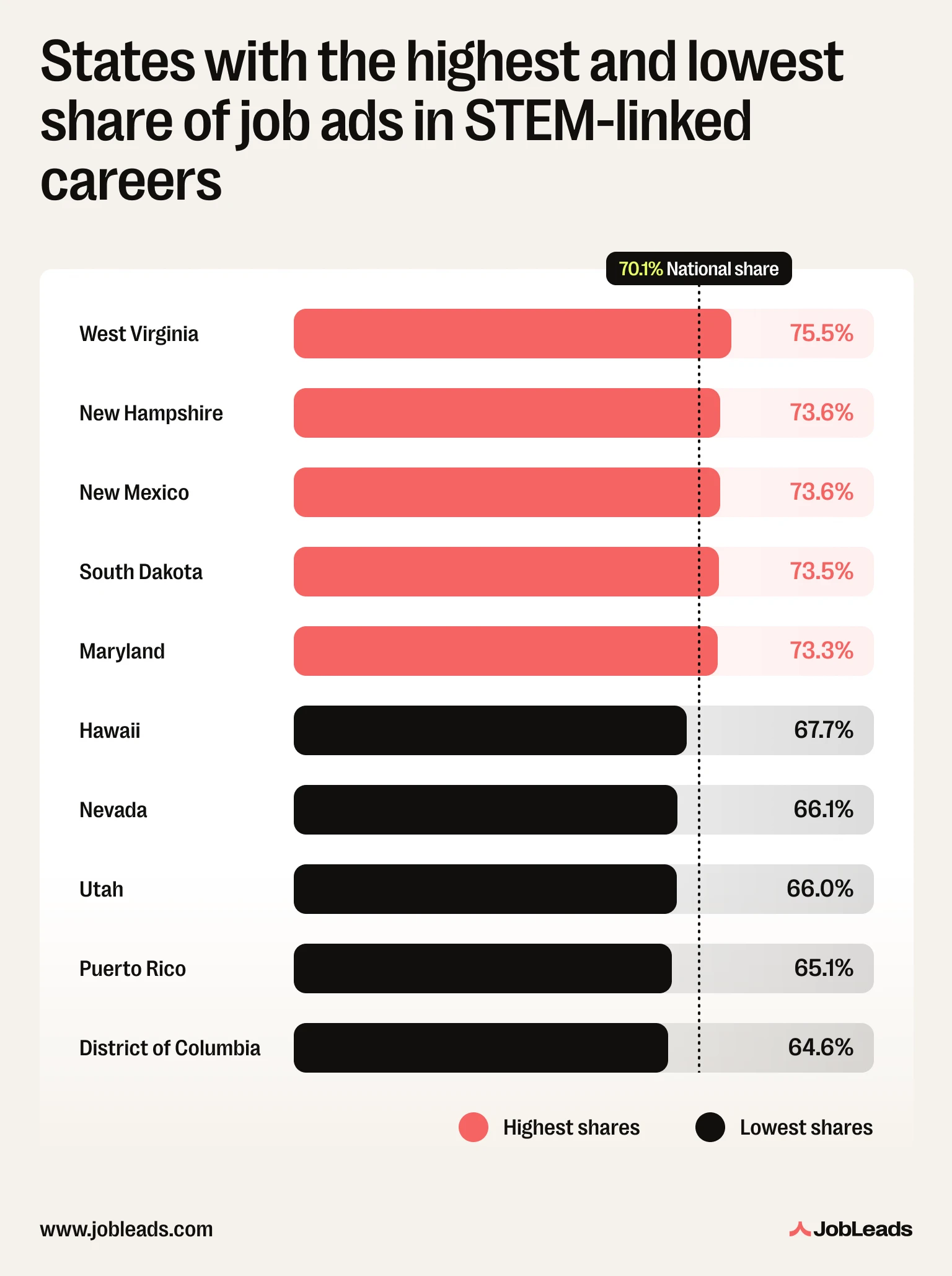
West Virginia (75.5%) is followed by New Hampshire (73.6%), New Mexico (73.6%), South Dakota (73.5%) and Maryland (73.3%). At the other end, DC (64.6%), Puerto Rico (65.1%), Utah (66.0%), Nevada (66.1%) and Hawaii (67.7%) have the lowest shares.
West Virginia's lead is sharpest in the sciences. About 43% of its jobs are in Physics-linked careers, 12 percentage points above the US average of 31%. It also tops the rankings for Chemistry and Biology. This could be because Healthcare, the biggest career for all three sciences, makes up a larger share of jobs there.
DC shows the opposite picture. Despite having the lowest STEM-linked share overall, DC leads the country on Computer Science-linked careers, with neighboring Virginia and Maryland also in the top five. The science-heavy states trail: West Virginia ranks second to last on Computer Science.
So "STEM" means different things on different maps: science around hospitals in smaller states, and computing around the federal capital.
Remote work doesn't spread STEM careers evenly either. In Connecticut, 57% of remote job ads are in a STEM-linked career, against 72% across all of the state's jobs. That's a gap of over 14 percentage points, the widest in the country.
West Virginia goes the other way: 81% of its remote jobs are STEM-linked, nearly 6 points above its 76% overall. That's on top of having the highest overall share in the country.
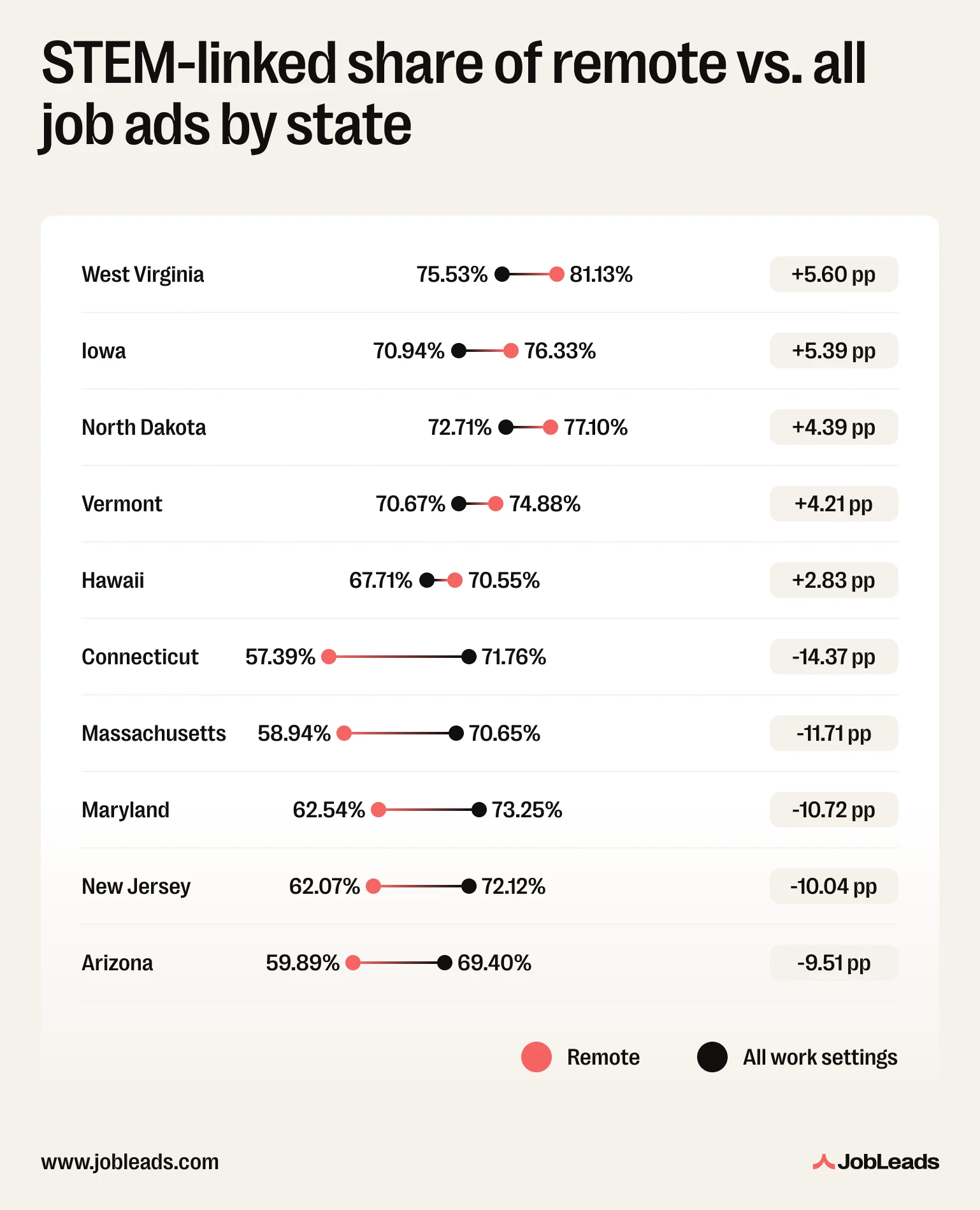
This suggests remote STEM opportunities follow local industry. Where linked careers are mostly hands-on, as in healthcare, remote listings tend to come from other fields. Where linked careers include more desk-based roles, more of them go remote.
What does this mean for students and job seekers?
If you're picking subjects, or deciding what to do with the ones you've got, the data points one way. Choose for the range of careers a subject opens, not for one job title.
Start by looking past the classic career list. Physics' biggest market is in hospitals, not labs. And computer knowledge links to 3.5 times as many management jobs as software jobs, and to as many art and culture jobs as software development jobs. Math is the safest bet, linking to 47 career areas and one in three US jobs. And where you live matters: the same subject leads to different careers in West Virginia than in DC.
Use STEM Day to explore growing careers. Officially defined STEM jobs are projected to grow 7% between 2025 and 2035, against 3% for all other jobs (BLS). But aim for skilled roles, whatever the title: STEM degree holders earn the biggest premiums in high-skill jobs, STEM or not, and little to none in basic-skill ones (Zhang & Liu, Industry and Higher Education).
Job seekers deserve to see the whole market, not just the jobs on the poster. A student who loves math might never picture themselves in sales, and someone who studies physics might never think of a hospital. Yet that's where most of the demand is. Knowing that early can change what you study and where you look for work.
Jan Hendrik von Ahlen – Co-Founder and Managing Director at JobLeads
Bottom line: on National STEM Day, the most honest career advice is that STEM subjects lead almost everywhere, just rarely to the jobs on the poster.
Dataset: 33,390,075 US job ads that first appeared on JobLeads between January and June 2026.
JobLeads is a career platform that aggregates job listings and connects professionals with relevant opportunities. These figures count job ads, not filled vacancies.
Classification: Each ad was classified into one of 135 JobLeads industry and job-title pairs (plus a small group of ads with no industry or title). A job title here means that classification, not the title written in the ad.
Subject matching: Each title was matched to the US Department of Labor's O*NET Knowledge ratings for six subjects: Mathematics, Physics, Chemistry, Biology, Computer Science and Economics. Engineering and accounting aren't school subjects, so they aren't linked. A subject was linked to a title when O*NET rated its importance at 70 or more out of 100. O*NET rates importance from 1 ("Not Important") to 5 ("Extremely Important") and converts it to a 0–100 scale (O*NET OnLine), so 70 equals 3.8 on the original scale. This gave 137 subject–title links across 76 titles, 7 of which are broad titles that cover several occupations.
Counting rules: A job linked to several subjects counts once under each subject, so subject totals overlap. The "any subject" total counts each job once. State shares use each state's own job total, across 52 regions (50 states, DC and Puerto Rico). A job posted in several states counts in each. Remote, hybrid and on-site shares are compared with the same state's share across all work settings.
Limitations:
Ethics: All data is aggregated and anonymized. No individual job seeker or employer data is reported.
Journalists and media organizations are welcome to reproduce charts and data from this article with attribution to JobLeads and a link to this page. Please do not reproduce the article in full without permission. For questions, additional data, or interview requests, contact press@jobleads.com.

Content & Insight Writer
Beata creates content that puts job seekers first. From practical blog advice to first-hand research studies, her writing is designed to give people the clarity and confidence to find the role they deserve.
Job Market TrendsJobLeads ranked the 50 biggest US cities for graduates by what's left after rent, not headline pay. See where a starting salary stretches furthest.
 Job Market Trends
JobLeads analyzed UK entry-level job postings between H1 2025 and H1 2026 and found they're falling. Here's what that means for graduates job hunting right now.
 Job Market Trends
JobLeads studied responses from thousands of job seekers on their application process. Learn the real number behind how many applications it takes.