
 Job Market Trends
October 21, 2026
Unrealistic Job Requirements Aren't Why No One Applies [Study]
JobLeads analyzed 1.4M US job ads. Jobs that get clicks but no applications don't ask for too much. They're just vague about what they need.


Have you ever wondered how much your salary would change if you switched from working in the office to working remotely–or vice versa? Or are you suspecting your company is lowballing you?
As return-to-office mandates clash with worker demands for flexibility, compensation has quietly become the deciding factor. Yet most tech professionals are making this choice blind, unaware of how their work location directly impacts their paycheck.
JobLeads analyzed 121,370 US tech job postings across 42 standardized roles to reveal how work location affects pay in 2026. The findings expose a pattern companies don't advertise: where you work determines not just your lifestyle, but your earning power.
Key remote vs. on-site salary in tech statistics:
Read more: Check out the annex with the complete remote vs. on-site salary comparison across all 42 tech roles analyzed.
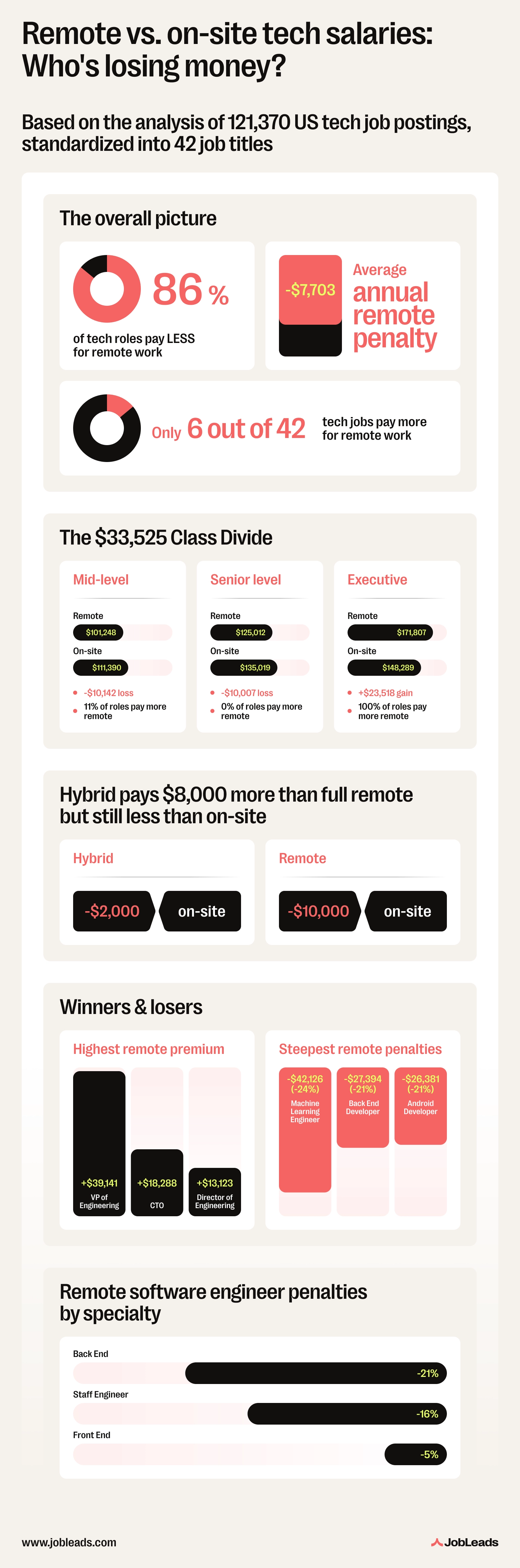
Across 42 tech job titles analyzed, the average remote worker earns $7,703 less annually than their on-site counterpart. The median penalty sits at $6,626, resulting in a 6% pay cut for the privilege of working from home.
This isn't a small adjustment or cost-of-living tweak. It's a devaluation of remote work that affects 36 out of 42 roles analyzed. This means that only six positions (just above 14% of the tech job market) pay more for remote work than on-site.
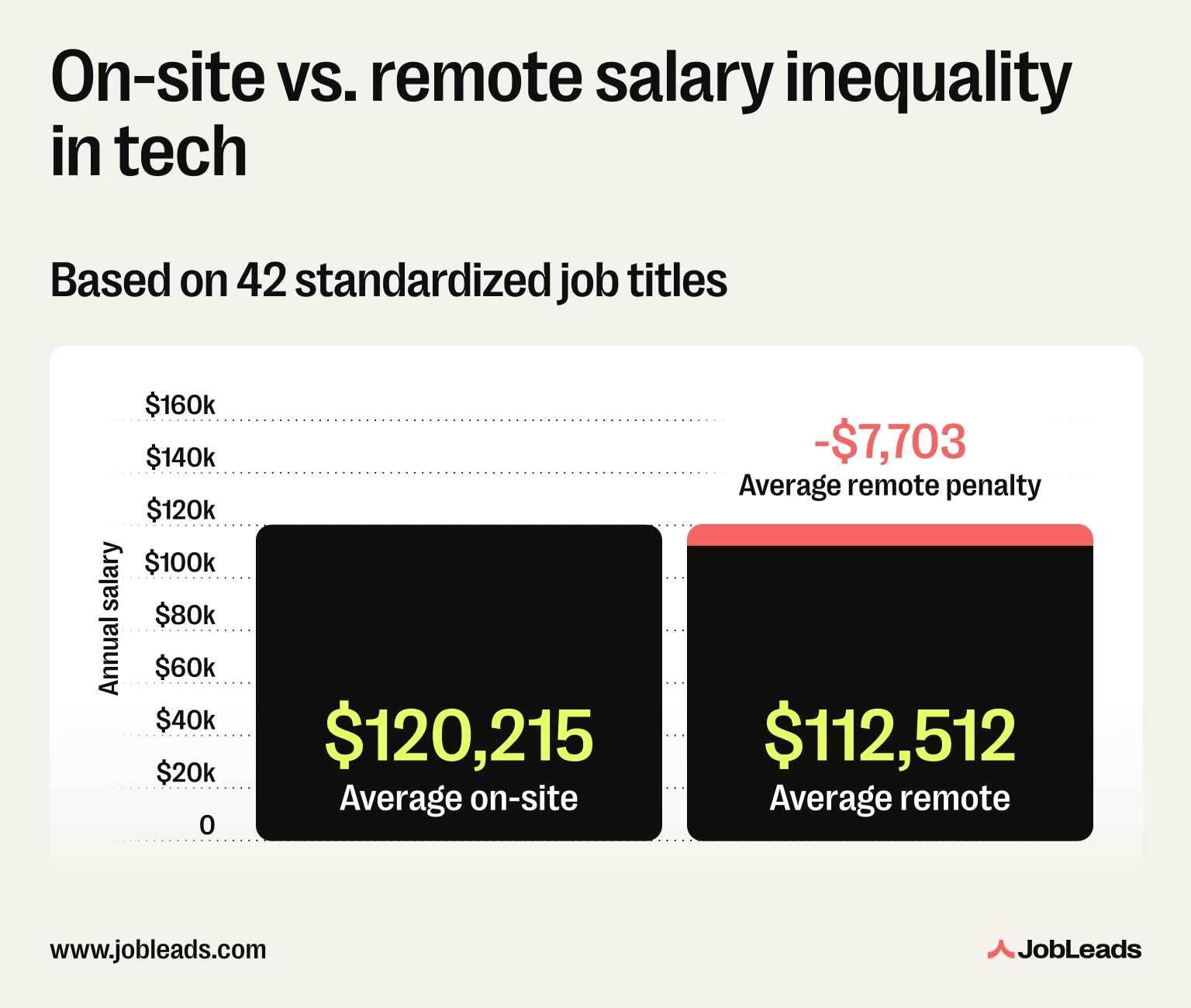
People are used to associating remote work with location independence, higher quality of life, and great flexibility. While these remain true, there is a high cost emerging. Most remote workers are losing thousands annually for flexibility, whether they realize it or not.
But averages hide the real story. The "remote penalty" isn't distributed evenly across all roles and seniority levels.
When remote work is already becoming more and more scarce, we are seeing a real “compensation hierarchy” based on seniority levels of remote employees.
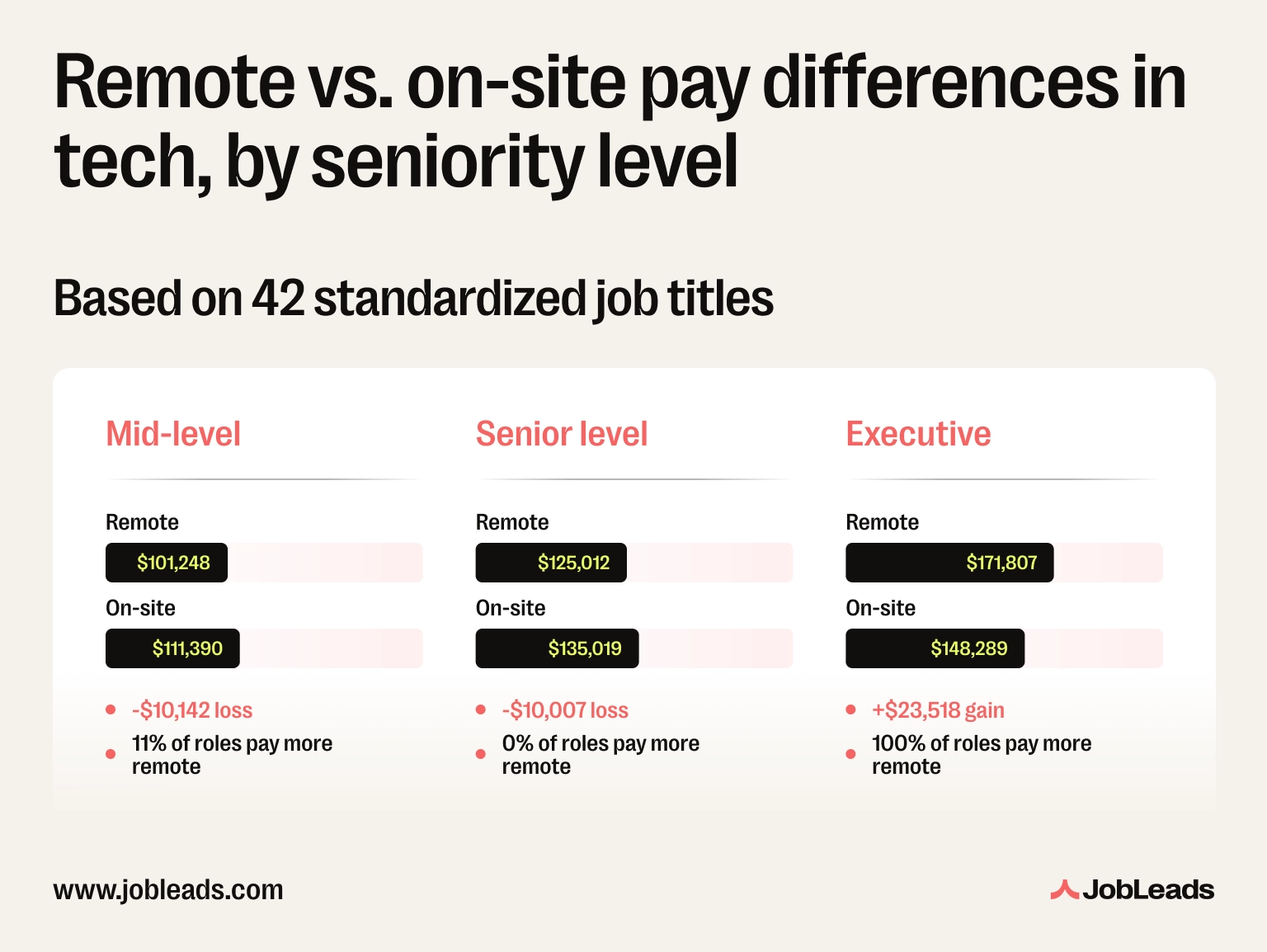
JobLeads’ analysis reveals an interesting pattern: where you sit in the org chart determines whether remote work boosts or tanks your earnings. Remote work increases executive pay by 16% ($23,518 on average), while mid-level workers take a 9% pay cut ($10,142) for the same arrangement. Senior professionals lose roughly $10,000, too. The pattern is consistent: remote work pays at the top of the org chart and costs everywhere below it.
| Seniority level | Avg. annual salary on-site | Avg. annual salary remote | Difference | % of roles paying more remote |
|---|---|---|---|---|
| Mid-level | $111,390 | $101,248 | -9% | 11% |
| Senior | $135,019 | $125,012 | -7% | 0% |
| Executive | $148,289 | $171,807 | +16% | 100% |
We clearly see that the only tech employees winning financially from remote work are executive-level professionals at the top of the career ladder. The rest are paying the true "remote tax."
The executive advantage:
On the flip side, not a single senior-level role commands a remote premium. Senior engineers, senior product managers, senior data scientists all face pay cuts when they work from home. Mid-level workers fare slightly better, but only 3 out of 28 roles (11%) pay more remotely.
The remote specialist money trap:
So, when remote work is offered as a benefit, it's important to remember the unspoken truth: benefits may vary by level.
Hybrid work is often sold to employees as a compromise: you get the flexibility of remote and some on-site collaboration. According to our research, when it comes to salaries, hybrid is far from a "win-win" situation.
In general, hybrid work pays less than on-site when it comes to senior and mid-level specialists:
But executives break the pattern entirely:
At the executive level, every work mode beats on-site pay. Executives earn more working hybrid than in the office full-time, reinforcing the class divide where flexibility costs workers money but earns executives more.
Still, salaries of mid and senior hybrid workers beat those of fully remote ones:
For most tech roles, choosing hybrid means accepting approximately $2,000 less annually compared to going into the office full-time. Workers are paying for the "privilege" of working from home two to three days a week.
In a market where almost 86% of roles penalize remote workers, six positions stand out as exceptions. These remote jobs that pay well don't just offer flexibility but are ready to pay higher salaries for it.
The highest paying remote jobs when compared to the same positions on-site include:
VPs lead distributed teams, set strategy, and drive results regardless of location. If you're targeting high paying remote jobs, executive leadership is where remote work actually increases your value.
Chief Technology Officers command remote premiums across all companies analyzed. The role transcends geography and results matter more than physical presence.
Engineering directors managing multiple teams see remote work as an advantage, not a limitation. Companies pay more for directors who can lead distributed organizations effectively.
The surprise on this list. QA engineers testing distributed systems and remote deployments become more valuable working remotely. They test what customers actually experience, which increasingly means remote infrastructure.
Project managers coordinating distributed teams and asynchronous workflows see modest remote premiums. The role requires coordination skills that work regardless of location.
Security analysts monitoring threats, responding to incidents, and analyzing logs might perform even better with focus time away from office distractions. Companies pay slightly more for this focused remote work.

For the 86% of roles that pay less to remote workers, the cuts are substantial and consistent. Many face career-altering pay differences that compound over time.
| Job title | Avg. on-site salary | Avg. remote salary | Annual loss | % remote penalty |
|---|---|---|---|---|
| Machine Learning Engineer | $174,102 | $131,977 | -$42,126 | -24% |
| Back End Developer | $132,732 | $105,337 | -$27,394 | -21% |
| Android Developer | $124,397 | $98,016 | -$26,381 | -21% |
| Technical Product Manager | $145,359 | $122,668 | -$22,691 | -16% |
| Staff Software Engineer | $141,135 | $119,135 | -$22,000 | -16% |
| iOS Developer | $115,432 | $97,399 | -$18,033 | -16% |
| Security Architect | $128,731 | $109,015 | -$19,717 | -15% |
| Data Scientist | $148,191 | $129,035 | -$19,155 | -13% |
| Site Reliability Engineer | $133,106 | $116,200 | -$16,906 | -13% |
| Senior Product Manager | $179,894 | $160,562 | -$19,332 | -11% |
The roles with the worst remote pay cuts have one thing in common. They're individual contributors without executive-level negotiating power. Remote Machine Learning Engineers lose $42,126 compared to their on-site colleagues, Back End Developers $27,394, and Senior Product Managers have a pay cut $19,332. Meanwhile, VPs gain $39,141.
The work itself isn't the issue since all these roles can be performed remotely. The penalty exists because companies can get away with paying less. Individual contributors accept the cuts (if they're even aware of them). But Executives don't have to.
The remote pay gap is driven by market dynamics and worker preferences that companies have learned to leverage. Here's what research actually shows.
A 2025 Harvard-Brown-UCLA study analyzing real job offers from companies like Google, Apple, and Meta found that tech workers are willing to sacrifice 25% of total compensation to avoid commuting. In fact, multiple reports show candidates routinely accept 5-15% salary reductions for remote work. When workers signal they'll accept less for flexibility, companies feel free to adjust their pay accordingly.
According to JobLeads's survey, 74% of workers would always choose remote work, even when aware that remote jobs on average pay less than those on-site.
Stanford economist Nicholas Bloom's research found companies save approximately $11,000 per remote employee annually through reduced real estate and facilities costs. When it comes to remote vs. office work comparison, companies save thousands per remote worker while paying them thousands less. And these cost savings flow to profits, not worker compensation.
When roles go fully remote, geographic hiring constraints disappear and candidate pools expand dramatically. As a result, downward wage pressure is becoming structural rather than temporary, and job seekers who once commanded a location premium are now competing directly with candidates willing to accept lower offers from anywhere in the country (or even the world).
If you suspect you are facing a remote salary penalty, these strategies can help narrow the gap:
Use tools like Levels.fyi, Glassdoor, and this study's data to understand compensation policies for your role. Use it to request specific compensation, for example: "The market shows your role at $X for remote work. I'm requesting $Y based on my track record."
If you are open to moving, a 15% pay cut can equalize or even increase your real earnings if you relocate strategically. For example: $135K in San Francisco ($42K rent) = $93K real earnings, while $115K remote in Austin ($21.6K rent) = $93.4K real earnings, plus $7K in commute/parking/lunch savings.
There are plenty of companies that pay location-agnostic salaries because remote is their default model, not a perk. Famous examples of remote-first companies include Hotjar, Toptal, Airbnb, Buffer, and more. Research those companies and apply strategically.
If base salary is fixed, you can try to negotiate additional stock grants. At startups and mid-size tech companies, equity can narrow or even fully eliminate remote penalties. So, pay attention to the Benefits section in job descriptions and look out for stock options, pension saving plans, private healthcare, wellness budgets, and similar perks.
Read more: Check out the top 6-figure salary jobs most job seekers overlook.
The data reveals an uncomfortable truth: remote work in tech has created a two-tier compensation system based on seniority. Executives earn $23,517 more remotely while 86% of other roles face pay cuts averaging $7,703 annually. This $33,525 class divide reflects fundamental differences in negotiating power between leadership and individual contributors.
For most tech workers, the question isn't whether remote work pays less (it does), but whether the tradeoff makes sense when it comes to freedom and flexibility. Location arbitrage, reduced expenses, and quality-of-life gains can offset salary penalties for some workers. For others, especially those losing $25K+ annually, the math doesn't work. The key is understanding your specific situation and negotiating accordingly.
Workers need to approach remote opportunities with clear eyes, calculating real earnings rather than nominal salary, and recognizing that flexibility comes with a price tag.
This study analyzed salary data for tech roles to understand how work location affects compensation in 2026.
Dataset:
Feel free to access the full dataset.
For each job title, we calculated average on-site salary and average remote salary, then computed the percentage differences. Roles were analyzed by seniority level to identify patterns in how remote work affects compensation at different career stages.
Limitations:
| Job title | Avg. on-Site salary | Remote salary | Difference in annual earnings | Difference in annual earnings in % |
|---|---|---|---|---|
| VP of Engineering | $183,607 | $222,747 | +$39,140 | +21.3% |
| CTO | $104,710 | $122,998 | +$18,287 | +17.5% |
| Director of Engineering | $156,550 | $169,673 | +$13,123 | +8.4% |
| QA Engineer | $98,290 | $107,388 | +$9,097 | +9.3% |
| Project Manager | $91,017 | $94,291 | +$3,274 | +3.6% |
| Information Security Analyst | $87,648 | $89,523 | +$1,874 | +2.1% |
| IT Manager | $86,492 | $86,365 | -$126 | -0.1% |
| Technical Support Engineer | $91,770 | $91,433 | -$337 | -0.4% |
| Network Engineer | $100,124 | $98,215 | -$1,908 | -1.9% |
| Business Intelligence Analyst | $95,794 | $93,884 | -$1,909 | -2.0% |
| DevOps Engineer | $113,349 | $111,010 | -$2,339 | -2.1% |
| Scrum Master | $86,630 | $83,980 | -$2,649 | -3.1% |
| Mobile Developer | $121,687 | $118,278 | -$3,409 | -2.8% |
| System Administrator | $90,102 | $86,623 | -$3,478 | -3.9% |
| Cloud Architect | $114,195 | $110,450 | -$3,745 | -3.3% |
| Cybersecurity Engineer | $113,981 | $108,793 | -$5,187 | -4.6% |
| Principal Software Engineer | $128,266 | $123,052 | -$5,214 | -4.1% |
| Engineering Manager | $120,179 | $114,571 | -$5,607 | -4.7% |
| Software Architect | $151,680 | $146,029 | -$5,650 | -3.7% |
| Front End Developer | $121,180 | $114,857 | -$6,323 | -5.2% |
| Senior Data Scientist | $142,842 | $136,280 | -$6,562 | -4.6% |
| UX Designer | $99,054 | $92,364 | -$6,689 | -6.8% |
| Data Analyst | $99,635 | $92,887 | -$6,747 | -6.8% |
| Solutions Architect | $142,663 | $133,133 | -$9,530 | -6.7% |
| Product Manager | $106,035 | $96,016 | -$10,019 | -9.4% |
| Data Engineer | $98,084 | $87,725 | -$10,358 | -10.6% |
| Cloud Engineer | $109,730 | $99,090 | -$10,639 | -9.7% |
| Software Engineer | $128,281 | $117,312 | -$10,968 | -8.6% |
| Full Stack Developer | $89,337 | $76,854 | -$12,483 | -14.0% |
| Senior Software Engineer | $149,132 | $136,531 | -$12,600 | -8.4% |
| Product Designer | $99,455 | $84,504 | -$14,951 | -15.0% |
| UI Designer | $104,421 | $89,280 | -$15,140 | -14.5% |
| Site Reliability Engineer | $133,105 | $116,200 | -$16,905 | -12.7% |
| iOS Developer | $115,431 | $97,398 | -$18,033 | -15.6% |
| Data Scientist | $148,190 | $129,035 | -$19,155 | -12.9% |
| Senior Product Manager | $179,894 | $160,562 | -$19,332 | -10.7% |
| Security Architect | $128,731 | $109,014 | -$19,716 | -15.3% |
| Staff Software Engineer | $141,134 | $119,134 | -$22,000 | -15.6% |
| Technical Product Manager | $145,359 | $122,668 | -$22,690 | -15.6% |
| Android Developer | $124,397 | $98,016 | -$26,381 | -21.2% |
| Back End Developer | $132,731 | $105,337 | -$27,394 | -20.6% |
| Machine Learning Engineer | $174,102 | $131,976 | -$42,125 | -24.2% |
If our study helped you better understand the difference between on-site and remote tech salaries, feel free to share any insights or statistics from this study. Please remember to credit JobLeads as the source and include a link back to this page. Thank you!

Digital PR & Content Marketing Manager at JobLeads
Maryia leads digital PR and outreach at JobLeads. Her work has earned coverage in Fast Company, AOL, Forbes, Fortune, Quartz, and ZDnet—and she specialises in building the systems that make that happen at scale.
Job Market TrendsJobLeads analyzed 1.4M US job ads. Jobs that get clicks but no applications don't ask for too much. They're just vague about what they need.
 Job Market Trends
JobLeads data across six countries shows part-time job clicks tripling since 2024 in the US, even as survey data shows fewer Americans have side hustles.
 Job Market Trends
JobLeads studied responses from thousands of job seekers on their application process. Learn the real number behind how many applications it takes.