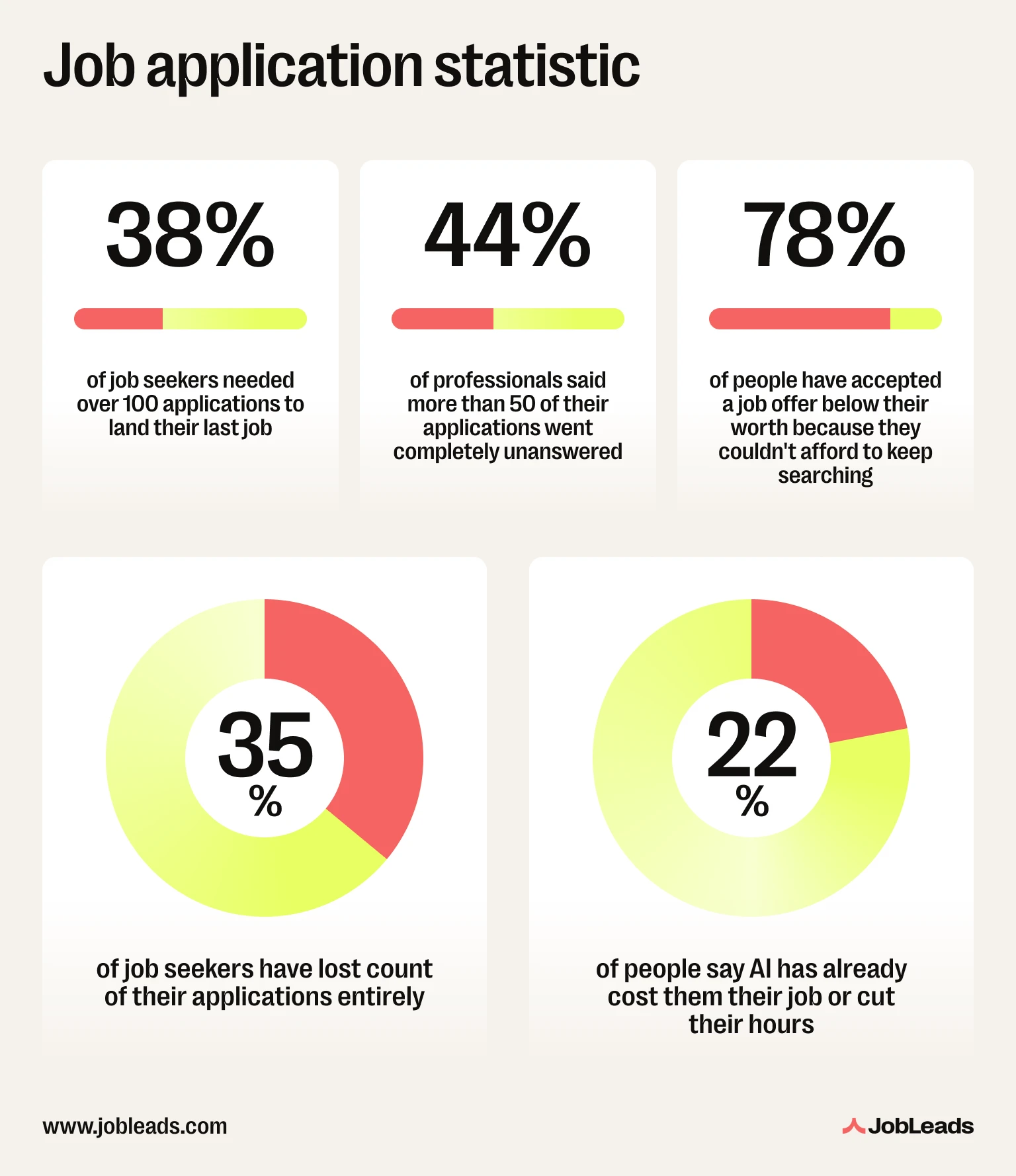
As many as 44% of job seekers say more than 50 of their job applications have gone completely unanswered–not even an automated rejection.
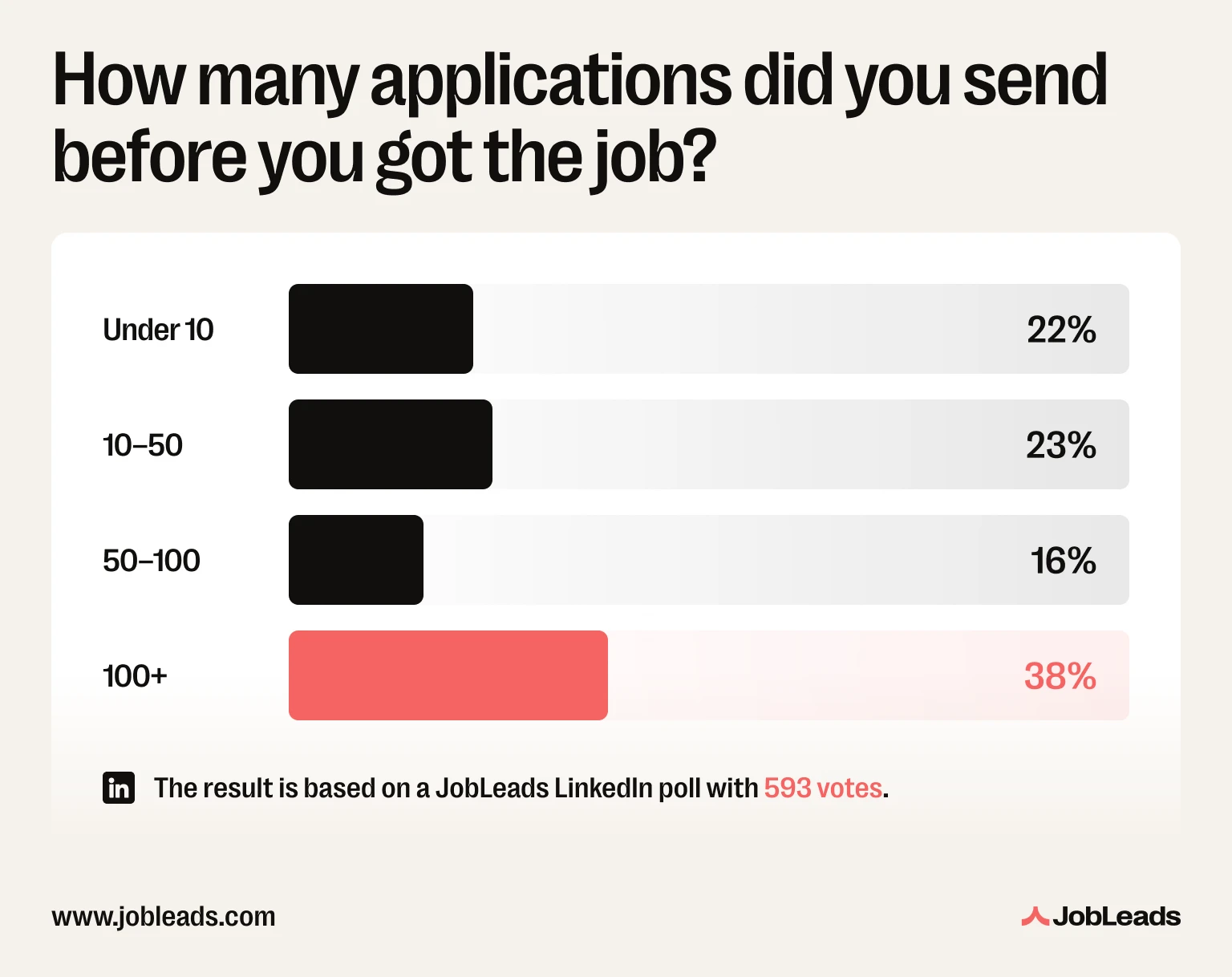
So how many applications does it take to get a job? Ask job seekers directly, and the answer is blunt: 38% of professionals said it took over 100 applications to land their last job. And only 22% got there in fewer than 10.
These findings come from five JobLeads LinkedIn polls with 593 to 3,367 votes each. So, what should candidates expect from their job search? Here's the data.
Key takeaways
A whopping 38% of job seekers needed over 100 applications to land their last job–only 22% needed fewer than 10
Over 44% of professionals said more than 50 of their applications went completely unanswered–not even an automated rejection
As many as 78% of people have accepted a job offer below their worth at some point because they couldn't afford to keep searching
Among job seekers polled on when the search "breaks" them, 35% say they've lost count of their applications entirely, and another 27% are past 100
AI plays a role in how tough the job market is–22% of people say AI has already cost them their job or cut their hours
Only about a fifth of professionals landed a job in fewer than 10 tries. On the other side of the spectrum, 38% needed 100 or more applications. This is enough to raise a fair question:
How many jobs should you apply for before it starts to feel excessive?
That frustration shows up outside this poll, too. In Indeed's Workforce Insights Report, nearly half of workers (49%) agreed that most job application processes are "too long and complicated". Also, 71% said they were open to a new role, but only 60% felt actually prepared to apply for one.
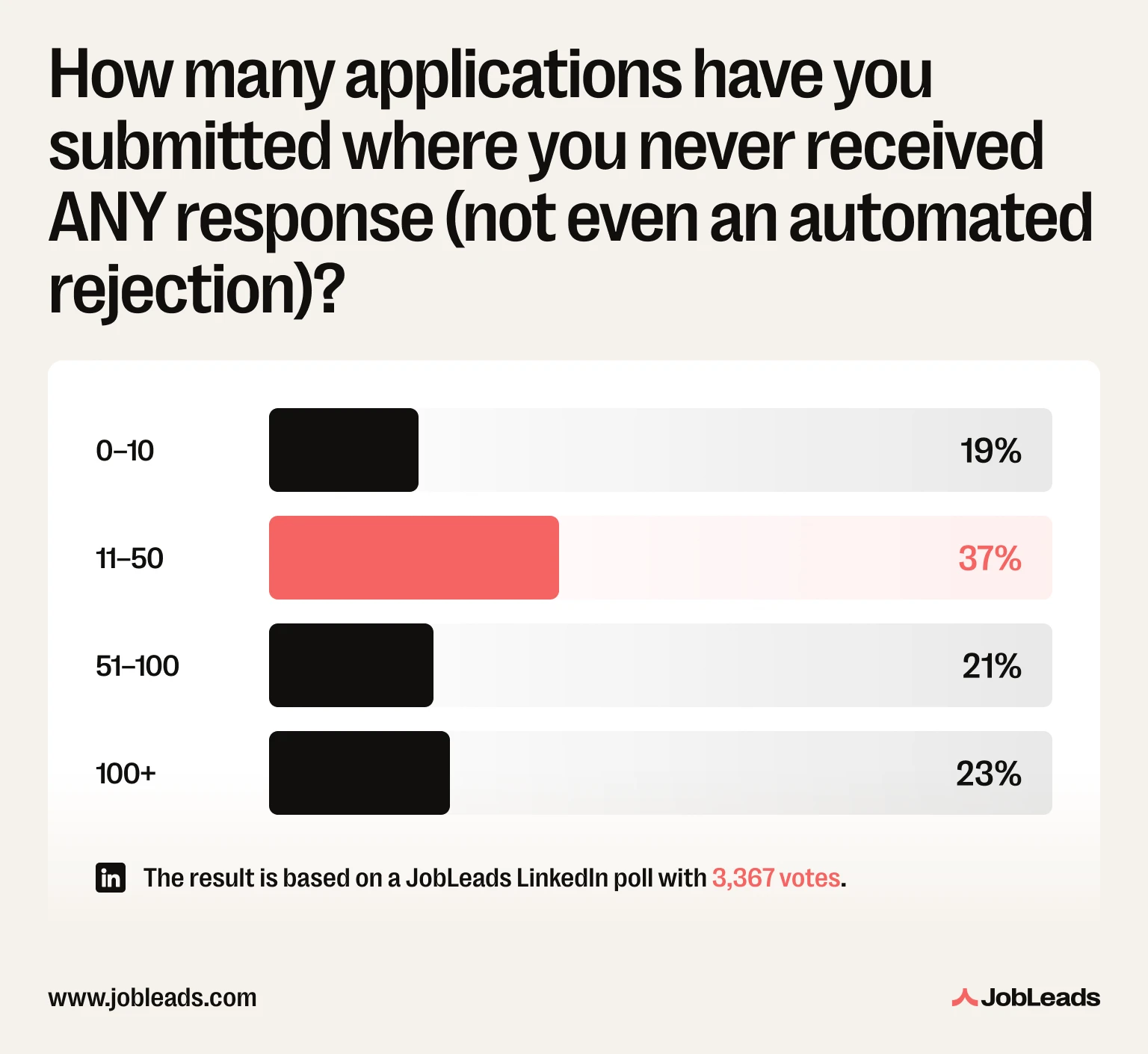
A separate JobLeads poll asked how many applications job seekers sent that went completely unanswered–not even an automated rejection:
As many as 44% said over 50 of their applications disappeared into total silence. And 37**%** said that between 11 and 50 of their applications went unanswered. The waiting itself is its own job search anxiety, separate from the odds of any single application working out.
Some of that silence may not be about visibility alone. In a ResumeBuilder.com survey of hiring managers, 40% said their company had posted a fake job listing in the past year, and 30% had one active at the time of the poll. This doesn't explain why job seekers get ghosted but it shows one factor that plays into it.
A JobLeads survey asked directly: have you ever accepted a job offer below your worth because you couldn't afford to keep searching?
Response
Share of respondents
Yes, I had no choice
45%
Yes, but I kept looking anyway
33%
No, I waited for the right one
12%
No, it's never happened to me
11%
Combined, 78% of professionals have settled for less than they were worth at some point. This is a different pressure than competition or visibility. A long, silent search costs time but more importantly, for most job seekers polled, it eventually costs leverage too. Which is exactly the leverage salary negotiation depends on once an offer is finally on the table.
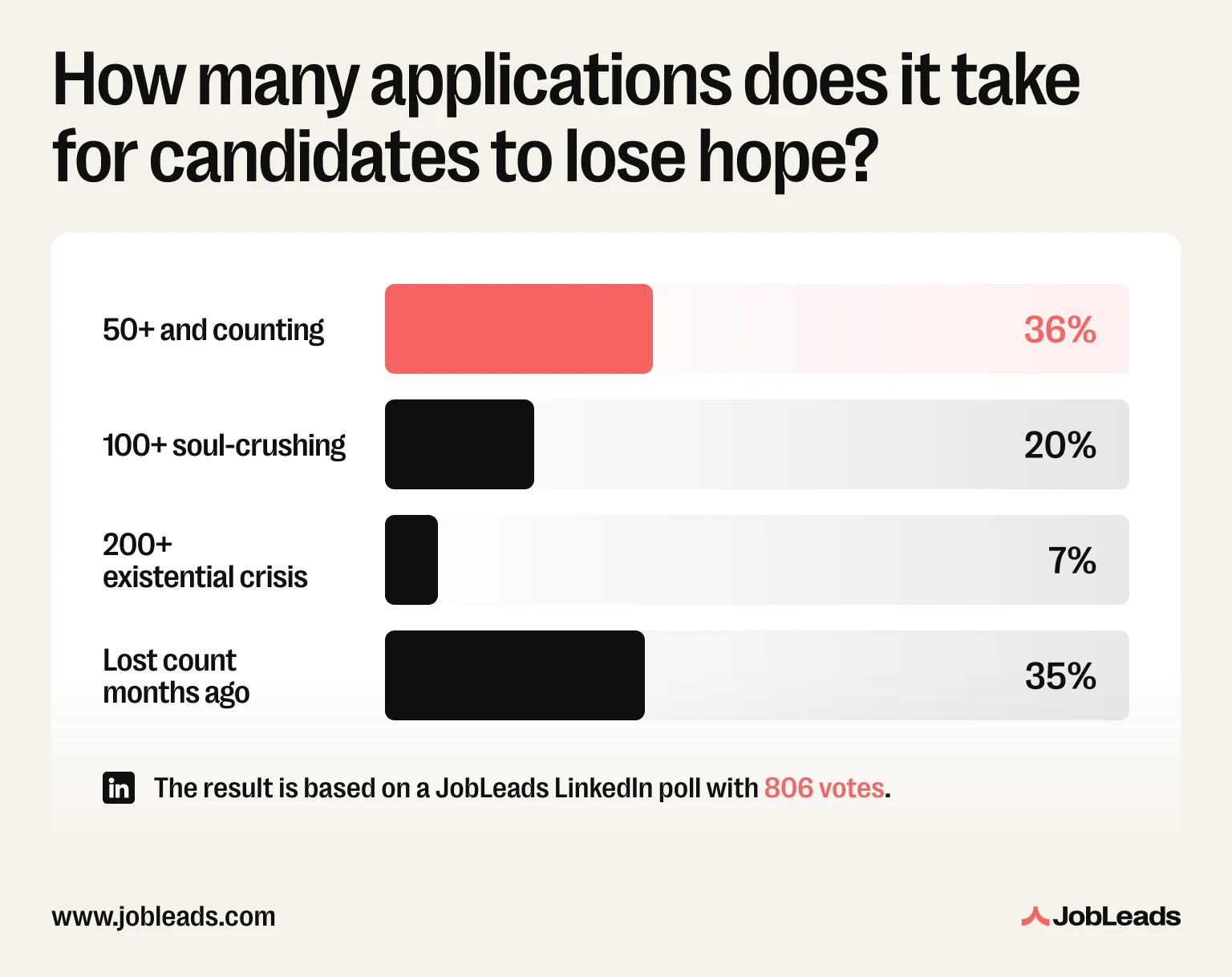
Here's how many applications it takes for candidates to lose hope:
The near-even 36%/35% split between over 50 applications and "lost count months ago" suggests a threshold effect. Counting works as a coping mechanism up to a point as a way to measure effort and stay oriented, but past that point the number itself becomes hard to face. That's when people stop tracking rather than watch it climb.
Counting applications gives people a sense of control early on. It's proof that they're doing the work. But once the number gets big enough, it stops feeling like progress and starts feeling like a verdict. Letting go of the count is often a way of protecting motivation, and that's worth recognising.
Jan Hendrik von Ahlen – Co-Founder and Managing Director, JobLeads
This also suggests that people who answered "lost count" are likely around the 100+/200+ applications mark. Meaning the real share of candidates past 100 applications could be closer to 62%.
Part of the answer of why the applicant pool keeps growing may have something to do with the reasons people are let go. A JobLeads poll asked people whether AI implementation had reduced or cut their role. Here are the results:
Response
Share of respondents
Yes, laid off entirely
15%
Yes, hours or tasks cut or changed
7%
No, but seen it happen
20%
No, not affected
58%
As many as 22% of professionals were directly affected. A further 20% haven't been personally affected but have seen it happen to someone else.
That lines up with a separate, unrelated pattern in the JobLeads' platform data: applications per job seeker climbed over 9% quarter over quarter between Q1 and Q2 2026. More people applying, more often.
The two datasets weren't designed to be compared, and this article can't prove AI displacement is driving the volume increase. But a labor pool being pushed back into search is one plausible thread connecting them.
The self-reported numbers here aren't encouraging.
A plurality of job seekers need 100-plus applications to land an offer. Nearly half of candidates say most of their applications vanish without so much as an automated rejection. On top of that, most people who've settled for less did it because they ran out of time, not because the offer was right.
None of that means volume is the answer. There's no dataset available anywhere that names exactly how many applications to send, or how many jobs you should apply for per week, to guarantee an offer.
You can improve your chances by replacing the 200 random applications with 10 strategic ones. So, optimize for ATS and apply through a trusted platform to avoid ghost jobs. This will help you land the job quicker.
All five are independent LinkedIn polls, self-reported and non-scientific, run to different audiences at different times. They cannot be joined at the individual level. This article never implies, for example, that the same respondents who needed 100-plus applications in Poll 1 are also the ones who settled for less pay in Poll 2. Each finding stands on its own poll's sample.
Platform data (supporting): applies per applied job by country, H1 2026, across 42 countries (applied jobs = distinct postings with at least one apply-click; total applies = raw apply-click events, not deduplicated; rate = total applies ÷ applied jobs); and a quarterly platform summary, Q1–Q2 2026 (jobs posted, clicks, applies, distinct users, and rates).
Limitations:
All five polls are self-reported, self-selected LinkedIn audiences, not scientific samples, and each carries its own recall or survivorship bias (Poll 1's respondents, for instance, could only answer because they eventually got hired).
Poll 4's answer options only offered escalating-frustration framings, with no option describing an easy or fast search–it measures intensity among people already deep in a hard search, not job seekers overall.
No dataset here, poll or platform, tracks true applications-to-hire for an individual; both are proxies.
The applies-per-applied-job rate excludes the postings with zero applies, so it measures crowding conditional on a posting already drawing interest, not the overall odds of getting any response.
JobLeads gates applying behind payment, which likely suppresses its raw applies-per-job rate relative to open job boards; these numbers shouldn't be cross-compared to non-JobLeads benchmarks.
Poll 5's AI-displacement data and the platform's application-volume growth are presented side by side as a plausible connection, not a proven causal link. The two datasets weren't designed to be compared.
Data collected and analyzed: December 2025 - August 2026 (polls), H1 2026 (platform data).
Feel free to share the findings, statistics, and graphics from this study for editorial and non-commercial purposes. Please credit JobLeads with a link back to this page, so readers can see the full methodology and context. Any third-party findings referenced here should be attributed to their original source. For questions, additional data, or interview requests, contact press@jobleads.com.
Beata creates content that puts job seekers first. From practical blog advice to first-hand research studies, her writing is designed to give people the clarity and confidence to find the role they deserve.
Frequently asked questions
There's no verified number as no platform tracks a full application-to-hire loop. A JobLeads poll found that 38% of job seekers needed over 100 applications, though 22% needed fewer than 10. This shows that the rate is rather individual.
Extremely common. In a JobLeads poll, only 19% of job seekers said 10 or fewer of their applications went completely unanswered. On the other hand, 44% said they never heard back for more than 50 of their applications.
Rarely. You might get a rejection email but you're also likely to not hear back from the company at all. In a JobLeads poll, 81% of job seekers said 11 to over 100 of their applications never got any response–not a call, not an automated email, nothing. Silence, not an explicit rejection, is the more common outcome.
No, according to JobLeads' data, 23% of job seekers needed between 10 and 50 applications to get hired. Also, 38% needed over 100 applications before landing a job.
There's no dataset that defines an ideal weekly number. What data does show is that volume alone isn't what's rewarded, as per JobLeads' survey, 44% of job seekers never got any reply for over 50 of their applications. Prioritizing which postings to apply to as well as tailoring each application matters more than raising the number sent per week.



 Job Market Trends