Remember when everyone said, learn AI or get left behind?
People listened.
Millions of professionals rushed to add AI skills to their resume. Employers responded just as quickly, adding "AI knowledge required" to job descriptions across industries.
But when everyone has the same skill, what happens to its value? Where do all these jobs actually lead? And what does AI literacy even mean nowadays?
We analyzed 110K job postings with AI literacy skills in the requirements to understand what the AI hiring explosion really created. The answers surprised us.
Key findings:
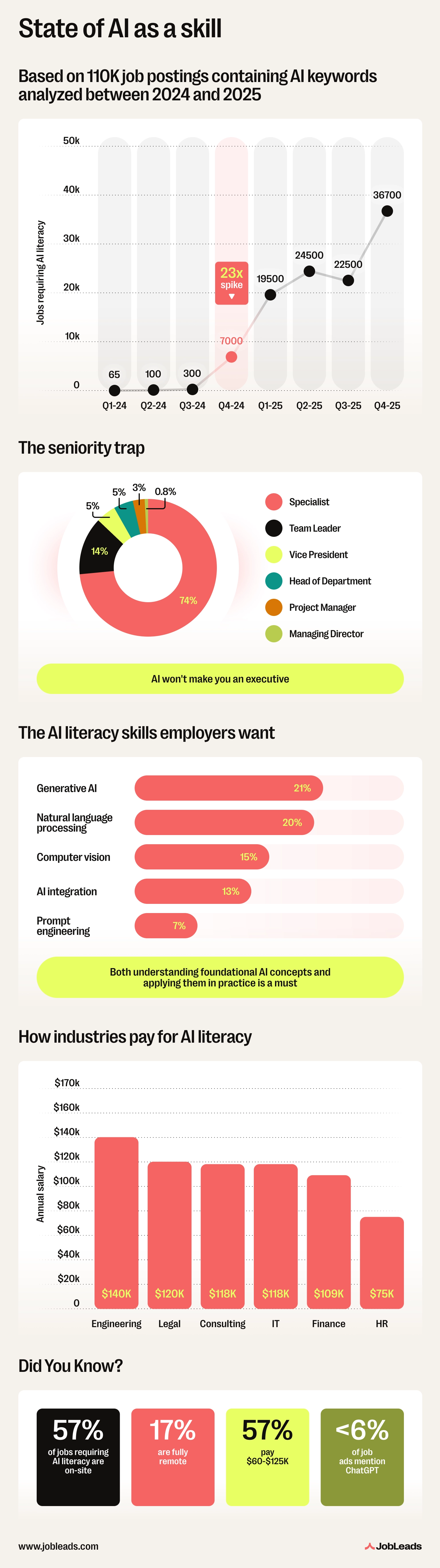
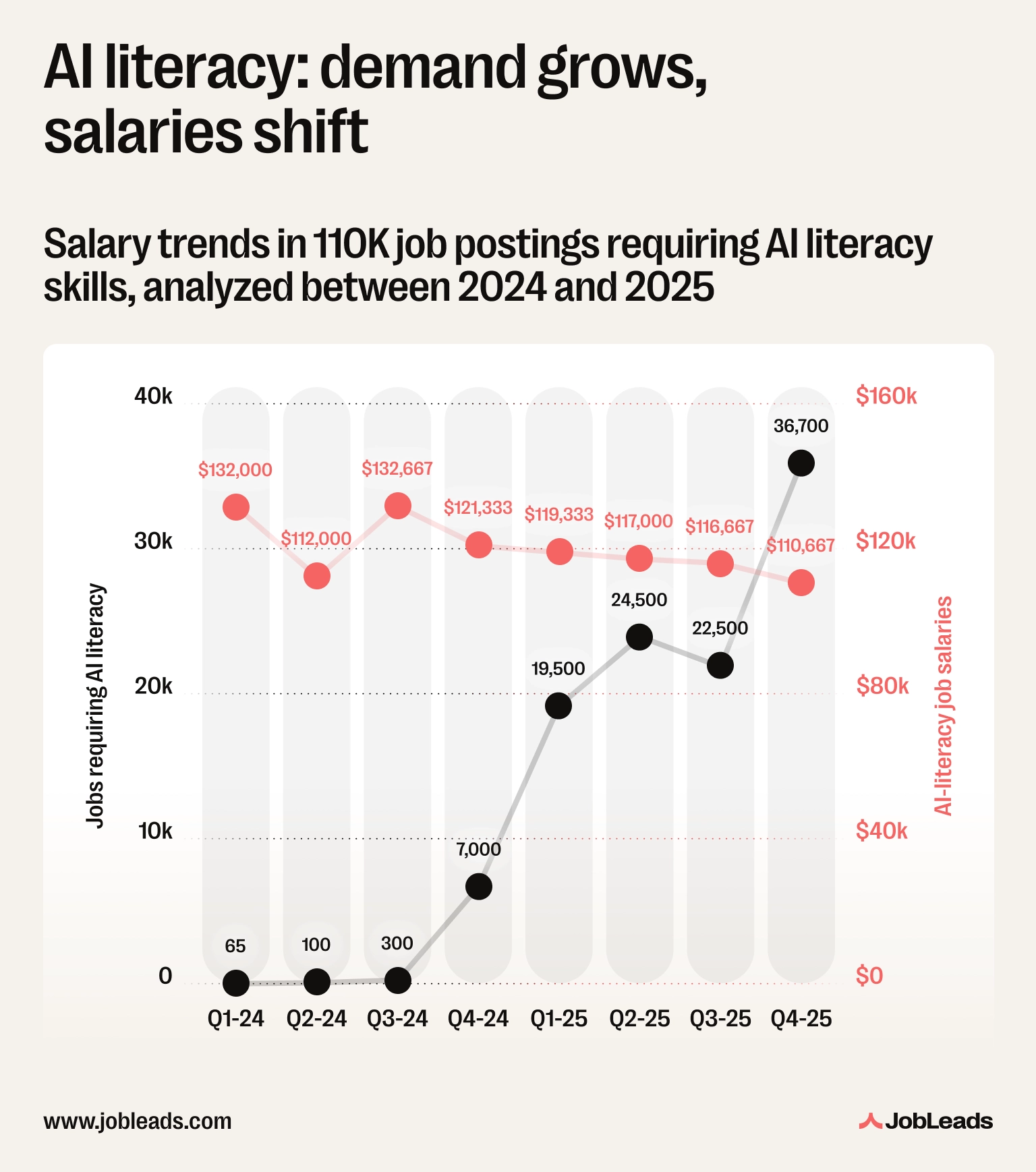
- Jobs requiring AI literacy exploded 1,300% between 2024 and 2025, but average salaries fell around 4% on a year-over-year basis
- Q4 2024 saw a 23x spike in one quarter as every company rushed to add "AI skills required" to job descriptions
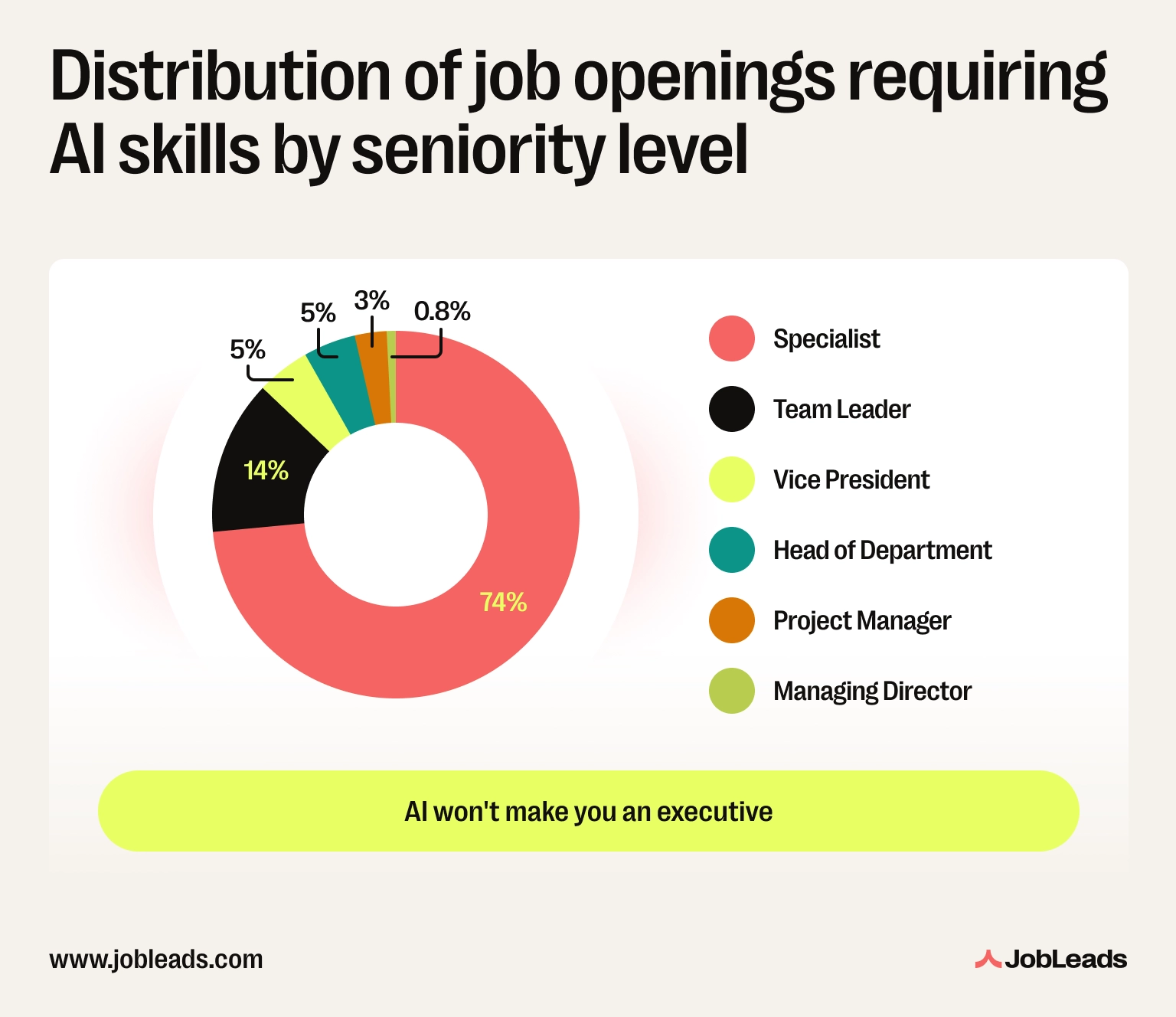
- About 74% of jobs requiring AI literacy are mid-level specialist positions, and only 0.8% are Managing Directors
- Marketing & Media jobs saw the biggest paradox: +2,551% growth but -7.5% salary for jobs that require AI skills
- Industry often matters more than skills. The same AI expertise pays $140K in Engineering but only $75K in HR
- More than 57% of AI jobs are on-site and only 17% fully remote, despite AI being entirely digital work
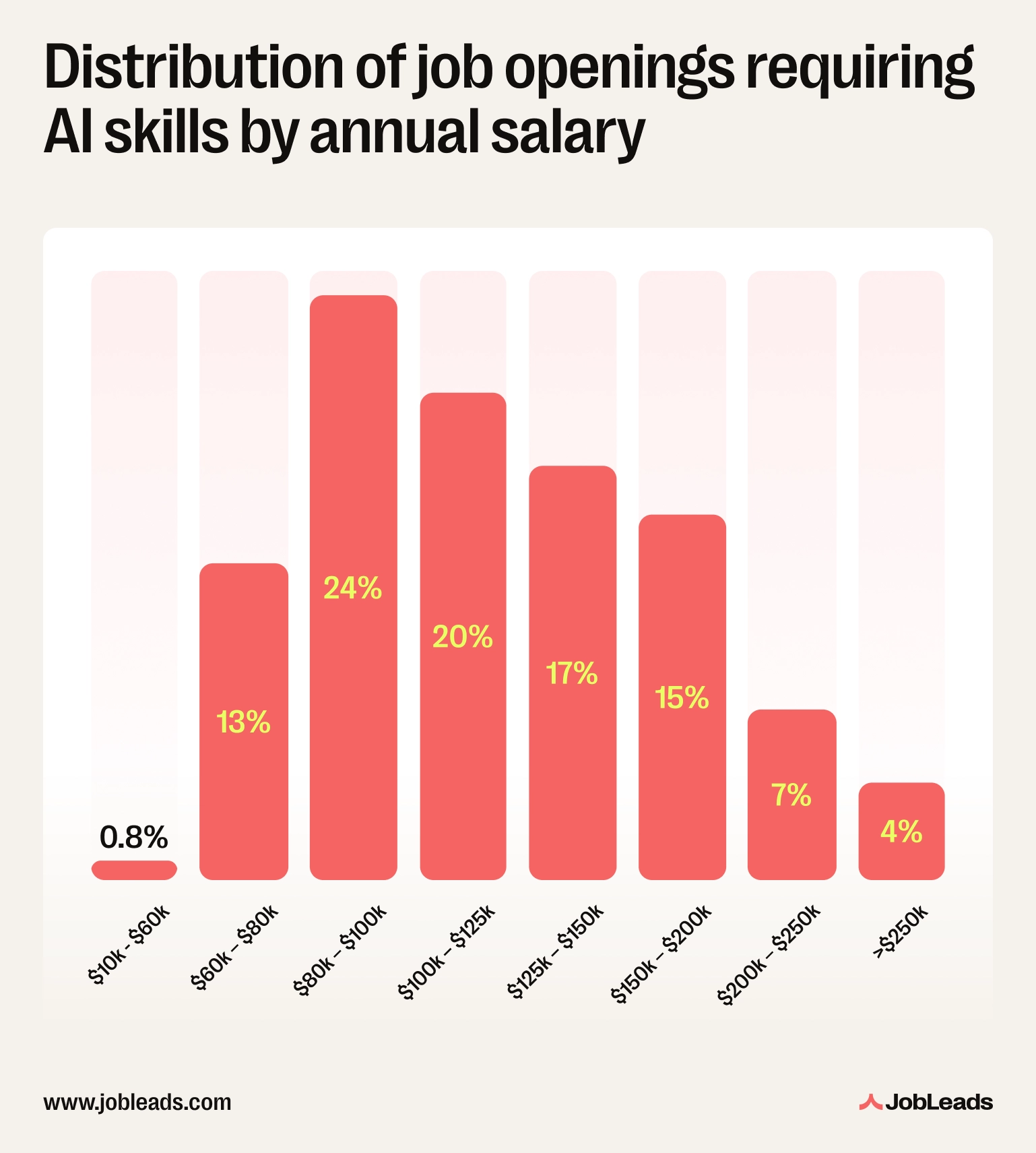
- Jobs with AI literacy required span all salary ranges: 24% cluster at $80K-100K, but 52% pay six figures ($100K-200K), and 11% reach executive compensation ($200K+)
- HR commoditized AI most: 22% of HR AI jobs are entry-level ($10K-60K), the highest share of any industry
- Consulting is the industry that offers the most six-figure salaries (70%) for AI literacy skills
The numbers paint a picture of what happened when AI went mainstream. Let's dive deeper into specific insights and how they affect the job market.
To understand how we got here and what it means for job seekers and companies, we need to look at the timeline, the industries, and the skills employers actually want.
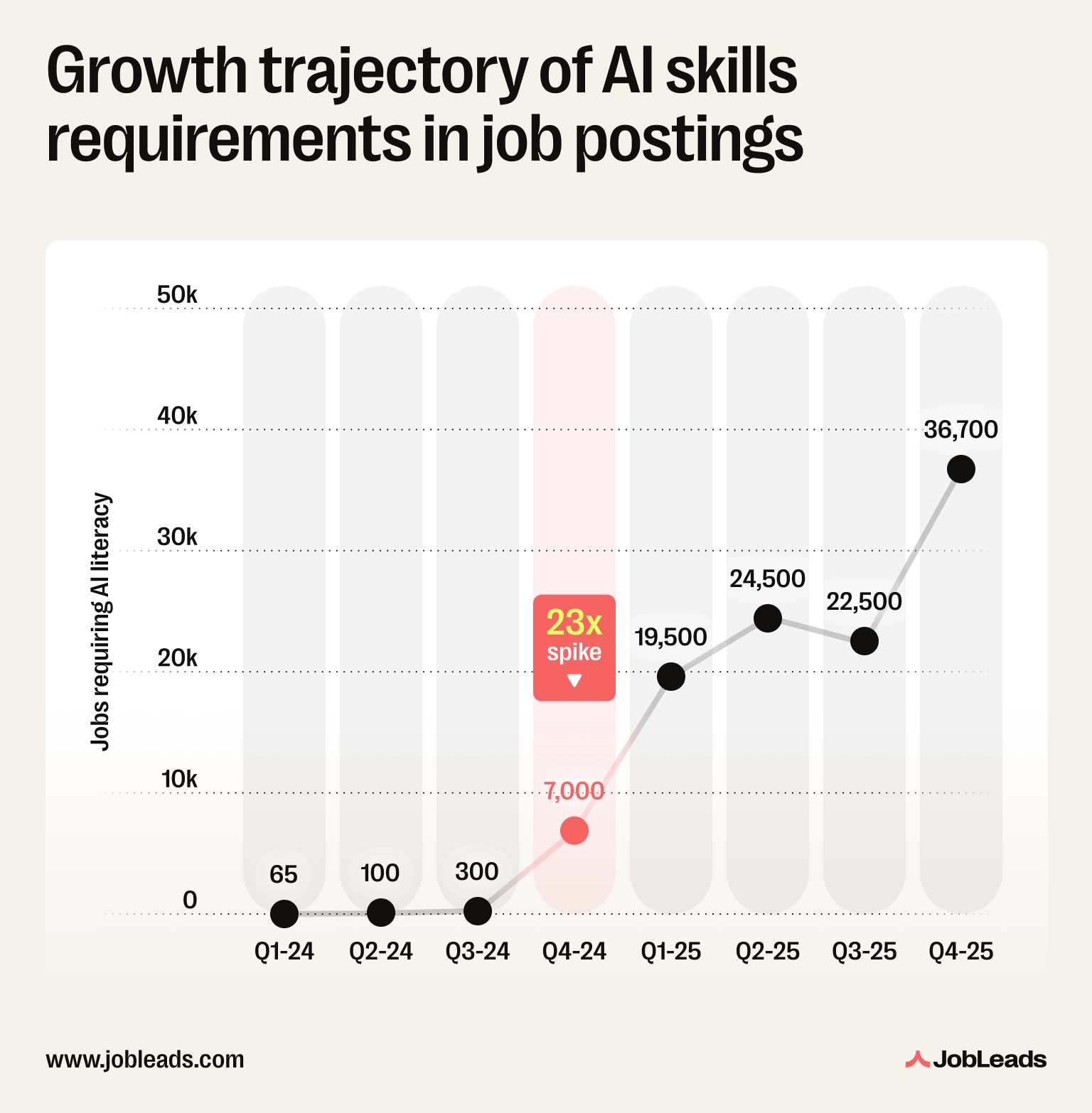
AI hiring truly detonated in late 2024. For the first three quarters of 2024, AI job postings crept upward at a measured pace, growing about 4x in nine months.
Then came Q4 2024, and everything changed.
Job postings mentioning AI skills in requirements exploded to 7,000, resulting in a 23x spike in a single quarter. The acceleration didn't stop there. By Q1 2025, postings hit 19,000. In Q2, 24,500. By Q3, 22,500. And by the time Q4 2025 came, the market reached 36,700 AI job postings per quarter.
And it's not slowing down.
What happened? The enterprise AI boom hit critical mass. According to OpenAI, 2024 was the year enterprises shifted from experimentation to solving specific business problems. And by late 2024, over 1 million businesses were actively using AI tools, with message volume growing 8x year-over-year.
Companies poured $37 billion into generative AI in 2025, up from $11.5 billion in 2024. Every Fortune 500 company announced AI initiatives. And suddenly, managers across every department, from marketing to legal to HR, started adding AI-related skills to job descriptions.
The result? In 18 months, AI went from a niche technical requirement to a mass-market expectation.
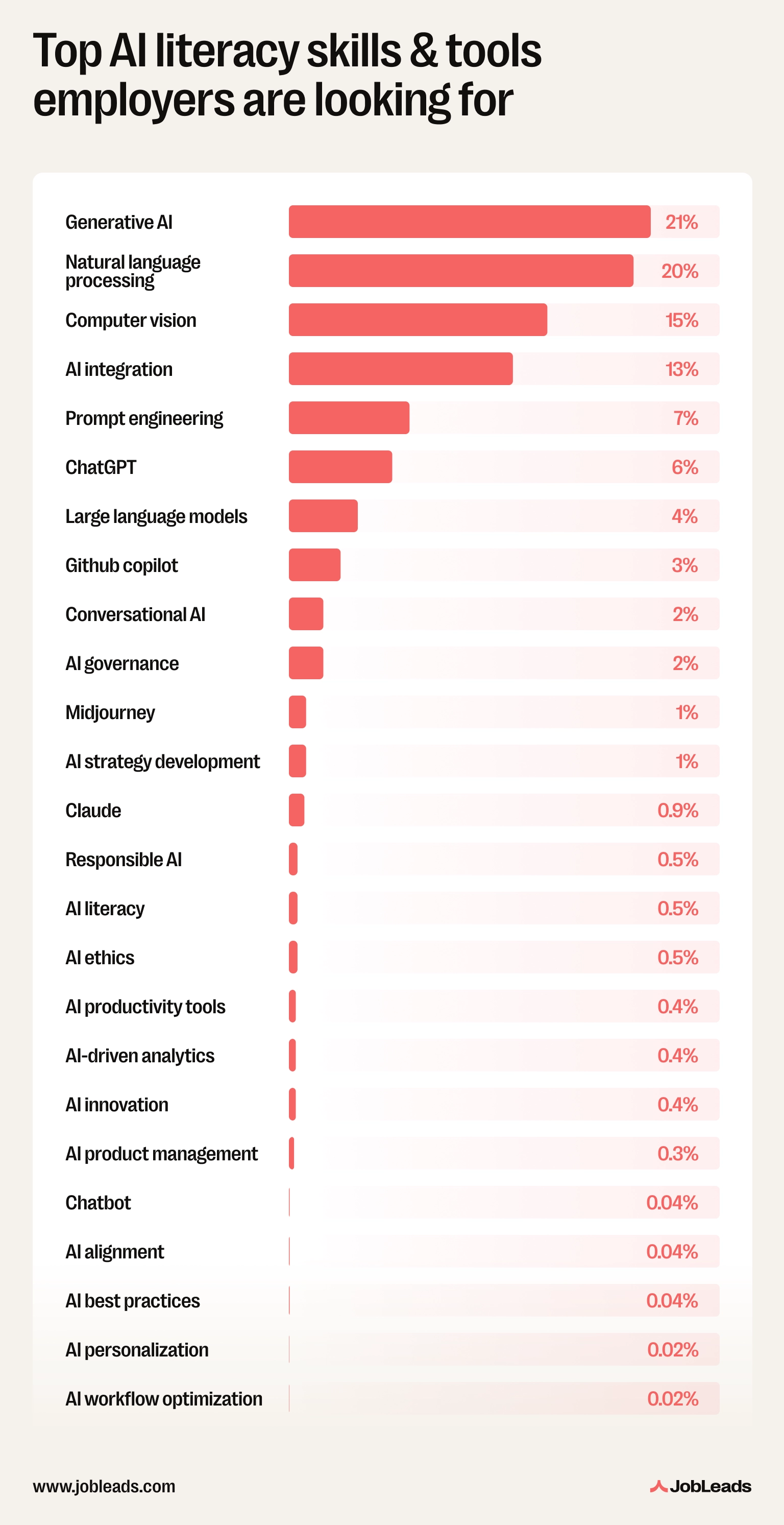
Generative AI tops every other skill at 21%, appearing in the requirements in one out of every five positions. This makes complete sense since generative AI is an umbrella term that includes AI that creates new content, from text to images. Generative AI is becoming a baseline requirement across industries.
Natural language processing follows close behind at 20%, while computer vision claims 15% and AI integration is sought in 13% of job ads.
Practical application skills follow at lower but meaningful rates. Prompt engineering shows up in 7% of postings, ChatGPT in 6%, large language models in 4%, and GitHub Copilot in 3%. Together, these hands-on capabilities represent the operational side of AI work.
Specialized skills fill the remaining gaps. Conversational AI (1.8%), AI governance (1.5%), Midjourney (1.4%), AI strategy development (1%), and Claude (0.9%) each appear in fewer than 2% of postings.
The 2026 reality is that companies don't need employees who can write clever prompts–everyone can do it now. They need people who deeply understand how AI functions and how it can streamline their jobs. That's where the real AI skills gap hides.
The growth of demand for AI brought mixed results for workers who learned AI skills–some industries rewarded the expertise, others didn't.
While AI job postings surged 1,300% from 2024 to 2025, jumping from 7,500 to 103,000 positions, median salaries shifted in different directions depending on industry. Overall, median salaries decreased about 4%, but the industry-by-industry picture reveals winners and losers.
Five industries saw salary increases:
Bio, Pharmacology & Health led gains with an 18% jump ($90K → $106K median), followed by Sales at 15% ($85K → $98K). Consulting grew 11% to $118K, while HR gained 4% to $75K, and Management & Operations rose almost 2% to $111K.
Engineering held steady:
Engineering maintained its position at $140K median with 0% change–the most stable industry despite massive job growth when it comes to AI requirements.
Five industries saw salary declines:
Marketing & Media took the biggest hit with a 7.5% drop ($93K → $86K median). Legal fell 4% ($125K → $120K), IT & Technology declined almost 2% ($120K → $118K), and Finance dipped 0.9% ($110K → $109K).
Why the split?
Industries that saw increases like Healthcare, Sales, and Consulting, compete fiercely for talent with specialized knowledge. Industries where salaries declined saturated their markets with "AI-literate" candidates faster than they could absorb them at higher rates.
The supply of workers listing ChatGPT, prompt engineering, and AI tools on resumes flooded certain markets, while others maintained barriers to entry through specialized domain knowledge or client-facing billing structures.
When millions of candidates can claim AI literacy and when learning those skills becomes a commodity, the reward becomes scarce. As a result, in certain industries, those with deep AI knowledge are no longer competing for scarce specialist roles. They're competing against the flood.
Jan Hendrik von Ahlen, Managing Director & Career Expert, JobLeads
Engineering stood out as the most stable industry during the AI surge. While jobs requiring AI literacy grew 1,021% from 2024 to 2025, median salaries in Engineering held perfectly steady at $140K–a 0% change.
Engineering has had the lowest job growth rate of any industry (for instance, Sales surged 4,389%). This can be connected to the many layoffs and hiring freezes in tech that happened in the years following the pandemic. Still, Engineering maintained its compensation floor.
Engineering roles require deployable skills that can't be easily learned. You can't fake production-grade technical knowledge. An AI-literate engineer needs to demonstrate they can architect systems that scale, optimize machine learning pipelines, or write code that handles millions of requests. The barrier to entry remained high.
The biggest AI wage winner wasn't tech: it was healthcare. Bio & Pharmacology & Health led all industries with an 18% median salary increase ($90K → $106K), a $16K jump that crushed both the 3-4% inflation rate and every other sector's wage growth.
This seems counterintuitive. Healthcare is traditionally conservative, slow to adopt new technology, and heavily regulated. But AI applications in drug discovery, clinical trial optimization, and diagnostic imaging created fierce competition for a rare skill combination: professionals who understand both life sciences and how to apply AI in their profession.

Being AI-proficient definitely helps with career progression, however, it definitely won't fast-track you to seniority or leadership.
The salary data makes sense when you see the seniority breakdown. Companies aren't really hiring many AI executives. Overall, 74% of jobs requiring AI skills are specialist positions, the corporate designation for mid-career individual contributors.
Only 14% are Team Leaders, 5% are Vice Presidents, 5% are Heads of Department, 3% are Project Managers, and a mere 0.8% are Managing Directors.
Leadership opportunities that focus on AI literacy exist, but they're scarce. For every 100 AI jobs posted, 74 are individual contributor roles, 14 are team leads, and fewer than 1 reaches the C-suite level.
The salary distribution for jobs requiring AI literacy is broad. Positions spread across nearly every compensation tier, with meaningful representation at senior levels.
The largest concentration sits at $80K-125K (44% of all jobs), split between $80K-100K (24%) and $100K-125K (20%). This represents the core AI job market: experienced professionals with specialized skills earning solid mid-to-upper-middle-class salaries.
Over half of AI jobs pay six figures. When you combine the $100K-125K (20%), $125K-150K (16.5%), $150K-200K (15%), and $200K+ tiers (11%), you get more than 60% of positions paying $100,000 or more annually.
Executive-level pay is accessible but selective. About 11% of AI jobs offer $200K+ compensation (7% at $200K-250K, 4% at $250K+). While this isn't the majority, it represents roughly 12,000 positions in the current market, which is far from negligible.
Entry-level and lower mid-range positions that need AI literacy exist but remain rare. Only 0.8% of AI jobs pay under $60K, suggesting AI skills generally command at least mid-level compensation even for junior roles.
Getting more AI-knowledgeable is on the to-do list for many jobseekers. Let's see what working conditions they can expect and how to get there.
Contrary to a popular belief, AI skills don't automatically unlock more remote possibilities–quite the opposite. Despite AI being entirely digital work, employers aren't offering location flexibility. Overall, 57% of AI jobs are on-site, 26% are hybrid, and only about 17% are fully remote.
Marketing & Media leads remote flexibility at 25% fully remote positions–the only industry where more than one in five jobs that require AI skills offer location independence. IT & Technology, Legal, and Healthcare follow at 17% each.
Engineering and Finance trail behind with 15.6% and 15.5% remote respectively, despite being sectors you'd expect to embrace distributed work.
Consulting remains the flexibility king: With 36% hybrid and 16% remote, Consulting offers 52% of its AI jobs with location flexibility, which is double the market average. HR follows with 47% flexible roles (31% hybrid, 16% remote), and Sales offers 45% (29% hybrid, 16% remote).
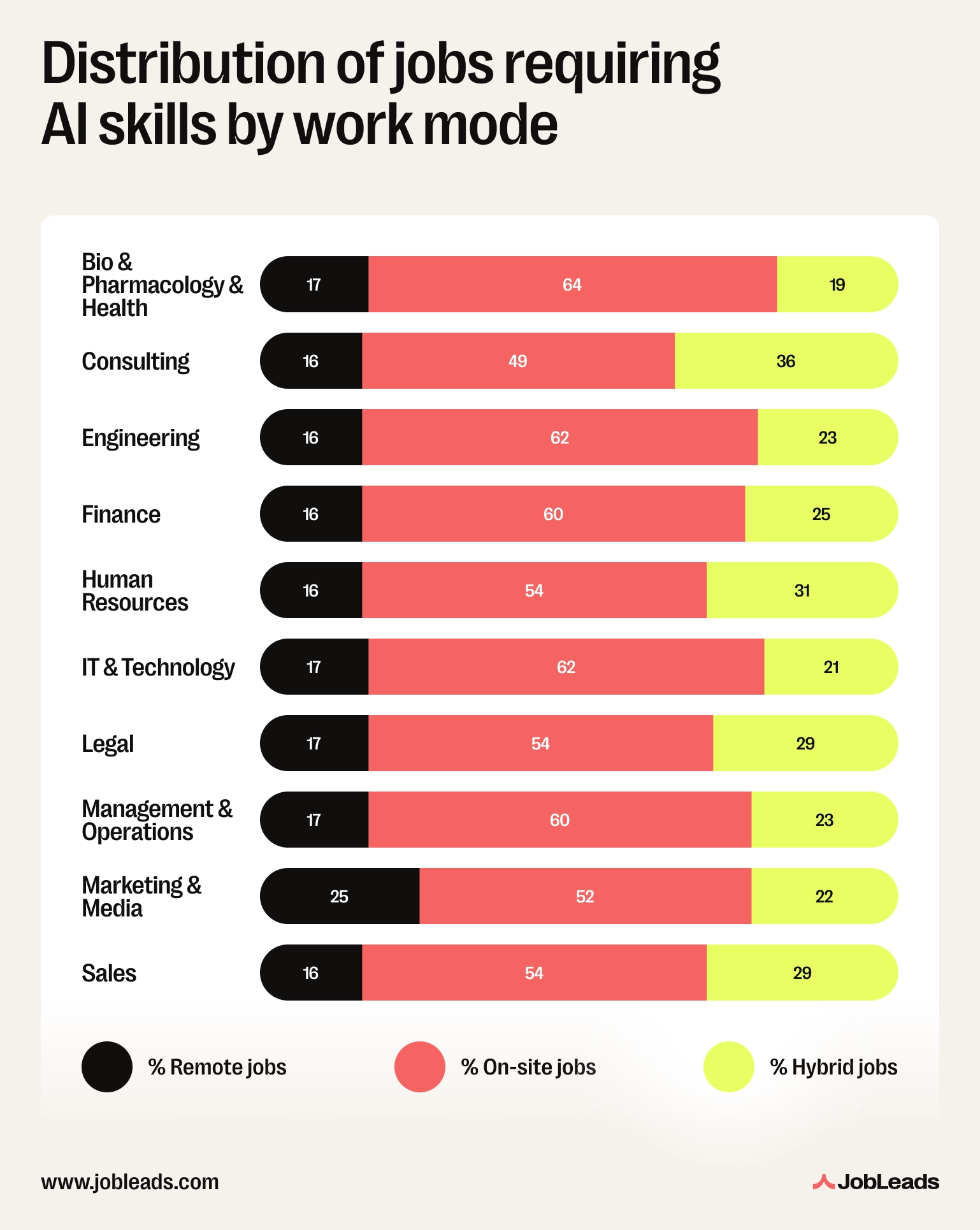
The irony persists: AI was supposed to enable remote work, yet companies building AI products require office presence at rates similar to traditional industries. According to JobLeads' research on remote work statistics, 23% of job seekers want only remote work while 6% seek hybrid arrangements. AI skills don't unlock that flexibility as only 17% of AI jobs offer full remote work.
Given everything we've learned from 110K+ job postings, here's how to actually position yourself for success in the job market that values AI literacy.
Generative AI (21% of job postings), natural language processing (20%), and computer vision (15%) dominate employer requirements. These aren't specific platforms but broad conceptual capabilities that apply across every industry and survive tool changes.
For technical roles: Understanding how AI systems actually work matters more than which framework you use. Learn the fundamentals of how generative models create content, how NLP processes language, where computer vision applies. Technical depth in AI integration (13% of postings) and implementation beats surface familiarity with trending tools.
For business roles: Focus on AI integration skills like embedding AI into existing workflows, interpreting AI-generated insights, validating AI recommendations against domain expertise. Prompt engineering (7%) and ChatGPT proficiency (6%) are baseline now, not differentiators. The value comes from knowing when and how to apply AI to solve actual business problems. Embedding AI into existing workflows usually means connecting models to the tools a team already runs on. Employers increasingly want people who can wire AI into CRMs, ticketing systems, and internal documentation rather than operate a chat window in isolation, which tracks with how AI is actually being deployed inside companies, where adoption is now broad but deep integration is still rare.
The market rewards depth, not breadth. For example, in Bio & Healthcare, computational biologists who understand both protein folding and machine learning command premiums. Sales professionals who combine AI-powered pipeline optimization with relationship skills earn more. Consultants who translate AI capabilities into measurable client ROI bill premium rates.
Surface-level AI familiarity like "I can use ChatGPT" gets you past resume filters but won't give you premium pay anymore. The 110,000 jobs requiring AI literacy split into clear tiers: generalists cluster at $80K-125K (44% of jobs), specialists with domain expertise reach $125K-200K (48% of jobs), and executives combining AI literacy with business leadership hit $200K+ (11% of jobs).
About 74% of jobs requiring AI skills are specialist-level positions, 14% are Team Leaders, and fewer than 1% reach Managing Director. AI literacy opens doors to $80K-200K individual contributor and team lead roles but it doesn't automatically fast-track you to C-suite. Leadership requires traditional management skills (building teams, strategic thinking, business acumen) layered on top of AI knowledge.
Also, keep in mind that despite AI being digital work, 57% of AI jobs require office presence, 26% are hybrid, and only 17% are fully remote. Prepare for on-site or hybrid work unless you're targeting Marketing (25% remote) or IT (17% remote).
Most importantly, the AI job market isn't looking for "prompt wizards". It wants professionals who understand when and how to apply AI capabilities, validate their outputs, and integrate them into real workflows. The market is looking for capable humans who possess AI literacy skills to actually distinguish when to apply AI and when to avoid, what output can be trusted, and when human sense of taste is irreplaceable.
With headlines proclaiming that AI is transforming the job market, it's easy to assume that learning AI guarantees career success. But the reality is more nuanced. Even though demand for AI roles surged by 1,300%, salaries have shifted across industry in different ways. Meanwhile, 74% of AI-related openings are mid-level specialist roles, 57% require office presence, and though 52% pay six figures, what industry you are in matters more than AI skills alone.
Are AI skills still valuable in 2026?
The short answer is yes. The long answer is that data suggests they've been commoditized rather than devalued. AI knowledge is now baseline (like "proficient in Microsoft Office" was in 2010), not a differentiator. What creates value is combining AI literacy with specialized domain expertise valued by your industry.
The future of AI skills seems to be a growing mismatch: millions learned AI expecting premium pay, remote flexibility, and leadership fast-tracks. What the market delivered instead are $80K specialist roles requiring office presence, with advancement capped at mid-career. When everyone has the skill, no one has an advantage.
JobLeads scraped 60M job ads posted in the United States between January 2024 and December 2025. Jobs were then classified as AI jobs if they mentioned any of 35 keywords related to AI literacy, mainstream AI technology, tools, and usage as requirements for job applicants. The final job ads pool included 110K job postings.
Classification and analysis:
- Jobs included: Only jobs active at least once during the time period were counted, with deduplication to avoid counting the same posting multiple times
- Salary data: Based on employer-provided annual compensation ranges in job postings, presented in US dollars
- Industry classification: Jobs categorized into 10 industries (Bio & Pharmacology & Health, Consulting, Engineering, Finance, Human Resources, IT & Technology, Legal, Management & Operations, Marketing & Media, Sales)
- Seniority levels: Classified into 7 categories (Specialist, Team Leader, Head of Department, Vice President, Managing Director, Project Manager, Member of the Board)
- Work location: Categorized as on-site, hybrid, or remote based on employer-specified arrangements
- Keyword list used in analysis: Generative AI, Large Language Models, Natural Language Processing, Computer Vision, Conversational AI, Prompt Engineering, ChatGPT, Claude, Google Gemini, GitHub Copilot, Midjourney, Notion AI, AI Literacy, AI Ethics, AI Governance, Responsible AI Practices, Explainable AI, AI Alignment, AI Best Practices, AI Productivity Tools, AI Workflow Optimization, AI-Powered Automation, Intelligent Automation, AI Integration, Operationalizing AI, AI Strategy Development, AI-Driven Analytics, AI Personalization, AI Product Management, AI Product Strategy, Artificial Intelligence Strategy, AI Content Creation, Chatbot, AI Safety, AI Innovation
Limitations:
This analysis identifies jobs that mention AI literacy skills in requirements, not jobs where AI expertise is the primary function. A software engineering role requiring "familiarity with generative AI" and a dedicated AI Product Manager position are both counted equally in our dataset.
Keyword-based identification: We used 35 carefully selected keywords focused on mainstream AI literacy concepts rather than comprehensive AI engineering terminology. This approach captures roles where AI knowledge is expected across industries but may undercount highly specialized AI research or machine learning engineering positions that use different technical vocabulary.
Industry categorization: Job classification into 10 industries relies on JobLeads' existing taxonomy, which combines some functional roles (like Consulting) with sector-specific categories (like Bio & Pharmacology & Health). This may create overlap or ambiguity in how certain positions are categorized.
Salary data coverage: Salary figures reflect only postings where employers provided compensation ranges and don't account for the final take-home pay.
Scope: Analysis covers US job postings only and focuses on AI literacy as a general professional skill rather than deep AI technical expertise or machine learning engineering specializations.
These limitations don't invalidate our findings but provide important context for interpretation. Our data reveals meaningful trends in how employers across industries are incorporating AI literacy into job requirements and what that means for compensation, seniority, and work arrangements.
About JobLeads: Founded in 2007 in Hamburg by Christian von Ahlen, Martin Schmidt, and Jan Hendrik von Ahlen, JobLeads is a global career platform empowering professionals to take control of their careers and discover new opportunities. Today, more than 20 million members in over 40 countries rely on JobLeads' independent, data-driven tools and insights to successfully plan their next career move.
If our research on AI skills helped you understand modern job market requirements better, feel free to share any insights or statistics from this study. Please remember to credit JobLeads as the source and include a link back to this page. Thank you!



 Job Market Trends