Two graduates start their first jobs on the same morning. One takes a high-paying role in a glamorous coastal city, the other settles for a considerably smaller salary somewhere cheaper and quieter.
A year later, it's the second person who has more money left in the bank. For anyone starting their career, where they live can matter more to what a paycheck is really worth than the figure on the offer letter.
JobLeads ranked the 50 largest US metros by what a graduate fresh out of college actually keeps: money left after rent. The results paint a ranking of the best US cities for young professionals and clearly show where an early career goes furthest.
How JobLeads ranked the 50 cities
JobLeads took the median entry-level salary in each metro (from the US Bureau of Labor Statistics), and subtracted a year of rent for a one-bedroom (Apartment List, 2025). Every city also had to have at least 5,000 entry-level openings on JobLeads in the past year. More details in the methodology.
Key takeaways
- Portland is the #1 US metro for graduates, leaving $28,016 a year after rent–$11,412 more than Los Angeles
- The city that pays graduates the most leaves them with the least. San Jose has the highest entry-level wage in America ($49,800), yet ranks 49th of 50 for money left after rent
- The "Rust Belt" quietly wins on take-home: Cleveland, Detroit, Cincinnati, Milwaukee and Buffalo all land in the top 10 for money left after rent
- Seattle is the only truly high-wage metro that keeps its promise, pairing the 2nd-highest wage ($49,160) with a manageable 43% rent burden to finish 3rd
- The biggest job markets are often the worst financial deal. Chicago has the most graduate openings in the country (64,235) yet ranks just #41 of 50 for money left after rent. New York (#48), DC (#38) and San Francisco (#45) tell the same story
- Across the 50 metros, a city's starting wage has almost no relationship to what a graduate actually keeps (correlation just +0.06), because higher pay and higher rent rise together (+0.80)
- The average US graduate spends 40% of their entire starting salary on rent for a one-bedroom
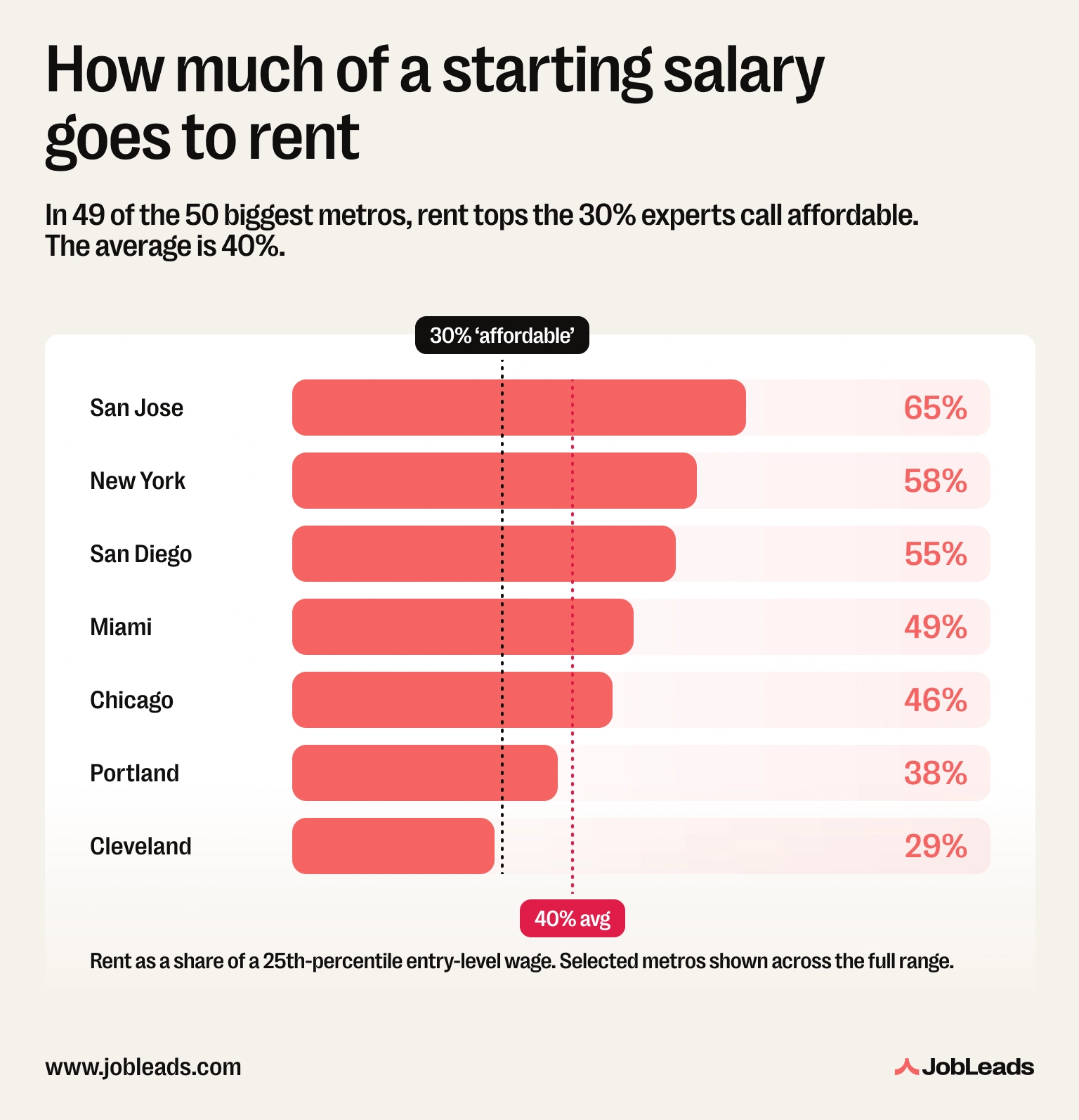
- In 6 of the 50 metros, rent alone swallows half or more of an entry-level wage, peaking at 65% in San Jose. The easiest is Cleveland at just 29%
- Nearly 2 in 3 entry-level job ads (62%) don't disclose a salary, leaving the candidates with the least bargaining power the most in the dark
- The most salary-transparent metros are high-payers like Seattle and Denver (both ~56%), while Milwaukee (24%), Orlando and Virginia Beach (27%) hide pay most–transparency laws in place correlate with higher pay
The headline salary has become the most misleading number in a graduate's job search. A city like San Jose can advertise the highest starting pay in the country precisely because rent hides what that pay is really worth, and for years that opacity has worked quietly in high-cost employers' favor. Pay-transparency laws are now forcing those numbers into the open. And once graduates compare real take-home pay, the prestige premium of the expensive coastal metros looks less like ambition and more like a wealth transfer from young workers to landlords.
Jan Hendrik von Ahlen – Career Coach & Co-Founder, JobLeads
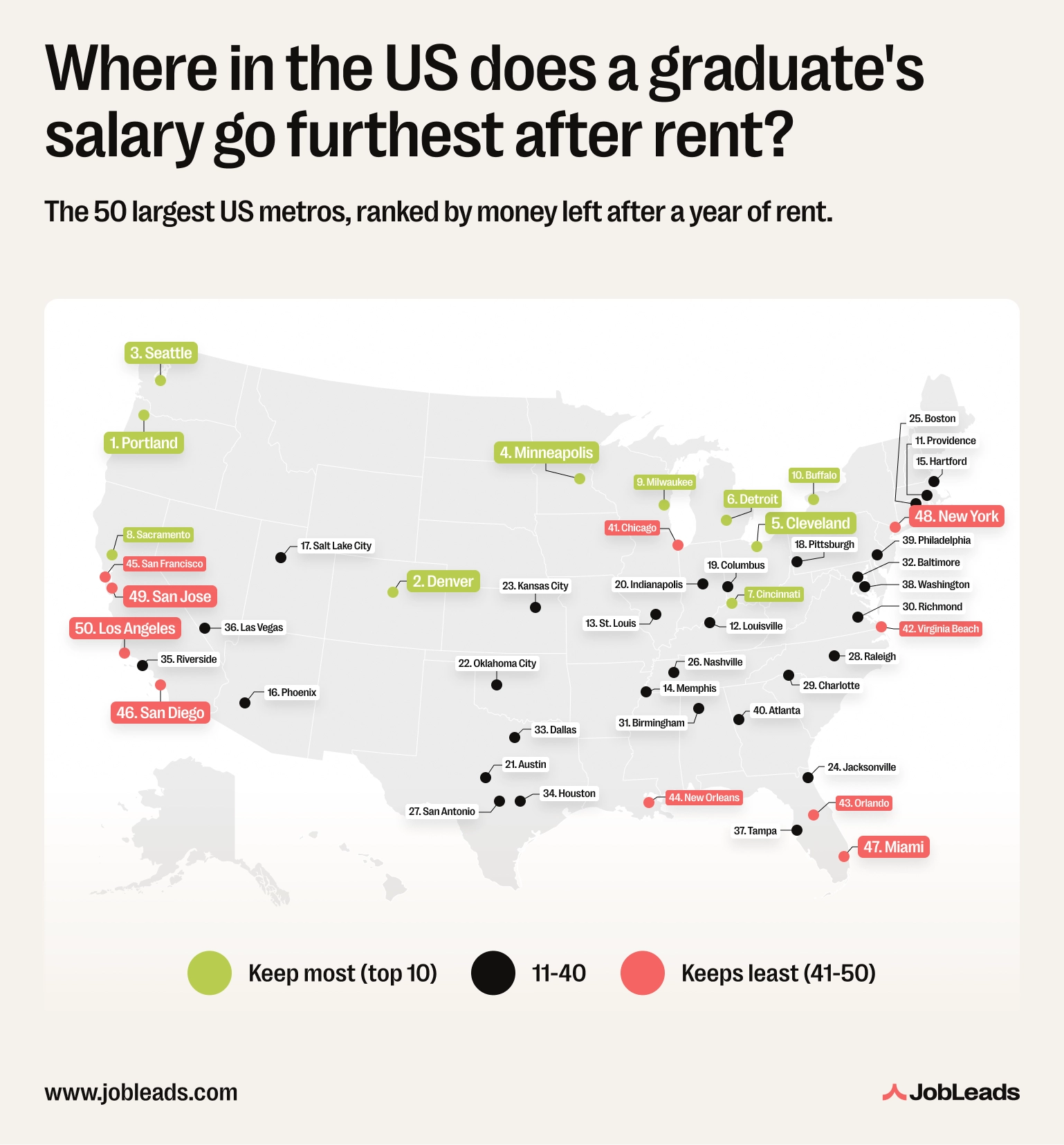
Now let's look at how all 50 major US cities compare, from where a starting salary stretches furthest to where rent claims most of it.
Below is the full ranking, ordered by money left after rent, with each city's entry-level wage and one-bedroom rent shown alongside.
| Rank | City | Money left after rent | Entry-level wage | Median 1-bed rent | Rent (% of wage) | Grad jobs (past yr) |
|---|
| 1 | Portland, OR | $28,016 | $45,320 | $1,442 | 38% | 14,942 |
| 2 | Denver, CO | $27,952 | $45,460 | $1,459 | 39% | 27,301 |
| 3 | Seattle, WA | $27,896 | $49,160 | $1,772 | 43% | 29,132 |
| 4 | Minneapolis, MN | $26,410 | $41,830 | $1,285 | 37% | 30,518 |
| 5 | Cleveland, OH | $26,320 | $37,240 | $910 | 29% | 7,763 |
| 6 | Detroit, MI | $26,180 | $37,880 | $975 | 31% | 22,512 |
| 7 | Cincinnati, OH | $25,936 | $37,300 | $947 | 30% | 17,090 |
| 8 | Sacramento, CA | $25,794 | $42,450 | $1,388 | 39% | 11,612 |
| 9 | Milwaukee, WI | $25,652 | $37,940 | $1,024 | 32% | 18,287 |
| 10 | Buffalo, NY | $25,428 | $37,680 | $1,021 | 33% | 8,542 |
| 11 | Providence, RI | $25,108 | $38,800 | $1,141 | 35% | 9,384 |
| 12 | Louisville, KY | $25,032 | $36,960 | $994 | 32% | 10,651 |
| 13 | St. Louis, MO | $24,942 | $37,050 | $1,009 | 33% | 20,618 |
| 14 | Memphis, TN | $24,908 | $36,020 | $926 | 31% | 8,613 |
| 15 | Hartford, CT | $24,882 | $40,590 | $1,309 | 39% | 10,310 |
| 16 | Phoenix, AZ | $24,704 | $38,780 | $1,173 | 36% | 36,998 |
| 17 | Salt Lake City, UT | $24,554 | $39,050 | $1,208 | 37% | 15,028 |
| 18 | Pittsburgh, PA | $24,534 | $36,630 | $1,008 | 33% | 7,663 |
| 19 | Columbus, OH | $24,492 | $37,800 | $1,109 | 35% | 19,302 |
| 20 | Indianapolis, IN | $24,348 | $37,200 | $1,071 | 35% | 18,346 |
| 21 | Austin, TX | $24,154 | $38,230 | $1,173 | 37% | 25,547 |
| 22 | Oklahoma City, OK | $24,076 | $34,600 | $877 | 30% | 9,523 |
| 23 | Kansas City, MO | $23,788 | $37,600 | $1,151 | 37% | 22,141 |
| 24 | Jacksonville, FL | $23,492 | $36,860 | $1,114 | 36% | 9,604 |
| 25 | Boston, MA | $23,338 | $45,850 | $1,876 | 49% | 31,810 |
| 26 | Nashville, TN | $22,846 | $37,630 | $1,232 | 39% | 18,679 |
| 27 | San Antonio, TX | $22,782 | $34,950 | $1,014 | 35% | 15,452 |
| 28 | Raleigh, NC | $22,490 | $37,430 | $1,245 | 40% | 13,317 |
| 29 | Charlotte, NC | $22,366 | $37,330 | $1,247 | 40% | 22,332 |
| 30 | Richmond, VA | $22,278 | $37,290 | $1,251 | 40% | 11,853 |
| 31 | Birmingham, AL | $22,114 | $34,990 | $1,073 | 37% | 8,990 |
| 32 | Baltimore, MD | $21,928 | $39,160 | $1,436 | 44% | 21,546 |
| 33 | Dallas, TX | $21,908 | $36,800 | $1,241 | 40% | 61,645 |
| 34 | Houston, TX | $21,780 | $35,640 | $1,155 | 39% | 36,948 |
| 35 | Riverside, CA | $21,582 | $38,430 | $1,404 | 44% | 14,537 |
| 36 | Las Vegas, NV | $21,498 | $35,490 | $1,166 | 39% | 10,996 |
| 37 | Tampa, FL | $21,394 | $36,670 | $1,273 | 42% | 19,780 |
| 38 | Washington, DC | $21,254 | $44,990 | $1,978 | 53% | 55,389 |
| 39 | Philadelphia, PA | $21,240 | $37,440 | $1,350 | 43% | 23,542 |
| 40 | Atlanta, GA | $21,142 | $37,030 | $1,324 | 43% | 40,606 |
| 41 | Chicago, IL | $20,948 | $38,480 | $1,461 | 46% | 64,235 |
| 42 | Virginia Beach, VA | $20,332 | $36,280 | $1,329 | 44% | 11,621 |
| 43 | Orlando, FL | $20,176 | $35,800 | $1,302 | 44% | 15,122 |
| 44 | New Orleans, LA | $19,858 | $31,690 | $986 | 37% | 8,247 |
| 45 | San Francisco, CA | $18,780 | $47,280 | $2,375 | 60% | 41,573 |
| 46 | San Diego, CA | $18,676 | $41,740 | $1,922 | 55% | 5,785 |
| 47 | Miami, FL | $18,576 | $36,480 | $1,492 | 49% | 23,378 |
| 48 | New York, NY | $17,708 | $42,560 | $2,071 | 58% | 55,780 |
| 49 | San Jose, CA | $17,556 | $49,800 | $2,687 | 65% | 23,278 |
| 50 | Los Angeles, CA | $16,604 | $39,320 | $1,893 | 58% | 41,104 |
Grad jobs (past yr) = entry-level roles on JobLeads, Aug 2025-Aug 2026, all 50 cleared the 5,000 jobs minimum.
Of course, a ranking doesn't tell the full story. But it serves as an interesting pre-text to what life in each of the cities could look like for a recent grad.
These are the best affordable cities for young professionals: the ones that pair a solid entry-level wage with rent that doesn't eat it alive.

💰 $28,016 left after rent (#1) | Wage $45,320 | Rent $1,442/mo (38% of wage) | 14,942 grad jobs
Portland is the country's best balance of pay and rent: a top-ten entry wage that a moderate rent doesn't erase. Oregon state charges no sales tax either, so a starting salary stretches even further than the ranking shows.
What stands out: A Portland graduate keeps roughly $10,500 more a year than one in San Jose, despite earning a smaller salary.
The upside for a grad: The "Silicon Forest" gives early-career workers real employers to aim for, with Intel and Nike anchoring a tech scene where salaries run about 12% above the national average.
The catch: Rent still takes 38% of a starting salary, above the 30% affordability line, and the job market is smaller than Denver's or Seattle's.
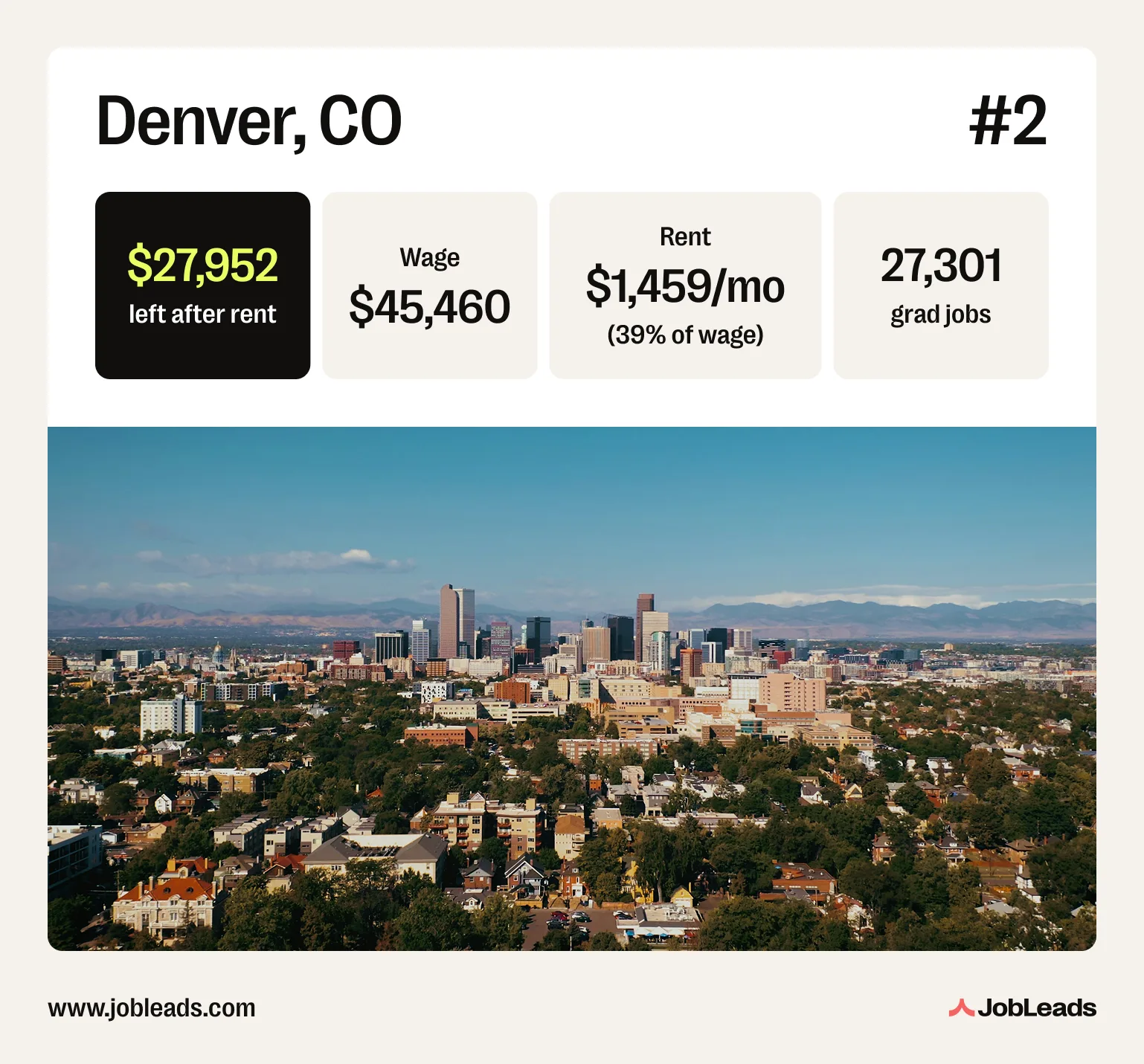
💰 $27,952 left after rent (#2) | Wage $45,460 | Rent $1,459/mo (39% of wage) | 27,301 grad jobs
Denver finishes a tiny bit behind Portland, pairing a similarly strong entry wage with rent that stays in check. It also offers a far bigger pool of job openings than most cities near the top, so the take-home comes without sacrificing choice.
What stands out: More than half of Denver's entry-level ads (56%) post a salary range, one of the highest disclosure rates in the country. That's thanks to Colorado's law that requires pay ranges in job postings.
The upside for a grad: Denver is the nation's top metro for private aerospace jobs, and employers like Lockheed Martin and Ball Aerospace run dedicated new-graduate development programs.
The catch: The best-paid openings skew heavily toward STEM, so non-technical grads see less of the upside.
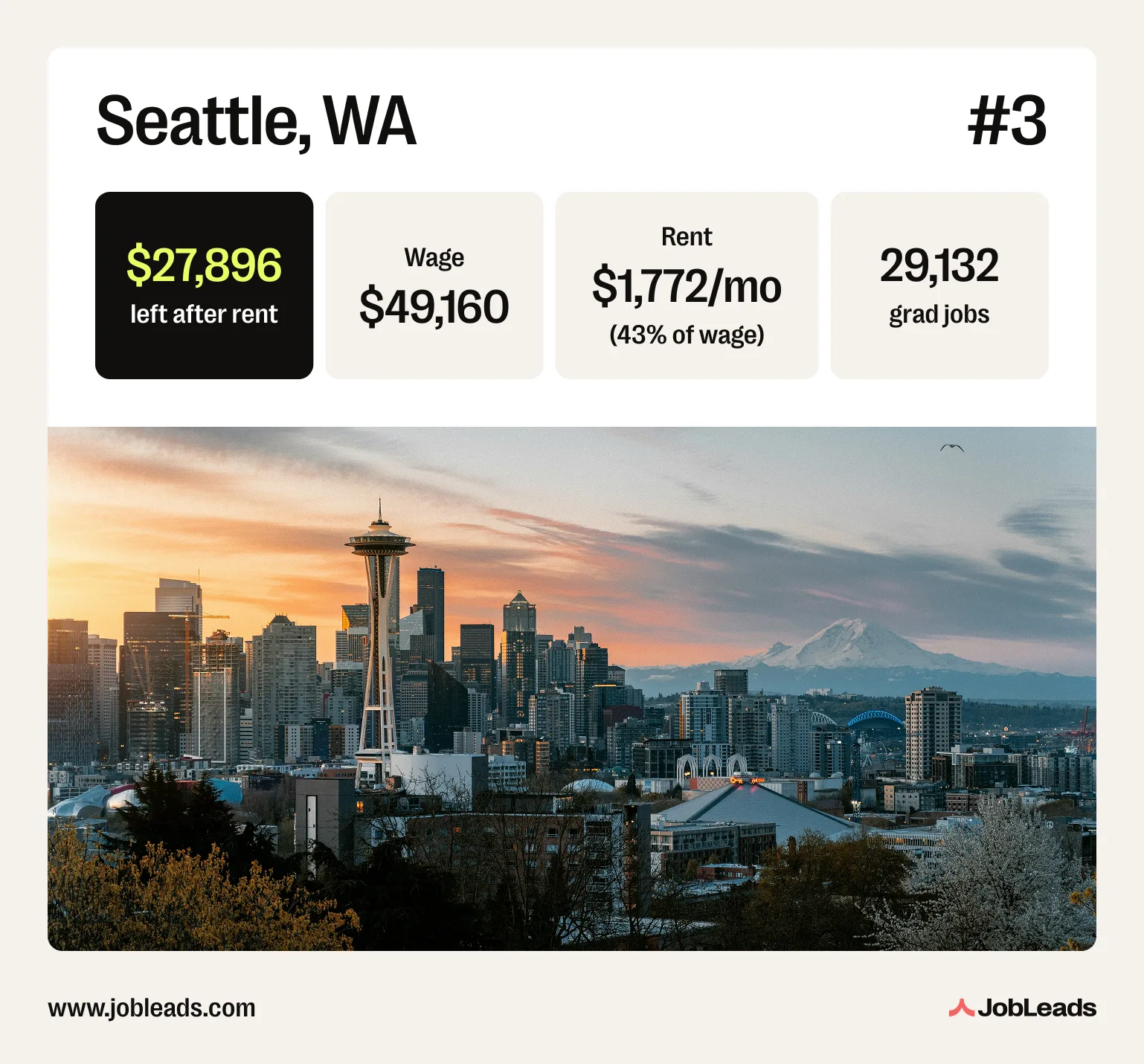
💰 $27,896 left after rent (#3) | Wage $49,160 | Rent $1,772/mo (43% of wage) | 29,132 grad jobs
Seattle is the highest-paying city that still leaves graduates ahead: the second-biggest entry wage in the country, and rent that takes a serious but survivable bite. Washington has no state income tax either, which adds several percent to what actually lands in grads' accounts.
What stands out: Seattle and San Jose pay almost the same starting wage, yet Seattle ranks #3 and San Jose #49, because rent eats 43% of the paycheck here versus 65% there.
The upside for a grad: Microsoft and Amazon both run structured graduate programs in Seattle, and Microsoft's internship-to-full-time pipeline is one of the most established routes in.
The catch: Entry-level tech hiring has fallen sharply, running around 50% below pre-pandemic levels, so competition for those graduate roles is fierce before rent even takes its 43%.
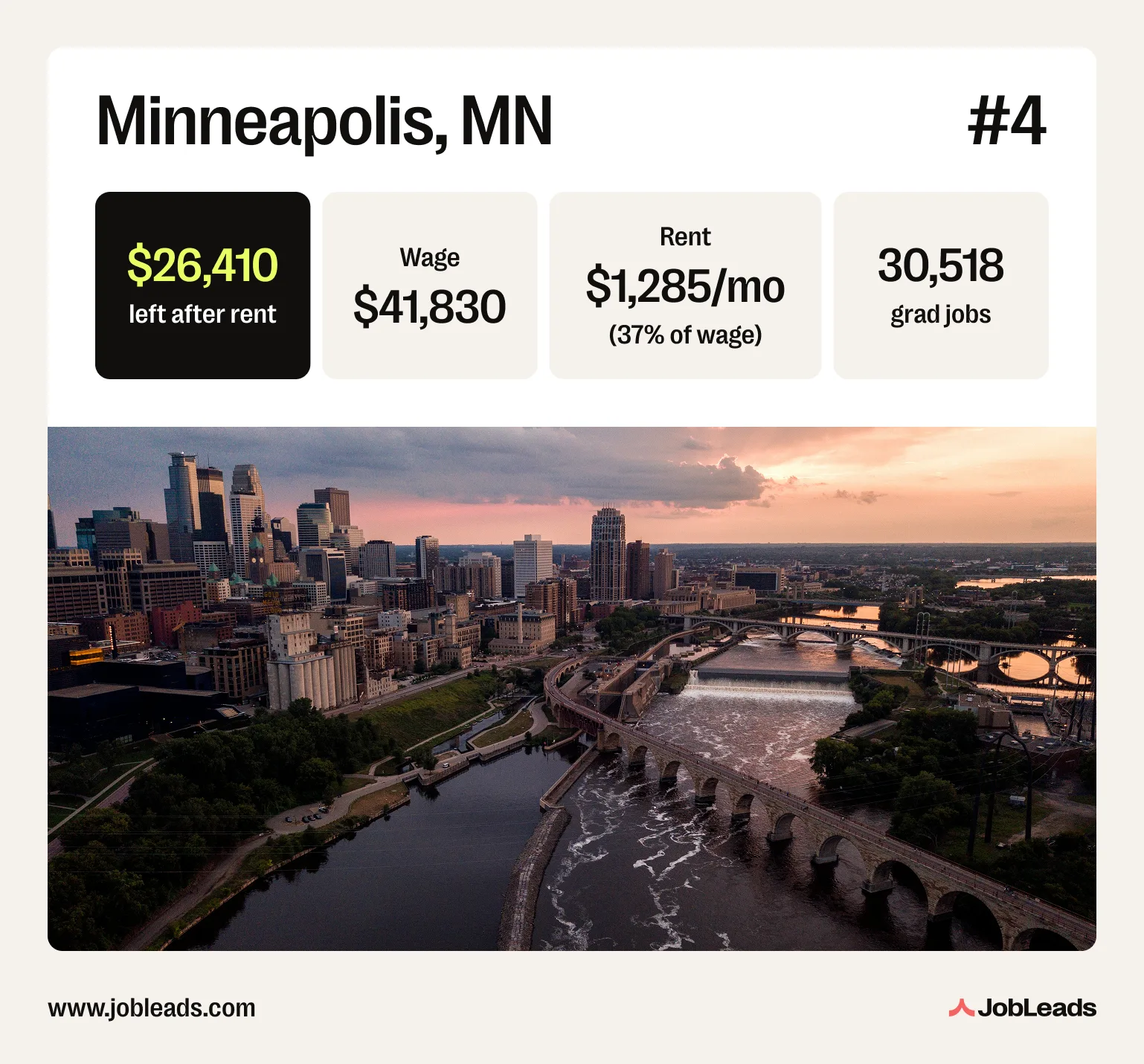
💰 $26,410 left after rent (#4) | Wage $41,830 | Rent $1,285/mo (37% of wage) | 30,518 grad jobs
Minneapolis pairs the largest job pool in the top five with rent that stays low for a major metro. So, a more modest wage still goes a long way. Its real edge is breadth: this is a market with openings across many fields, not one industry.
What stands out: The Twin Cities host more than a dozen Fortune 500 headquarters, a corporate density that rivals metros three times their size.
The upside for a grad: Minneapolis has many big-name employers like UnitedHealth Group and Target that hire far beyond tech, giving graduates from many majors a real shot rather than just coders.
The catch: At $41,830 the entry wage is the lowest of the top four cities, and the payoff comes with some of the country's harshest winters, which not every grad will relish.
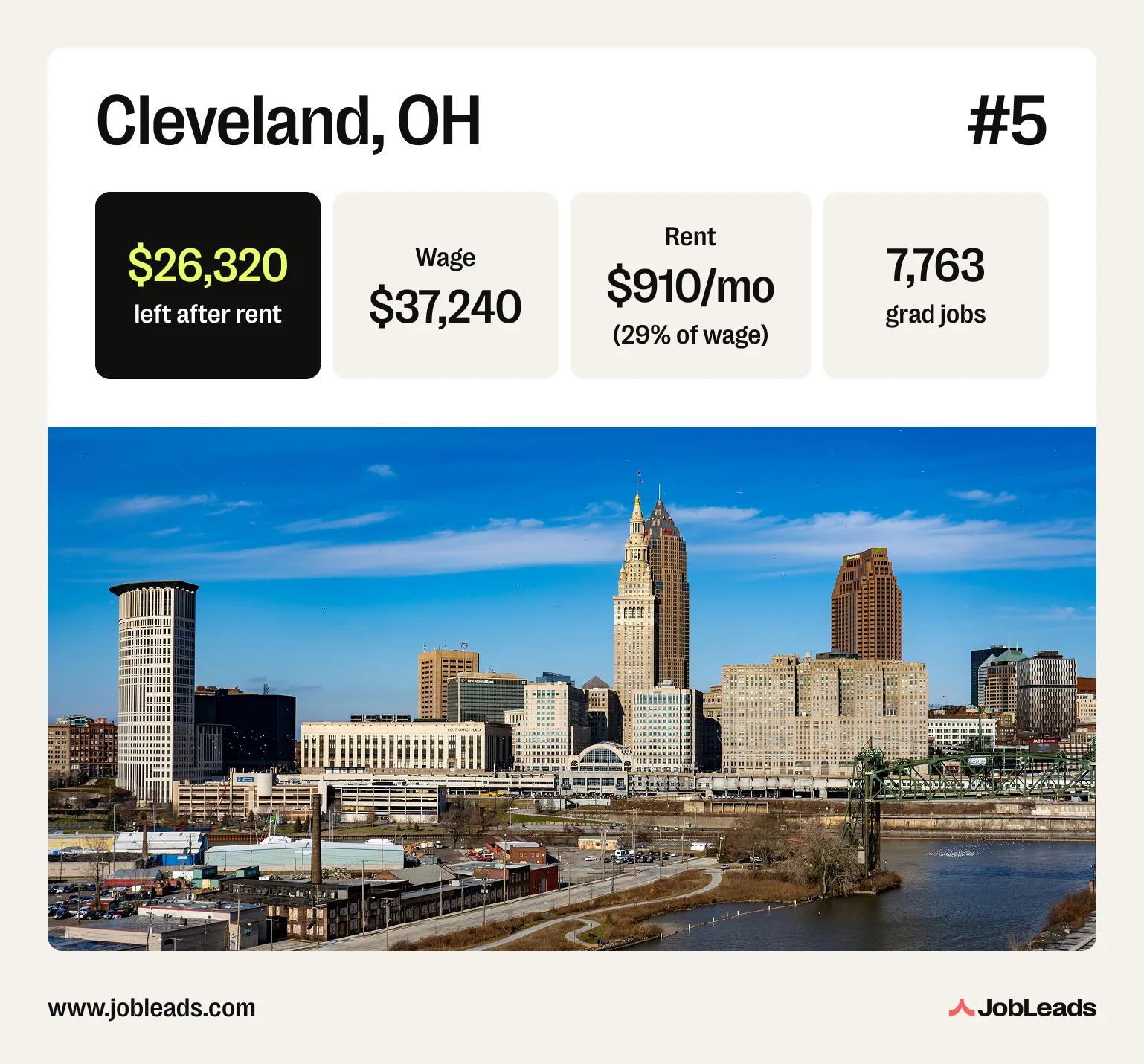
💰 $26,320 left after rent (#5) | Wage $37,240 | Rent $910/mo (29% of wage) | 7,763 grad jobs
Cleveland reaches the top five the opposite way to Portland: not on pay, but on the cheapest rent among the 50 largest metros. A modest $37,240 wage goes further here than far bigger salaries do in other states.
What stands out: Rent takes just 29% of a starting salary, the lowest burden of any metro in the study, at about $910 a month.
The upside for a grad: Healthcare anchors the economy, with Cleveland Clinic employing more than 48,000 people. Local unemployment sits at 3.5%, below the national rate, so roles are relatively easier to land.
The catch: It has the smallest job pool in the top five (7,763 openings), and demand leans heavily on healthcare, so grads outside that field have fewer options.
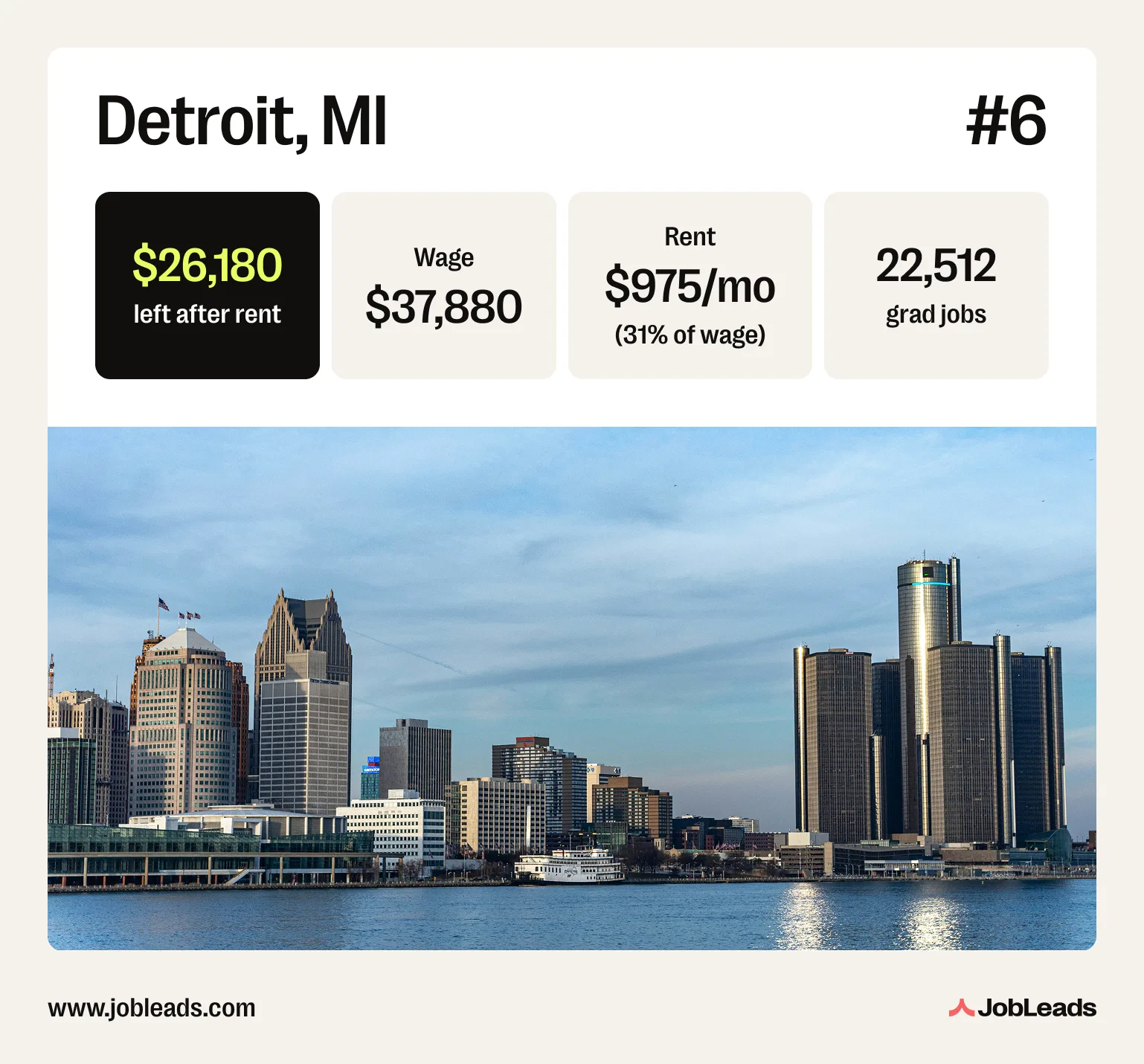
💰 $26,180 left after rent (#6) | Wage $37,880 | Rent $975/mo (31% of wage) | 22,512 grad jobs
Detroit delivers Rust Belt affordability without the small-market trade-off, holding rent to 31% of a starting wage. That leaves take-home on par with the coasts while offering far more openings than the other budget-friendly cities near it.
What stands out: With more than 22,000 entry-level openings, Detroit has one of the deepest job pools of any affordable city on the list.
The upside for a grad: The economy has broadened well beyond cars, with Rocket Companies powering a downtown fintech revival and the auto giants hiring into mobility as well as EV tech.
The catch: The entry wage is modest and pay is rarely advertised, with only about 28% of junior ads disclosing a salary, among the lowest transparency rates in the study.
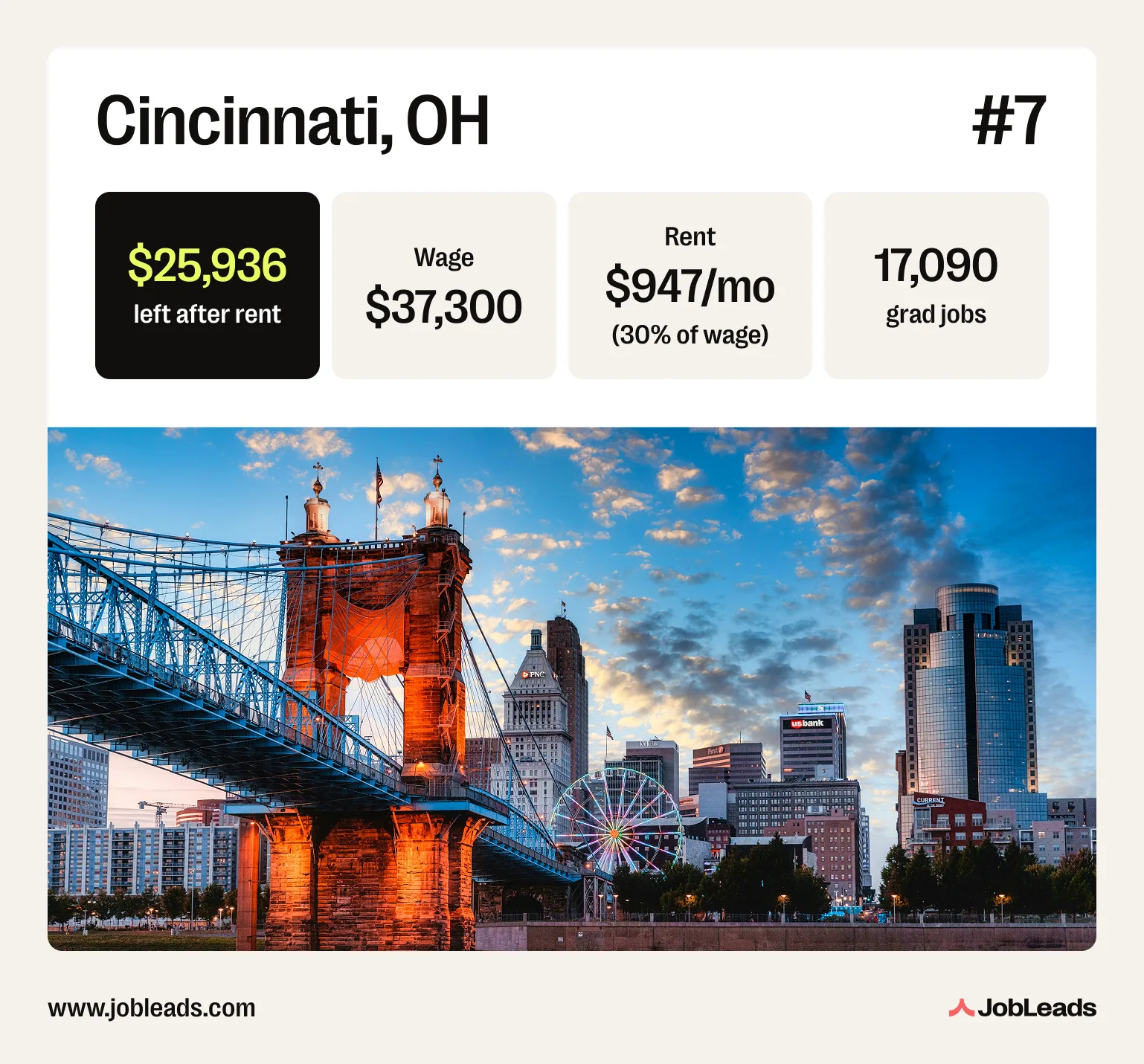
💰 $25,936 left after rent (#7) | Wage $37,300 | Rent $947/mo (30% of wage) | 17,090 grad jobs
Cincinnati punches above its size on big employers while keeping rent to just 30% of a starting wage. For a mid-size, affordable metro, it carries surprising corporate weight.
What stands out: The metro hosts several Fortune 500 headquarters, including Procter & Gamble and Kroger, unusual heft for a city this affordable.
The upside for a grad: The University of Cincinnati's renowned co-op program funnels students into paid stints at employers like P&G and GE Aerospace that often convert into full-time offers.
The catch: The entry wage is modest and the job pool is smaller than Detroit's, so there's less breadth than in the bigger markets higher up the list.
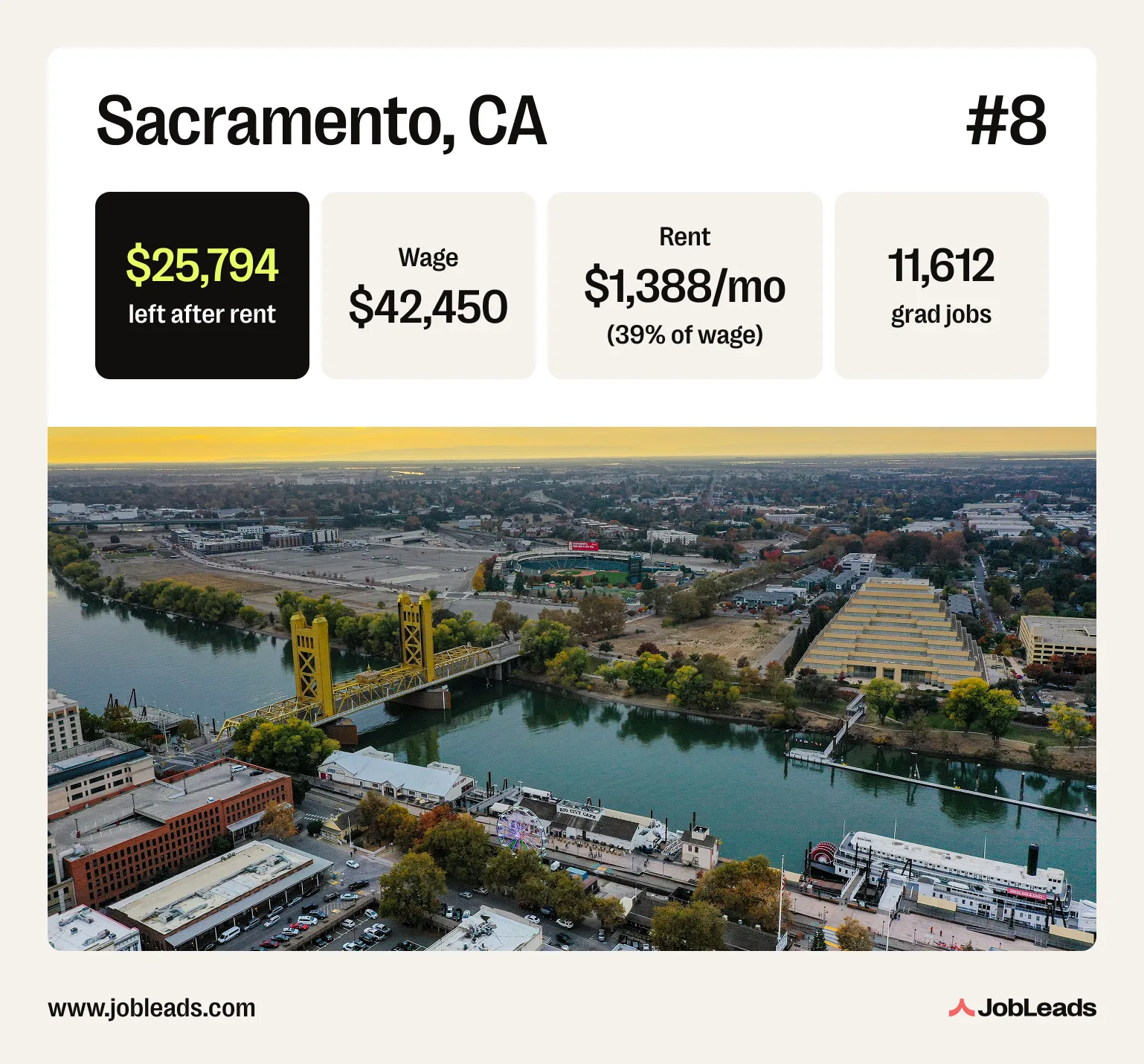
💰 $25,794 left after rent (#8) | Wage $42,450 | Rent $1,388/mo (39% of wage) | 11,612 grad jobs
Sacramento is the only California city in the top ten, and it earns the spot by proving you can live in that state and still come out ahead. Wages stay high by national standards while rent runs far below the Bay Area's.
What stands out: It offers a wage well above the affordable Midwest cities near it, yet rent costs far less than it does two hours west in San Francisco.
The upside for a grad: State government and healthcare anchor a steady job base, so hiring holds up even when tech stumbles, which is good news for non-technical graduates.
The catch: Rent still takes 39% of a starting salary, and the pool of 11,612 openings is on the smaller side, with much of it tied to the pace of public-sector hiring.
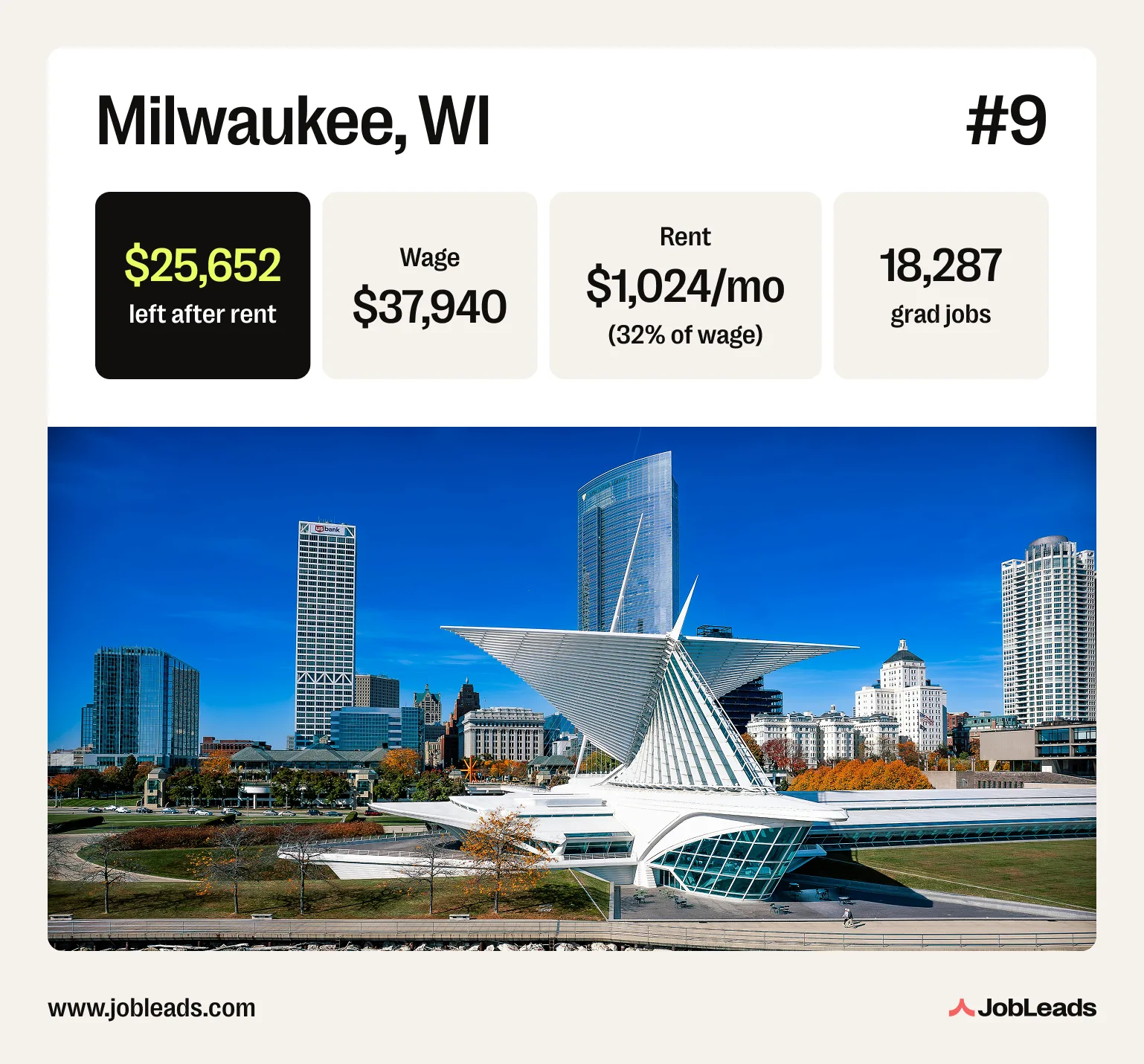
💰 $25,652 left after rent (#9) | Wage $37,940 | Rent $1,024/mo (32% of wage) | 18,287 grad jobs
Milwaukee turns a modest wage into strong take-home thanks to low rent, and it backs it with a healthy pool of openings for its size. Finance and advanced manufacturing give the economy a stable base.
What stands out: Milwaukee is the least transparent job market in the study, with only 24% of entry-level ads disclosing a salary, so applicants here are the most in the dark when negotiating pay.
The upside for a grad: Milwaukee-headquartered Northwestern Mutual was named a Forbes "Best Employer for New Grads," and Rockwell Automation offers a route into manufacturing technology.
The catch: Beyond the pay opacity, the entry wage is modest and the class of 2026 is facing one of the tightest local hiring markets in years.
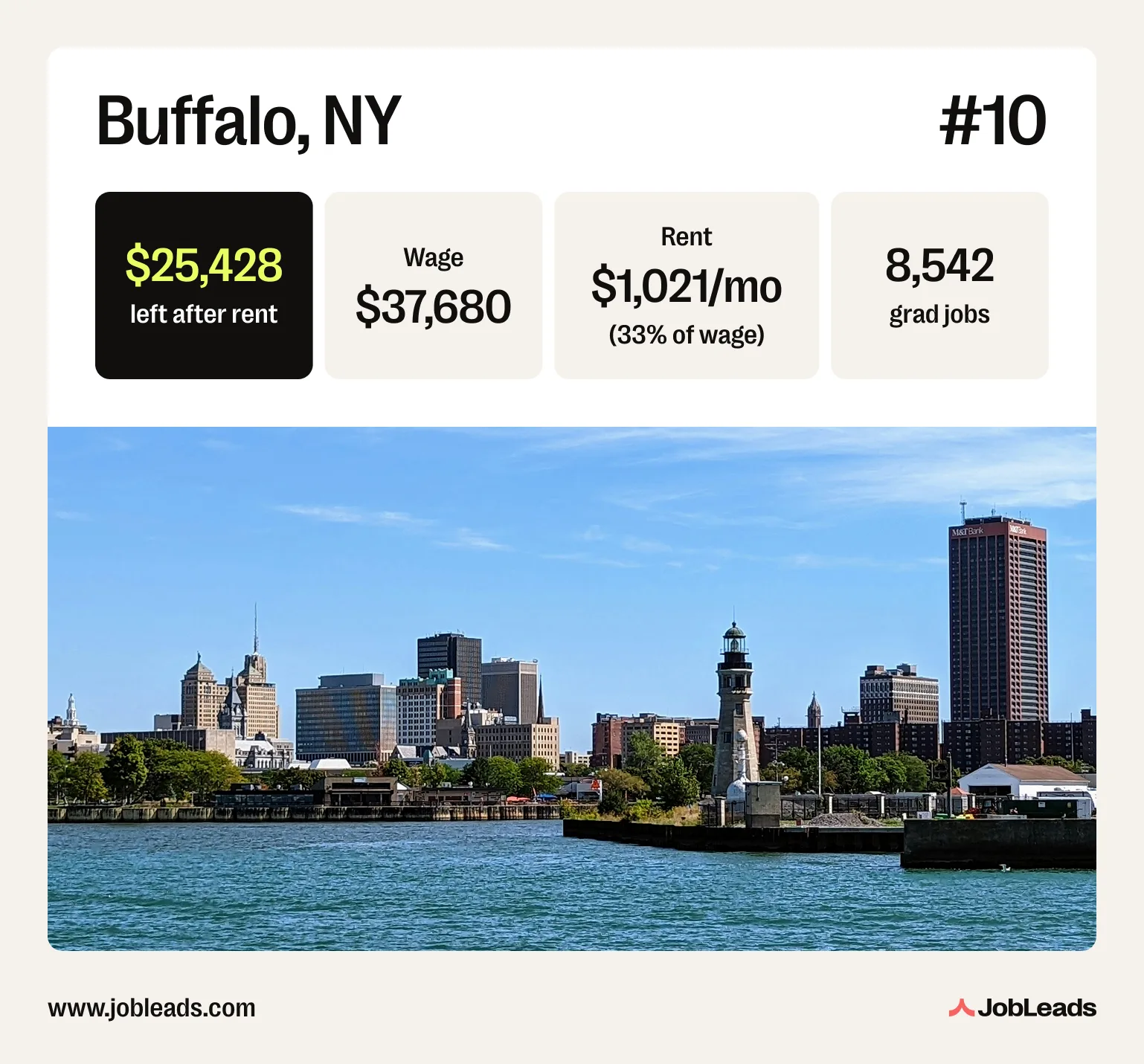
💰 $25,428 left after rent (#10) | Wage $37,680 | Rent $1,021/mo (33% of wage) | 8,542 grad jobs
Buffalo rounds out the top ten on the affordability route, with rent at a third of a starting wage. Its steady "eds and meds" economy keeps demand stable even when other sectors cool.
What stands out: Healthcare and education anchor hiring here, and nursing roles are among the easiest for a new grad to land, at roughly 25 applicants per opening.
The upside for a grad: Buffalo-headquartered M&T Bank and the University at Buffalo are the region's biggest recruiters, giving finance and education graduates clear targets.
The catch: The job pool is small at 8,542 openings, and Buffalo's famously heavy winters are not for everyone.
If the top of the ranking rewards balance, the bottom punishes its absence, and, ironically, the cities that fall hardest are often the ones graduates most want to move to.
Each of the five cities below pairs a tempting salary or a vast job market with rent so steep that graduates finish the year with the least to show for it.

💰 $16,604 left after rent (#50) | Wage $39,320 | Rent $1,893/mo (58% of wage) | 41,104 grad jobs
Los Angeles ranks dead last: a graduate here keeps less after rent than in any other US metro. The problem is not a lack of jobs but wages that never caught up with the cost of living.
What stands out: LA has one of the country's largest graduate job markets, over 41,000 openings, yet it leaves early-career workers the least money of all 50 cities.
The upside for a grad: Opportunity is broad, from the entertainment industry to a vast healthcare sector, and rents recently slid to a four-year low.
The catch: Even after that dip, rent still consumes 58% of a starting salary, so the paycheck is largely gone before anything else.
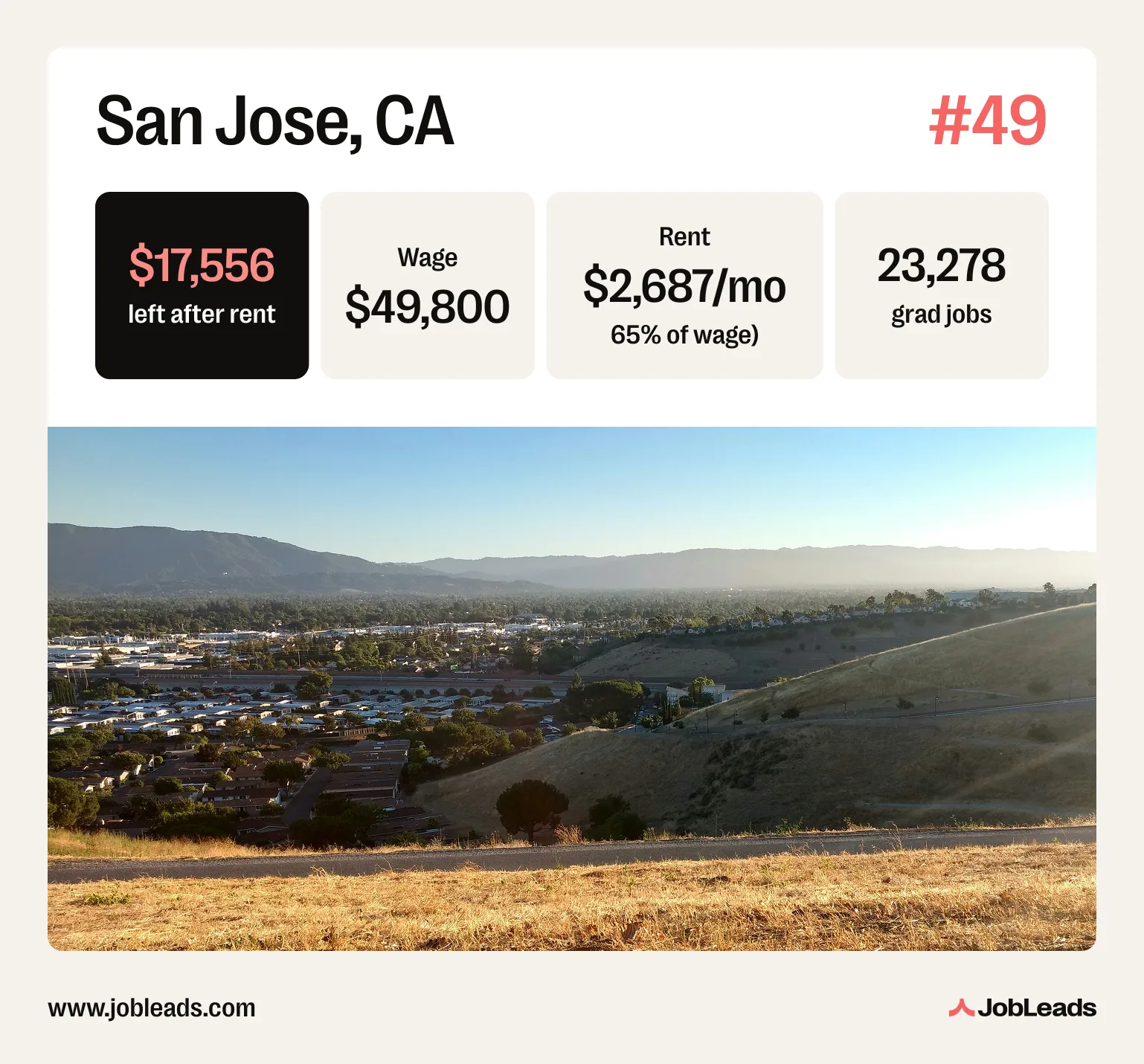
💰 $17,556 left after rent (#49) | Wage $49,800 | Rent $2,687/mo (65% of wage) | 23,278 grad jobs
San Jose is the paradox at the heart of this study: the highest entry-level wage in America, and almost the worst money left after rent. Silicon Valley pays like nowhere else, then charges rent to match.
What stands out: It posts the top starting wage of all 50 metros yet the heaviest rent burden, 65% of pay, drops it to the 49th place on take-home.
The upside for a grad: San Jose leads the nation in hiring new graduates, and its tech and semiconductor salaries sit far above what any other city offers.
The catch: Rent is the highest in the study, and once living costs are counted, Silicon Valley's six-figure tech starting salaries shrink to little more than half their headline value.
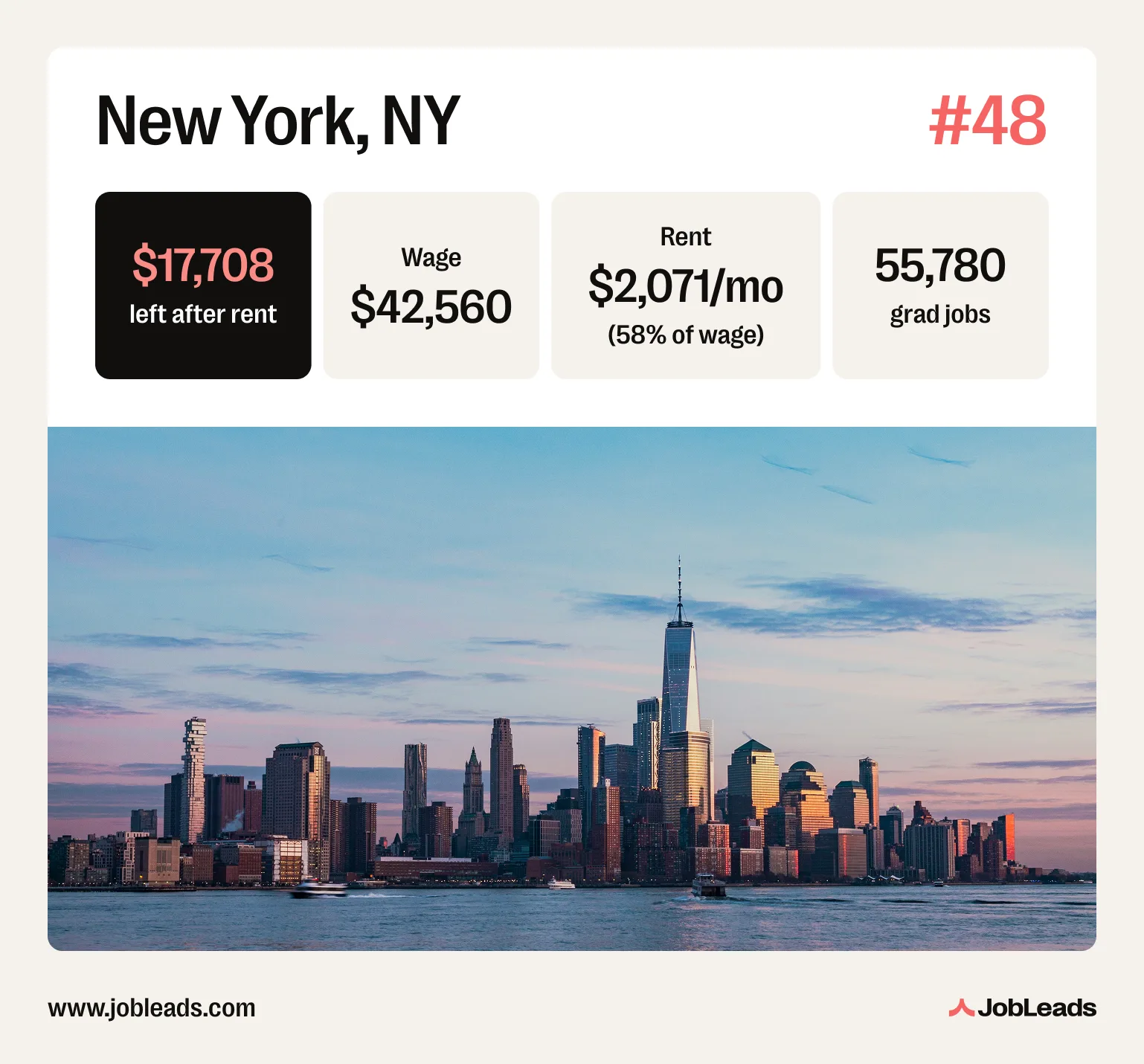
💰 $17,708 left after rent (#48) | Wage $42,560 | Rent $2,071/mo (58% of wage) | 55,780 grad jobs
New York is one of the country's biggest graduate job markets and one of its worst for take-home pay. The doors it opens are unmatched, but rent closes most of them again.
What stands out: With 55,780 entry-level openings, New York has the third-most graduate jobs of all 50 metros, yet finishes third from the bottom on money left after rent.
The upside for a grad: No city matches its breadth of career paths, from finance to media, so the raw number of opportunities is enormous.
The catch: Rent reached record highs for the class of 2026 and now takes 58% of a starting salary, leaving little once housing is paid.
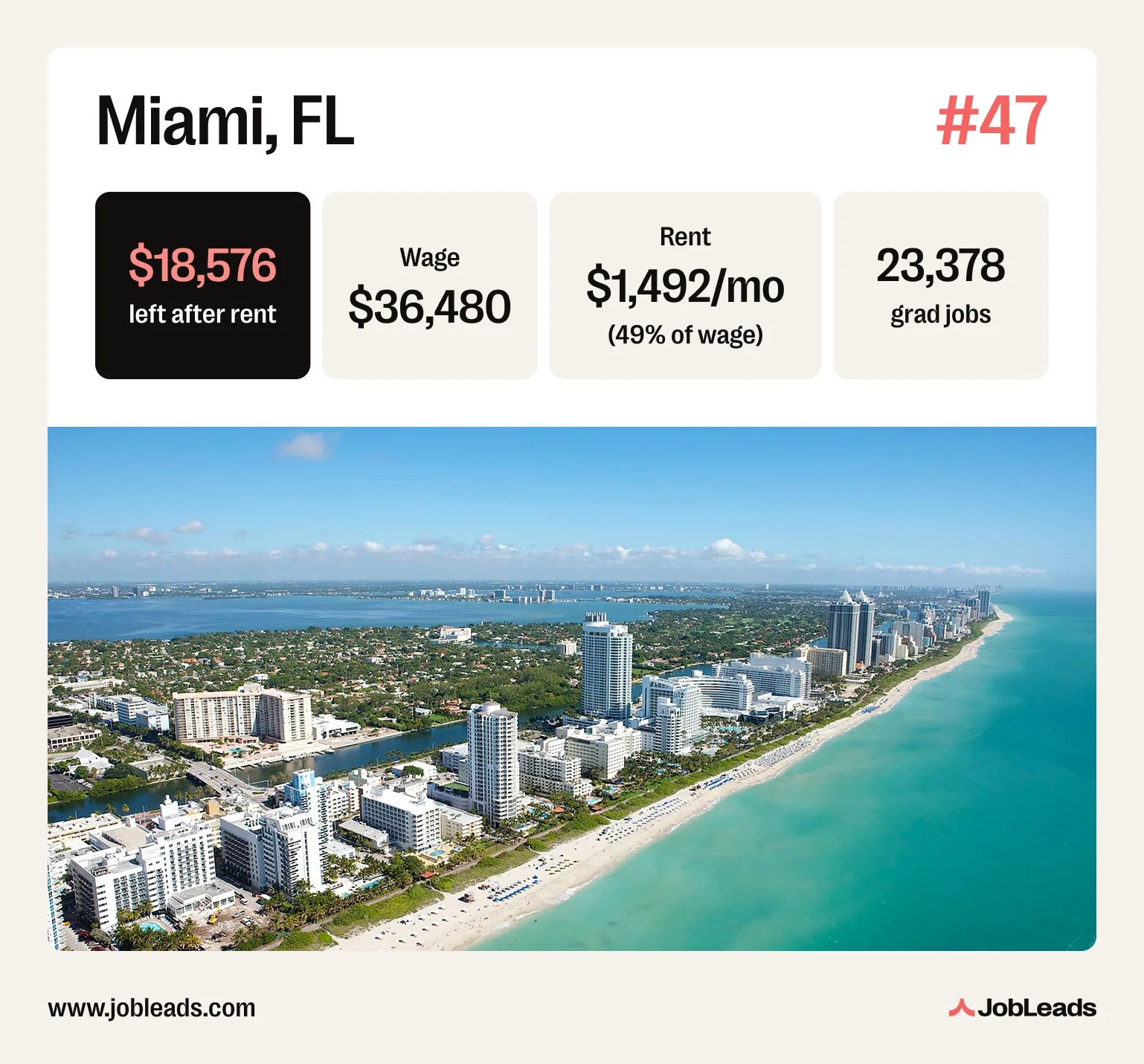
💰 $18,576 left after rent (#47) | Wage $36,480 | Rent $1,492/mo (49% of wage) | 23,378 grad jobs
Miami is the worst of both worlds: modest entry-level pay paired with rent that swallows nearly half of it. Unlike the coastal cities in California, there is often no big-tech salary to cushion the cost.
What stands out: Miami's cost of living now rivals New York's, yet its wages are low for such an expensive city, a squeeze few other places put on graduates.
The upside for a grad: Florida charges no state income tax, so more of a modest paycheck survives, and a growing finance scene is drawing employers south.
The catch: Rent takes 49% of a starting salary while pay has barely moved, so affordability keeps slipping even as rent growth cools.
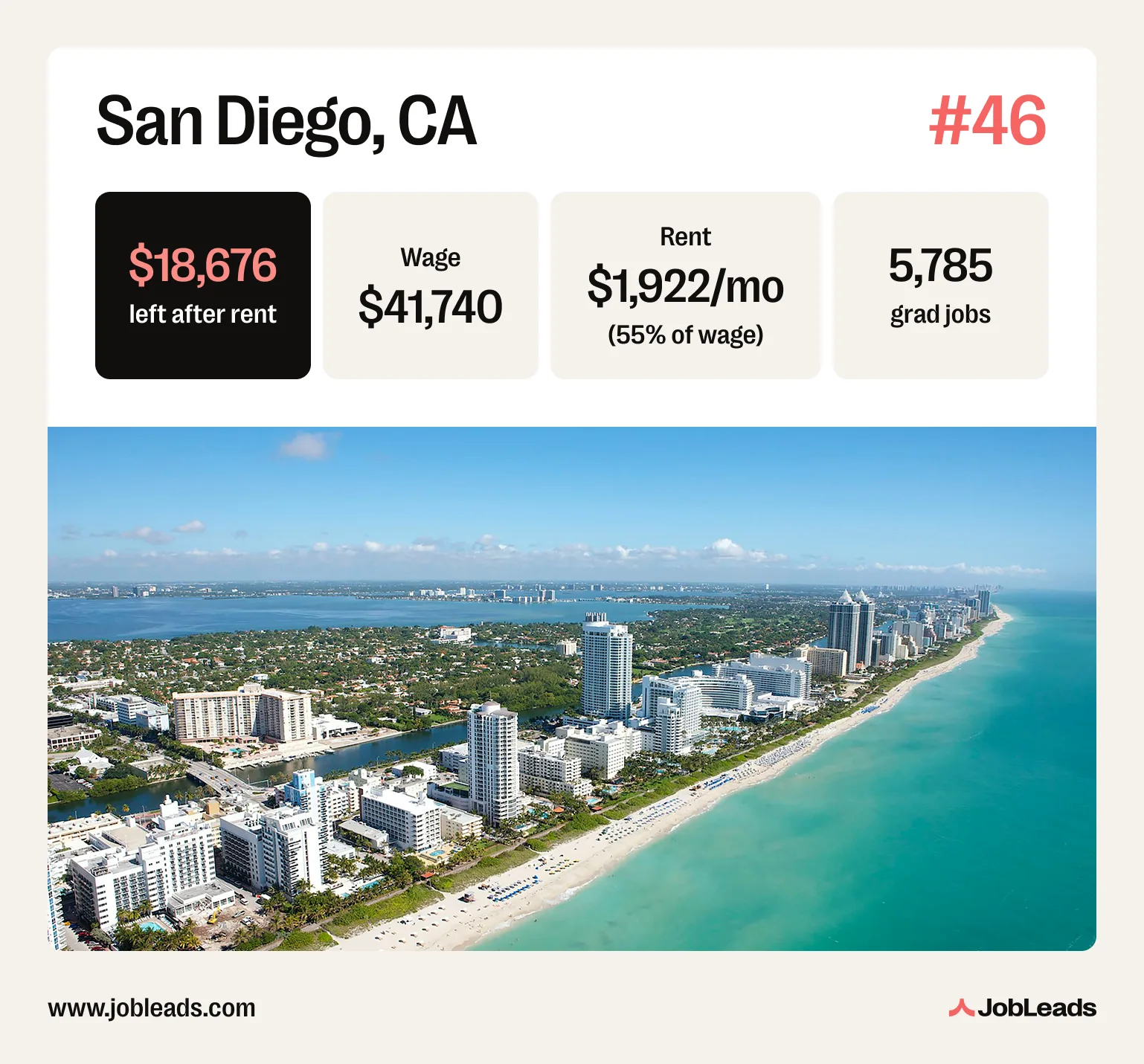
💰 $18,676 left after rent (#46) | Wage $41,740 | Rent $1,922/mo (55% of wage) | 5,785 grad jobs
San Diego combines two problems for graduates: the smallest job pool of any metro in the study and rent that eats more than half a starting wage. The scenery is famous, the math less so.
What stands out: At 5,785 entry-level openings, San Diego has the fewest graduate jobs of all 50 metros, and rent still takes 55% of a starting salary.
The upside for a grad: It's one of the nation's biggest life-science hubs, so biotech and defense offer a genuine niche for science and engineering graduates.
The catch: For everyone else the market is punishing, with about 42 applicants per opening and AI beginning to erode entry-level roles.
What links the cities at the bottom isn't bad luck but a pattern worth unpacking. It begins with the most counterintuitive finding in the data: the highest-paying cities often leave graduates with the least.
On paper the advice looks simple: always chase the biggest salary. The data says otherwise. Across all 50 metros, a city's starting wage has almost no bearing on what a graduate actually keeps. The reason is that pay and rent climb almost in lockstep, so a fatter paycheck usually just buys a bigger rent bill rather than a better standard of living.
Read more: Check out the JobLeads' study on highest paying cities in the US and the world.
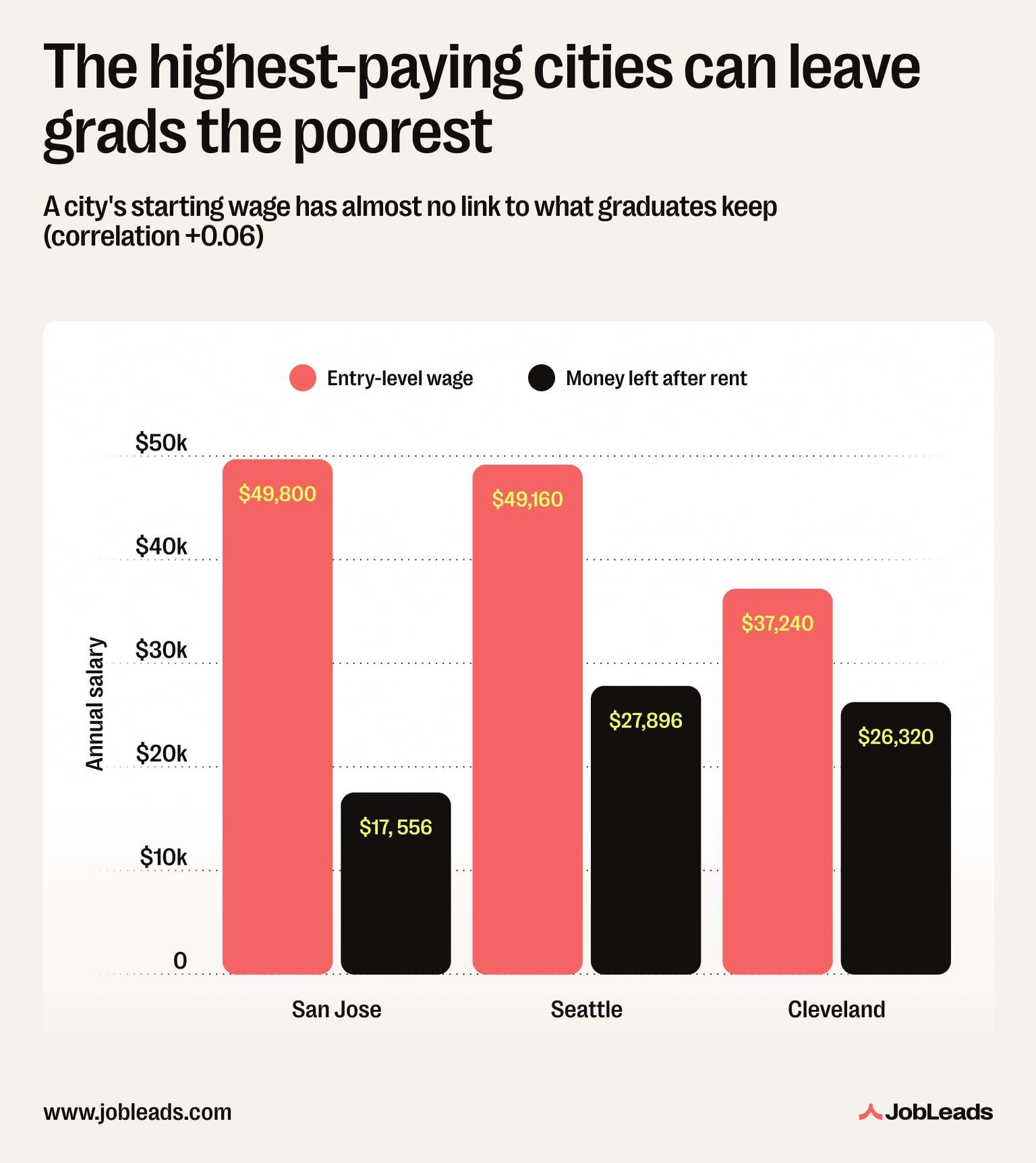
Nowhere is this clearer than in Silicon Valley. San Jose offers the highest entry-level wage in the country at $49,800, yet it finishes 49th of 50 for money left after rent, because a one-bedroom swallows 65% of that salary. Seattle pays almost exactly the same ($49,160) but lands in 3rd, since rent there takes a survivable 43%. The starkest case is a straight swap: a graduate in San Jose out-earns one in Cleveland by $12,560, yet ends the year $8,764 poorer once the rent is paid.
Financial advice has long held that housing should take about 30% of your income. For new graduates, that rule is broken almost everywhere. Across the 50 metros, the average entry-level wage loses 40% to a one-bedroom, and in 49 of the 50 rent claims at least 30% of the paycheck. Only Cleveland slips under the line, at 29%. In six metros rent takes half or more of a starting salary, peaking at a punishing 65% in San Jose.
The bigger lesson is that rent, not pay, decides where a graduate comes out ahead. Entry-level wages are relatively similar from city to city, spanning about 1.6 times from the lowest to the highest. And 1-bed rents are not: they range more than threefold, from $877 a month in Oklahoma City to $2,687 in San Jose. Wages span about 1.6x across the 50 metros, rents more than 3x–so the address on the lease shapes a graduate's finances more than the number on the offer letter.
Another logical instinct for a new graduate is to head where the jobs are. The data suggests that can backfire. Across the 50 metros, the more entry-level openings a city has, the less money its graduates tend to keep, a negative correlation of -0.32. Eight of the ten largest graduate job markets in the country land in the bottom half for money left after rent.
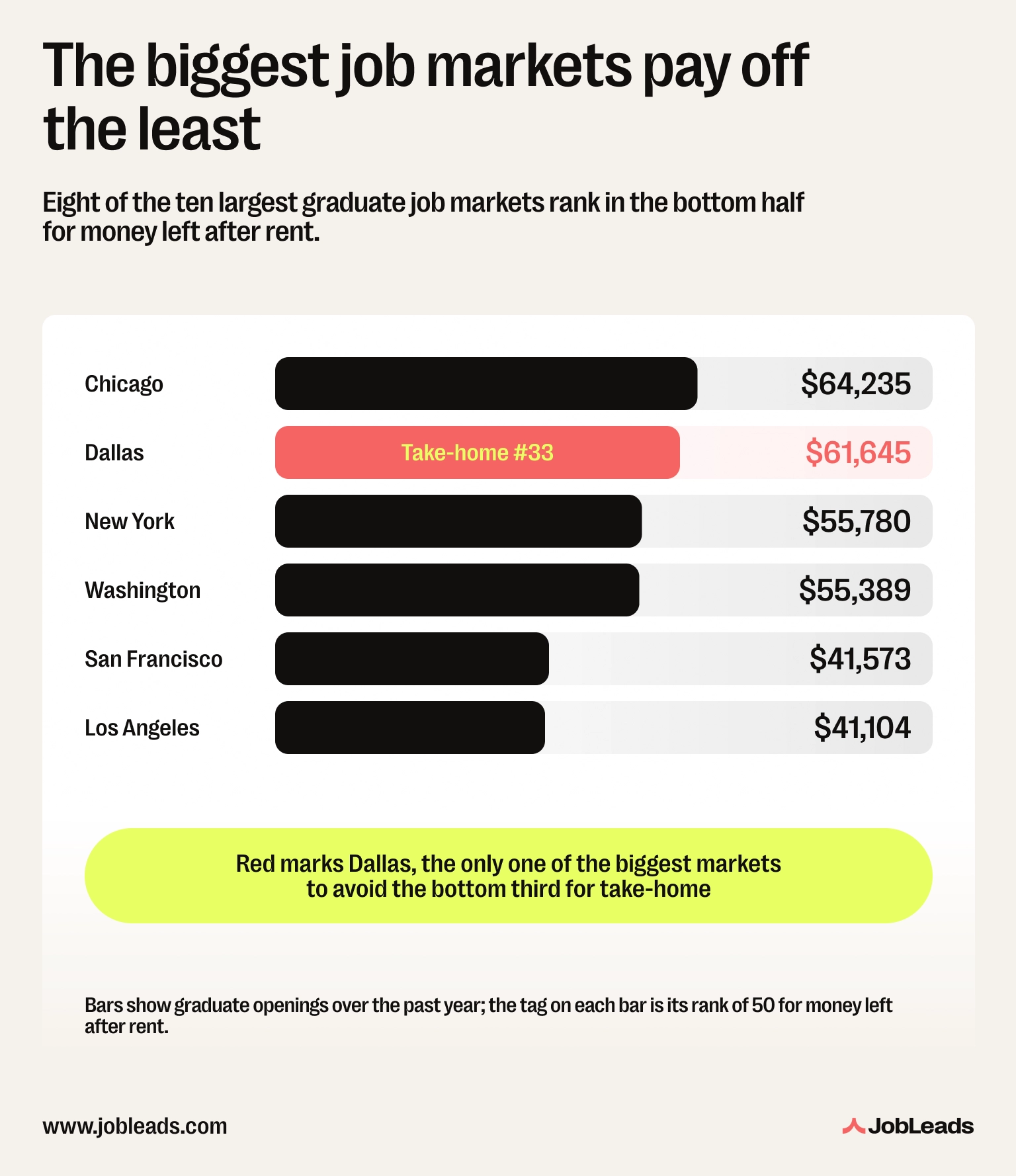
The pattern is stark at the very top. Chicago posts more graduate openings than anywhere else (64,235) yet ranks just 41st for take-home, and New York, the third-largest market, fares worse still at 48th. Of the five biggest graduate job markets, only Dallas escapes the bottom third. Meanwhile Portland, the best city for money left after rent, has fewer than a quarter of Chicago's openings, proof that more choice usually comes with a thinner paycheck.
Across all entry-level postings in the dataset, nearly two in three (62%) list no salary at all, leaving the candidates with the least experience and the weakest bargaining position guessing at their worth. And the blackout is very uneven across the US: disclosure ranges from just 24% of junior ads in Milwaukee to 56% in Seattle and Denver.
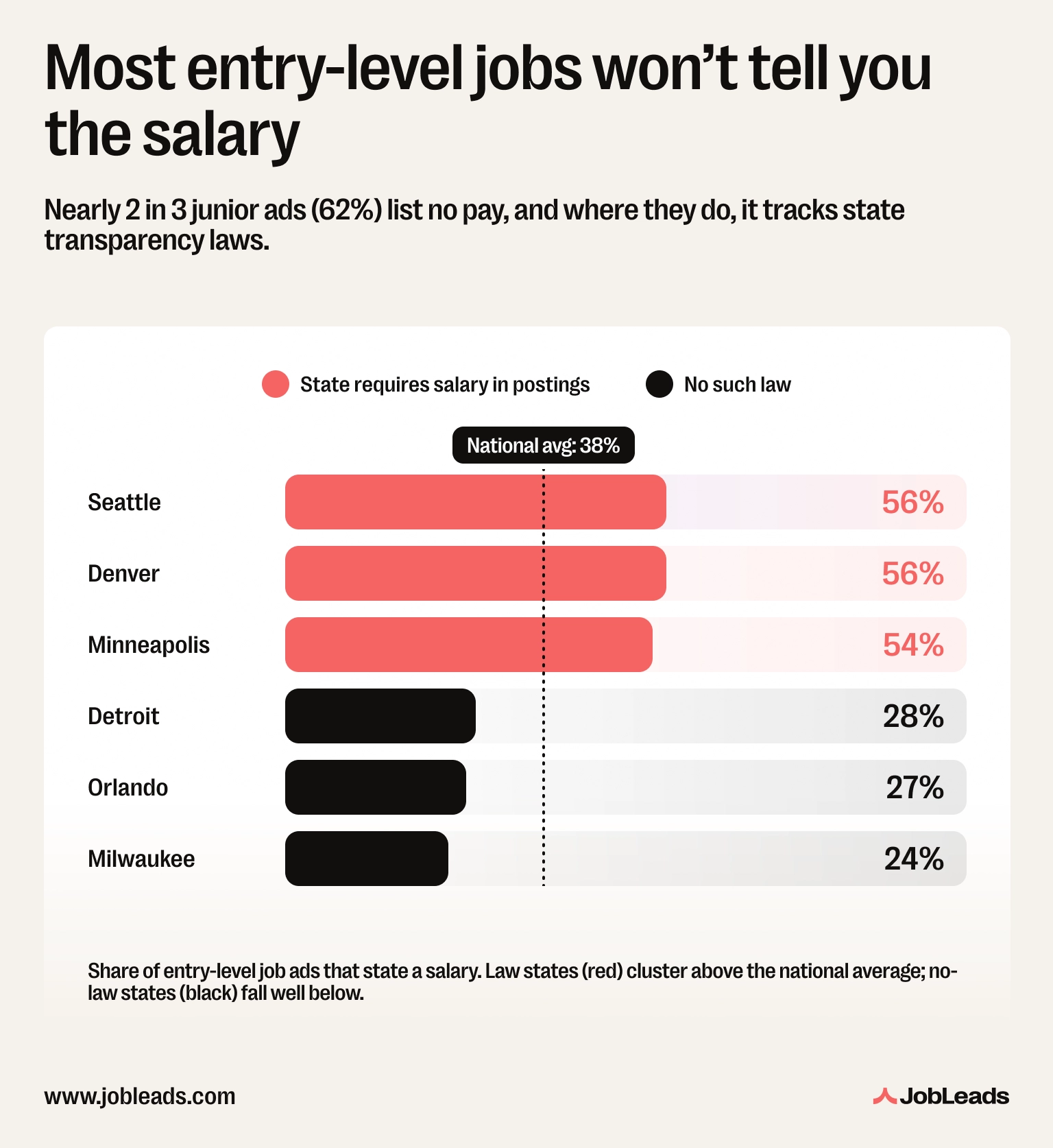
That spread is not random. It tracks state pay-transparency laws almost exactly: the most open markets are in states that require salary ranges in job postings, while the most secretive sit in states without such rules. The link between disclosure and pay is just as telling, a correlation of +0.73, meaning the cities that hide salaries most tend to be the ones that pay the least. For a graduate, silence or vague details like "competitive salary" are rarely good news.
The lesson of this ranking isn't that graduates should chase the biggest salary or the biggest city, but that they should chase the biggest gap between what they earn and what they pay to live. On that measure the map turns upside down: the cities that pay the most often leave the least. And many seemingly unglamorous places quietly beat San Jose and New York where it actually counts–in the bank account at the end of the month.
For the class of 2026, the takeaway is both simple and freeing.
A job offer is only as good as what survives the rent and other basic expenses, so weigh the number against the local cost of living before you sign, and don't write off a city just because it isn't on everyone's list. When you weigh the best cities to start a career, judge them by what survives the rent.
JobLeads ranked the 50 largest US metropolitan areas by money left after rent: the median entry-level wage minus a full year of rent on a one-bedroom apartment. To make sure every ranked city is a real graduate job market, only metros with at least 5,000 entry-level openings on JobLeads over the past year were included. All 50 cleared that threshold, so affordability alone sets the order.
The figures come from three sources:
- Entry-level wages: US Bureau of Labor Statistics (OEWS, May 2025), using the 25th-percentile wage across all occupations as a standard proxy for starting pay.
- Rent: Apartment List (2025), median asking rent for a one-bedroom, averaged across the calendar year.
- Job availability and salary disclosure: JobLeads job postings, from August 2025 to August 2026.
Metros follow US Census definitions and are shown by their common city names.
Limitations:
- Money left after rent counts rent, a graduate's largest single cost, rather than the full cost of living, so it measures what is left after the biggest bill, not total disposable income.
- It assumes one graduate renting a one-bedroom alone. Those who share or take a studio will keep more.
- Job-posting counts reflect activity on JobLeads rather than the entire market, so the authors use them as a qualifying threshold and as context, not as a ranking factor.
- The wage figure is the 25th-percentile across all occupations, a proxy for entry-level pay rather than a graduate-specific salary.
- The study is a single snapshot of the past year, so it captures where things stand as of August 2026 rather than how they are changing over time.
Feel free to share this study's findings for editorial use with credit to JobLeads and a link back to this page. For additional data or interviews, contact press@jobleads.com.



 Job Market Trends