
 Job Market Trends
May 08, 2026
AI Skill Demand Soars 1,300% as Salaries Fall [2026 Study]
AI skills are now required everywhere. We analyzed 110K job postings to understand what that means for salaries, career paths, and remote work opportunities.


Recently, The Guardian published a list of industries it called "safe from AI." These jobs required human skills, physical presence, or regulatory requirements that would keep artificial intelligence at bay. The six industries are: Medical, Education, Law, Hospitality, Trades, and Banking & Finance.
JobLeads tested that claim against 8,334,147 unique US job postings, scanning each one for the mainstream AI keywords, like Prompt Engineering or Machine Learning.
Only 0.4% of postings–roughly 1 in 260–mention AI at all. But that aggregate number hides a huge swing between industries–from 0.01% in Hospitality to 2.5% in Law. Here's the full picture.
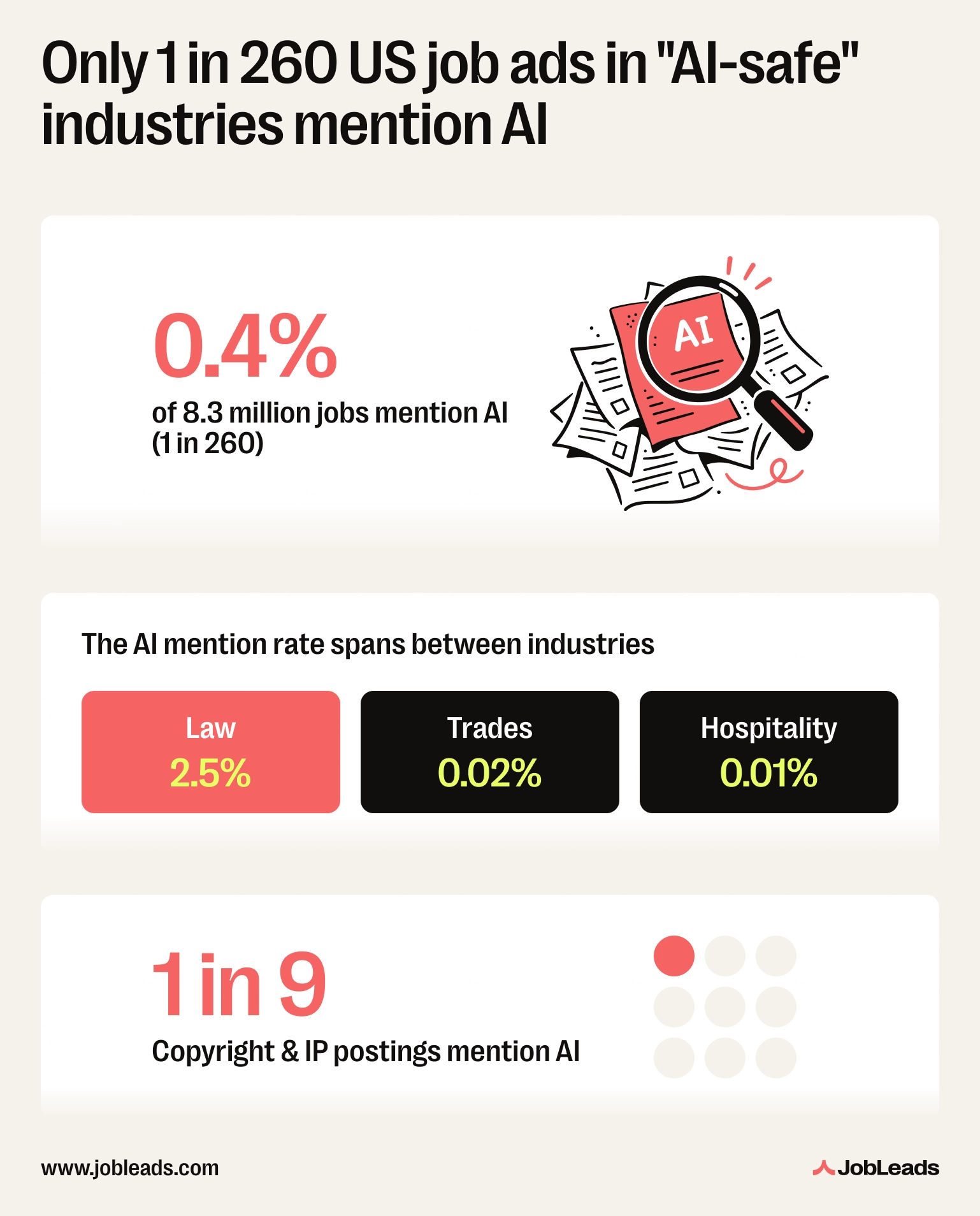
This doesn't measure whether AI is replacing jobs in these industries. It measures how often AI keywords appear in job ads, which shows how much each industry talks about AI when it hires.
For context: all six industries, supposedly safe from AI takeover–the AI penetration in job ad content is low, which would confirm the Guardian's list. Of 8,334,147 postings, 32,201 mention at least one of the 12 AI keywords scanned–a 0.4% rate, or roughly 1 in 260 ads.
For context, Indeed's AI Tracker put the economy-wide share of postings mentioning AI at 4% in December 2025. The six industries studied run more than ten times below that broader-economy rate.
| Industry | Total jobs | Ads mentioning AI | % of ads mentioning AI |
|---|---|---|---|
| Law | 238,013 | 5,896 | 2.5% |
| Banking & Finance | 150,468 | 1,698 | 1.1% |
| Education | 952,039 | 6,861 | 0.7% |
| Medical | 5,761,775 | 17,564 | 0.30% |
| Trades | 719,308 | 111 | 0.02% |
| Hospitality | 512,544 | 71 | 0.01% |
Trades and Hospitality are where the "safe from AI" claim holds most literally–effectively zero mentions of AI requirements, across more than 1.2 million combined job ads. Of the six industries studied, these two come closest to genuinely AI-proof jobs, at least by this measure.
That tracks with outside research on large language models specifically: a study found tasks involving physical labor, outdoor work, and fine motor skills–the kind of hands-on hard skills a model can't replicate–sit at the bottom of LLM exposure. On the other hand, writing, data analysis, and specialized reasoning sit at the top (Eloundou, Manning, Mishkin & Rock, 2024).
Industry-level averages hide what happens inside each industry. In Law, Copyright & Intellectual Property postings mention AI at 10.7%–roughly 1 in 9. It's the single highest AI mention rate of any sub-category across all six industries.

The rest of Law clusters unevenly around that peak: Legal (5.2%), Corporate Law (4.5%), and Tax Law (4.3%) all sit in the 4-5% range, while Public Law (0.2%) and Antitrust (0.00%) show almost no AI mentions at all. Two sub-categories, same industry, same broad profession but opposite ends of the scale.
The same internal split shows up elsewhere, at a smaller magnitude. In Education, Training & Coaching postings mention AI at 1.3%–driven largely by AI tutor and coding-instructor roles. This comes to more than double the 0.5% rate in Science, Research & Teaching.
Medical sub-categories, by contrast, stay uniformly low, from 0.3% in Healthcare and Physicians down to 0.02% in Medical Teaching. There's no pocket of concentration the way Law has one. Trades and Hospitality show no adoption pockets anywhere: every sub-category in both industries sits near zero.
The interpretation almost writes itself. Contract review, e-discovery, and patent and trademark search were among the first legal tasks where AI tools matured. And IP work leans heavily on all three. But IP law is also where AI's own legal questions landed: who owns what a model generates, whether training on copyrighted material counts as fair use, whether an AI can be named as an inventor. On top of using AI, IP lawyers are being hired to argue about it.
In other words: "Is my industry safe from AI?" is the wrong question for a Law job seeker. "Is my specialty safe?" is the right one–and it's the question to build a targeted job search around.
Grouping postings into three tiers: C-Suite (Managing Director, Vice President), Management (Head of Department, Team Leader), and Individual Contributors (Specialist, Project Manager) reveals a consistent gradient in most of the six industries.
Here's the share of jobs mentioning AI in their job requirements at different career levels:
| Industry | C-Suite | Management | Specialist |
|---|---|---|---|
| Law | 5% | 2.9% | 1.6% |
| Banking & Finance | 2.8% | 1.6% | 1% |
| Trades | 2.2% | 0.01% | 0.02% |
| Education | 1.8% | 1.3% | 0.6% |
| Medical | 0.1% | 0.07% | 0.3% |
| Hospitality | 0.1% | 0.01% | 0.01% |
In Law, Banking & Finance, and Education, seniority and AI mentions move together. Law's C-Suite rate (5%) is more than three times its Individual Contributor rate (1.6%).
That pattern suggests AI is entering these industries through strategic and leadership-level decisions before it reaches day-to-day practitioner roles. Companies hire leaders to have an AI strategy long before that strategy changes what a paralegal, loan officer, or teacher does on an ordinary Tuesday. The C-Suite posting is the announcement; the specialist posting is the adoption. The gap between Law's 5% and 1.6% is, in effect, the lag between the two.
It also lines up with a broader labor-market shift: Indeed Hiring Lab found US senior-level job postings up 15% year-over-year, while entry-level postings fell 6% and mid-level postings fell 7% over the same period–one reason so many entry-level jobs now ask for experience.
Medicine inverts it. Individual Contributors (0.3%) mention AI more than Management (0.07%) or C-Suite (0.1%). In every other industry studied, AI talk starts at the top. In medicine, it starts at the bottom–showing up in practitioner-level tools like clinical decision support, AI-assisted documentation, and diagnostic aids rather than in management strategy.
That makes sense given where medical AI actually lives. In healthcare, the decision to trust an AI output isn't made in a boardroom–it's made next to a patient, by the clinician reading the scan or signing off on the chart note. Regulation keeps it there as the licensed professional stays accountable for the call. So the job ads asking for AI familiarity are the ones for the people who'll actually use it.
The work setting shows the same divide as seniority, and just as sharply. Here's the share of postings mentioning AI by work setting:
| Industry | Remote | Hybrid | On Site |
|---|---|---|---|
| Law | 6.1% | 3% | 2% |
| Banking & Finance | 2.3% | 1.8% | 0.9% |
| Education | 1.5% | 0.7% | 0.5% |
| Medical | 0.5% | 1.2% | 0.2% |
| Hospitality | 0.3% | 0.2% | 0.01% |
| Trades | 0.2% | 0.1% | 0.01% |
Remote postings carry the highest AI mention rate in Law, Banking & Finance, Education, Hospitality, and Trades. Law's remote rate (6.1%) is three times its on-site rate (2%) and the pattern repeats in Banking as well as Education.
That's hardly a coincidence. Fully digital work is exactly where LLM-shaped tools go. A job that can be done from anywhere is already made of documents and data that's essentially the raw material a model works with. Put simply, if a job can be done from anywhere–as most digital nomad jobs can–parts of it can be done by a model.
The medical sector breaks the pattern a second time. Hybrid roles lead at 1.2%, ahead of remote (0.5%)–consistent with telehealth and hybrid clinical roles that blend in-person care with AI-assisted tools. Combined with the seniority findings above, Medical is the one industry in this dataset where AI adoption signals concentrate at the point of care, not at the top.
Salary follows a similar shape: in every industry, AI mentions are higher in the $100–150K band than in the lowest band. Here's how many job postings mention AI for jobs on different salary bands:
| Industry | Under $60K | $60–100K | $100–150K | $150K+ |
|---|---|---|---|---|
| Law | 1.2% | 1.8% | 4.5% | 4% |
| Education | 0.6% | 1.1% | 2.5% | 4.1%* |
| Banking & Finance | 0.2% | 1.2% | 2.5% | 2.2% |
| Medical | 0.02% | 0.3% | 0.9% | 1.6% |
| Trades | 0.01% | 0.01% | 0.2% | 0%* |
| Hospitality | 0.01% | 0.01% | 0.1% | 0% |
*Education's $150K+ band (459 postings) and Trades' $150K+ band (333 postings) are small samples–directional, not conclusive.
Law peaks at $100–150K (4.5%) and Medical peaks at $150K+ (1.6%), consistent with specialist physician roles using clinical AI tools. Trades and Hospitality stay near zero at every salary level studied–even at $100–150K, only 0.2% and 0.1% of postings mention AI, respectively.
Two outside data points frame why this gradient exists. Eloundou et al. found that occupational exposure to large language models skews toward higher-income work, not away from it. And separately, Lightcast's analysis of more than 1.3 billion job postings found that listings requiring AI skills carry a 28% salary premium–worth factoring into any upskilling strategy. Higher pay and higher AI-mention rates appear to move together well beyond these six industries–a point worth bringing into your next salary negotiation.
Three patterns run through this entire dataset. AI penetration in job ad content is low almost everywhere–fewer than 1 in 260 postings across all six industries mention it. Where it does appear, it concentrates in specific sub-specialties rather than whole industries, the way Copyright & IP Law (10.7%) dwarfs Public Law (0.2%) inside the same profession. And within nearly every industry, it clusters at the senior, remote, and higher-paid end of the market.
The hypothesis that some industries are safer from AI than others, is right in the ground level but misses the ceiling. Whole industries aren't exposed to AI. Instead, specific tasks are. That's why, for example, 1 in 9 IP-law job ads already mentions AI while a plumber's job ad hasn't changed a word. So, we should stop focusing on industries but look at which of your tasks could a model do first.
Ricardo Meneses Flores – Data Analyst, JobLeads
In some industries "is my industry safe from AI" is the wrong thing to ask. Especially when Copyright & IP Law and Public Law sit 67 times apart inside the same profession.
There is no single list of jobs that AI can't replace or careers safe from AI across the board. But there's a gradient, and this data shows exactly where it runs steepest.
JobLeads analyzed 8,334,147 US job ads that were live between January and June 2026, taken from its own job database. Duplicate ads were removed. The analysis focused on the six industries that The Guardian called "safe from AI":
JobLeads sorted jobs into these industries using its own job categories, so the groups may not match The Guardian's exactly.
How JobLeads spotted AI skills
JobLeads searched each job ad for these terms: AI, Artificial Intelligence, ChatGPT, LLM, Large Language Model, Prompt Engineering, ML, Machine Learning, Generative AI, AI Integration, Claude, Gemini. The search covered the skills, tools and qualifications JobLeads' system pulls out of each ad. If an ad used more than one term, JobLeads counted it once, under whichever term came first in that list.
To avoid false matches, JobLeads only counted short terms like "AI" and "ML" when they appeared as a word of their own, so words like "email" or "paid" didn't count. "Claude" and "Gemini" only counted when they were listed as a skill or tool. That way, a hiring manager named Claude or a mention of the star sign Gemini didn't count.
Limitations
JobLeads searched the key details pulled from each ad, not the full text. If an ad mentioned AI but the system didn't pick it up, the analysis missed it. The real number of AI mentions is probably higher. Also, each ad counts under one AI term only.
A mention of AI doesn't tell you how AI is used. An ad might want someone who uses AI tools, oversees AI, or thinks about AI ethics. JobLeads counted mentions, not meaning.
Salaries are estimated from the job ad, not provided by employers.
A few groups are small, so read those results with caution: C-suite roles in Trades (182 ads, 4 mentioning AI) and jobs paying $150K+ in Education (459 ads) and Trades (333 ads).
Mentioning AI isn't the same as being affected by AI
When a job ad mentions AI, that shows AI is part of the job. It doesn't show that jobs are being lost or that pay is changing. The US Bureau of Labor Statistics makes the same point in its own research on AI, noting that "exposure does not imply job loss, productivity gains, automation probability, or wage effects" (US Bureau of Labor Statistics, "Artificial Intelligence (AI) Exposure Categories," August 2026). This study looks at something simpler: whether job ads mention AI at all.
This data comes from JobLeads' job database and doesn't cover the whole US job market. All figures are totals, and no individual job ads or employers are named.
Journalists and media organizations are welcome to reproduce charts and data from this article with attribution to JobLeads and a link to this page. Please do not reproduce the article in full without permission. For questions, additional data, or interview requests, contact press@jobleads.com.

Content & Insight Writer
Beata creates content that puts job seekers first. From practical blog advice to first-hand research studies, her writing is designed to give people the clarity and confidence to find the role they deserve.
Job Market TrendsAI skills are now required everywhere. We analyzed 110K job postings to understand what that means for salaries, career paths, and remote work opportunities.
 Job Market Trends
JobLeads analyzed 1.2 million entry-level job listings to find what skills employers request most. Learn what entry-level jobs actually require, pay, and offer.
 Job Market Trends
Overqualified for a job? New JobLeads data shows 63% of US senior job seekers now apply below their level, forgoing about $51k a year.