Remote work has been a hot topic in the last year. Return-to-the-office mandates across corporate America have been ever-present in the news and concerned even companies that seemed to champion flexibility. From Google to Amazon to Dell to the federal government, employees have encountered tightened restrictions on flexible work.
So–a valid question appeared.
Are we really living through the great downfall of remote work?
To dig deeper into remote work trends, JobLeads analyzed 5+ million jobs posted in the US in the second half of 2025 and surveyed more than 426 thousand American job seekers. We wanted to understand how the work mode supply vs. demand looks across states, cities, industries, and income levels as we are moving into 2026.
Key remote workforce statistics:
- In the United States, 87% of all open roles are fully in-office, while 7% are hybrid, and only 6% are fully remote
- Jobseeker preferences are evenly divided between remote and on-site work: 23% of candidates prefer fully remote work, and another 23% want to work exclusively on-site; Only about 6% prefer hybrid arrangements
- Nearly one in three US job seekers is open to any work setting, signaling high flexibility on the talent side
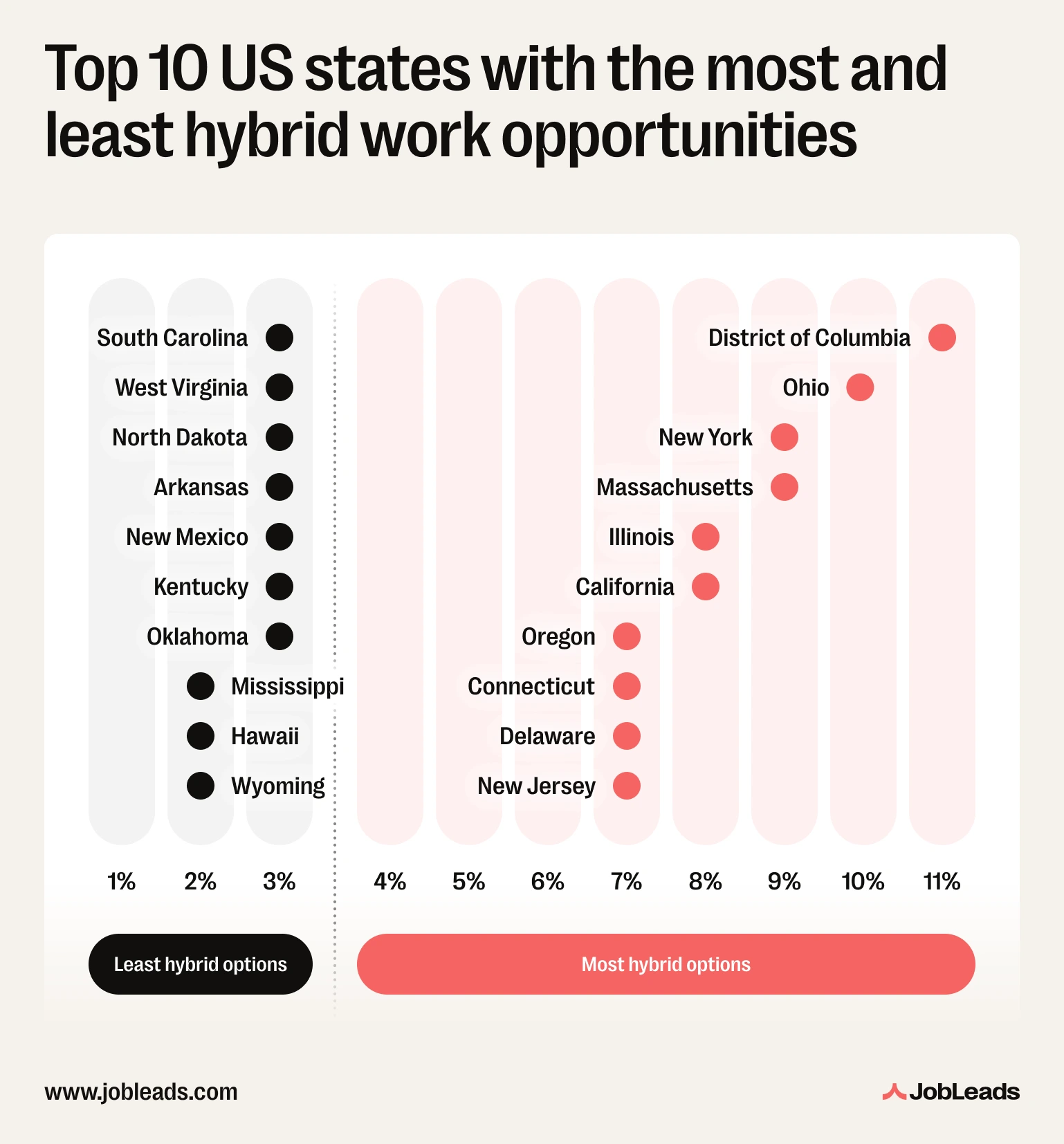
- Oregon is the national remote work hotspot, with 10% of all open positions being fully remote. The District of Columbia leads in hybrid roles, where 11% of all jobs offer a mixed setting
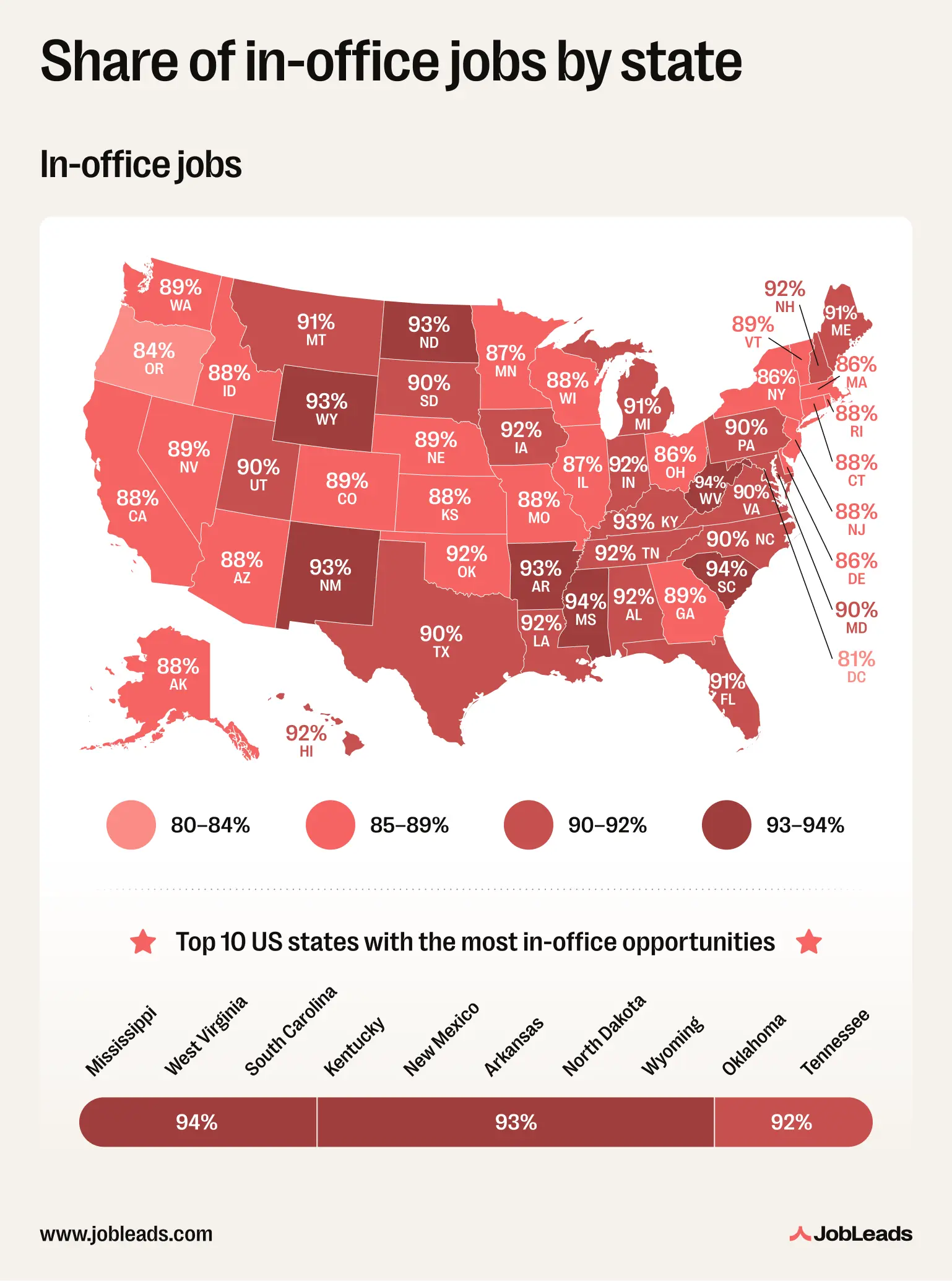
- Mississippi, West Virginia, and South Carolina are the most in-office-dominant states, with 94% of their open roles requiring full on-site presence
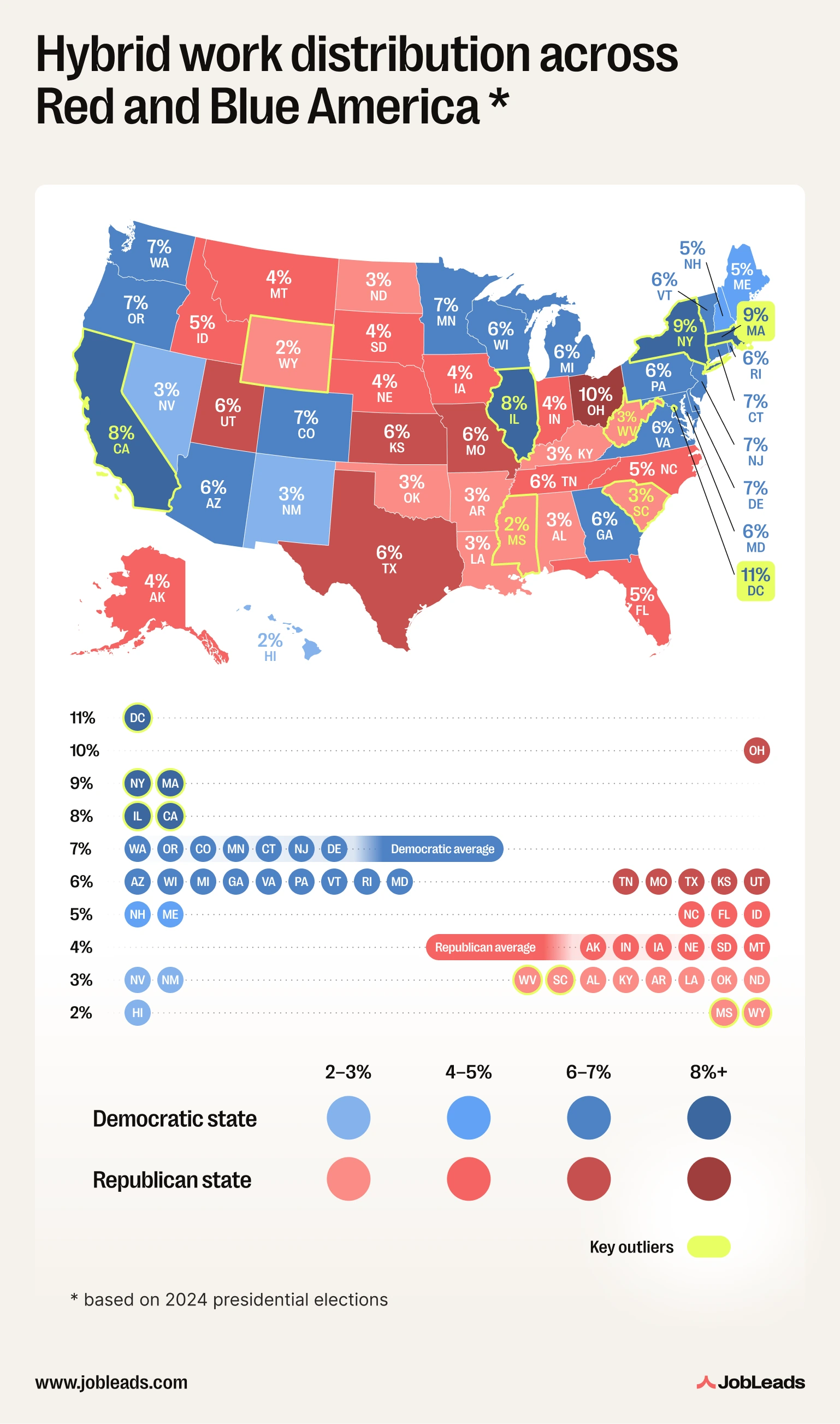
- Blue states offer an average of 7% hybrid roles–almost double the red-state average of 4%
- Among major cities, Detroit stands out as the remote-work leader with 8% fully remote roles. San Antonio is the most in-office city (92%), while San Francisco leads in hybrid roles (18%)
- New York offers just 4% fully remote roles, making it one of the least remote-friendly cities in the country
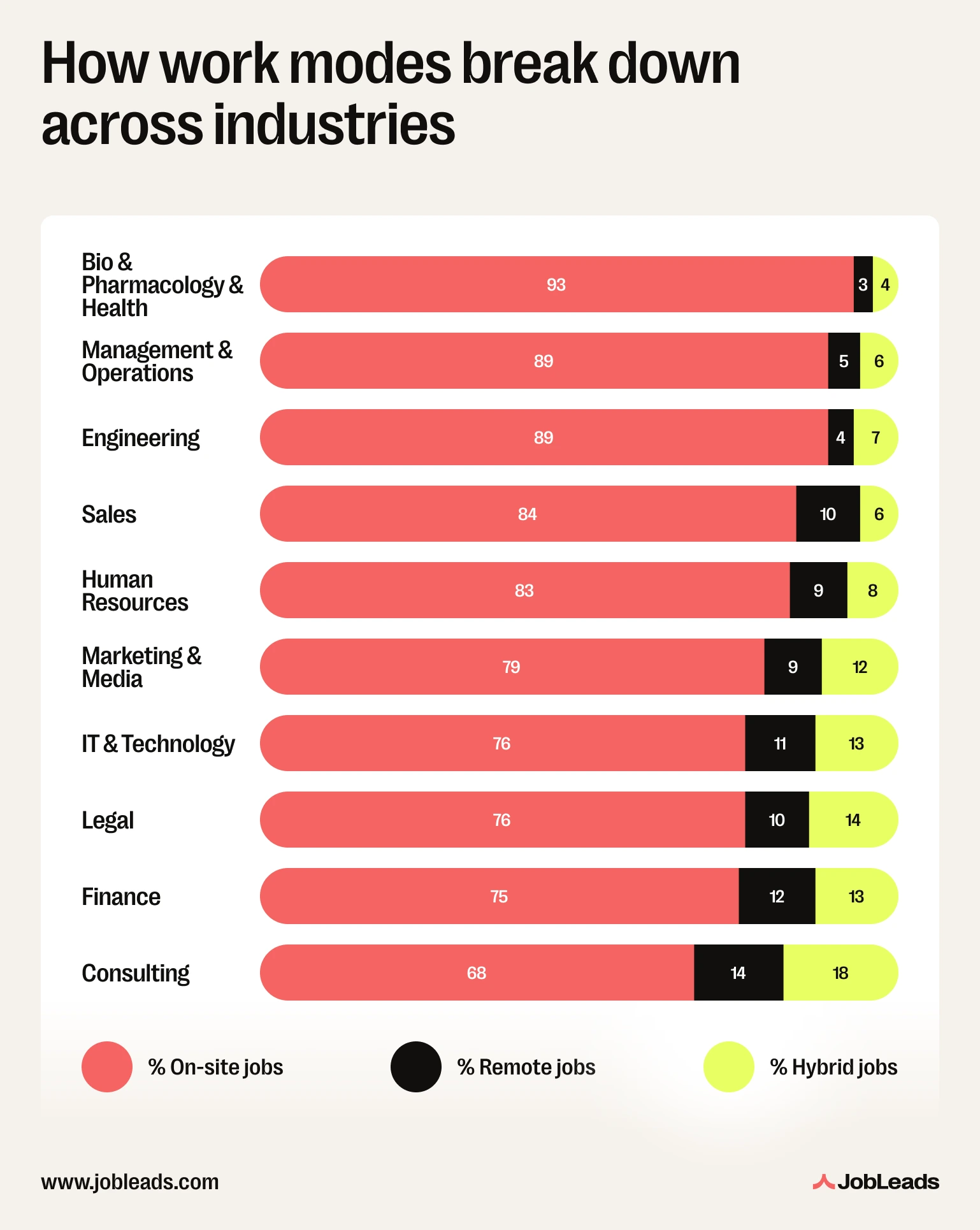
- Consulting is the king of flexibility: 18% of consulting jobs are hybrid, and 14% are fully remote, making consulting roles almost three times as likely to be hybrid as the average US job (7%)
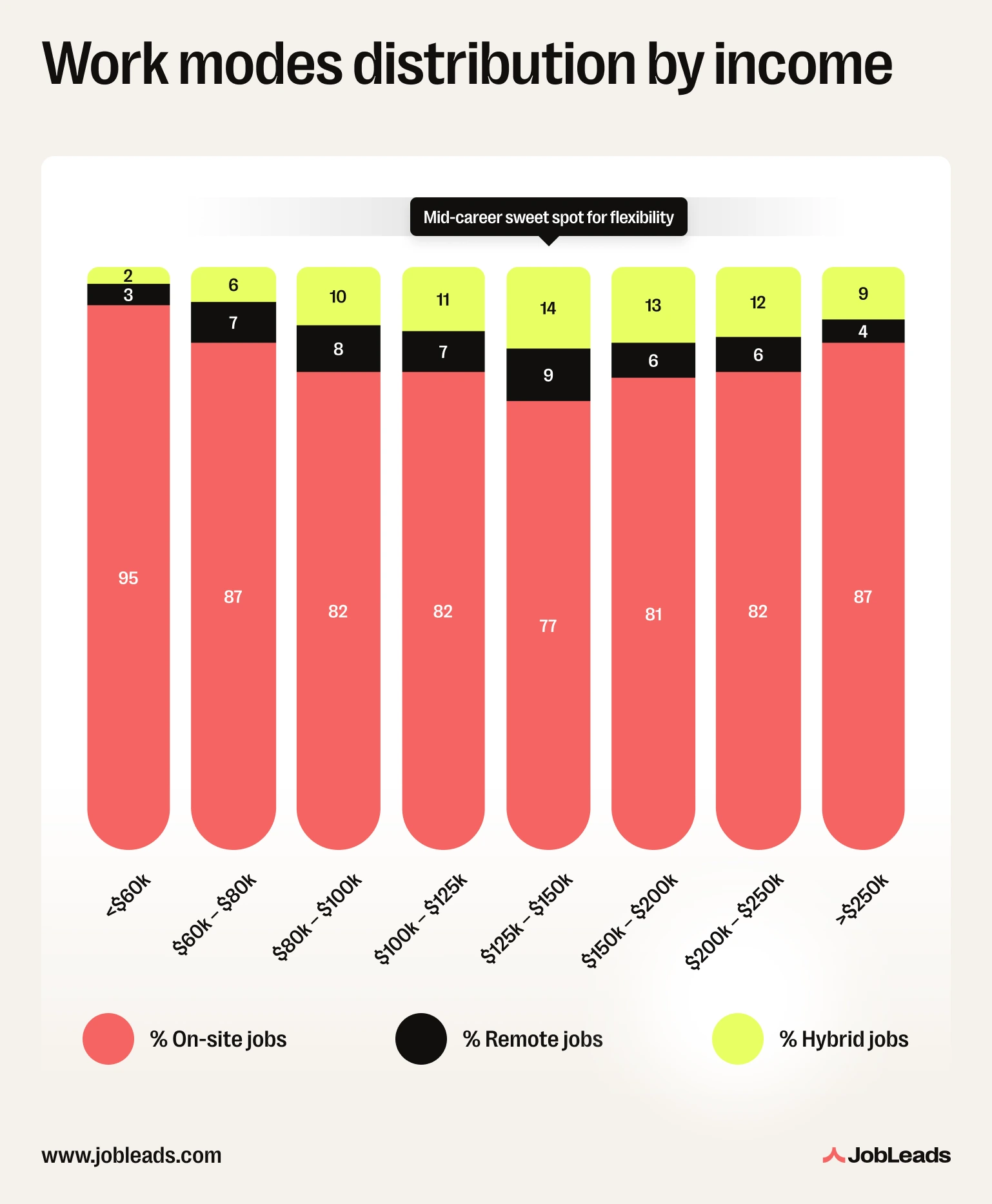
- Flexible work is a mid-career privilege: remote roles peak at 9% in the $125k-$150k band, but drop to just 3% below $60k and 4% above $250k

Let's dive into our findings:
It seems that the big return to the office is actually a thing. In-office jobs in the US have increased by 21% since 2023, when about 66% of job postings were on-site. According to return-to-office stats, 2025 has been the year when many largest companies tightened their RTO rules, citing better collaboration, culture, and mentoring as the main reasons. Giants like Dell, Amazon, Walmart, JPMorgan, Google, Uber, and many others have posted their RTO mandates in 2025, serving as an example to many smaller organizations.
Hybrid mode used to be a popular compromise, however, it has also dramatically declined. Hybrid work statistics state that in 2023, over 70% of US employers offered some hybrid options. In late 2025, only 7% of newly opened positions are marked as hybrid, which is a dramatic decline. It's also lower than the global average, with 8% of open positions worldwide marked as hybrid. So, while the remote job market is shrinking, hybrid work predictions are also not exactly optimistic.
Research suggests that flexible working options benefit both employers and employees. As many as 61% of employees working remotely report being more productive when working from home.
Benefits of remote work for companies include cost savings, better employee retention, and reduced absenteeism. In fact, estimated company savings per remote employee reach as high as $37k annually. So, working from home increases productivity while significantly lowering costs.
While it does seem like a win-win situation, the push back into the office in the United States is only gaining speed. There is no expected increase in remote work in the United States in 2026, across all sectors and locations.
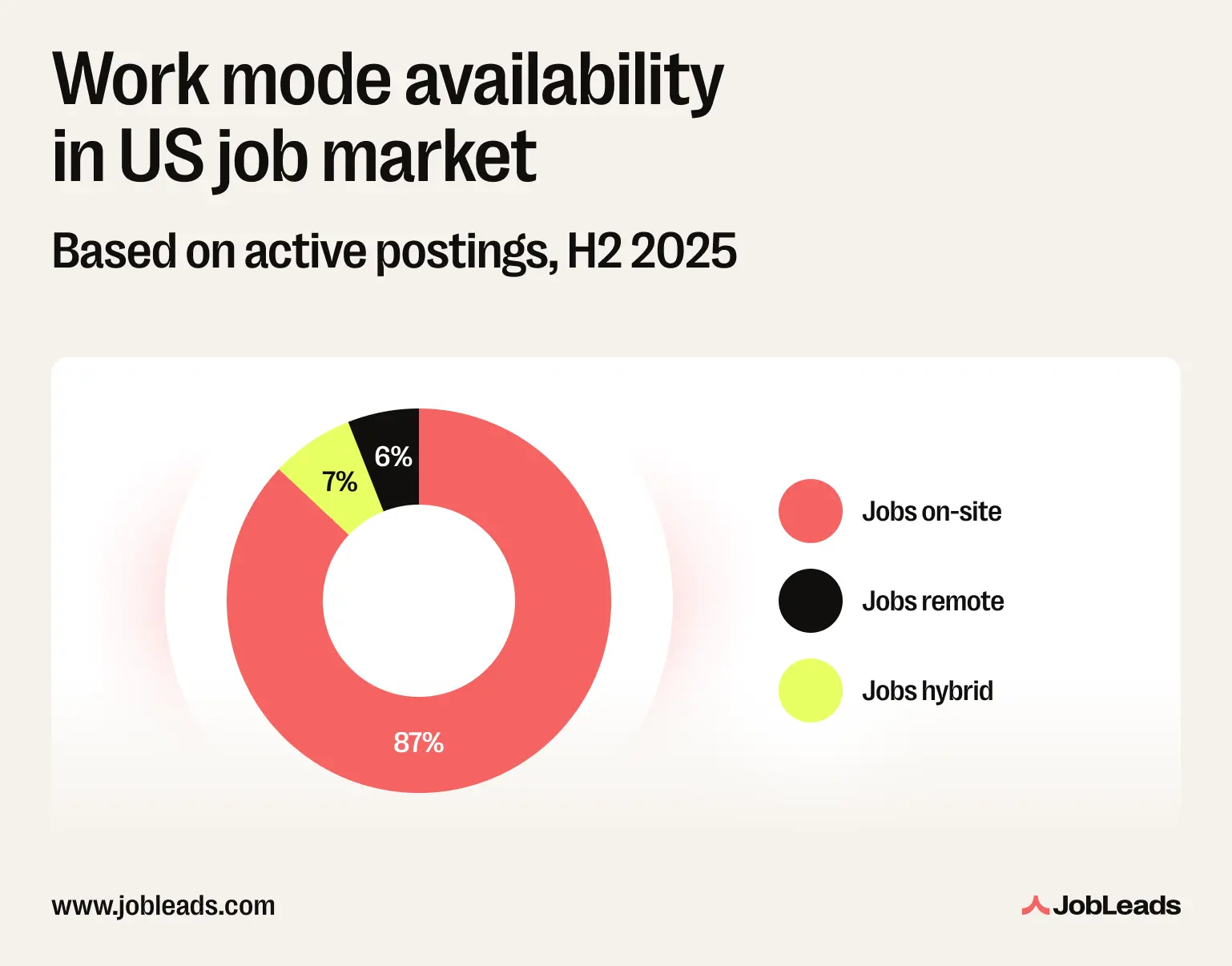
US job seekers seem to be split between two extremes–fully remote and fully on-site–but the labor market overwhelmingly offers something very different. About 23% of candidates want in-office roles only, while about 37% are considering either a fully on-site arrangement or something different, like remote or hybrid. At the same time, a whopping 87% of all open jobs are in-office positions, creating an imbalance in supply vs. demand.
At the same time, the strongest jobseeker preference is for fully remote work (also 23%), yet only 6% of open roles across the United States provide that option.
This mismatch in remote hiring trends has negative outcomes for both companies and employees. US employers are running the risk of losing the best talent because remote work, the most in-demand work format, is underrepresented on the job market. And job seekers aiming for remote roles face high competition and limited openings, while many on-site roles remain hard to fill.
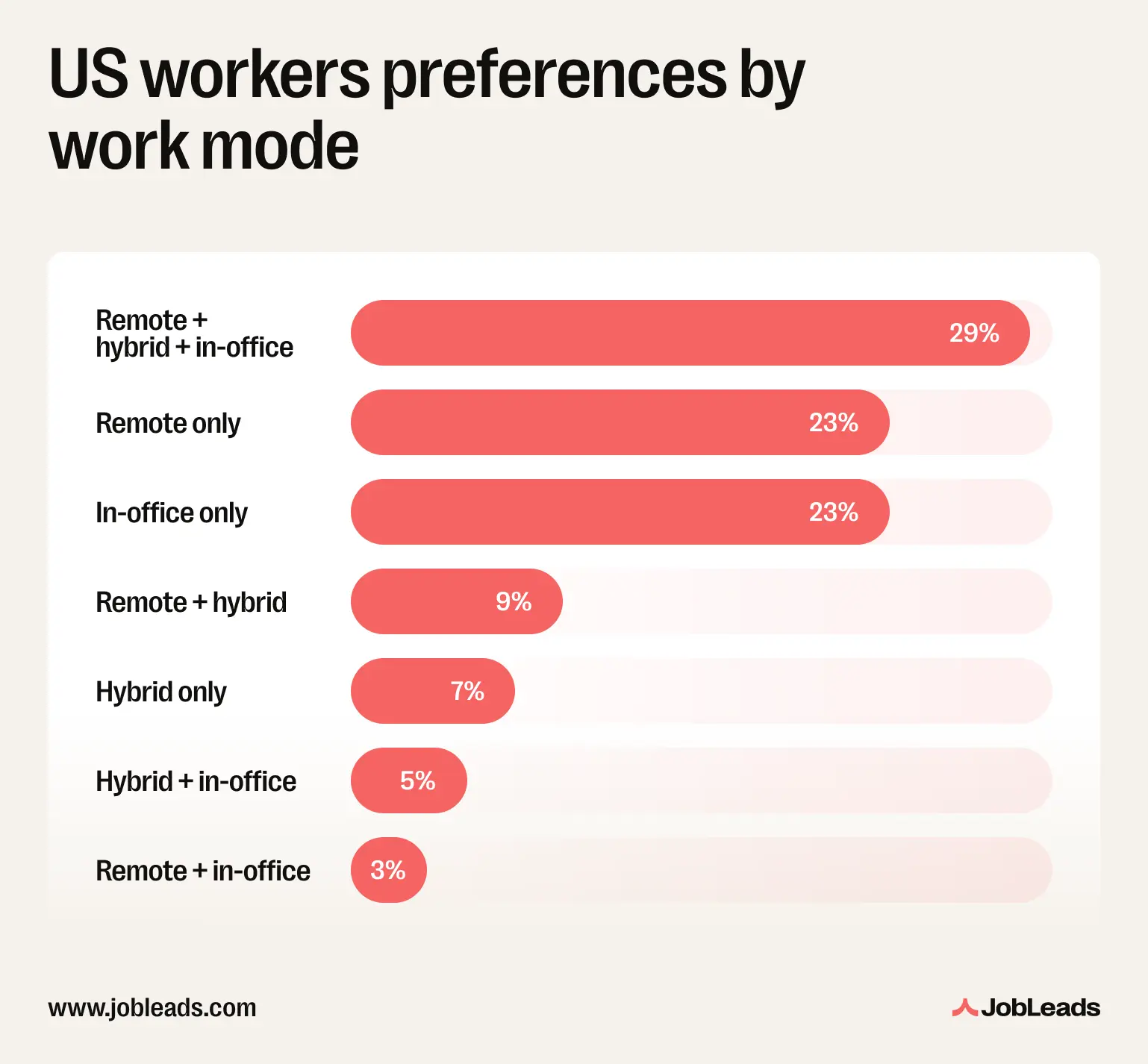
Almost 30% of our respondents haven't stated a strict preference for their desired work model. In today's cooling job market, this openness is essentially a necessity. Unemployment has climbed to around 4.4%, the highest since 2021, while job openings have fallen from their 2022 peak, making it harder for candidates to be picky.
At the same time, layoffs have surged: over 1 million job cuts have been recorded in 2025, with tech and other white-collar sectors hit especially hard. Many people are ready to compromise on the work model they actually prefer because they simply can't afford to have a preference in the current job market.
Oregon leading in remote work opportunities makes sense: the 2023 census data showed that nearly 18% of Oregonians worked from home, the second highest number in the country after Colorado (20%). This trend is driven by a strong tech presence in Oregon–the state is home to the so-called Silicon Forest, a cluster of high-tech companies located in Portland.

The District of Columbia's hybrid dominance is more surprising at first glance, given its heavy concentration of public-sector work. DC also offers the lowest share of fully on-site positions (81%). Both the DC government and many federal agencies have long-standing remote work and alternative-schedule programs, and the wider metro area now has one of the largest high-tech sectors in the US, which explains such a lean towards flexible working.
Oregon and DC aren't the spots with the largest absolute number of job openings: that title belongs to heavyweights like California, Texas, New York, and Florida. Their higher shares of remote and hybrid work make them important destinations for candidates who prioritize flexibility.
At the other end of the spectrum, states like Mississippi, West Virginia, and South Carolina have around 94% of roles fully on-site, which is 7% more than the national average. They represent economies that lean more on in-person industries such as manufacturing, logistics, and local services.
These three states are heavily shaped by industries that still depend on physical presence, like construction and mining (Mississippi), energy (West Virginia), and manufacturing (South Carolina). For workers who want or need remote options, these states are particularly challenging: the local job mix simply doesn't generate as many roles that can be done from home.
It appears that states don't just vote differently but also work differently. In our data, Democratic-voting states average 7% hybrid roles, almost double the 4% seen in Republican-voting states. The biggest shares of hybrid jobs are in places like DC (11%), New York and Massachusetts (9%), and California and Illinois (8%), while many red states – including Mississippi, Alabama, Louisiana, West Virginia, and South Carolina – sit at just 2-3% hybrid.
We can see this pattern show up in terms of remote and in-office work, too. Oregon (10% remote) and DC (8%), and blue-leaning states such as New York and Massachusetts are more likely to offer fully remote roles. At the other end, states like Mississippi, West Virginia, and South Carolina not only have the lowest remote shares (2–3%) but also the highest in-office shares (94%). In short, flexible work is heavily concentrated in knowledge-economy states that are often blue, while much of red America remains conservative in its work mode.
Detroit is the surprising remote-work outlier, with 8% of open roles fully remote. Despite not being a classic tech hub, Detroit scores higher than places like Chicago (6%), San Francisco (6%), New York (4%), and Los Angeles (5%).
That lines up with recent reporting that remote and hybrid jobs are increasingly part of Detroit's economic reboot, with local professionals working for out-of-state employers and a growing startup scene targeting remote talent. On the opposite end, cities with the most in-office positions include San Antonio (92%), Houston (89%), and San Diego (88%).
San Francisco stands out for hybrid work: it has the highest share of hybrid roles (18%). The Bay Area is a booming startup hotspot: its startup ecosystem grew +19.9% in 2025 and ranks #1 globally, with 14542 startups and total startup funding over $109.61B. The preference for flexibility here truly makes sense. The hybrid work runners-up are Boston (16%), Chicago (14%), and New York (14%).

New York looks surprisingly old-school for such a global business hub: only 4% of open roles are fully remote, while 82% are on-site and 14% are hybrid. In 2023, a survey on what percentage of people work from home in Manhattan indicated that only a minority of office workers are in five days a week, with the rest on some kind of hybrid schedule, and office occupancy had plateaued at roughly half of pre-pandemic levels. It seems like 2025 is the year of the "great RTO", even for New Yorkers.
Part of the explanation might be sector mix: New York's economy is dominated by finance, law, media, and real estate, which are industries that have been among the most aggressive in pushing people back to their desks.
When you zoom into remote work by industry trends, work models are not equally spread across the market. On the one hand, consulting is the flexibility champion: 18% of consulting jobs are hybrid, and 14% are fully remote, meaning almost one in three roles (32%) offers some kind of work-from-home option. This flexibility comes with a trade-off, though: management consulting is still one of the most travel-heavy and time-intensive careers.
A similar pattern appears in white-collar fields like finance, IT & technology, legal, and marketing & media, where roughly one in four jobs is either hybrid or remote (24-25%).
Predictably, hands-on sectors tell a very different story. In Bio & Pharmacology & Health, 92% of roles are on-site and only 7% offer hybrid or remote options at all. Engineering, management & operations, sales, and HR also remain heavily office-bound in the US, with around 8-9 out of 10 jobs still tied to a physical workplace.
In the United States, flexible work is indeed a mid-career privilege. According to the data, remote roles peak at 9% in the $125k-$150k salary band, where a lot of mid-level white-collar professionals sit, including tech, finance, and consulting talent spread across corporations and startups.
Below $60k a year, flexibility is practically non-existent, with just 3% remote and 2% hybrid, because those jobs are far more likely to be hands-on or frontline, mostly spanning around many blue-collar industries.
Above $250k annually, the pattern reverses again: only 4% of roles are remote and 9% hybrid, showing that the highest earners and executives in corporate America are still expected to be in the office, even if everyone else is dialing in from home.
Read more: A JobLeads study on tech salaries on-site vs. remote found that almost 86% of roles in tech pay less for working from home.
With the media bombarding people with news on return-to-office mandates in the US, it might feel like remote work is disappearing. The reality is more nuanced: while the vast majority of new roles popping up in the United States are office-based, flexible opportunities haven't vanished. Instead, remote and hybrid work has become much more selective: concentrated in certain states (like Oregon), big coastal cities (like San Francisco or Boston), specific industries like consulting, and mid-career income levels.
Are we really witnessing the end of remote work?
Work from home statistics suggest that it's a repositioning rather than the end. Remote and hybrid roles are now much harder to get: they have turned into premium perks for specific kinds of workers in specific places.
The future of remote working seems to be a growing mismatch and expectations crash: many Americans are desperate for flexibility, but only a fraction of jobs offer it.
In 2025, around 22% of Americans worked remotely. How many Americans work from home varies across states, industries, and income levels. The percentage of people working from home is shrinking, with only 6% of new jobs posted marked as remote.
Consulting has the most remote job openings: about 32% of consulting roles are hybrid or fully remote (18% hybrid, 14% remote), with other white-collar fields like finance, IT & technology, legal, and marketing close behind. Hands-on sectors such as health, engineering, operations, sales, and HR remain predominantly on-site.
According to our research, only about 6% of newly posted jobs in the United States are remote. How many remote jobs there are in different states is very different: while Oregon has 10% of fully remote open positions, South Carolina can offer only 2%.
States such as Oregon, Washington, and California, along with the District of Columbia, show the highest share of remote and hybrid job postings. Metropolitan areas like Atlanta, Detroit, and San Francisco are strong hubs for flexible work. By contrast, large parts of the South and Midwest remain overwhelmingly on-site, confirming that remote work opportunities are still clustered around urban, white-collar, coastal markets.
Yes, but the state of remote work is evolving. Fully remote roles are now a small minority of US job postings, while most openings are back to fully on-site. At the same time, remote and especially hybrid options have become a perk for higher-skilled, mid-career, better-paid roles rather than the norm.
This study is based on two proprietary JobLeads data sources:
- 5,266,418 active job postings in the United States in October 2025
- 426,252 survey responses from US-based job seekers collected between July and November 2025
For job postings, we classified each role by work model (on-site, hybrid, remote) based on the employer's description and then analyzed work-mode availability by state, city, industry, and salary band.
The jobseeker survey was conducted online among JobLeads site visitors. Responses were cleaned for quality before analysis. All insights in this report are based on JobLeads' internal data and reflect trends within our platform.
If our research helped you better understand work from home trends in the US, feel free to share any insights or statistics from this study. Please remember to credit JobLeads as the source and include a link back to this page. Thank you!


 Job Market Trends