
 Job Market Trends
January 19, 2026
US Remote Work Statistics and Trends [2026 Study]
Understand the state of remote work in the US in 2026 with JobLeads data on hiring demand, industry trends, regional patterns, and worker preferences.


Workplace stress is at record levels. According to the American Psychological Association, nearly 77% of workers report experiencing work-related stress. And it's taking a measurable toll on health, focus, and performance.
The good news is that workplace mindfulness offers a practical way to push back.
This isn't a guide about meditation retreats or hour-long breathing sessions. Here you'll find concrete exercises and proven tips that you can start using today.
Let's start from the basics–
Mindfulness at work means paying attention to what you're doing right now. It also means noticing how you feel without judging yourself. Instead of going through the motions, you choose to be present.
There seems to be two common misconceptions that get in the way of people trying to be more mindful at work. Let's debunk the myths. Firstly, mindfulness at work doesn't require a meditation cushion or a quiet room. Secondly, it isn't a scheduled practice you do separately from work, rather, it's a quality of attention you bring to work.
Replying to an email, running a one-on-one meeting, or reviewing a report can all be done mindfully. The difference isn't what you're doing; it's how present you are while doing it.Mindfulness can also help you reconnect with your career purpose. It can remind you what you actually want from work.
Psychologist Jon Kabat-Zinn created a well-known mindfulness program at the University of Massachusetts. He defined mindfulness as "paying attention in a particular way: on purpose, in the present moment, and non-judgmentally." That definition translates directly to the office environment.
Moving on to the benefits–
The case for mindfulness at work is built on decades of research. Benefits fall into two categories. Namely, the individual employees and companies.
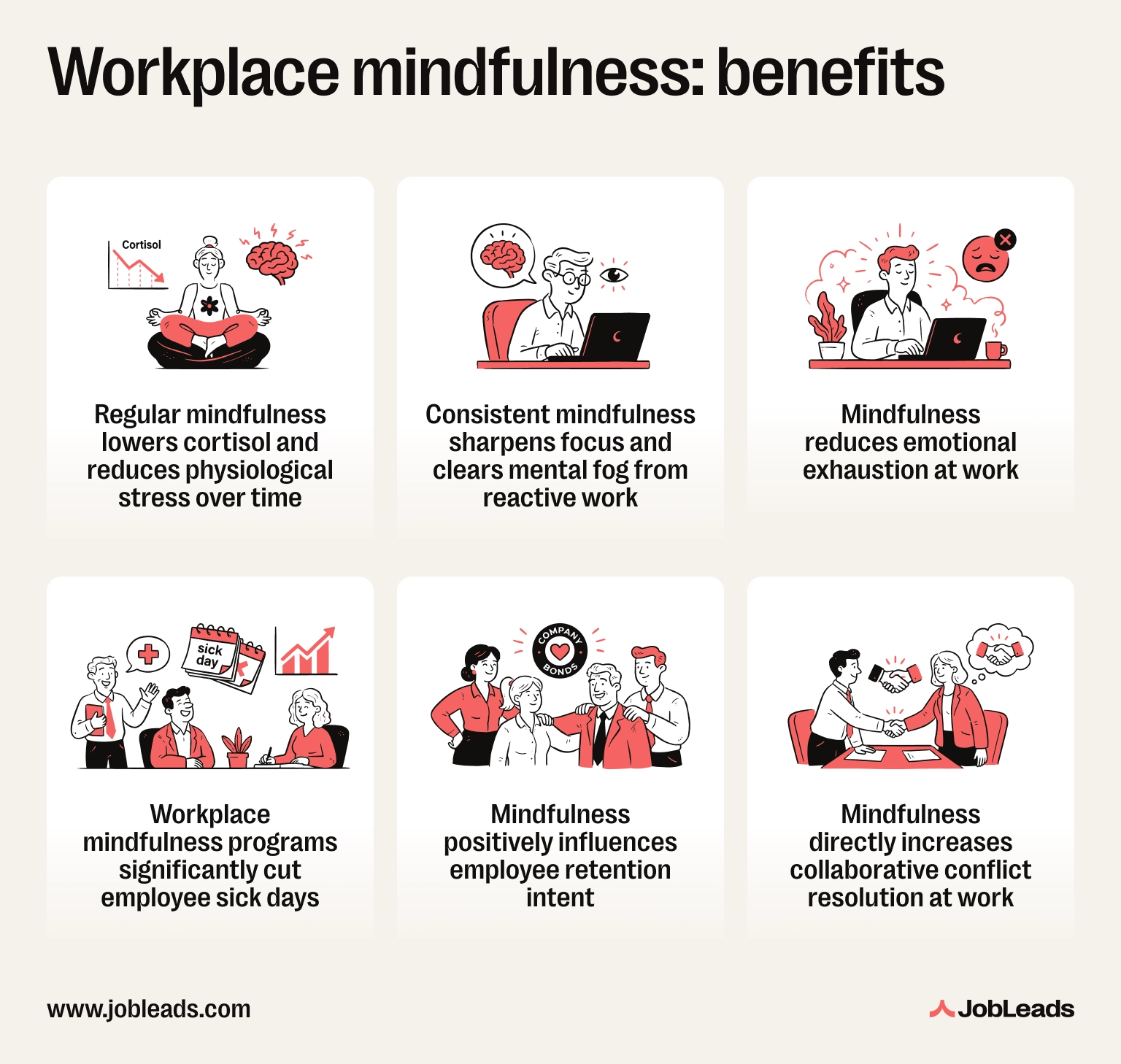
Mindfulness matters at work because it gives you tools to handle stress. It also helps you face hard situations with more care. The main benefits are:
Studies show that regular mindfulness lowers cortisol which is your body's main stress hormone. It also calms your body's stress reaction over time.
When your to-do list keeps growing faster than you can work through it, the body's fight-or-flight response kicks in. Cortisol rises. Concentration breaks down. A few minutes of mindfulness exercises at your desk might be the solution to that. The APA's Stress in America research consistently identifies work as one of the top sources of stress for adults. In fact, mindfulness is one of the few interventions shown to interrupt that cycle rather than just help cope with it.
Mindfulness helps you focus better. It also clears the mental fog that builds up from hours of scattered work.
Modern workplaces are designed to fracture attention. Notifications, open-plan offices, and constant context-switching between tasks make sustained concentration difficult. Mindfulness trains the brain to notice when attention has wandered and bring it back. A study in Psychological Science found that mindfulness training improved focus and memory.
Read more: Check out all the remote work benefits that employees and employers enjoy.
Mindfulness lowers mental exhaustion at work. A study in the Journal of Applied Psychology confirmed this.
Picture receiving a blunt email from a senior colleague moments before you're presenting to a client. Without awareness, the frustration hijacks the next two hours. Mindfulness creates a small but decisive gap between a trigger and your response. This gives you the space in which you can choose how to react. Employees who practice mindfulness say they respond more calmly to conflict and pressure. They react less on impulse.
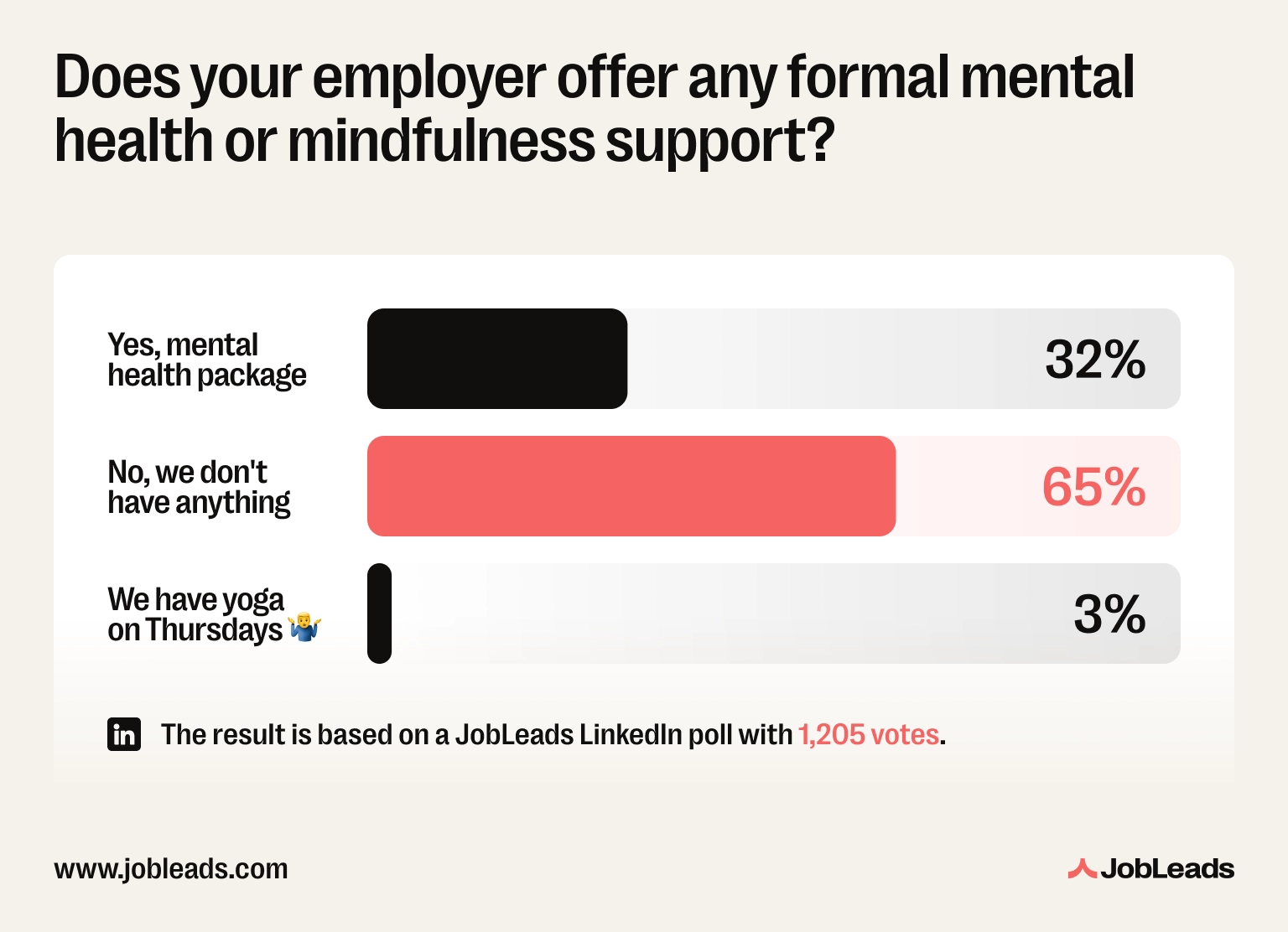
Surprisingly, a JobLeads survey found that over 65% of companies offer no mental health or mindfulness programs in their non-salary perks. This may be because companies don't yet see these benefits as worth it. Or they may be too focused on financial goals.
And, when people across a team practice being present, the benefits of mindfulness actually start to show in business results, such as:
Springer journal study found that mindfulness-based workplace significantly reduced employee sick days.
Chronic workplace stress drives sick days and burnout leaves. Aetna ran a mindfulness program for its employees. It reported around $2,000 in healthcare cost savings per employee per year. Stress levels also dropped. That led to an estimated $11 million dollars in output gains. This isn't a one-off result. In fact, companies with structured wellbeing programs report fewer sick days than those without them.
A BMC Psychology study found that mindfulness significantly influences employees' turnover intentions.
Employees whose wellbeing is supported stay longer and engage more. Mindfulness programs show that a company invests in its people and not just in what they produce. This matters in hiring and in keeping staff. Employees now treat mental health support as a culture fit signal. In workplaces where burnout is common and people leave often, a focus on employee mental health is a real edge.
Read more: Learn how to avoid job search burnout and maintain a good work-life balance.
A study by Adam A. Kay and Daniel P. Skarlicki found that mindfulness helped teams handle conflict better together.
Self-aware employees with high emotional intelligence escalate fewer interpersonal issues. Moreover, they listen more carefully in meetings and handle disagreement more constructively. This means managers and HR spend less time sorting out conflict between people. Companies like Google and General Mills have run mindfulness programs with documented results.
These ten techniques are immediately applicable. You don't need any apps, training programs, or a dedicated space. Each of the exercises takes 30 seconds to five minutes and can be used during a normal working day.
Box breathing is a structured breathing technique. It works by slowing your breath on purpose. This turns on your body's calm-down system, sometimes called the "rest and digest" system. It does the opposite of the stress response. When you slow your exhale, your body gets a signal to lower your heart rate and reduce cortisol.
Here are the exact steps for this exercise:
Repeat the steps 3 or 4 times for best results.
Surgeons and military personnel use this technique. They train themselves to stay calm under pressure. That calm is a skill, not a personality trait. It's discreet enough so you can easily use it at your desk before a stressful meeting or other task.
The STOP technique is a four-step micro-practice. It works because most stress-driven reactions at work are automatic. Your brain detects a threat, whether it's a sharp email or an overdue deadline, and fires a response fast. This happens before the thinking part of your brain has had time to process what's going on. The STOP technique breaks that automatic reaction. It gives your thinking brain time to catch up before you respond.
Here are the exact steps:
The full technique takes 30 seconds and interrupts the automatic stress response before it escalates. It's one of the most portable mindfulness exercises at work.
Multitasking is a myth. Research shows the brain doesn't do two things at once. It switches back and forth fast. But, every switch has a mental cost. Researcher Sophie Leroy called this "attention residue." It means the traces left from a previous task get in the way of your current one.
Single-tasking means giving your full focus to one task at a time. Close every unrelated tab. Silence your notifications. Set a clear goal for what you're working on. Bring your attention back each time it drifts. This builds the habit of steady focus.
Deep single-task focus produces better work. And it gets more done in less time than jumping between tasks.
Most people immediately open the next thing after ending a task. This leads to them carrying mental residue from one activity into the next. Mindful transitions interrupt this pattern.
A mindful transition is essentially a mental handshake. It tells your brain that one context is done and a new one is starting. That improves how well you focus on what's next.
So, before moving from one task to another, take 60 seconds to pause. Close what you were doing, take a breath, and set a clear intention for what's next.The pause feels short. But the effect on your focus and mood is bigger than you'd expect.
This exercise works because your brain needs time to let go of one task before it can lock on to the next. Without that pause, unresolved thoughts from the previous task carry over. They reduce your focus on what follows.
Sitting still for hours creates physical tension that most people don't consciously register. You probably know the tight shoulders and the unnecessary clenched jaw.
A desk body scan means moving your attention slowly upward from your feet. Notice areas of tension without trying to fix them. This exercise takes one to three minutes. This exercise builds body awareness and prevents the tension that turns into headaches and back pain by the end of the week.
It works because most people build up body tension at work. They don't even notice it. That tension makes stress feel worse. This means that the body is already braced, so any additional stressor lands harder. By bringing deliberate attention to the body, the scan interrupts the unconscious tension cycle.
Sitting for long periods makes you tired. It also slows blood flow and causes physical pain. All of this drains your mental energy.
Mindful desk stretching means doing simple movements, like shoulder rolls, neck tilts, or arm stretches. The trick is to focus on how each muscle feels. Don't look at a screen or think about your next task.
This exercise works on two levels at once. Moving your body fights the tension that builds up from sitting all day. Focusing on how your body feels keeps you in the present moment. It also cuts through mental fatigue.
In two to three minutes, you get physical relief and a mental reset. That makes this one of the most useful mindfulness exercises for office workers.
Before a hard task or a tough conversation, spend 60 to 90 seconds picturing it going well. See yourself staying calm. See yourself responding with confidence.
It works because your brain treats imagined events and real events in a similar way. When you mentally rehearse an action, it fires many of the same brain circuits as doing it for real.
Athletes use this technique as a regular practice. It works just as well for a performance review or a client pitch. Picturing a hard situation helps prepare your brain for it. It also makes the situation feel less new when it actually happens.
Set 10-minute windows away from all screens throughout the day. So, no phone, no laptop, no TV in the background. Use the time to take a short walk, make a hot drink in your custom coffee mug, or simply sit without input.
This is an intentional non-stimulation. It works because long screen time wears out your ability to focus. It also turns off a key part of your brain called the default mode network (DMN). The DMN is most active when you rest. It helps you process what you've learned and make creative links.
When you step away from screens, the DMN can do its background work. University of Michigan research shows that real breaks restore your ability to focus. This leads to an improved quality of focus when you return to work.
Five to ten minutes of something with no goal, like doodling or freewriting, shifts your brain out of work mode. The key is that it has no performance objective. There is no right outcome and no one is evaluating the result.
Long periods of analytical work tire out the thinking part of your brain. Doing something creative uses different brain areas instead. That gives your thinking brain a rest.
Research shows that creative, goal-free activity restores mental energy. It also often unblocks your thinking on the problem you stepped away from.This is why the best solutions often arrive in the shower, not at the desk.
An end-of-day reflection is a two to three-minute practice. Do it before closing your laptop or leaving your desk. Use this time to review the day. Write two to three bullet points: what went well, what felt hard, and one goal for tomorrow.
But remember: you're observing, not judging. You're wrapping up, not solving problems.
This creates a clear line between work time and personal time. That line matters most in remote and hybrid work. There's no physical separation to tell your brain the day is done.
Research on the Zeigarnik effect shows that your brain keeps unfinished tasks "open." It returns to them on its own. That makes it hard to switch off after work. Writing down tomorrow's goal closes those open loops. It tells your brain it no longer needs to track them.
Mindfulness in the workplace can look different depending on the role and culture. Here are short scenarios you can picture and replicate.
A manager gets an urgent message about a team conflict. Instead of replying right away, she uses the STOP technique. She stops, takes one breath, notices her reaction, and writes a calm reply instead. The pause takes 30 seconds. But the conflict gets resolved in one meeting instead of three.
An account manager is presenting to a new client for the first time. Before entering the meeting room, he spends ninety seconds using a box breathing technique in the corridor. His heart rate settles. He enters the room present rather than anxious, and his opening lands with the confidence he'd practiced.
A remote product team ends each Friday with a five-minute mindful check-in. Each person shares one word describing their week and one goal for the weekend. No metrics or action items. The practice builds trust. It gives the team a moment of real connection that task-focused meetings don't.
Bringing mindfulness to the workplace doesn't require a formal program from day one. Whether you're an employee or work in HR, start smaller than you think you need to. That's the right move.
The most sustainable workplace mindfulness programs begin with voluntary adoption, not top-down mandates. If you're an employee wanting to introduce mindfulness to your team informally:
Before rolling this out to the whole company, test it first. Survey employees or run a pilot with one team. See if there's real interest. Get leaders on board early as this is key. Programs that managers support but senior leaders ignore rarely take off. Link the business case to real numbers like sick days, staff turnover, and output.
When there's real interest, choose a training format that fits your team's schedule, culture, and budget. Here's a brief comparison table for mindfulness training formats.
| Format | What it involves | Best for |
|---|---|---|
| In-person MBSR-based programs | 8-week structured course based on the UMass Medical School model, it involves weekly group sessions plus daily home practice | Employees with consistent availability and genuine interest in depth |
| Live virtual workshops | Instructor-led sessions via video, it offers more flexible scheduling than in-person | Remote and hybrid teams, it's good for pilots before committing to longer programs |
| Self-guided app-based options | Individual practice via apps on personal schedule | Employees who want to self-direct as it has a lower barrier to entry but lower completion rates and weaker evidence base than facilitated programs |
| Peer-led team practices | Short rituals, like meeting openings or check-ins, led by team members rather than external trainers | Teams looking to embed mindfulness culturally without formal investment, it's scalable, low-cost, and maintains autonomy |
No single format is best for everyone. Larger companies with bigger budgets often pair a formal program with lighter team rituals. This gives them depth and broad reach at the same time.
Individual techniques are where workplace mindfulness begins, but they're not where it ends. Workplaces that embed mindful working as a genuine cultural value are more human and more sustainable as places to build a career.
As hybrid and remote work continue to blur the boundary between "on" and "off," mindfulness is becoming less of a wellness perk and more of a baseline professional skill. And employees increasingly look for that in employers, not just in themselves.
If you're rethinking where you work, look for companies that truly care about their people's wellbeing. It can make a real difference in your daily life.

Content & Insight Writer
Beata creates content that puts job seekers first. From practical blog advice to first-hand research studies, her writing is designed to give people the clarity and confidence to find the role they deserve.
Job Market TrendsUnderstand the state of remote work in the US in 2026 with JobLeads data on hiring demand, industry trends, regional patterns, and worker preferences.
 Job Market Trends
JobLeads analyzed behavioral data from 881,776 U.S. job seekers to better understand how the gender pay gap develops throughout the job search process. The study finds that women ultimately earn 83 cents for every dollar men earn, but that difference is shaped long before a paycheck is issued.
 Job Search
Maximize your job search success with a targeted strategy. Learn the 6 Pillars of Job Search Excellence to find opportunities faster and land your dream job.