
 Resume
July 15, 2026
15 Best Free Resume Builders Compared [2026]
Compare the 15 best free resume builders. Learn pros, cons, and pricing of each to pick the right tool for your needs.


Here is something most job seekers get backwards. Studies show that recruiters actually scored two-page resumes 21% higher than one-page ones (ResumeGo). Moreover, they were nearly 3 times more likely to prefer two pages for managerial roles. The "always keep it to one page" rule most of us grew up on is not quite true.
So, how long should a resume be?
A good rule of thumb is that most resumes should be one page for candidates with fewer than 10 years of experience, and one to two pages for those with 10 or more years of experience or senior and executive-level roles.
This guide gives you a full breakdown on how long your resume should be.
Not sure if your resume is the right length? Get a free resume review from JobLeads.
A resume should be one page if you have fewer than 10 years of experience, and one to two pages if you have more than 10 years of experience or are applying for a senior, management, or executive role.
However, this is not fixed. The right length is however long it takes to show your most relevant, quantified achievements without padding.
Why is there no single fixed rule? Recruiters don't reject resumes for being one or two pages on principle. They reject resumes that are hard to scan or full of irrelevant details. Length is a proxy for relevance, not a rule in itself.
The rule of thumb: if you can tell your career story–relevant roles, quantified results, key skills–in one page, use one page. If cutting it down means losing genuinely relevant experience, two pages are expected.
Read more: See our full guide on how to write a resume for the complete structure before you worry about length.
Should resumes be one page across the board? For decades, the safe default said yes. But it's not a strict rule, and forcing 15 years of experience onto one page can do more harm than a clean second page.
In fact, the data points the other way more often than people expect. A study by ResumeGo found that reviewers spent around 4 minutes on two-page resumes versus around 2 minutes on one-pagers. And they scored two-pages 8.6 out of 10 versus 7.1 out of 10 for one-pagers. Moreover, recruiters were over 2.3 times more likely to prefer a two-page resume overall.
| Best for | Risk if you get it wrong | |
|---|---|---|
| One page | 0-10 years experience, entry-level, career changers | Cramming (tiny fonts, no white space) to force-fit content |
| Two pages | 10+ years, senior, management, executive roles | Padding page two with irrelevant or outdated detail |
Read more: Check out the top tips from recruiters that can help to get you hired.
Should my resume be one page? Usually, yes, in these situations:
✅ Right: A one-page resume for a candidate with 4 years of experience, tightly focused on the most relevant roles and quantified wins.
❌ Wrong: A one-page resume crammed with 6pt font and 0.3 margins to force 12 years of experience onto one page.
Read more: Check out JobLeads study on the state of the UK entry-level jobs.
Are resumes supposed to be one page even at 15 years of experience? Not always. A two-page resume fits for:
Pro-tip
If you are on the fence, print your resume and read it as a recruiter would. If page two is mostly white space or repeats page one, cut it. If every line on page two adds a new, relevant signal, keep it.
There are four general brackets, depending on where you are in your career. Find your bracket below.
| Experience | Length | Word count |
|---|---|---|
| 0-5 years | One page | ~400-500 words |
| 5-10 years | One page | ~400-600 words |
| 10-20 years | One to two pages | ~600-900 words |
| 20+ years / executive | Two pages | ~600-900 words |
One page, always. Focus on education, internships, projects, and any quantified early-career wins. There usually is not enough relevant history to justify more, and a one-page resume at this stage typically runs around 400 to 500 words.
Still one page for most mid-career candidates. The goal is relevance, not completeness. Cut or condense roles from early in your career that no longer support your current target role.
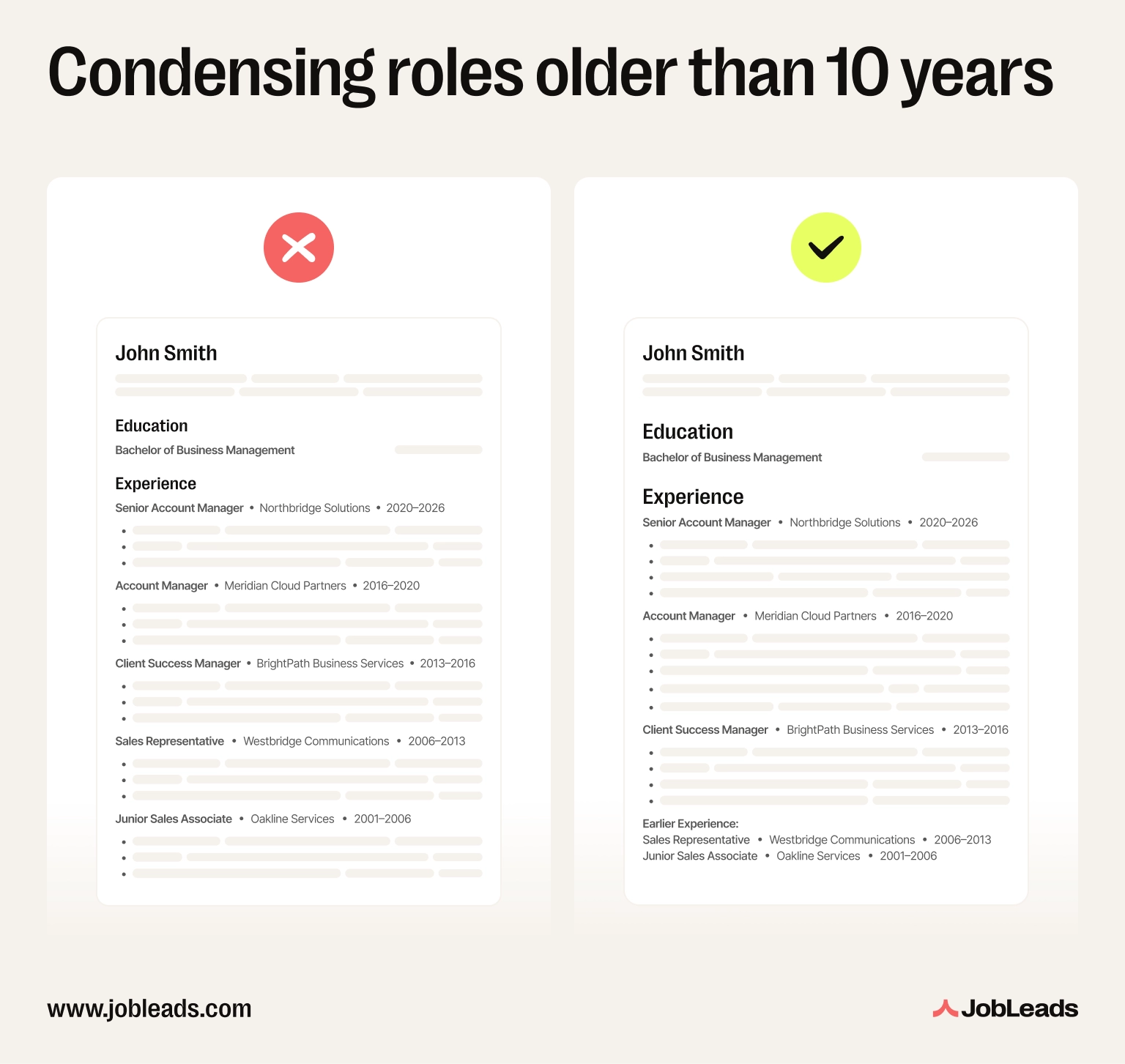
One to two pages. At this stage, a second page is expected if you have held multiple roles that each add distinct, relevant value. Older or less relevant roles can be condensed into a brief "Earlier Experience" line rather than fully detailed.
How long should a resume be for 20 years experience, or at executive level? Two pages is standard. Executive resumes prioritize strategic impact and board-level results over a full chronological history. List only the most senior, relevant years in detail.
Did you know that…
Career coaches commonly recommend keeping resumes to the last 10 years of work history once you have 15+ years of experience, according to AARP's guidance on age-proofing your resume{rel=""nofollow""}{rel=""nofollow""}–partly to stay relevant, partly to avoid age-related screening bias.
For most roles and industries, no–a resume longer than two pages is rarely necessary. The main exceptions are academic CVs and roles requiring an extensive list of publications, patents, or certifications. Outside those cases, a 3-page-or-longer resume is not appropriate.
One classic exception has actually disappeared. Federal resumes used to run far longer than private-sector ones. But, as of a 2025 OPM policy change, USAJOBS applications are now capped at two pages, the same ceiling as everywhere else.
Here are the exceptions still relevant today:
✅ Right: A 4-page academic CV listing 20+ peer-reviewed publications for a tenure-track application.
❌ Wrong: A 4-page resume for a marketing manager role padded with a decade of outdated, irrelevant roles.
People often search for the "ideal resume length" or the "average resume length," hoping for one universal number. It doesn't exist, but there is a reliable resume word count range.
A one-page resume should run around 400 to 600 words, and a two-page resume around 600 to 900 words. Think of this as a natural word count, not a strict resume page limit to hit.
Chasing a word count leads to padding. Instead, cut anything that doesn't answer: what did you do, how much, and with what result? If a bullet doesn't clear that bar, it doesn't belong, regardless of how much space you have left.
Pro-tip
If you are short on words but not short on relevant experience, you likely need to quantify your resume–numbers, tools, outcomes.
Most resumes should only list the last 10 years of work experience. Older roles rarely add relevant signals and can make a resume run too long.
Before we get to the length, let's look at the quick differences between a CV and a resume.
A resume is a concise, typically one-to-two-page summary tailored to a specific job application, highlighting relevant skills, work experience, and achievements. A CV (Curriculum Vitae), by contrast, is a comprehensive document commonly used in academic, medical, scientific, or research-oriented fields. It chronicles a person's entire academic and professional history, including publications, research, presentations, teaching experience, and awards.
Keep in mind that in many European countries "CV" is simply the standard term for what Americans would call a resume. But in the US and Canada, resumes are the norm for most job applications, while CVs are reserved for academic or specialized roles.
Should a CV be one page, the way a US resume often is? Not necessarily.
In the US, the same one-to-two-page rule applies. In the UK, Ireland, and most of Europe, the convention runs slightly longer. Reed.co.uk found that as many as 91% of UK recruiters consider two pages the ideal CV length, running to around 700 to 1,000 words, even for early-career candidates. Academic CVs are the exception and can run much longer.
If you are applying internationally, check which convention the employer uses.
Most length problems aren't really about length. They're about what is taking up the space. Here are the mistakes that make a resume feel too long, or too short, regardless of page count.
Part of the problem is timing. A JobLeads LinkedIn survey found that only 42% of job seekers said they update their resume before every application. A resume that only gets revisited under pressure is exactly the kind that quietly picks up outdated roles, repeated phrasing, and padding nobody trims.
Here are the common resume mistakes to avoid:
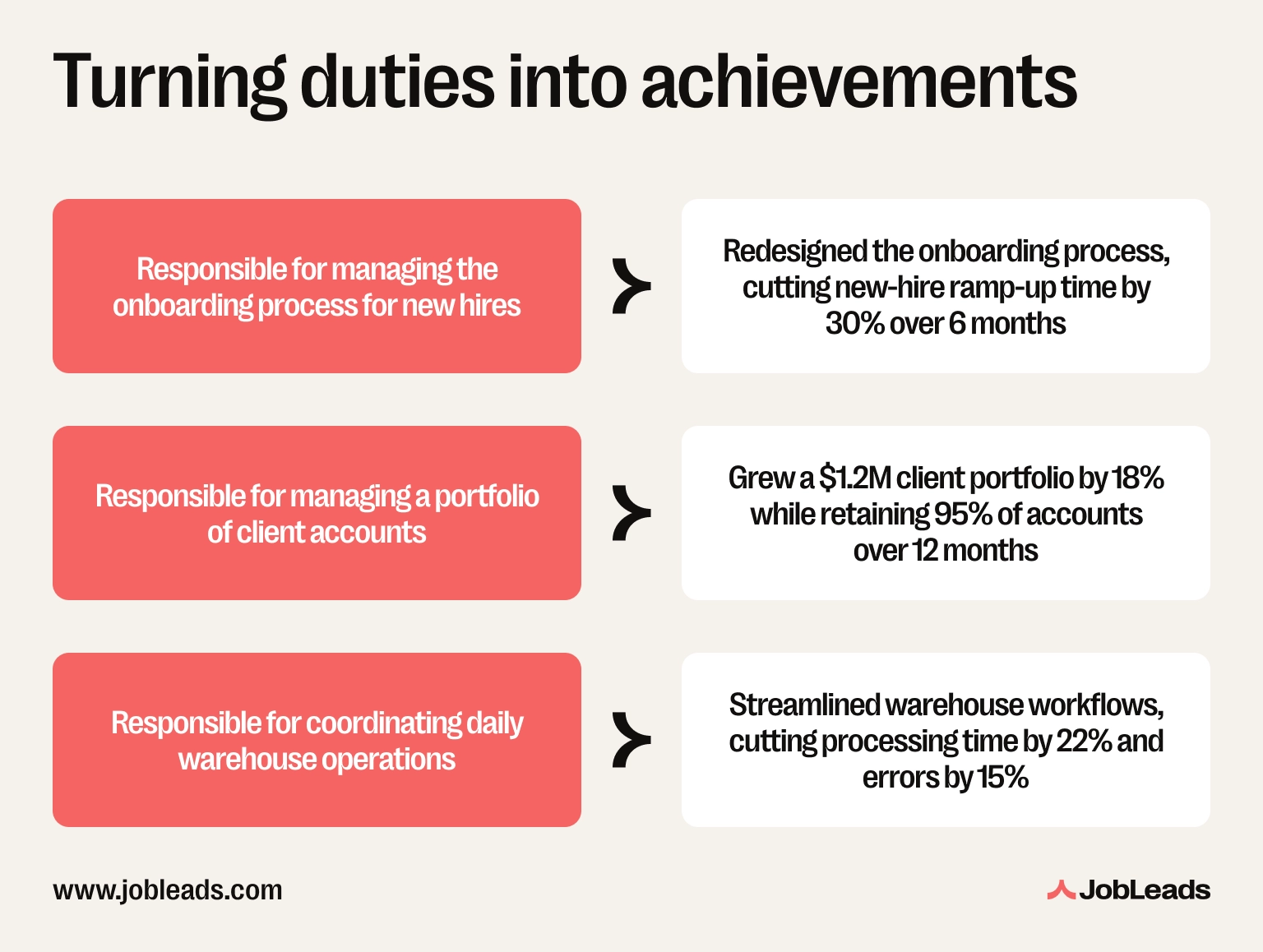
✅ Right: "Reduced onboarding time by 30% by redesigning the new-hire training program over 6 months."
❌ Wrong: "Responsible for various HR duties including onboarding and training."
If your resume has spilled onto a third page, don't panic. Most of the time, the fix is subtraction, not a full rewrite. Work through these steps in order.
Condense or remove roles beyond the 10-year window unless they are directly relevant to the job you want.
Delete any bullet that describes a responsibility rather than a result. If it doesn't have a number or a clear outcome, cut it or rewrite it.
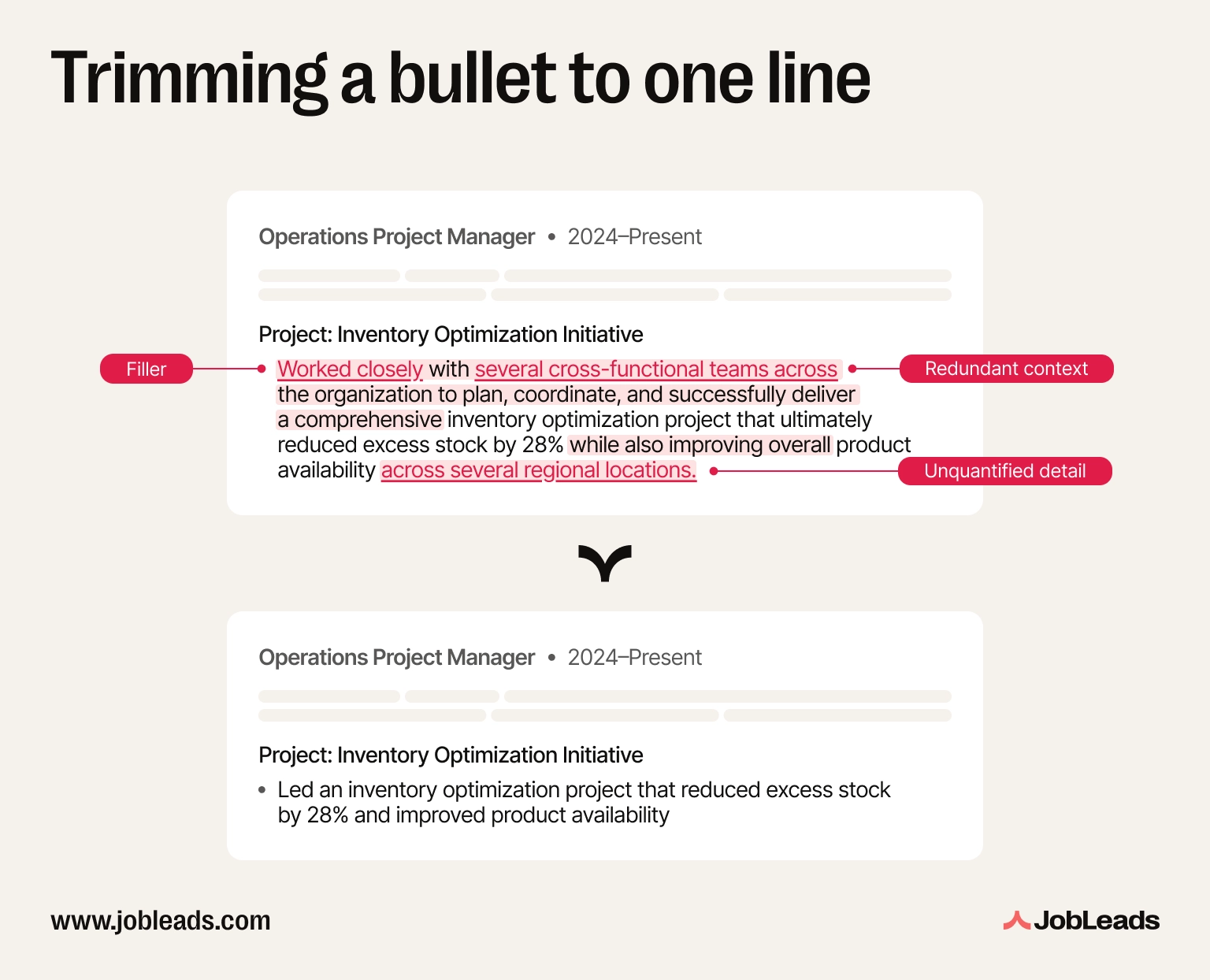
How long should bullet points be on a resume? Aim for one line each, around 15 to 20 words. If a bullet wraps to a third line, it is doing too much. Split it or trim it.
Pro-tip
Read every bullet and ask "so what?" If you cannot answer with a number or outcome, rewrite it or delete it.
Drop objective statements, "References available on request," and skills that are now assumed, like "Microsoft Word" for most office roles. These are also the kind of fixes an ATS scan flags first.
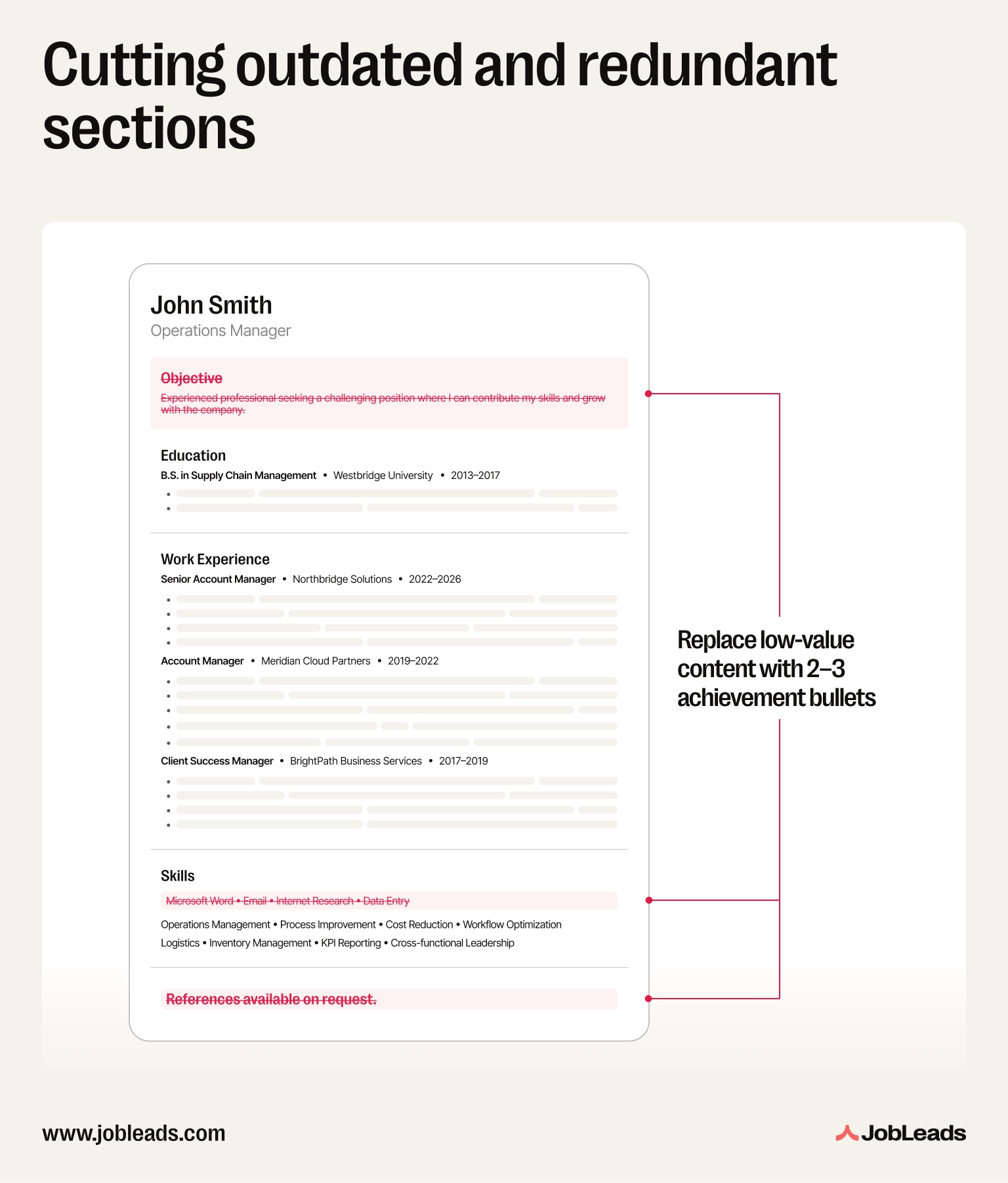
Example: David was a 14-year operations manager whose resume had crept to three pages. He cut roles older than 10 years into a single "Earlier Experience" line, rewrote 22 duty-based bullets into 14 quantified ones, and dropped an outdated "Objective" section. His resume landed on two pages–down from three–and he had two interviews booked within a month.
Resume length is essentially a byproduct of relevance.
Fewer than 10 years of experience means one focused page. Ten or more years, or a senior title, means a clean two pages is expected, not excessive. Beyond that, only academic CVs and roles with extensive credentials need more room.
If you're still not sure whether your resume is doing its job at whatever length it currently is, the fastest way to find out is to get professional eyes on it.
JobLeads offers a free resume review from a career expert, plus an AI-powered resume builder that helps you tailor length and content to every role. So you can stop guessing whether your resume is too long or too short–get a straight answer and fix it in minutes.

Content & Insight Writer
Beata creates content that puts job seekers first. From practical blog advice to first-hand research studies, her writing is designed to give people the clarity and confidence to find the role they deserve.
ResumeCompare the 15 best free resume builders. Learn pros, cons, and pricing of each to pick the right tool for your needs.
 Resume
Learn what an ATS-friendly resume is with the format and fonts that pass parsing. Check out real examples and how to check your ATS score before applying.
 Resume
Looking for an AI resume builder to help with your CV? Compare the best AI resume writing tools, paid and free, based on the main features and top use cases.