
 Job Market Trends
June 19, 2026
Fewer Than 1 in 10 Job Seekers Ever Talk to a Headhunter
Our survey of 43,000+ job seekers reveals why most never access the hidden job market, and the strategies that actually work to change that.


That gap between ambition and action, between where people search and where the six-figure income actually lives is the real story behind making this income in today's job market.
And the data reveals that the mismatch runs deeper than most people realize, cutting across industries, geographies, job levels, and even educational backgrounds.
The question most job seekers are really asking is how to make six figures, and which jobs actually pay that much.
JobLeads analyzed over 53 million active postings across 33 countries and 10 industries and found answers to candidates' questions.
But before we dive in: what is a six-figure salary, exactly? A six-figure salary is any annual income between $100,000 and $999,999. For many professionals, the goal is clearing that first threshold of $100K. So, let's first look at industries that offer high salaries.
The path to a six-figure income looks different depending on where in the world you're looking. But some industries and six-figure careers consistently rise to the top whether you zoom in on the US or pull back to a global view.

Globally, Legal dominates not by volume but by concentration. While IT & Technology and Engineering account for millions of job postings worldwide, Legal converts nearly 30% of its postings to six-figure salary jobs. That is the highest share of any industry with a mean salary of $146,720. Consulting follows at 24%, and IT & Technology at 20%.
What's striking is that the industries most job seekers flock to when thinking about careers that make 6 figures, like Sales or Engineering, sit much lower in the six-figure distribution. They only make up 8% and 14% of postings crossing the threshold respectively. The volume of opportunity in those fields masks the relatively low density of high-paying roles.The best-paid engineering roles usually cluster in specialized fields–our analysis of engineering pay across major automakers found Volkswagen advertises the highest median engineering salary in US auto, ahead of Tesla and GM.
In the US, the picture sharpens further. Consulting pulls ahead domestically, with nearly half of all US job postings offering six figures. This is a much higher rate than its global average suggests.

Legal and IT each sit at 34% domestically, reinforcing their status as reliable but not dominant players in the six-figure job market. The gap between Consulting's global (24%) and US (nearly 50%) performance is notable, and likely reflects the concentration of high-value consulting firms and clients in the American market.
Three of the top five most-posted six-figure jobs belong to the Legal industry including Tax Law, Arbitration, and Industrial Property Rights. Salaries in these specializations aren't just clearing the bar. In fact, at least 90% of postings in Tax Law and Industrial Property Rights list compensation above $100K. Supply Chain & Logistics matches that rate, making it one of the most underrated careers that pay 6 figures in the market.
For those wondering what jobs make six figures in Tech, the answer depends heavily on how you position yourself. Software Architecture & Engineering leads within the sector at 49% of US postings above six figures. But IT professionals who position themselves inside the Consulting industry under titles like IT, Technology & SAP, see that number climb to 69%. The same skill set, pointed at a different industry, yields a meaningfully better return. It's one of the best ways to make 6 figures without changing what you actually do.
There's one career path that consistently flies under the radar when people discuss six-figure careers: Vice President roles in Health & Pharma. In the US, 99.83% of VP postings in that field offer six figures, with a mean salary of $217,000. That's higher than VP roles in Finance, Legal, Consulting, or IT.
Health & Pharma also leads all industries globally on average salary at $160,503 (considering only high paying jobs sample), well ahead of Legal ($146,720) and Finance ($141,060). Yet it rarely features in conversations about what jobs pay 6 figures at the top level. For professionals with the right background, it may be the most underleveraged six-figure job opportunity in the market.
Seniority drives earnings across nearly every sector, with Vice Presidents, Heads of Department, and Managing Directors among the best six-figure jobs in most industries, crossing the $100K threshold at rates above 70%. Sales is the notable exception, where only around half of senior postings hit that level. Though posted salary almost certainly understates real compensation given how much of sales pay comes from commission and variable income.
The more interesting signal, for most people thinking about how to make six figures, is at the non-executive level. Consulting remains the standout industry for earlier-career six-figure access. In most sectors, the share of sub-executive postings above $100K sits between 10% and 35%. Consulting consistently outperforms that range making it the clearest path to a six-figure income before you reach the top of the org chart, both in the US and globally.
The mismatch between where job seekers focus their search and where the six-figure salary jobs actually concentrate is real. Sales and HR attract enormous candidate interest but deliver 6-figure incomes to a small fraction of their workforce. Legal and Consulting, by contrast, punch well above their weight and for professionals with the right skills, repositioning toward those industries can make a significant difference in earnings trajectory.
Where you work, not just what you do, has become one of the most significant factors in whether salary crosses the six-figure salary threshold. For professionals researching six-figure jobs with work-life balance, the data points to a clear answer: hybrid roles.
| Location type | Share of jobs with 6-figure salaries |
|---|---|
| Hybrid | 22.5% |
| Remote | 15% |
| On site | 11% |
Globally, hybrid positions are more than twice as likely to offer six-figure salaries as on-site roles. Hybrid job postings convert at 23%, compared to just 11% for on-site positions. Remote sits in the middle at nearly 15% which makes it a better option than showing up in the office every day, but well behind the hybrid premium.
The data challenges a narrative that has been building since the return-to-office push: that on-site work commands a pay premium. At least in terms of posted salaries, the opposite appears to be true. If you're looking for six-figure salary jobs that don't chain you to a desk five days a week, hybrid is where the data points.
The UK is the most striking example. About half of all UK remote postings (51%) cross the six-figure threshold. That's meaningfully higher than UK on-site roles, where the equivalent figure sits at about 34%. Choosing remote over on-site in the UK preserves your earning potential while also tilting the odds in your favor.
Norway follows a similar pattern. Almost 30% of Norwegian remote job postings offer six figures, compared to about 14% of on-site postings. This means that remote roles in Norway are more than twice as likely to pay six figures as their office-based equivalents. The same gap shows up in Sweden, where the remote six-figure rate sits at 12% is more than three times the on-site rate of about 3%.
The US remote market runs at about 20%, still ahead of US on-site roles at about 15%. For US-based job seekers, going fully remote doesn't mean sacrificing salary. It just means targeting the right roles within a market where remote six-figure jobs make up a fifth of all remote postings.
Switzerland is the outlier, and not in the direction most people expect. Swiss remote postings with 6-figure salaries stand at about 52%, which is lower than Swiss on-site at about 61%, and lower than Swiss hybrid at about 68%. In Switzerland, the remote format is the least likely to reach six figures. Though "least likely" in a market where over half of remote roles still clear the threshold is not exactly a compelling argument against it.
Switzerland consistently tops the six-figure rankings. But the high cost of living in Geneva or Zurich absorbs a substantial share of that salary premium. The more actionable question isn't which country pays the most in absolute terms. It's which country lets you earn the most while living somewhere it costs significantly less.
That's where remote work changes the calculation entirely.
The UK's remote market offers a six-figure rate of about 51%. In Portugal, Spain, and Italy where the domestic remote six-figure rate sits at or near 0%, that gap is enormous. A professional in Lisbon with the skills to land a UK remote role is accessing a salary market operating at roughly 51% six-figure density, while paying costs that bear no resemblance to London prices.
Read more: The same arbitrage works inside the US, where a cheaper city can beat a higher-paying one. See the study on the best cities for young professionals.
Norway presents the same dynamic. With almost 30% of its remote postings offering six figures, Norwegian remote roles represent a meaningful opportunity for job seekers across lower-cost European markets. Poland's remote six-figure rate sits at about 0.6%. So–a Polish professional landing a Norwegian remote role is earning more in a completely different market.
The countries that benefit most from this arbitrage are the ones where domestic six-figure remote opportunities are effectively unavailable. Germany, France, the Netherlands, Italy, and Portugal all have remote six-figure rates that round to zero. Their labor markets offer little domestically, but are geographically and linguistically close to UK, Norwegian, and broader Anglophone markets that are operating at rates between 20% and 51%.
Switzerland's remote rate of about 52% makes it the third option in this framing, behind Qatar (63%) and UK (51%). But the Swiss remote market is considerably smaller in scale than the UK's. For job seekers who can access it, the Swiss remote market offers near-on-site salary density with the location flexibility that makes the cost-of-living arbitrage possible.
The gap between aspiration and action, though, tells a more troubling story. US behavioral data reveals a striking disconnect between what job seekers say they want and what they actually pursue. A remarkable 77% of US users set salary expectations above $100K. This is the highest ambition rate of any country in the dataset.
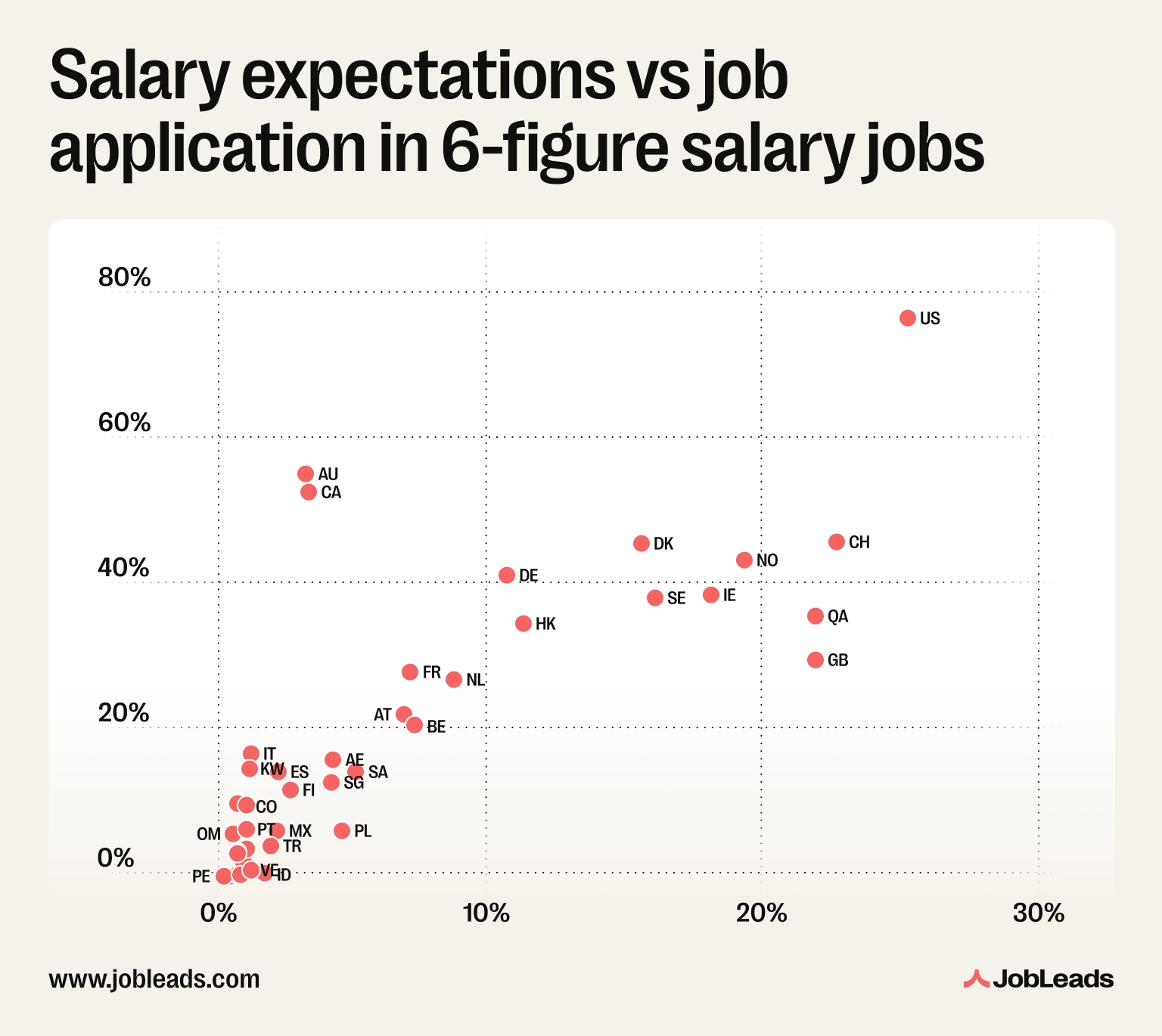
But the funnel deteriorates sharply from there. Of all jobs those users actually encountered, 46% offered six figures. Of those, only 27% were clicked on. And just 19% resulted in an application. Nearly 8 in 10 job seekers are targeting six-figure roles, but fewer than 2 in 10 follow through to the application stage.
Read more: Learn about job seekers' salary expectations vs how much companies are offering.
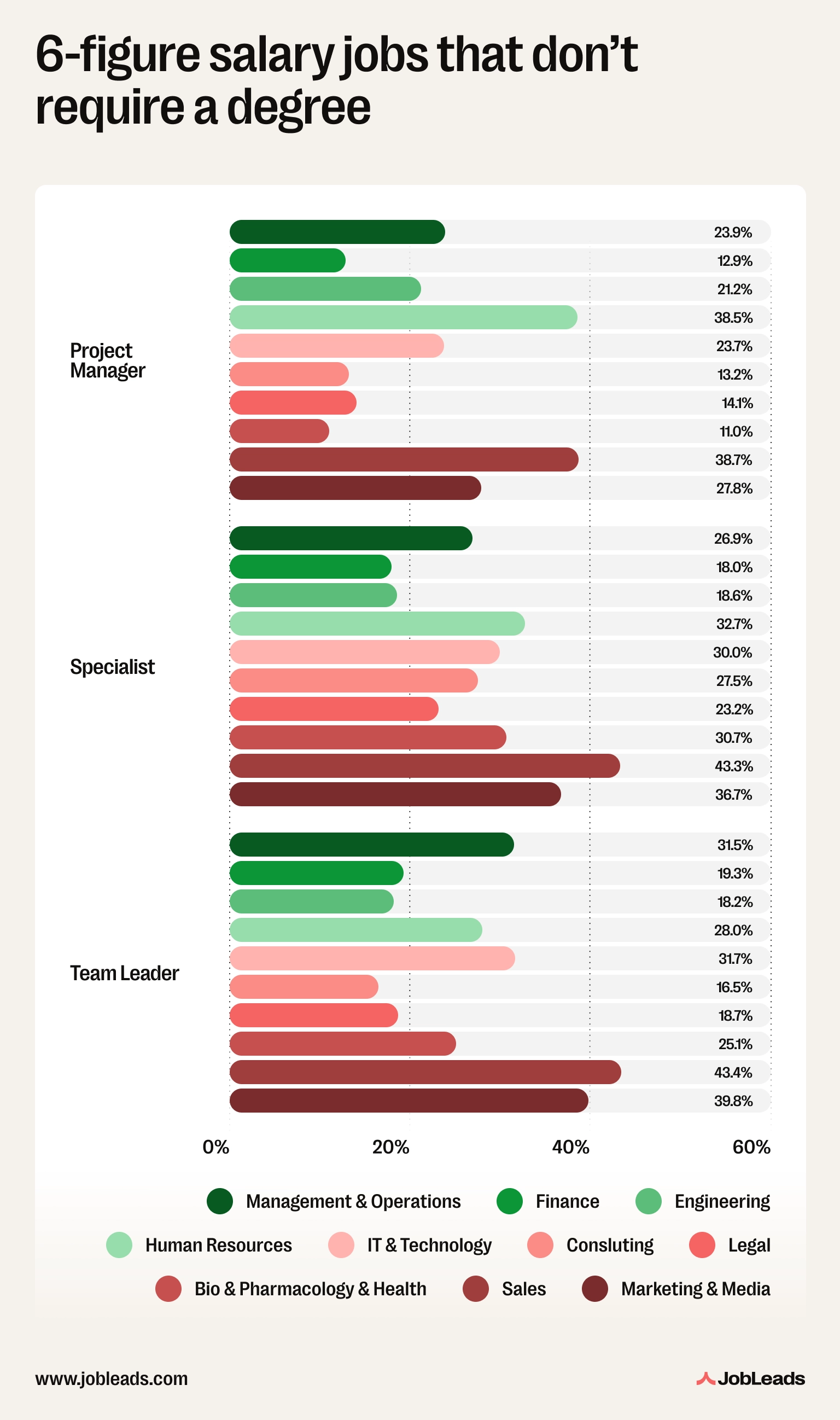
The college degree has long been treated as the default entry ticket to making 6 figures. But the data tells a more complicated story. Across industries and job levels, a meaningful share of six-figure jobs without a degree requirement exist, and the opportunities are more accessible than most job seekers assume.
Sales is the most direct route to 6 figure jobs without a degree. Sales Team Leaders and Sales Specialists both top the dataset at around 43% of postings not mentioning a degree. Head of Department roles in Sales also come in at 39%, reinforcing a consistent pattern. In Sales, what you deliver matters more than where you studied.
Marketing & Media follows a similar logic, making it one of the more accessible six-figure careers. Nearly 40% of postings for Team Leaders in the industry don't mention a degree requirement, and Specialists come in at 37%. This suggests that portfolio work and demonstrated creative or commercial skill are increasingly accepted substitutes for formal education.
Human Resources offers another underappreciated pathway for jobs that pay 6 figures without a degree. Team Leaders in HR show 28% of postings without degree requirements, and Specialists reach 33%.
At the other end of the spectrum, Legal and Engineering remain the most credential-dependent industries. Legal Project Managers and Head of Department roles sit at just 14% without a degree requirement. These are fields where formal qualifications are either legally mandated or deeply embedded in hiring culture.
| Country | % of six-figure jobs |
|---|---|
| Switzerland | 62% |
| Qatar | 48% |
| United Kingdom | 39% |
| Ireland | 28% |
| US | 17% |
| Norway | 16% |
| Hong Kong | 14% |
| Denmark | 12% |
| Austria | 7% |
| Germany | 7% |
| Netherlands | 4% |
In the global race for six-figure income, geography matters enormously. Where you're based, or where you're willing to work, may be the single biggest lever available for making 6 figures.
Switzerland sits at the top of the global six-figure salary rankings, and by a considerable margin. Two out of every three jobs posted in Switzerland offer a six-figure salary, with 62% of all postings crossing the $100K threshold. That's not just the highest share in the world, it's a fundamentally different labor market dynamic, where a six-figure income is the baseline expectation rather than the prize.
Qatar follows at 48%, and Great Britain rounds out the top three at 39%, meaning nearly half of all Qatar job postings qualify as six-figure salary jobs.
Ireland ranks fourth at 28% and the United States round out the top five at 17%. These figures might look modest against the top three but represent an enormous volume of six-figure jobs in absolute terms.
Beyond the top five, Norway (16%), Hong Kong (14%), Denmark (12%), Austria (7%), and Germany (7%) complete the top ten for six-figure salary jobs globally. The drop-off after the top three is steep, and the contrast between Switzerland's and Germany's or Austria's share underscores just how concentrated high-salary density is at the very top of the global rankings.
Not every outlier tells a density story, though. Singapore sits outside the top ten in terms of share, with just above 3% of postings offering six figures, yet its mean salary for those roles sits at $411,977. This is nearly three times higher than any other country in the dataset. It's a market of extreme concentration. Very few six-figure jobs, but the ones that exist pay at a level that distorts the average dramatically.
| Country | Share of six-figure jobs searched by users | Share of job seekers who expect a six-figure salary |
|---|---|---|
| Norway | 62% | 44% |
| Switzerland | 51% | 46% |
| Denmark | 51% | 46% |
| US | 46% | 77% |
| Qatar | 45% | 36% |
| Sweden | 39% | 39% |
| UK | 38% | 30% |
| Germany | 37% | 42% |
| Ireland | 29% | 39% |
The expectation gap is where the most actionable insight lives. A remarkable 77% of US job seekers are actively pursuing a six-figure salary against a market where only about 20% of postings deliver it. That's the largest ambition-to-availability gap in the dataset, and a key reason so many Americans feel that making 6 figures is harder than it should be.
British job seekers present the mirror image with only 30% targeting six-figure income, despite operating in a market where nearly half of all postings offer it.
For job seekers seriously thinking about how to make six figures, the data points to geographic arbitrage. Switzerland and Qatar offer six-figure salaries at rates three times higher than the US. It's often the country you work in that may ultimately matter as much as the industry or role you choose.
The national figure of about 20% of US job postings offering six figures conceals an enormous spread across states. Depending on where you're searching, the odds of finding a six-figure role range from slim to overwhelmingly likely.
For example, the District of Columbia sits in a category of its own. About 84% of job postings in DC offer six-figure salaries. This concentration reflects the unusual density of federal government, policy, consulting, and lobbying roles concentrated in a single city. It operates less like a state labor market and more like a highly specialized industry hub.
Among the 50 states, the gap is nearly as striking. Hawaii and California both sit at about 40%, with Massachusetts close behind at nearly 39%. Washington state, which houses the headquarters of Amazon and Microsoft, converts nearly 31% of its postings to six figures. Illinois and Maryland round out the top tier at roughly 29% and 27% respectively.
What's notable about the top performers is the mix of forces driving them. California and Massachusetts reflect tech and biotech concentration. Washington and Illinois point to a combination of Big Tech and finance. Maryland's figure is likely shaped by its proximity to DC and the volume of federal contractor roles that spill across state lines.
At the other end of the spectrum, Mississippi sits at just over 6%. This is the lowest rate of any state in the dataset. Arkansas, Oklahoma, Alabama, and Tennessee all cluster around 7%, creating a band of states where a six-figure salary posting is the exception rather than anything approaching a norm.
| State | Share of six-figure postings |
|---|---|
| District of Columbia | ~84% |
| Hawaii | ~40% |
| California | ~40% |
| Massachusetts | ~39% |
| Washington | ~31% |
| Illinois | ~29% |
| Maryland | ~27% |
| Alaska | ~22% |
| Connecticut | ~22% |
| Colorado | ~20% |
The gap between DC and Mississippi is roughly 14 to 1. Even stripping DC out and comparing the top and bottom states, California at about 40% is more than six times the rate of Mississippi at just over 6%. These represent fundamentally different labor markets operating under the same national currency rather than subtle regional variations.
Texas, often cited as a jobs-rich alternative to California, runs at about 12%, which is less than a third of California's rate. New York, home to the country's largest financial sector, sits at about 16%. This figure may seem low but likely reflects the sheer volume of lower-paid roles that accompany any economy of New York's scale. The high-paying jobs are there, they're just outnumbered.
For job seekers specifically targeting six-figure roles, the state you're searching in may matter as much as the industry you choose.
Six-figure salary jobs are less evenly distributed than most job seekers assume, and the patterns in the data point to some clear, actionable conclusions.
The gap between where the money is and where people are looking is the defining feature of today's six-figure job market. Closing it requires applicants to target the right industry, the right country, and the right work arrangement.
Perhaps the most striking finding in this entire dataset is also the simplest. The vast majority of US job seekers are targeting a six-figure salary, but only a fraction actually apply to jobs that offer one.
That's not a market problem, there are millions of six-figure job postings in the US alone. It's a behavior problem. The roles exist, the ambition exists, and yet somewhere between opening a job listing and hitting apply, most candidates talk themselves out of it. The single biggest obstacle standing between most job seekers and a six-figure income appears to be the job seekers themselves.
You now know which industries, countries, and roles offer the highest concentration of six-figure salary jobs. The next step is getting in front of them. JobLeads surfaces high-quality, high-salary matches tailored to your profile, so you can spend less time searching and more time interviewing for six-figure careers that actually meet your expectations.
Use the JobLeads database of millions of job postings to find high-salary roles matched to your profile.
This study is based on active job postings published during Q4 2025 that included a disclosed salary. In total, JobLeads analyzed approximately 27 million jobs in the US alone, of which 4.6 million met the six-figure threshold. Globally, the dataset spans tens of millions of additional postings across 33 countries and 10 industries.
For the purposes of this report, a six-figure salary is defined as any annual compensation equal to or greater than $100,000. Job postings listing salaries in currencies other than USD were converted using the exchange rate applicable on the first active date of each posting, ensuring consistency across global comparisons.
To maintain the integrity of the analysis, an outlier cap of $1 billion was applied to remove anomalous salary entries that would otherwise distort industry and country-level averages. All mean salary figures referenced throughout this report reflect this cleaned dataset.
User behavior data including salary expectations, job clicks, and application rates is drawn from first-party behavioral data collected from JobLeads users during the same period. It reflects salary preferences set by users within the platform.
Limitations:
If our research helped you better understand 6-figure salary jobs in the US, feel free to share any insights or statistics from this study. Please remember to credit JobLeads as the source and include a link back to this page. Thank you!
Full table #1 — application vs expectation by country
| Country | Share who apply to at least one six-figure job | Share who expect a six-figure salary |
|---|---|---|
| US | 25.1% | 77.0% |
| AU | 3.0% | 55.7% |
| CA | 3.1% | 53.1% |
| DE | 10.4% | 41.6% |
| IE | 17.9% | 38.9% |
| GB | 21.7% | 30.1% |
| FR | 6.8% | 28.4% |
| CH | 22.5% | 46.2% |
| DK | 15.3% | 46.1% |
| NO | 19.1% | 43.7% |
| SE | 15.8% | 38.6% |
| QA | 21.7% | 36.1% |
| HK | 11.0% | 35.0% |
| NL | 8.4% | 27.4% |
| AT | 6.6% | 22.5% |
| BE | 7.0% | 21.1% |
| IT | 1.0% | 17.1% |
| AE | 4.0% | 16.3% |
| KW | 0.9% | 15.1% |
| SA | 4.8% | 14.7% |
| ES | 2.0% | 14.7% |
| SG | 3.9% | 13.2% |
| FI | 2.4% | 12.1% |
| CL | 0.5% | 10.2% |
| BH | 0.8% | 10.1% |
| CO | 0.8% | 10.0% |
| PT | 0.8% | 6.7% |
| PL | 4.3% | 6.6% |
| MX | 1.9% | 6.5% |
| OM | 0.3% | 6.1% |
| TR | 1.7% | 4.5% |
| NZ | 0.8% | 4.1% |
| PH | 0.5% | 3.7% |
| ZA | 0.5% | 3.4% |
| MY | 0.7% | 2.2% |
| VE | 1.0% | 1.1% |
| ID | 1.5% | 0.8% |
| PK | 0.6% | 0.6% |
| IN | 0.5% | 0.5% |
| BR | 0.2% | 0.4% |
| AR | 0.5% | 0.4% |
| PE | 0.0% | 0.3% |
Full table #2 — share of six-figure jobs by country
| Country | % of six-figure jobs |
|---|---|
| CH | 61.7% |
| QA | 48.2% |
| GB | 39.1% |
| IE | 27.7% |
| US | 17.2% |
| NO | 16% |
| HK | 14.2% |
| DK | 12.4% |
| AT | 7.2% |
| DE | 7% |
| NL | 4.3% |
| FR | 4.3% |
| BE | 4.1% |
| SE | 3.9% |
| AU | 3.9% |
| CA | 3.9% |
| FI | 3.6% |
| ES | 2.9% |
| SG | 2.8% |
| KW | 2.7% |
| BH | 2.1% |
| SA | 1.5% |
| NZ | 1.3% |
| IT | 1.1% |
| PT | 1% |
| AE | 0.8% |
| OM | 0.5% |
| PL | 0.3% |
| CO | 0.2% |
| CL | 0.1% |
| TR | 0% |
| IN | 0% |
| MY | 0% |
| BR | 0% |
| PK | 0% |
| MX | 0% |
| PH | 0% |
Full table #3 — searched vs expected by country
| Country | Share of six-figure jobs searched | Share who expect a six-figure salary |
|---|---|---|
| AE | 15.6% | 16.3% |
| AR | 2.9% | 0.4% |
| AT | 15.7% | 22.5% |
| AU | 5.9% | 55.7% |
| BE | 12.9% | 21.1% |
| BH | 1.9% | 10.1% |
| BR | 1.2% | 0.4% |
| CA | 5.8% | 53.1% |
| CH | 50.9% | 46.2% |
| CL | 1.8% | 10.2% |
| CO | 3.2% | 10.0% |
| DE | 37.4% | 41.6% |
| DK | 50.7% | 46.1% |
| ES | 3.6% | 14.7% |
| FI | 5.3% | 12.1% |
| FR | 24.9% | 28.4% |
| GB | 38.2% | 30.1% |
| HK | 27.8% | 35.0% |
| ID | 6.5% | 0.8% |
| IE | 29.4% | 38.9% |
| IN | 1.9% | 0.5% |
| IT | 1.8% | 17.1% |
| KW | 1.8% | 15.1% |
| MX | 3.6% | 6.5% |
| MY | 2.6% | 2.2% |
| NL | 15.8% | 27.4% |
| NO | 62.4% | 43.7% |
| NZ | 2.6% | 4.1% |
| OM | 0.5% | 6.1% |
| PE | 0.1% | 0.3% |
| PH | 2.0% | 3.7% |
| PK | 3.1% | 0.6% |
| PL | 10.7% | 6.6% |
| PT | 1.5% | 6.7% |
| QA | 45.1% | 36.1% |
| SA | 12.6% | 14.7% |
| SE | 39.1% | 38.6% |
| SG | 5.5% | 13.2% |
| TR | 5.9% | 4.5% |
| US | 46.1% | 77.0% |
| VE | 5.8% | 1.1% |
| ZA | 2.2% | 3.4% |

Content & Insight Writer
Beata creates content that puts job seekers first. From practical blog advice to first-hand research studies, her writing is designed to give people the clarity and confidence to find the role they deserve.
Job Market TrendsOur survey of 43,000+ job seekers reveals why most never access the hidden job market, and the strategies that actually work to change that.
 Job Search
Discover effective job search strategies and learn how the hiring process works. Debunk myths and follow the steps that actually secure your dream position.
 Resume
Learn how ATS works and what to prioritize. Follow the steps to optimize resume for ATS to make sure your CV wins over the algorithm and the recruiter.