
 Job Market Trends
January 19, 2026
US Remote Work Statistics and Trends [2026 Study]
Understand the state of remote work in the US in 2026 with JobLeads data on hiring demand, industry trends, regional patterns, and worker preferences.


Why do entry-level jobs require experience? It's one of the most common frustrations in the job market and the assumption behind it is simple: "entry-level" should mean no experience needed.
The data tells a more interesting story.
JobLeads analyzed over 1.2 million active US entry-level job listings alongside behavioral data from more than 18,000 job seekers. What employers actually ask for is not what most candidates fear. Interestingly, whether the "entry-level" label means what it says depends less on the industry than on where the job is located.
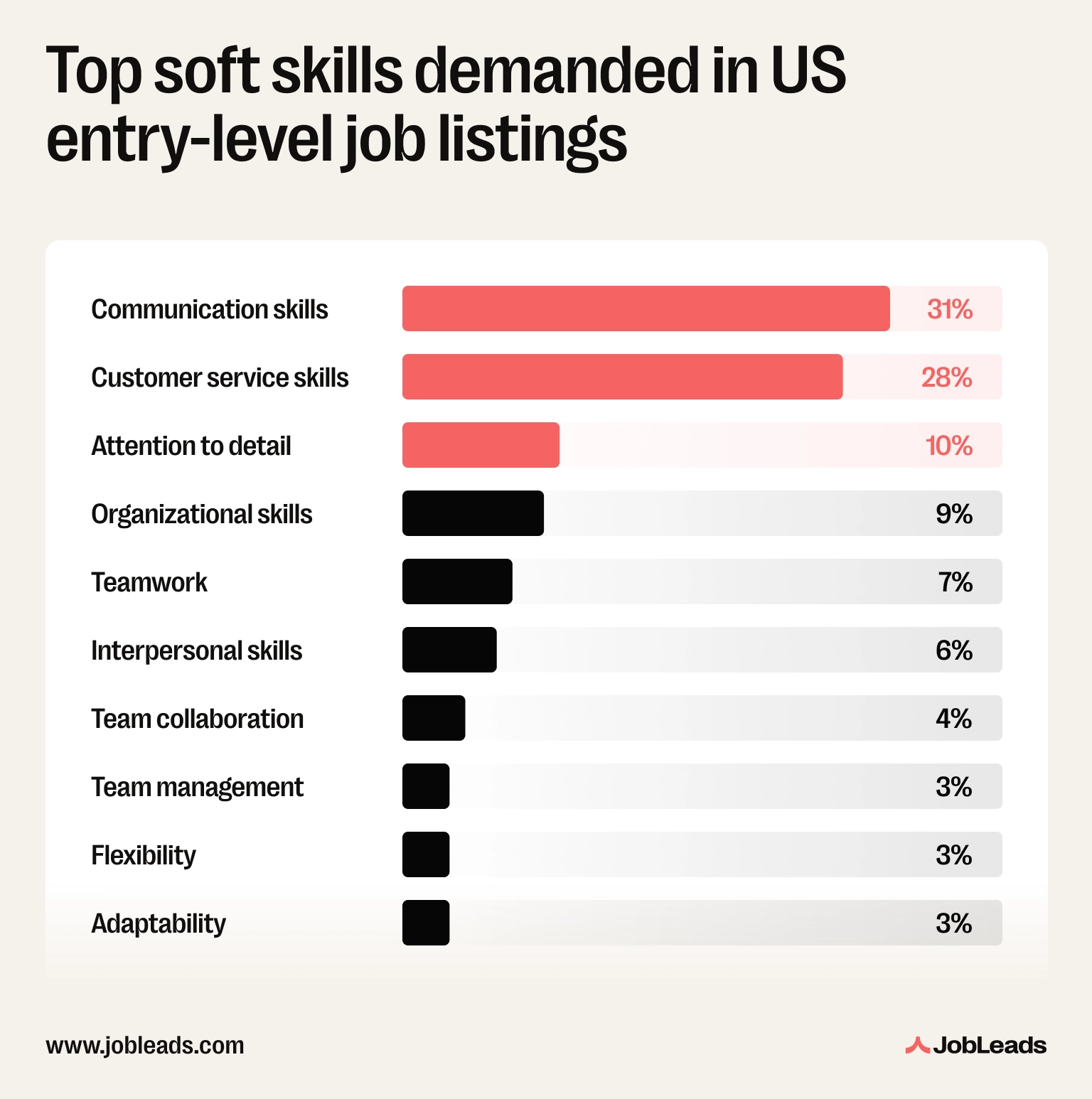
Across more than 1.2 million US job listings, the most demanded attribute in entry-level roles is communication. This skill appears in nearly 31% of all listings. Customer service skills come second at almost 28%, followed by attention to detail at just over 10%.
That is a level of market penetration no technical skill comes close to matching.
| Skills | % of jobs |
|---|---|
| Communication skills | 31% |
| Customer service skills | 28% |
| Attention to detail | 10% |
| Organizational skills | 9% |
| Teamwork | 7% |
| Interpersonal skills | 6% |
| Team collaboration | 4% |
| Team management | 3% |
| Flexibility | 3% |
| Adaptability | 3% |
The dominance of soft skills in entry-level listings is not an accident of the dataset. It reflects a measurable shift in how employers think about early-career hiring.
The emphasis on soft skills is not incidental. Nearly two-thirds of employers now use skills-based hiring practices for new entry-level hires, according to NACE. And the data from this study suggests job postings have caught up. Communication and customer service rank above every technical skill in entry-level requirements, by a significant margin.
The reason is largely practical. In fact, about 78% of employers in the TestGorilla study reported that they had previously hired a candidate with strong technical skills who underperformed specifically because of a lack of soft skills or cultural fit. The lesson employers learned was that technical skills can be trained but communication habits are far harder to install in someone who doesn't already have them.
LinkedIn's own workforce research adds a longer-term dimension. They found that workers with strong soft skills are promoted faster and earn more over time than those who lack them. At the entry level, these attributes are the most durable predictor of whether a hire will succeed.
The practical implication for job seekers is significant. If you have held any customer-facing role, whether it's in retail, hospitality, or even volunteering, you likely meet the most-demanded requirement in nearly one in five US entry-level job listings.
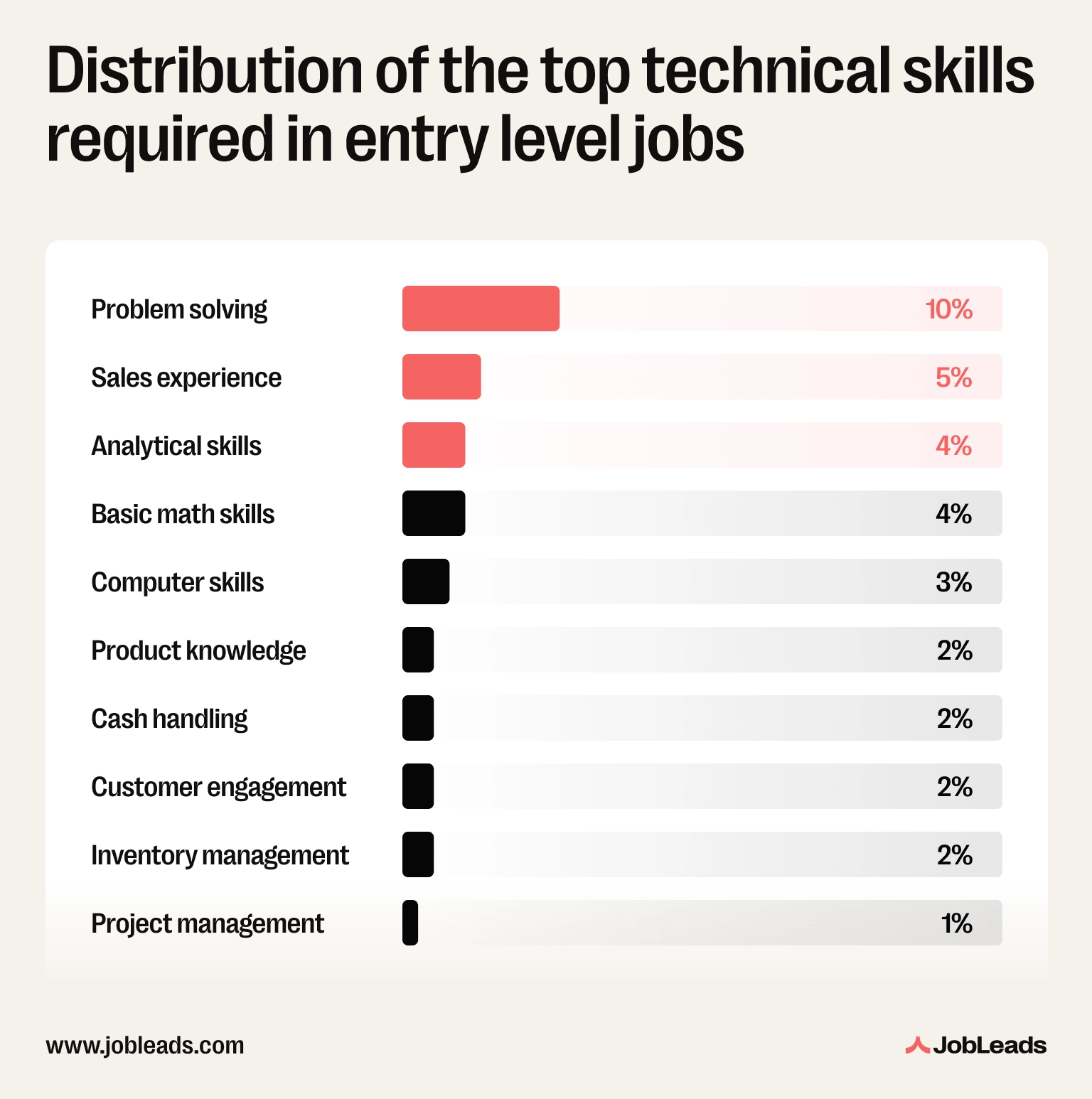
The technical side of the picture is telling in a different way. No single technical skill appears in more than about 10% of entry-level listings across the US market. The distribution is a long tail: dozens of role-specific requirements, each with minimal footprint in the overall dataset.
What this means is that entry-level technical requirements are role-specific. What matters in a cybersecurity entry-level role looks nothing like what matters in an entry-level HR position. The requirements are real. They are just not universal.
| Skill | % of jobs |
|---|---|
| Problem solving | 10% |
| Sales experience | 5% |
| Analytical skills | 4% |
| Basic math skills | 4% |
| Computer skills | 3% |
| Product knowledge | 2% |
| Cash handling | 2% |
| Customer engagement | 2% |
| Inventory management | 2% |
| Project management | 1% |
This may explain one of the most persistent cognitive distortions in early-career job searching. When candidates scan broadly across entry-level listings they encounter a wide variety of technical requirements that collectively feel overwhelming. But that breadth is an artefact of looking at the whole market at once.
A Harvard Business School and Burning Glass Institute analysis found that the gap between employers' stated commitment to skills-based hiring and their actual hiring behaviour is enormous. In practice, the technical bar for any specific role is far narrower than the full catalogue of entry-level requirements suggests.
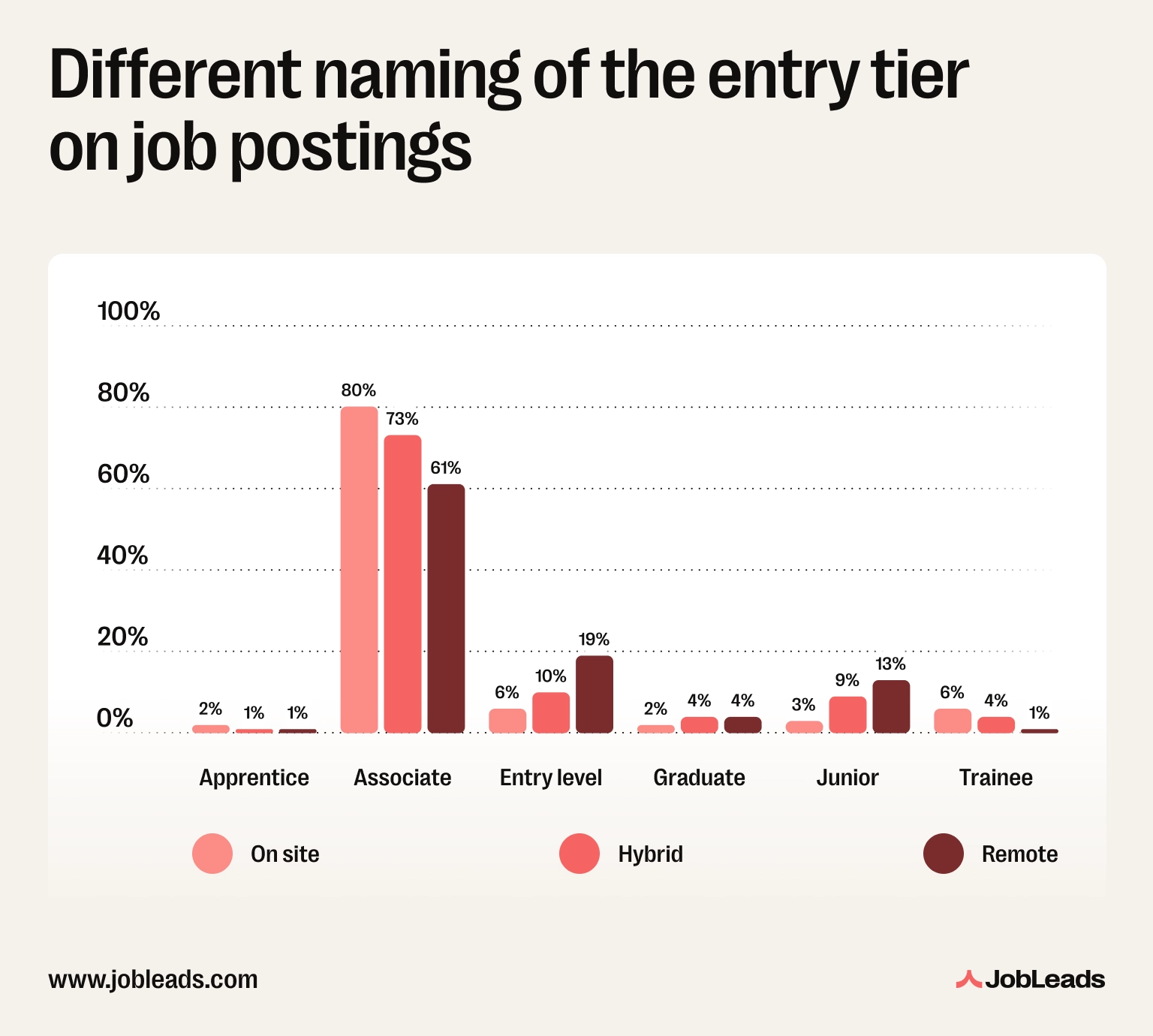
Across the full dataset, remote entry-level roles are more than 3 times as likely to carry a genuine entry-level or junior title as on-site roles. In fact, nearly a third of remote jobs (33%) are classified as entry-level or junior. For on-site jobs, that figure falls to just 9%.
The gap is clear in the numbers. Remote jobs carry a genuine entry-level 19% of the time and junior title 13%. These figures fall to just 6% and 3% when we look at on-site roles.
On the other hand, "associate" dominates on-site, accounting for over 80% of on-site entry-level jobs, a title that carries historically different seniority expectations than "entry-level" or "junior." Among remote listings, that figure drops to just over 61%, with genuine entry-level classifications filling more of the gap.
| Entry tier | On Site % | Hybrid % | Remote % |
|---|---|---|---|
| Apprentice | 2% | 1% | 1% |
| Associate | 80% | 73% | 61% |
| Entry level | 6% | 10% | 19% |
| Graduate | 2% | 4% | 4% |
| Junior | 3% | 9% | 13% |
| Trainee | 6% | 4% | 1% |
The gap in title classification between work models is not explained by a difference in who is applying. The most likely explanation lies in how and why employers write job listings differently depending on where the work happens.
Research by Bloomberry, based on an analysis of over one million remote job listings, found that remote roles in general require slightly more experience than non-remote equivalents. The report shows that senior-level roles are the most likely to be remote, followed by mid-level, with entry-level access to remote work being more limited.
Moreover, analysis from Indeed's Hiring Lab found that explicit years-of-experience requirements in job postings have actually declined, from about 40% of postings in 2022 to around 30% in 2024.
In other words, the word "entry-level" on a remote job listing and on an on-site listing are not describing the same thing. And the frustration many job seekers feel, that the label does not match the requirements, is statistically more valid for office-based roles than for remote ones.
Read more: Entry-level jobs in the UK are falling in numbers, check out what the market looks like for recent graduates.
"Entry-level" is not a salary tier.
Across the US market, the industry a candidate enters determines their starting salary far more than the "entry-level" label itself. Legal leads the table at a median of $90,000 - $102,000. Consulting is close behind at $86,000 - $103,000. At the lower end, sales and management & operations offer median salaries of around $50,000 - $69,000. There is a gap of up to $45,000 between the best and worst-paying sectors.
Read more: Location shapes an entry-level salary as much as industry does. See which US cities leave graduates the most money after rent.
The label unifies. The compensation does not.
| Industry | Hybrid ($) | On Site ($) | Remote ($) |
|---|---|---|---|
| Legal | $101,664 | $94,500 | $89,560 |
| Consulting | $102,680 | $88,128 | $85,980 |
| Finance | $78,810 | $78,810 | $78,021 |
| IT & Technology | $89,560 | $78,810 | $82,390 |
| Marketing & Media | $74,750 | $73,440 | $71,650 |
| Bio & Pharmacology & Health | $78,991 | $71,971 | $71,650 |
| Engineering | $85,000 | $69,860 | $80,600 |
| Human Resources | $69,860 | $55,000 | $50,150 |
| Management & Operations | $71,257 | $51,153 | $65,201 |
| Sales | $69,161 | $50,150 | $60,681 |
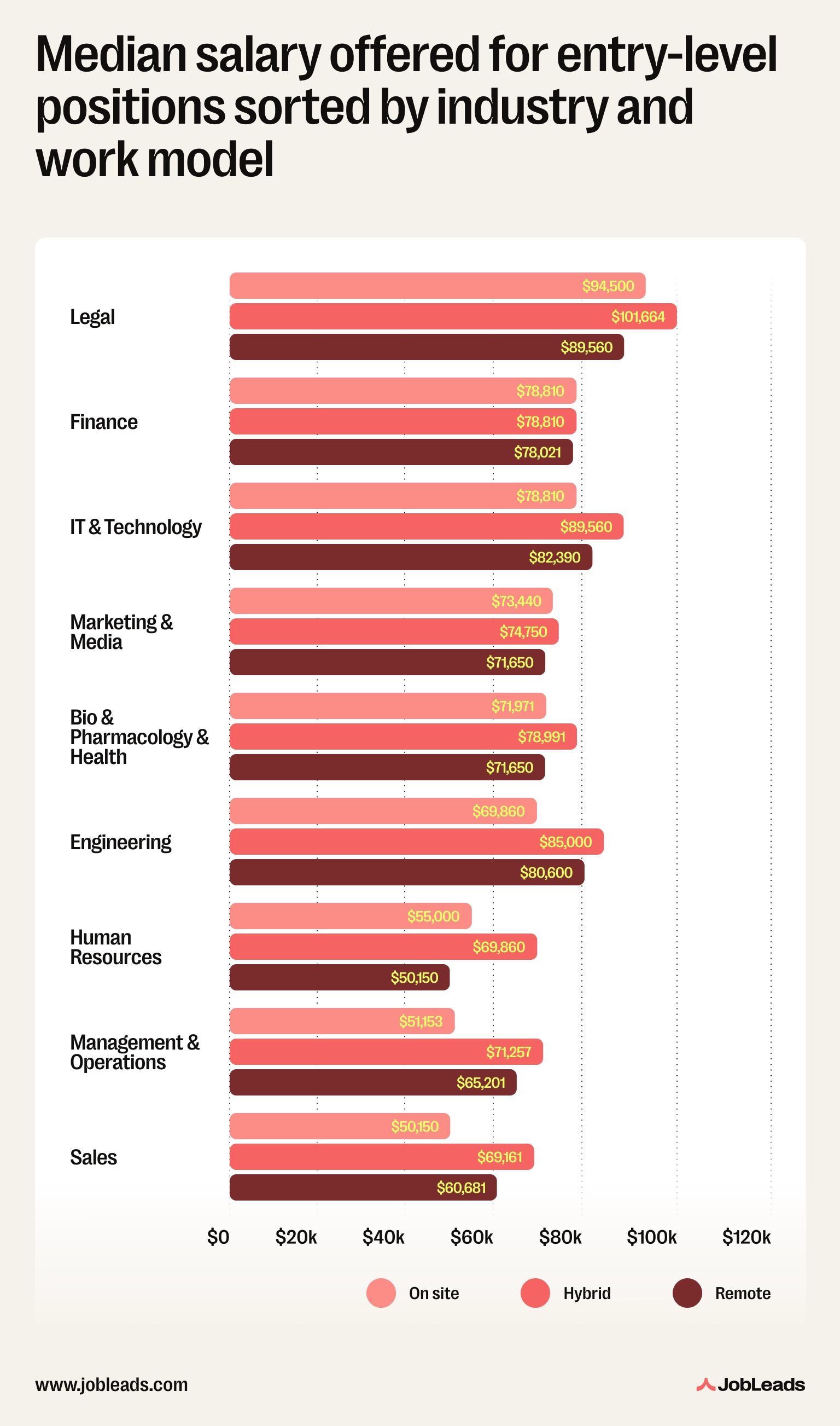
Entry-level salaries in legal and consulting fields reflect the market rate of the work being done, not an employer's willingness to develop raw talent. In law, an entry-level associate's time is billable from day one, which creates both the training investment and the compensation incentive.
On the other end of the spectrum, sales entry-level roles often front-load compensation with variable commission rather than fixed base salary. Listed medians in the data reflect posted base salary, not total on-target earnings.
The salary gap between work models is, if anything, even more striking than the industry gap.
Hybrid entry-level jobs carry a median salary of $77,020. On-site entry-level roles carry a median of $54,900. That is a $22,120 difference, or almost exactly 40%, in favour of hybrid. Remote sits in the middle at $69,860, some $15,000 above on-site but $7,000 below hybrid.
And that premium holds across industries.
| Work model | Median salary |
|---|---|
| Hybrid | $77,020 |
| Remote | $69,860 |
| On Site | $54,900 |
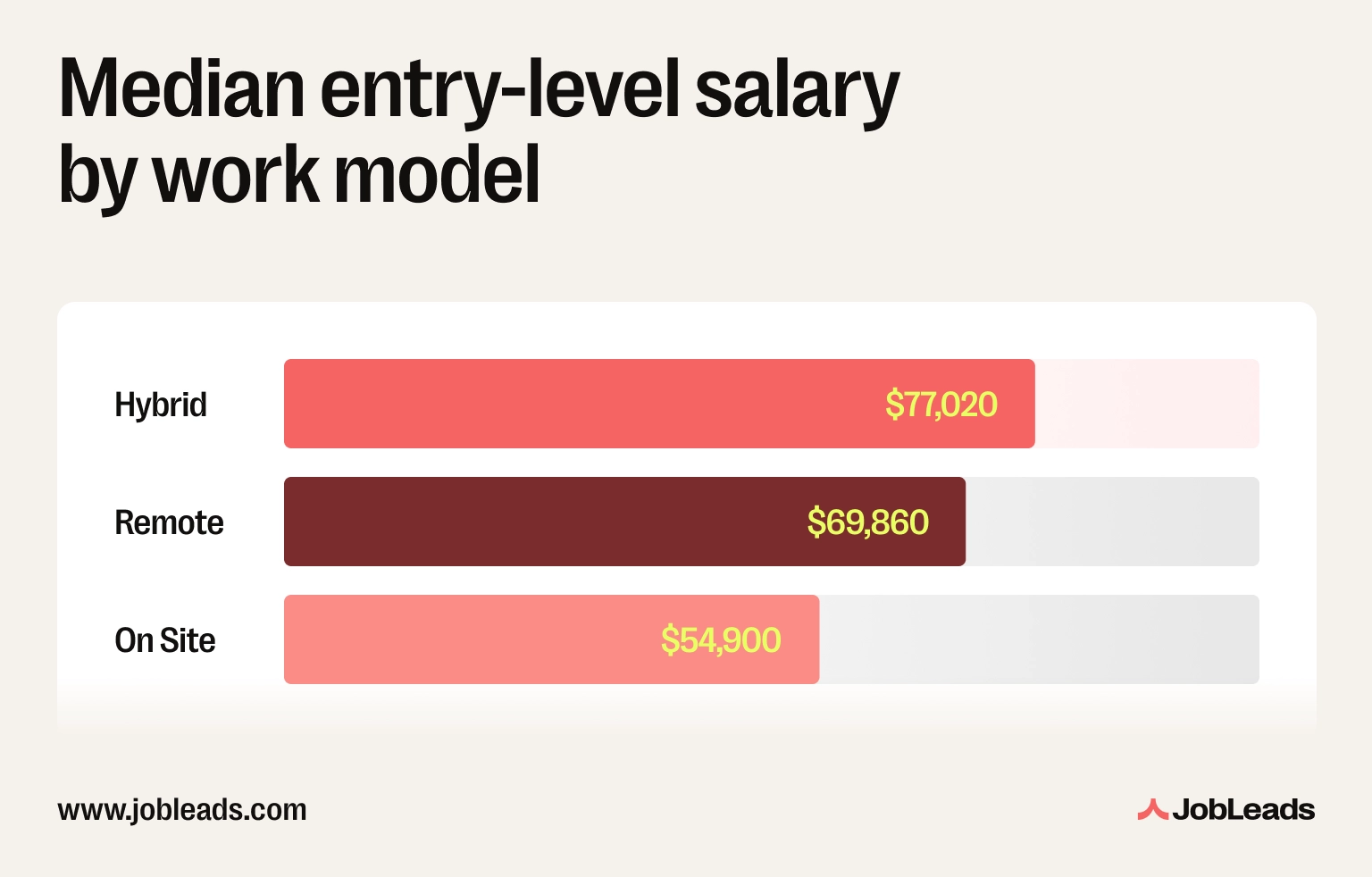
The existence of a hybrid salary premium is well-documented in the broader workforce literature. An analysis published by Allwork.space found that hybrid workers earn up to 12% more than their fully in-office counterparts.
Hybrid roles, JobLeads' data shows, are more likely to carry genuine entry-level or junior classifications. They attract a more geographically distributed and competitive candidate pool. And employers offering hybrid arrangements at this career stage appear to be competing more actively for talent than those defaulting to full on-site requirements.
The practical implication is a compound advantage. Hybrid entry-level roles pay more, carry more accurate titles, and offer greater flexibility. For early-career candidates evaluating where to focus their job search, the work model is as financially significant as the industry.
Looking at overall compensation, jobs with no listed perks have the highest median salary at $60,900. Jobs with 1-2 perks sit at a $60,000 median. Jobs with 3-5 perks drop to $56,168. Jobs with 6 or more perks recover slightly to $59,110.
Perk counts are also nearly identical across industries. They range from 3.3 to 3.7 average perks per listing regardless of industry, despite salary gaps between sectors of up to $45,000.
The data suggests a substitution effect. In entry-level roles, a longer list of benefits signals a lower paid position.
| Perk bucket | Median salary |
|---|---|
| No perks | $60,900 |
| 1-2 perks | $60,000 |
| 3-5 perks | $56,168 |
| 6+ perks | $59,110 |
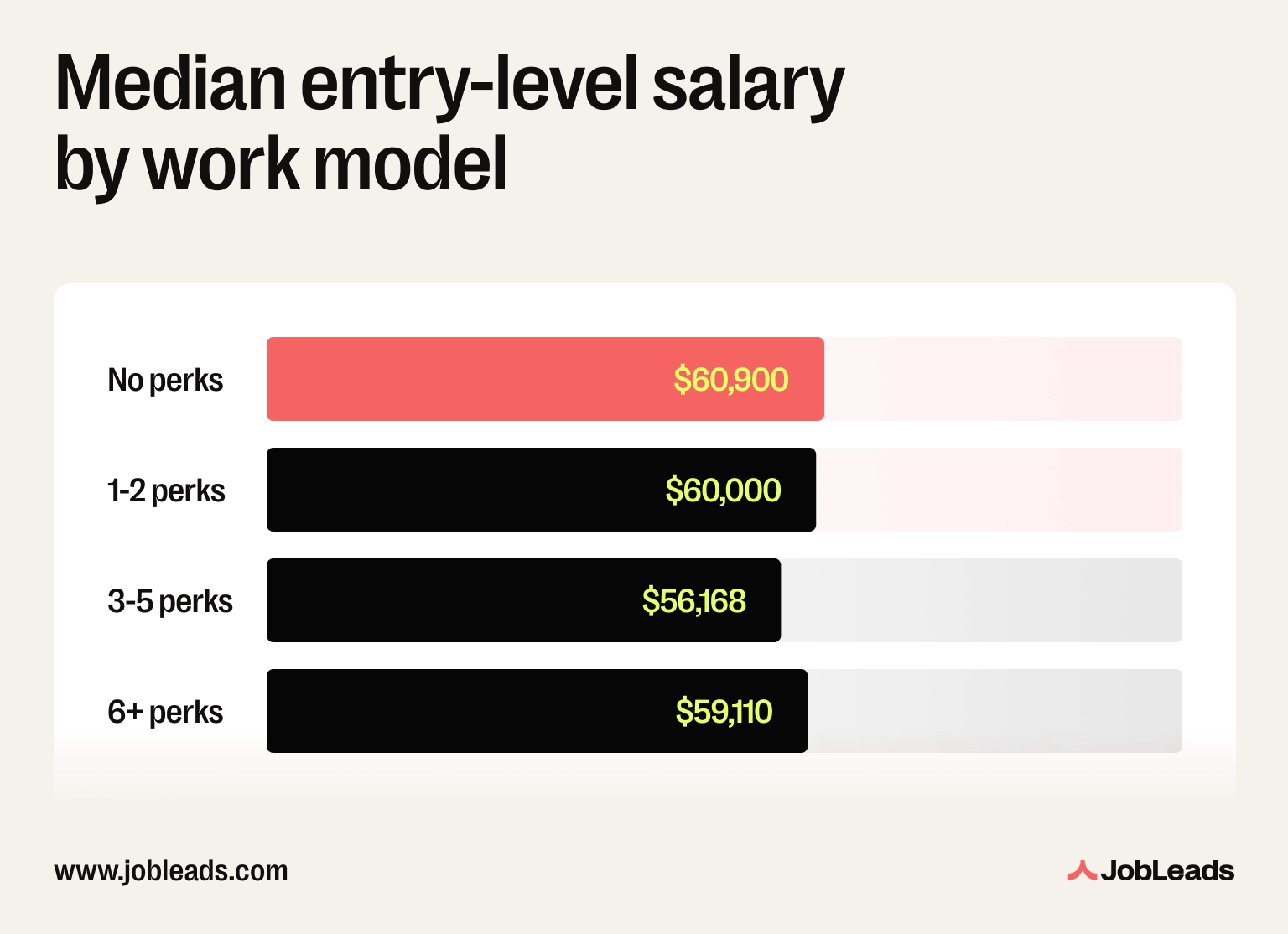
This finding is in line with what workers seem to value more. A Fractl survey found that 80% of people would choose a job with benefits over an identical job offering 30% more salary but no benefits. SHRM research found that 61% of employees say benefits directly boost their job satisfaction.
What the JobLeads data reveals is the supply side of that dynamic. Entry-level employers appear to use a richer perk offering as a recruiting tool specifically in roles where base salary is lower. This causes the perk list to become part of the framing instead of a neutral description of the role's total value.
A study by Greenwald and Fronstin found that when workers were asked to trade wages for benefits, only 18% would accept lower wages for more benefits. This suggests that using perks as a substitute for pay isn't universally successful, but enough candidates respond to the framing to make it a rational hiring strategy.
The uniform perk count across industries of around 3-4 perks per listing regardless of sector suggests that perks function as a listing convention rather than a genuine compensation signal. Employers in lower-paying industries list roughly the same number of perks as employers in higher-paying ones. The variable that actually changes is the salary.
The dominant narrative about early-career candidates is that they're desperate and willing to accept anything. The data doesn't support that characterization.
Across industries, up to 29% of entry-level applications go to jobs paying above the applicant's stated salary range. Candidates that apply to jobs paying less than their desired income, average just 15%. Most applications fall within range, but the directional skew is clearly upward.
| Industry | % Inside | % Above | % Below |
|---|---|---|---|
| Sales | 81.5% | 10.8% | 7.7% |
| Engineering | 74.5% | 16.1% | 9.4% |
| Management & Operations | 68.3% | 13.8% | 17.9% |
| Human Resources | 63.3% | 14.9% | 21.8% |
| IT & Technology | 62.6% | 22.5% | 14.9% |
| Bio & Pharmacology & Health | 60.8% | 20.3% | 18.9% |
| Finance | 59.3% | 29.0% | 11.8% |
| Marketing & Media | 58.6% | 26.4% | 15.0% |
| Legal | 56.9% | 24.6% | 18.5% |
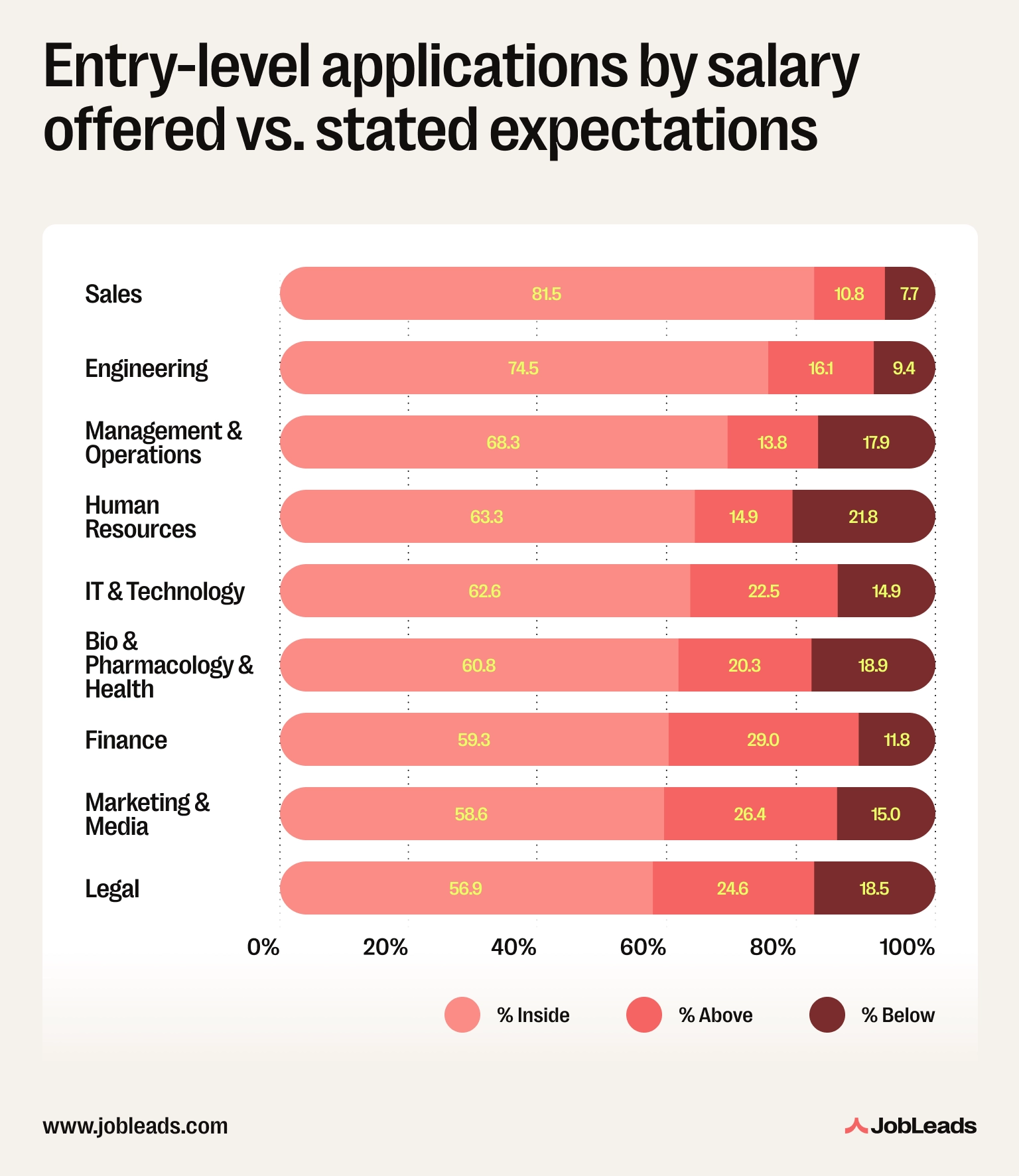
The pattern is consistent across industries. Early-career job seekers are systematically applying to roles that pay what they told themselves they needed or above. Whether that reflects strategic thinking or simple optimism, the behavioral data suggests that entry-level candidates are not as self-limiting as the conventional narrative suggests.
The aspiration gap in the JobLeads data aligns with what behavioral research has found about how job seekers actually set and use salary expectations.
A study published in PMC found that 24% of job seekers aspired to roles that paid more than 10% above their last occupation. By contrast, only 17% were applying to roles paying more than 10% less. The directional skew in the JobLeads data mirrors this pattern almost exactly.
Career researchers also note that salary ranges are used strategically, not as fixed anchors. When job seekers state a range rather than a single figure, the upper bound functions as an aspirational target while the lower bound serves as a floor. The act of applying to a higher-paying role does not represent an irrationality, but an intentional test of the market.
A broader survey found that earning more money was the number-one career goal for 42% of candidates and that 63% said they would withdraw from a job offer if a better one arrived. The behavioral picture is of a cohort that is more market-aware and more financially assertive than the conventional "desperate grad" narrative suggests.
The entry-level market is harder to navigate than the label suggests. But the friction is specific, not random.
Employers consistently prioritise soft skills over technical ones. This means that communication and customer service are at the top of the requirements list, and no technical skill comes close.
At the same time, where a job is located shapes whether the title is honest. Remote entry-level roles are over three times more likely to actually mean entry-level. And it's good to note that the industry is perhaps the strongest driver of entry-level pay. Looking at salaries ranging from around $50,000 in sales to over $100,000 in legal, it's clear that no amount of negotiation is likely to close this gap.
If you're searching for your entry-level opportunity, you should use a job search engine that's built specifically for candidates, and not companies. JobLeads tracks what entry-level employers are actually hiring for. And you can search and filter by skill, salary, and work model to find roles that match where you are in your career.
Search and filter by skill, salary, and work model to find roles that match where you are in your career.
JobLeads analyzed over 1.2 million active US job listings classified as entry-level or associate-level from Q3 and Q4 2025. The dataset covers 1,094,790 on-site listings, 50,780 remote listings, and 66,921 hybrid listings. Engagement data covers approximately 18,500 unique users with stated salary expectations.
Listings were classified by job title into entry-level, junior, associate, and other tiers. Two data cleaning passes removed seniority noise from the associate classification. Salary figures reflect posted compensation in job listings, not negotiated outcomes or final offers.
Limitations:

Content & Insight Writer
Beata creates content that puts job seekers first. From practical blog advice to first-hand research studies, her writing is designed to give people the clarity and confidence to find the role they deserve.
Job Market TrendsUnderstand the state of remote work in the US in 2026 with JobLeads data on hiring demand, industry trends, regional patterns, and worker preferences.
 Job Market Trends
JobLeads analyzed behavioral data from 881,776 U.S. job seekers to better understand how the gender pay gap develops throughout the job search process. The study finds that women ultimately earn 83 cents for every dollar men earn, but that difference is shaped long before a paycheck is issued.
 Job Market Trends
Our survey of 43,000+ job seekers reveals why most never access the hidden job market, and the strategies that actually work to change that.