
 Job Interviews
May 27, 2024
What's an elevator pitch - and how will it land me great jobs?
Learn what an elevator pitch is, how to create one, and how it can land you great jobs. Find tips, examples, and templates for crafting your perfect pitch!


A Resume Builder survey of business leaders found 51% of US companies already use AI in hiring, and 68% plan to. This means that the first reader of your application is, statistically, not a person.
That shift is happening fastest on the recruiter's side of the table. AI now sources, screens, schedules, interviews, scores, and rejects, often before a human ever picks up the file.
This guide covers why recruiters are leaning on AI harder every quarter, what candidates are saying about the experience, and the essential tips on how to nail an AI interview.
Get a free resume review from JobLeads and make sure the algorithm reads you right.
Let's start from the basics–
Each AI interview platform formats the experience differently. But, the AI interview tools used by most enterprise employers fall into one of three shapes.
| Format | What happens | Who reviews you |
|---|---|---|
| Live AI-led interview | A voice agent or avatar asks questions in real time, often with follow-ups | AI conducts; humans typically make final calls |
| Chatbot screening | Text-based Q&A covering basics like availability, experience, and requirements | Human managers review responses and decide who moves on |
| One-way recorded interview | You record answers to preset questions on your own schedule | A human reviewer, an AI layer, or both |
| AI-assisted assessment | A human interview (live or recorded) that AI transcribes, summarizes, or scores | Human interviewer, with AI as a support layer |
You log into a portal and a question appears on screen. You have 30 seconds to think and 90 seconds to record. Then, the next question pops up. It's all written by AI, and nobody is sitting on the other side of your screen. This interview focuses on you answering pre-set questions.
It's the most common AI video interview format, and most AI video interview software now scores the recording before a human ever sees it. When the bot also asks the questions, vendors brand it as an AI interview bot.
Your phone rings, and the thing on the other end is a large language model trained on job description. It listens, picks up on what you say, and asks follow-ups in real time. On a good day, the rhythm almost passes for a normal call.
That "almost" still needs a lot of work, though. The pacing is where it falls apart for most candidates, and one Reddit user summed it up perfectly:
This thing? It just machine-gunned questions at me. No real pauses. No reactions. No "that's interesting, tell me more." No actual flow between questions. Just question, answer, next question, next question, next question. It genuinely felt dystopian for a second.
Reddit user
You're talking to a real recruiter but you're not alone on their side. An AI interview agent transcribes every word and scores your answers in real time. Think of it as a panel interview where one of the panelist happens to be an algorithm. The recruiter you can see might smile and nod, but the machine listening alongside is the one quietly deciding whether you make it to round two.
Info
Resume Builder's survey found that over 82% of companies already use AI to review resumes. That means the first reader of your application is, statistically, not a person.
The interview is the tip of the iceberg. Often, AI shows up much earlier in the pipeline than most candidates realize. In fact, the SHRM Talent Trends report found that 43% of organizations now use AI in HR tasks–up from just 26% the year before. Among those, 51% use AI for recruiting.
Here are the most common uses of AI in a modern hiring funnel:
Read more: The JobLeads guide on how to optimize your resume for ATS covers the mechanics.
Talk to a solo recruiter, and the appeal is obvious. One post on Reddit laid it all out:
I'm handling sourcing, phone screens, scheduling, onboarding coordination, follow-ups, training classes, candidate tracking… almost everything is manual. I'm starting to realise I can't scale recruiting this way long-term.
Reddit user
The replies were unanimous: automate scheduling, follow-ups, basic screening, and status updates.
The strategic direction is even clearer from inside the agencies. One ex-staffing recruiter wrote:
Their long term goal is to have most things automated and a lot of recruiters will lose their jobs. A lot of the other recruiters and account managers were focused on creating agents within co-pilot to handle tasks.
Reddit user
So–
TThe pressure on recruiters to deploy an AI interview assistant is structural. As hiring teams move from isolated automation tools to connected workflows, some are using AI agent development services to integrate screening, scheduling, candidate communication, and human review. And for a solo recruiter running a high-volume call-centre pipeline, AI is sometimes the only way to make a good hire. For a candidate, that same logic is what turns the experience cold.
JobLeads survey found that more than 36% of candidates think that the first interview being conducted by AI instead of a human is a dealbreaker. Another 33% said it depends on the role or company. And just over a quarter (26%) said they would proceed anyway.
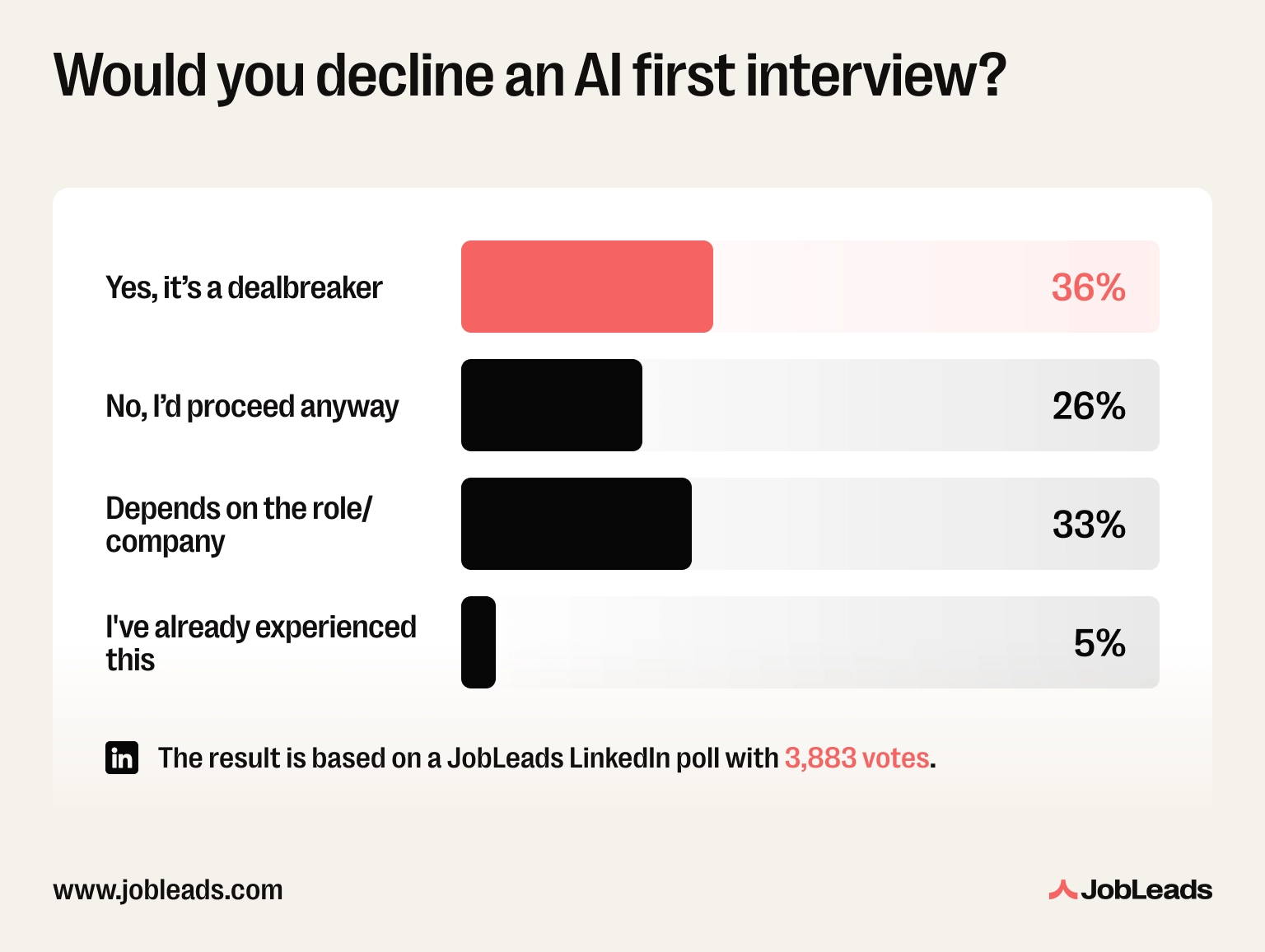
The split tracks with the Reddit sentiment. Being frank here–most candidates aren't fans. But they rarely walk away outright. Below are the five complaints that come up over and over.
I've done one with an AI text chat bot. I liked it more than voice AI as that's so dystopian, and at the end the text AI shows your results against other interviewers. It's so stupid as AI can't infer from questions and you just get a score card. It's so dystopian it's horrid.
Reddit user
The complaint isn't really about being interviewed by AI. It's about being scored by one and never finding out how. A leaderboard with no visible rubric reads less like feedback and more like a black box, and "dystopian" is the word candidates reach for when a process feels evaluative without ever feeling explainable.
The AI interviewed me as if I were applying to be a senior-level designer of an autonomous driving system at Tesla. I'm not joking. It asked deep technical questions about system architecture, decision pipelines, and autonomy tradeoffs that had absolutely nothing to do with the job I applied for (...)
Reddit user
Role drift like this is what happens when a screening tool leans on generic seniority signals instead of the actual job description. Without a recruiter in the loop to catch the mismatch, candidates end up defending expertise nobody asked them to have.
By the middle of it, I was so anxious that I couldn't form sentences properly even though I knew the answers conceptually. I'm also feeling weirdly judged because the entire interview is recorded, so now I keep replaying my awkward moments in my head. IMO, I feel AI interviews are not suitable for neurodivergents.
Reddit user
Being recorded and scored in real time raises the stakes on exactly the moments that many neurodivergent candidates already manage carefully, like hesitation, phrasing, and pace. When the format amplifies anxiety instead of accounting for it, the result is actually a narrower read on abilities.
I was so confused, like do I greet it or what (...) it kept moving on to next questions when I paused for a few seconds. I'm desperate enough to do another one because I can't be choosy right now.
Reddit user
The AI can't tell a thinking pause from a finished answer, so it just moves on which is a basic design flaw. But the real sting is the last line of the quote. Despite hating it, the Reddit user says they'll do another one anyway, because they can't afford to be picky right now. That's the uncomfortable part–it's not that the format works, it's that desperation keeps candidates completing it regardless.
This is exactly what happened to me today, absolutely horrible. They could have at least said it was going to be an AI interview instead of a screening call with a person to prepare.
Reddit user
Disclosure is a low bar, and companies keep missing it. Telling a candidate upfront that a screening interview will be AI-conducted costs nothing and lets them prepare accordingly. Skip that step, and an automated process starts to feel like a deceptive one.
A University of Washington study by Wilson and Caliskan tested three large language models across more than 3 million resume-to-job comparisons. The results showed that the models preferred white-associated names as much as 85% of the time and male-associated names about 52% of the time. Moreover, in not a single comparison did any model prefer a Black male name over a white male name.
That's not a marginal skew. It's a near-total pattern, and it's running through systems that are already screening resumes ahead of the interviews candidates are complaining about above.
Most of this bias is invisible to candidates by design as you don't get told which model scored you or how. So the only real lever you have is asking before you sit down. If you are about to sit an AI video interview for a regulated industry or a regulated jurisdiction, ask the recruiter directly whether facial-expression or vocal-tone scoring is used. The answer is informative either way.
This is where knowing your rights helps. In some US states and cities, you're entitled to more than an answer. Illinois requires employers to disclose AI video analysis, explain what it evaluates, get your consent, and delete your recording within 30 days if you ask. New York City's Local Law 144 requires annual bias audits of automated hiring tools, advance notice, and public audit summaries.
Elsewhere, rules vary or don't yet exist, but nothing stops you from asking the same three questions: Will AI evaluate my responses, or just record them? Will a human review my interview before any decision is made? And how long is my data kept, with the option to request deletion?
If you've decided to proceed, treat the AI interview as a different format than a human interview.
| ✅ Do | ❌ Don't |
|---|---|
| Speak in a clean STAR structure as the model is parsing for it | Ramble or self-correct mid-sentence |
| Use exact phrases from the job description | Assume the AI "knows" what your resume says |
| Pause briefly, then answer with intent | Take long thinking pauses–many bots cut you off |
| Look at the camera lens, not the screen | Read off notes–video models flag eye drift |
| Test mic, light, and a wired connection beforehand | Wing it on hotel Wi-Fi |
| Ask the recruiter beforehand if tone/expression scoring is used | Assume your accent or affect won't be scored |
You can use AI for interview preparation. Just copy these, paste your job description into the brackets, and run them in order.
Prompt 1: Mock interview generator
"Act as a [role] hiring manager at [company]. Interview me with 8 questions for this job description: [paste JD]. Ask one question at a time. Wait for my answer. Critique it before moving to the next."
Prompt 2: STAR-method answer rehearsal
"I need to answer this interview question: [question]. Here's my story: [bullet points]. Rewrite my answer using the STAR method in under 90 seconds spoken. Then give me three follow-up questions an interviewer would ask."
Prompt 3: Company and role research brief
"Brief me on [company] for a [role] interview. Cover: recent news in the last 90 days, product strategy, top three competitors, likely interviewer concerns about this role, and five smart questions I should ask at the end."
Tip
Record your answer on your phone, paste the transcript into Claude or ChatGPT, and ask for feedback on filler words, pace, and structure. You can run ten reps in an evening for free.
If AI is sitting on the recruiter's side of the table, a fast-growing slice of candidates have decided to put one on theirs, too. The system listens through your microphone, transcribes the question, and surfaces answers on a second screen in real time.
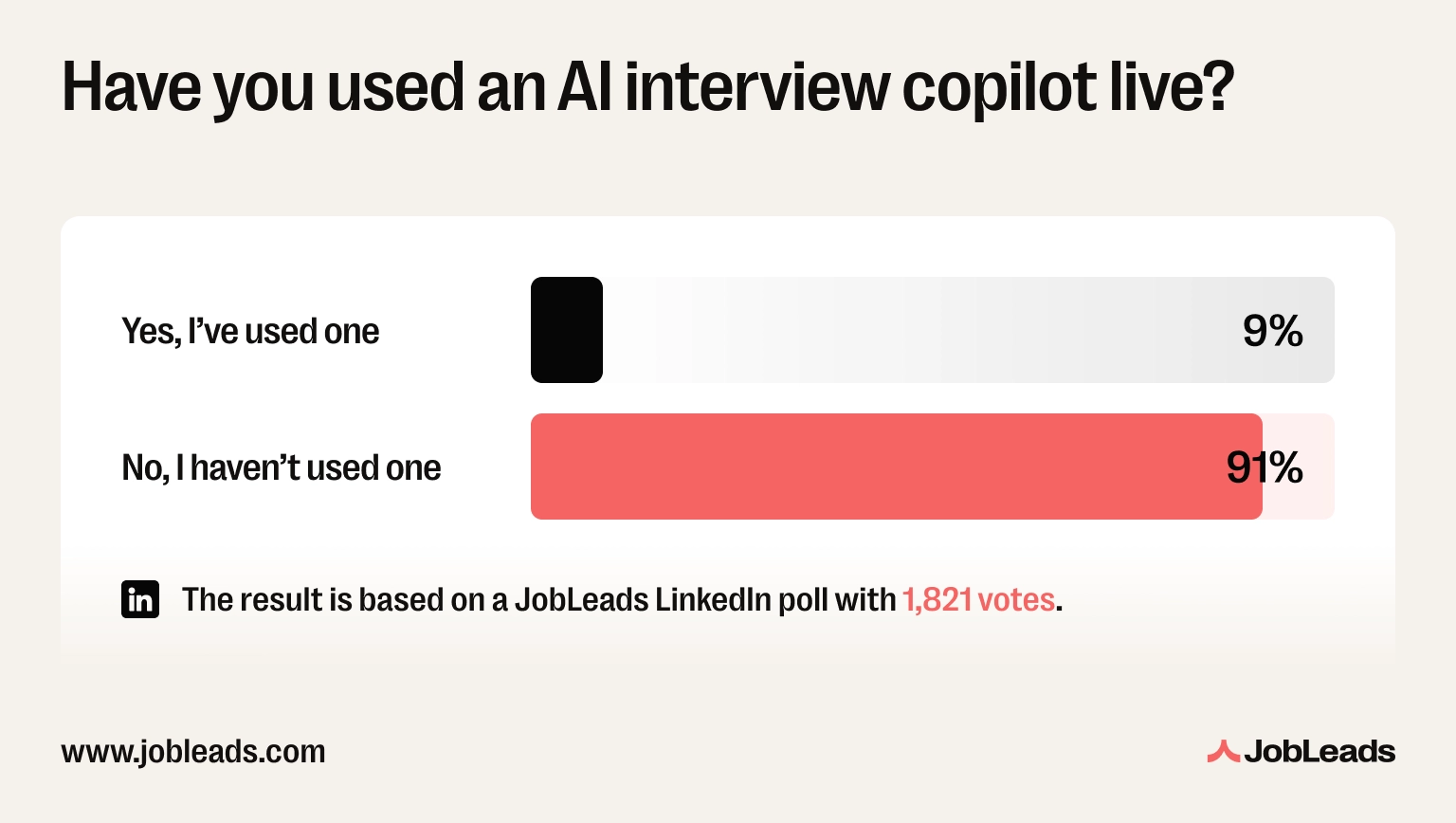
But not many people use it yet. JobLeads poll found that only 9% of job seekers have used an AI interview copilot to secretly help them perform better in a live online interview. The other 91% said they had not.
So–
Roughly 1 in 10 candidates admit to using one. That is only the people willing to say so on LinkedIn. The actual number is almost certainly higher, and on Reddit the tone has shifted from "is this cheating?" to "which one is best?":
(...) the interview process is already theater on both sides. The company is using scripts, rubrics, AI resume screeners, automated scheduling, and half the time the interviewer barely read your resume before hopping on the call. If candidates want to use a tool to keep up with that, then honestly good for them.
Reddit user
Two things, mostly.
1. Behavioral rounds: the structured "tell me about a time when…" format is where most candidates ramble. A copilot can surface a STAR scaffold the second the question lands.
I use mine mostly for behavioral rounds (…) the suggestions give me a framework to hang my actual experiences on and I sound way more structured. Went from rambling for 3 minutes to giving clean 90-second answers.
Reddit user
2. Recall under pressure: numbers, frameworks, jargon you knew but can't summon when your heart rate is at 110. A copilot is a memory aid, not a script.
What it is not good at is giving you opinions you don't hold, or carrying you through a technical round you haven't actually studied for. Candidates who use it as a crutch tend to get caught at the onsite stage, when the laptop isn't there.
Interview AI is great for the actual interview but make sure you still prep normally too. I see people treating it like a replacement for studying and then they get to the onsite and cannot do a whiteboard problem because the AI is not there.
Reddit user
| ✅ Right | ❌ Wrong |
|---|---|
| Glance at structured bullet hints, then speak in your own words | Read full AI-written answers verbatim |
| Use it to recall a metric or framework you actually know | Let it generate opinions you don't hold |
| Run two or three mock interviews with the tool active first | Use it for the first time in the real interview |
| Use a second monitor or tablet positioned beside your camera | Prop your phone next to the laptop–eye drift gives it away |
| Disable notifications on every device in the room | Leave Slack pinging on the second screen |
| Use a wired connection so transcription doesn't lag | Run it on hotel Wi-Fi |
The tells interviewers now watch for include eye drift away from the camera, unnatural pauses before fluent answers, language that doesn't match the rest of the conversation, and audio anomalies from the copilot itself. Several interview platforms now flag suspected AI-assisted candidates for human review.
Read more: Check out some essential tips from recruiters that will help you pass the interview stage.
AI reads your resume, books the call, asks the questions, scores your tone, and queues the rejection email.
The argument that's still open is what you do about it. You have three options:
None of those choices is morally clean.
So–
Prep with AI without apology and run two or three mock interviews with Claude or ChatGPT before any call where the stakes matter. Also, ask the recruiter upfront whether tone or expression scoring is in play. Last but not least, if you find yourself talking to a bot for the fourth round in a row, it's fair to ask yourself whether you actually want to work there.

Content & Insight Writer
Beata creates content that puts job seekers first. From practical blog advice to first-hand research studies, her writing is designed to give people the clarity and confidence to find the role they deserve.
Job InterviewsLearn what an elevator pitch is, how to create one, and how it can land you great jobs. Find tips, examples, and templates for crafting your perfect pitch!
 Job Interviews
Learn how to effortlessly explain your layoff in job interviews, turn setbacks into growth opportunities, and find a role that aligns with your career goals.
 Job Interviews
Explore 5 real-life bad interviews, learn valuable lessons, and gain tips on handling tough situations with professionalism and self-respect in your job search.