
 Job Market Trends
June 26, 2026
Which Job Perks Drive Applications [Study on 60M US Listings]
JobLeads analyzed 60M US job listings to find the perks that actually drive applications, and it's not the most-listed benefits that candidates respond to.


You've found a job you actually want. Better hours, a shorter commute, maybe the career change you've been circling for years. There's just one problem–it pays less than your current employer.
You're not alone in weighing it. In a JobLeads poll, nearly half of professionals said they'd take a pay cut for a guaranteed 4-day work week.
So–is taking a pay cut worth it? Sometimes. A lower salary can still leave you better off once benefits, saved costs and real career upside enter the math.
In this guide, you'll learn how to compare total compensation, run a monthly affordability check and spot the difference between a smart trade and a bad one.
Let's start from the basics–
A pay cut is any drop in your total compensation, not just your base salary. That includes bonuses, employer retirement contributions, insurance, equity and paid time off. It can happen when you're changing employers but also at your current job.
This matters more than most people think. Benefits make up nearly 30% of total compensation costs for private-industry employers, according to the US Bureau of Labor Statistics.
So a 10% lower salary with better health coverage might not be a cut at all. And a small salary dip can hide a much deeper one if the 401(k) match drops from 6% to 3% and the bonus disappears.
There's one catch. You often can't see the full package in the job ad. When JobLeads analyzed the benefits and salary of over 60M US job listings, about 31% didn't mention a single perk or benefit.
Before you compare anything, keep three numbers apart:
The first is the least useful. The last is the one that decides whether taking a pay cut for a new job makes sense.
Money isn't the only thing people are trading for. Here is what the data actually shows:
Researchers see the same pattern. An NBER working paper based on real job offers found that US tech workers accepted about 25% less pay for partly or fully remote roles.
But not everyone values flexibility that much. A European Central Bank analysis found fully remote employees would give up only about 5% of their pay on average.
Did you know that…
About 45% of professionals accepted an offer below their worth because they couldn't afford to keep searching (JobLeads). Not every pay cut is a choice–which is exactly why the math below matters.
Read more: Weighing a fully remote offer? Our breakdown of remote work pros and cons covers the trade-offs beyond pay.
Here are five steps you can follow to compare two offers on equal terms. Do them in order–each one filters out bad trades before you get emotionally attached.
List everything in each offer that has a dollar value. Then split it into what's guaranteed and what's variable:
| Component | Treat as | What to check |
|---|---|---|
| Base salary | Guaranteed | Take-home, not gross |
| Signing bonus | Guaranteed | Clawback terms |
| Annual bonus or commission | Variable | Use a low estimate, not the target |
| Retirement match | Guaranteed if you contribute | Match rate and vesting |
| Health, dental, disability | Guaranteed | Premiums and coverage |
| Paid leave | Guaranteed | Extra days × your daily pay |
Pro-tip
Ask when each benefit starts. Some plans don't kick in until month three or six–and a pay cut plus a benefits gap can be a bigger cut than it looks.
Read more: If a perk or benefit is missing from the offer, it might still be on the table. Check out the list of non-salary negotiable items before you sign.
This is where taking a pay cut for a new job can quietly pay for itself–or quietly get worse. Some costs disappear with the right job, and they can close a lot of the gap.
Start with your commute. Driving a new car costs about 77¢ per mile once fuel, insurance and depreciation are included, according to AAA. That means a 20-mile round trip, five days a week, adds up to nearly $3,900 a year.
Your time has a price too. The average US commute is about 27 minutes each way, according to the Census Bureau. Over a year, that's roughly 225 hours–more than five full work weeks you could get back with a remote or closer job.
If you have kids, look at childcare next. The average price of childcare in the US is about $13,184 a year, according to Child Care Aware of America. A role with hours that let you cut even one paid care day a week has a direct, calculable value.
Then add up the smaller costs that come with going to the office. Parking, work clothes, lunches near the office or even a second car you could sell all count.
Whatever you include, put a number on it:
Right
Wrong
Finally, keep cash savings separate from benefits. A gym stipend is a nice perk, but it won't cover your mortgage.
Before career upside enters the conversation, answer one question: does the new take-home pay cover your life?
Use this simple pay cut calculator:
If the number is comfortably positive, the pay cut is affordable–and the real decision begins.
If it's negative or close to zero, stop. A job you can't afford isn't a career move. It's a financial problem happening in slow motion.
Did you know that…
In a JobLeads poll, about 32% of professionals said they could cover their expenses for less than a month if they lost their income. If that's you, build a buffer before you accept a lower salary.
Here's where good decisions go wrong. Sort every non-salary advantage into two buckets:
| Concrete (in writing) | Promise (verify first) |
|---|---|
| Benefits package with start dates | "Fast promotion track" |
| Stated hours or remote arrangement | "Great culture" |
| Defined role and reporting line | "We'll revisit pay once you've proven yourself" |
| Salary review date with criteria | "This experience will pay off later" |
A promised raise or better culture is worth exactly zero in your spreadsheet until it's confirmed. Use it as a tiebreaker, never as compensation.
Pro-tip
If a recruiter hesitates to put a promise in the offer letter, you've learned what that promise is worth.
The "earn less now, earn more later" story is sometimes true–but not reliably. That's especially important if you're taking a pay cut to change careers.
A Burning Glass Institute and AEI analysis of over 23,000 credentials found that only about 1 in 8 learners saw meaningful wage gains they wouldn't have had otherwise.
So verify the return. Talk to people three years ahead of you on that exact path and ask what they earn now.
Also be honest about which move you're making:
Both can be the right call. They're just different decisions. In fact, nearly 39% of career changers say their biggest regret was not switching sooner, while about 16% said the financial sacrifice hurt most (JobLeads).
Read more: Making the switch? Here's how to write a resume for a career change that shows your transferable skills.
There's no universal percentage. Be suspicious of anyone who gives you one.
A 15% cut can be painless for someone with low fixed costs. For someone with a mortgage and two kids in daycare, it can be ruinous. Your affordability check from Step 3 is your number.
That said, the size of the cut changes how hard you should look:
| Size of cut | Often works when | Red flag if |
|---|---|---|
| Under 10% | Saved costs or better benefits close the gap | Benefits are also weaker |
| 10–20% | You gain concrete time, flexibility or growth | Your budget is already tight |
| Over 20% | It's a planned career change with savings behind it | The upside lives only in promises |
So–how much of a pay cut is too much? Any cut that pushes your monthly budget below zero after essentials, savings and verified cost changes.
A pay cut doesn't always mean you're losing out. Sometimes the trade buys you something your current job can't, like more time, better health or a career you actually want to grow in.
And for many people, it's a step they'd take on purpose. In a JobLeads poll, about 32% of professionals said they'd accept a role below their level if it was only temporary. That's a sign many see a lower salary as a short-term move, not a permanent step back.
The key is knowing what you're getting in return. These are the situations where taking a pay cut for a new job is easiest to justify:
A less stressful job can be worth real money–but only if the lower stress is built into the role. Check the expected hours, on-call duties and team turnover.
In a JobLeads poll, about 41% of professionals said their job is "fine, it pays the bills," while nearly 17% said they hate it. If you're in the second group, a lower-paid job that protects your health may be the better deal.
If your current job is affecting your sleep, your health or your relationships, the cost of staying is real–it just doesn't show up on your payslip. Taking a pay cut for mental health can be one of the best trades you make, especially if a calmer role helps you show up as your best self at work and at home.
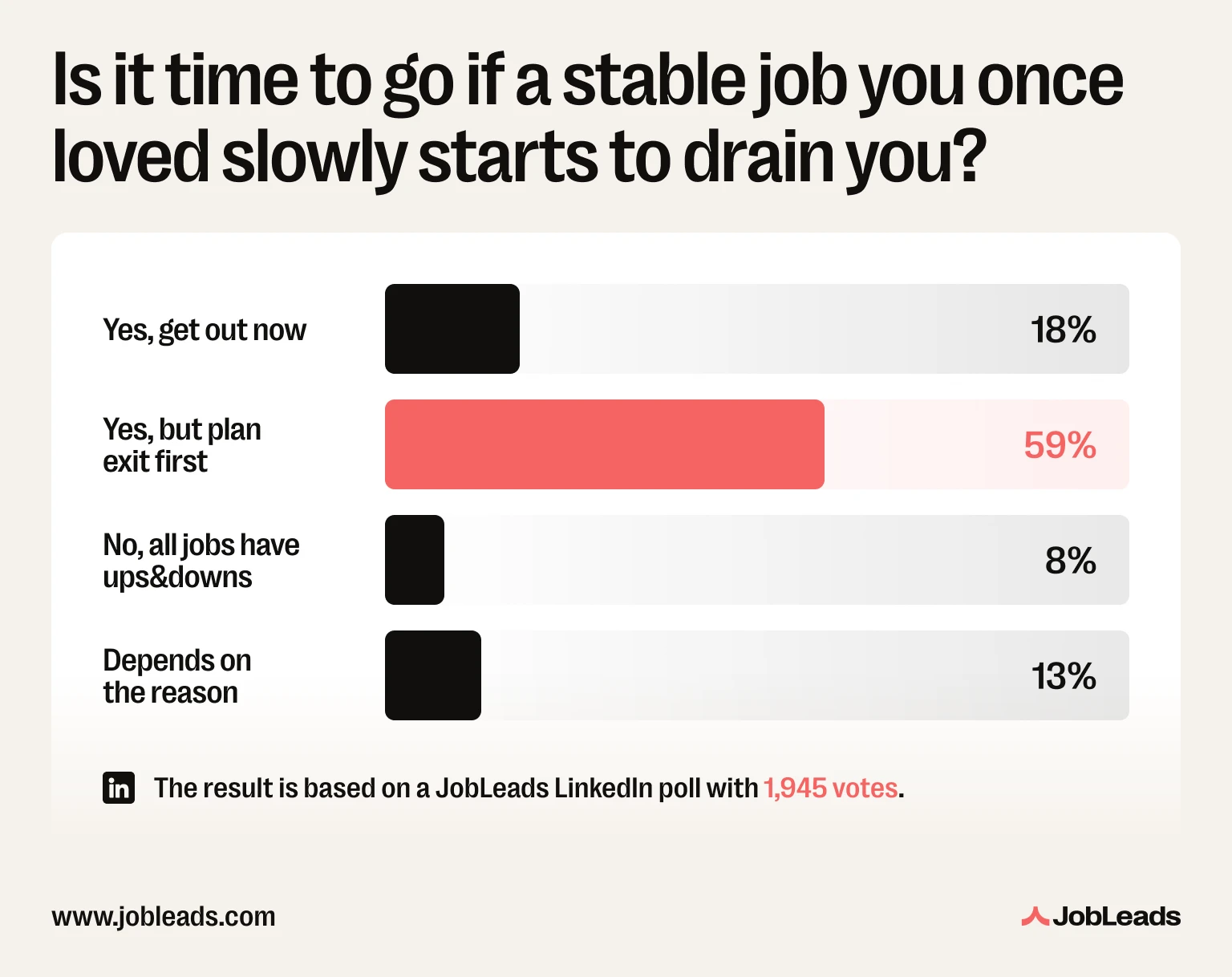
Still, try not to leave in a rush. In a JobLeads poll, 59% said you should leave a draining job–but only after planning your exit first. Give yourself time to build a savings buffer, run the affordability check and make sure the new role is truly less stressful, not just different. A lower salary should buy you real relief, not a fresh set of money worries.
Read more: Not ready to leave just yet? These workplace mindfulness techniques can help you manage stress while you plan your next move.
Remote work is one of the few perks that can pay you back in cash. Without a daily commute, you keep the gas, parking and car costs, plus the hours you used to spend on the road.
That's why so many people treat it as part of their pay. In fact, about 62% of professionals said remote work is very important or non-negotiable to them. And for those already working from home, nearly 47% said they'd want at least 20% more salary to go back to the office, while about 23% said they'd refuse no matter the money (JobLeads).
Before you accept a lower salary for a remote role, check two things. First, make sure the remote arrangement is written into your contract, not just a current policy that could change next year. Second, count the new costs of working from home, like a desk, a reliable internet connection and higher utility bills.
Read more: If the numbers still work, the trade can be a smart one. When you're ready to start looking, here's how to find a remote job.
For many professionals, job security is worth more than a bigger paycheck. If your industry is going through layoffs or your company's future feels uncertain, a steadier role with a lower salary can be the safer financial bet. A slightly smaller paycheck you can count on often beats a bigger one that might disappear.
That's why some people ask, "Should I take a pay cut for a government job?" Public-sector and other stable roles often pay less, but they can make up for it with pensions, stronger health coverage and more predictable hours. That can be a smart trade–as long as the benefits really make up for the lower salary.
Should you take a pay cut for a new job? Not before the employer answers these:
Read more: Want to push back on the number itself first? Use these salary negotiation examples to ask for more before you settle for less.
Taking a pay cut is worth it when two things are true. The new pay covers your essentials and savings with room to spare. And the role offers specific, verified advantages, not just hopeful ones.
A lower salary doesn't guarantee lower stress, better balance or faster growth. Only the details of the offer do.
So do the math on paper, label your assumptions and get the important promises in writing. The people who come out ahead aren't the ones who refuse every cut. They're the ones who checked.

Content & Insight Writer
Beata creates content that puts job seekers first. From practical blog advice to first-hand research studies, her writing is designed to give people the clarity and confidence to find the role they deserve.
Job Market TrendsJobLeads analyzed 60M US job listings to find the perks that actually drive applications, and it's not the most-listed benefits that candidates respond to.
 Career Development
The salary is final, but the offer isn't. Here are 10 non-salary negotiable items to ask for in a job offer, from remote work to a sign-on bonus.
 Career Development
Discover the pros and cons of working from home. Learn how employees and employers benefit from remote work and the challenges they encounter.