
 Career Development
June 15, 2026
Remote Work Pros and Cons: The Complete Breakdown [2026]
Discover the pros and cons of working from home. Learn how employees and employers benefit from remote work and the challenges they encounter.


JobLeads asked professionals on LinkedIn a simple question: is it time to go if a stable job you once loved slowly starts to drain you? Over 60% said yes but only if you plan your exit first.
And if you're struggling with the question "should I quit my job?", it's understandable.
This is one of the hardest calls in a career. It touches your income, your identity, your health, and more.
So, this guide isn't going to tell you "just leave" or "just stick it out." It will walk you through the specific situations and weigh the real arguments on both sides.
See what's out there before you decide. Browse jobs on JobLeads matched to your skills and priorities.
Before you look at your specific situation, run through these five questions. They're the same five a career coach would ask you, and they cut out most of the noise.
Signs you should quit your job tend to cluster around the same handful of patterns. If two or more of these are true for you, you can stop asking "can I quit my job?" The legal answer, in most standard employment, is yes–you can quit at any time. The harder question is when and how, which is exactly what the rest of this guide is for.
| Signal | What it usually means | What to do next |
|---|---|---|
| Sunday-night dread | Situational stress–possibly fixable | Talk to your manager first |
| Physical symptoms with no other explanation | A medical issue, not a mindset one | See a doctor and document it |
| Your manager has stopped listening | The internal-fix option is likely exhausted | Escalate to HR, or start planning your exit |
| 3+ months of expenses saved | You can afford to move if you need to | Start building your transition plan |
Let's run through the specific situations that bring most people to this question.
Anxiety at work doesn't always look dramatic. It's the pit in your stomach on Sunday night or the sense that you're bracing for impact every time your phone buzzes. Before deciding this means you need to quit, it's worth weighing both sides.
Chronic anxiety at work is often a sign of a toxic or mismatched environment, not a character flaw you need to fix in yourself. In the APA's Work in America survey, over 77% of workers reported experiencing work-related stress in the past month, and 57% said it had a negative impact on them. This includes irritability, difficulty concentrating, or a lack of motivation.
If your anxiety spills into your personal life, your sleep, or your physical health, that's a medical issue, not a mindset one. And staying in a high-anxiety job long-term risks burnout, which takes far longer to recover from than a gap on your resume ever will.
Anxiety can follow you. If the root cause is internal, like perfectionism, imposter syndrome, or any other pattern that's shown up in every job you've had, a new job alone won't fix it.
Financial instability is itself a major anxiety trigger, so quitting without a plan can make things worse, not better. And it's worth asking honestly whether the anxiety is situational–a bad manager or one difficult project–rather than structural to the role or company.
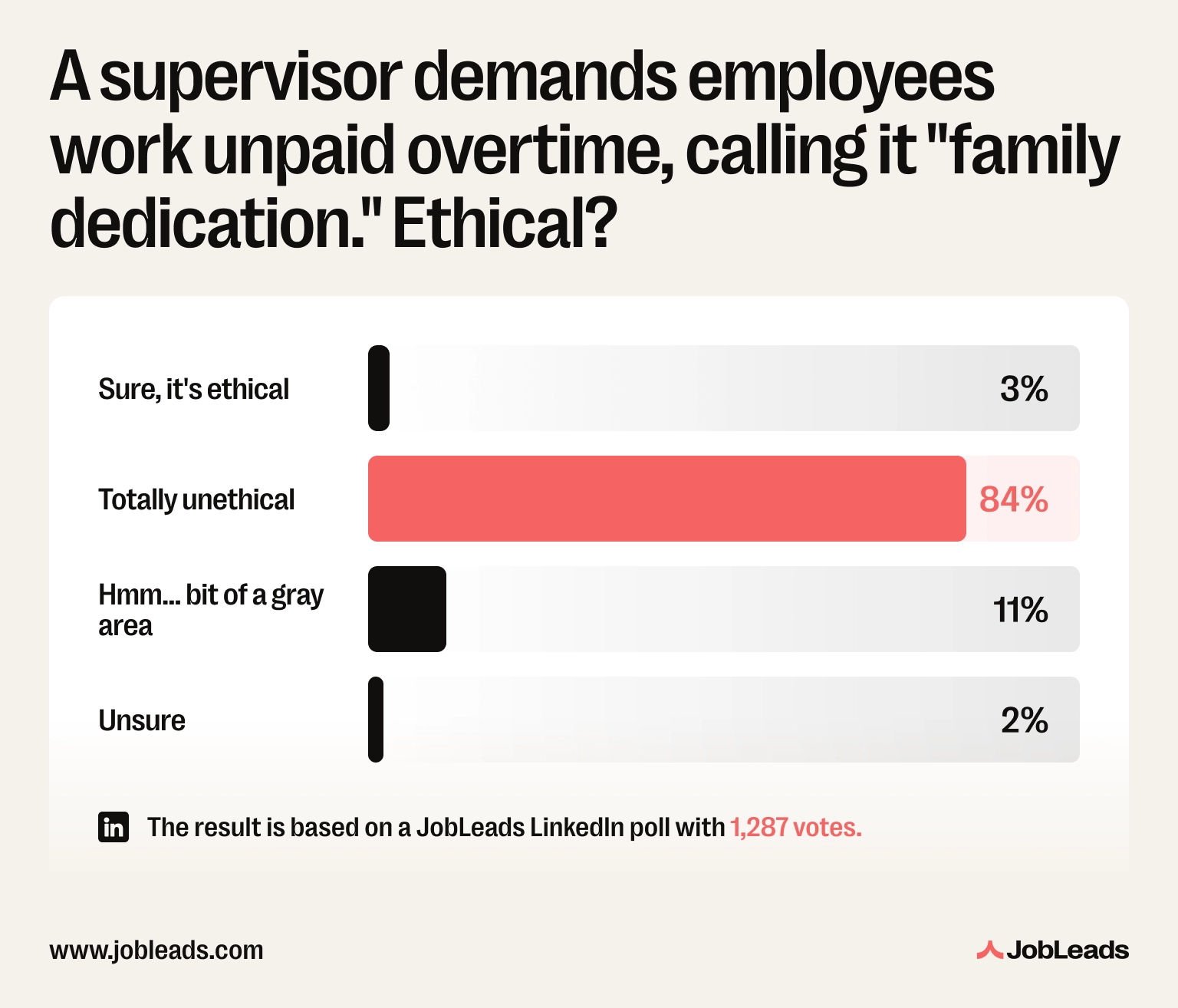
Try to identify the source before you leave. Document specific incidents, including dates, what happened, and how it affected you. For example, JobLeads study found that 84% of people think it's unethical for a supervisor to demand employees work unpaid overtime, calling it "family dedication."
If something happens that you're uncomfortable with, talk to your manager or HR. If the situation doesn't improve within a defined timeframe, and your health is still suffering, that's your signal to start planning your exit.
Note
Example: Tom's anxiety had started bleeding into weekends. Checking Slack at midnight and dreading Mondays became his reality. Before deciding to quit, he documented three months of specific incidents and brought them to his manager in one direct conversation. His workload was restructured within two weeks. He didn't need to leave–he needed the conversation he'd been avoiding.
Read more: If a difficult manager is at the root of it, see this guide on dealing with a toxic boss before you decide the whole job is the problem.
Sometimes the signal isn't emotional–it's physical. Headaches that show up every Monday, a flare-up of a condition that calms down on vacation, sleep that never really recovers. When your body is the one raising the alarm, the stakes are different, and so is the calculus.
Physical health is non-negotiable. No job is worth long-term damage to your body. Chronic work stress has documented medical consequences.
A review of more than 600,000 people across 27 cohort studies by Mika Kivimäki and Ichiro Kawachi, found that job strain and long working hours raise the risk of coronary heart disease and stroke by 10-40%. The cost of staying, medically and financially, often exceeds the cost of leaving.
Verify the source first. Illness can have multiple causes, and attributing it entirely to work may not be accurate. A full picture from a doctor matters more than a hunch.
Moreover, financial instability, and the loss of healthcare coverage in countries without universal healthcare, can make leaving a health risk in itself. And sick leave may be available to you before resignation becomes the only option.
See a doctor first–both to treat the symptoms and to create a medical record you may need later. Document the connection between your health and your working conditions as it emerges. If your employer won't accommodate reasonable adjustments once you've raised the issue, quitting is a legitimate and defensible choice.
Tip
Ask your doctor to note explicitly in your file if they believe your symptoms are work-related. That record can matter later–for a disability claim, a workers' comp case, or simply your own certainty that you made the right call.
This is the scenario that scares people the most: no offer in hand and no safety-net job waiting, just the decision to leave and figure out the rest. It's also more common than most people admit. And it's not automatically reckless, as long as you go in with your eyes open.
Toxic or unsafe environments don't always allow for a leisurely transition. Searching for a job full-time, using a structured job search strategy, is more effective than squeezing it around a 40-hour week. You have the hours and the headspace a passive search doesn't.
Employment gaps are harder to explain than most people realize. Field-experiment research on hiring bias found that resume gaps of six months or longer cut callback rates by roughly 45%. It's also measurably harder to find work once you've left. In fact, analysis from the Federal Reserve Bank of New York found that employed job-seekers received about half of all job offers, despite submitting only 20% of applications.
Employers simply favor candidates who already have a job. Financial pressure during a search clouds your judgment, too, and makes you more likely to accept the wrong offer out of urgency.
A JobLeads survey found that financial survival is the biggest fear about the unemployment gap for 61% of professionals. So, if you don't feel financially ready to quit, then you're not alone.
Use the 3-month savings rule: don't quit until you have at least three months of living expenses saved. Line up references before you leave, while your manager still remembers you fondly. If you're genuinely in a situation you cannot stay in, prioritize your safety and manage the employment gap strategically rather than not leaving at all.

Not every reason to quit is dramatic. Sometimes it's just this: the work has stopped meaning anything, and every day feels like it's being subtracted from your life rather than adding anything to it. That's real. But it's also worth interrogating before you act on it.
"I hate my job, should I quit?" is one of the most common dilemmas. And hating your job isn't a trivial complaint. Disengagement actively damages your performance, your reputation, and your wellbeing over time.
Life is too short to spend 40+ hours a week doing something that makes you miserable, especially once it starts coloring how you show up outside of work too. And there are better opportunities out there that you simply won't find while you're too exhausted to look for them.
Make sure you're not confusing a bad quarter with a genuinely broken fit. The two feel identical from the inside. Hating one element, like the manager or the project, is different from hating the role or the company as a whole. And skill-building or financial obligations may mean the timing isn't right yet, even if the destination is.
Audit what exactly you hate: the role itself, your manager, the team culture, the company's direction, or the workload. If it's fixable, and worth fixing, try that first. If it's structural and unlikely to change, set a leave-by date and start looking. It's important as a deadline turns "I hate my job" from a feeling into a plan.
Note
Example: Jordan thought he hated his job until he mapped out what specifically wasn't working. It wasn't the company or the role. It was one difficult stakeholder relationship and a project that was almost finished. He gave it six more weeks. The dread lifted before the project even wrapped.
This scenario is often searched as "should I quit my job to be a stay-at-home mom". The math and the trade-offs below apply the same way whichever parent ends up staying home.
After tax and childcare costs, the net income from working can be surprisingly small. Sometimes it's even negative once you account for commuting, wardrobe, and convenience spending that disappears when one parent is home.
The early years of a child's life are irreplaceable, and some parents prioritize being present for them over anything a job can offer. Reducing external demands can also lower stress for the whole household, not just the parent who leaves work.
Career re-entry after an extended gap is genuinely difficult, especially in fast-moving industries where tools and expectations shift every year you're out. Financial dependency within a relationship carries real risk if circumstances change. And many people underestimate the identity shift involved in leaving work, along with the social isolation that can come with it.
Run the full financial model, not just the surface-level comparison. Explore part-time, remote, or flexible options first. Make the decision together with your partner, with a clear, shared understanding of what returning to work would actually involve.
Note
Example: Maria and her partner analyzed her full financial picture before she quit. This included long-term earnings, pension contributions, and re-entry prospects, not just childcare costs vs. salary. Since her take-home barely exceeded childcare costs, she negotiated a part-time contract instead, keeping her foot in the door while halving her hours.
Leaving a stable paycheck to build something of your own is one of the most tempting scenarios. And one of the easiest to get the timing wrong. The decision usually comes down to how much you've already proven, not how excited you are.
Building a business alongside a demanding full-time job is genuinely hard. Focus matters, and divided attention shows up in the quality of both. Also, there's a momentum cost to treating your business as a side project indefinitely because some opportunities are time-sensitive and require full commitment to capture. If you've already proven demand, delaying full commitment can cost you the window.
According to the U.S. Bureau of Labor Statistics, 20% of new businesses fail within their first year, and nearly half fail within five. Your job income de-risks that period significantly while you validate the model, acquire first customers, and reach proof of concept. Quitting before you have product-market fit adds financial pressure that distorts your decision-making. You start optimizing for cash flow instead of the right long-term bet.
Validate with real revenue before you quit–not interest, not pre-orders, actual paying customers. Aim for six months of runway. Set a milestone trigger instead of a feelings-based one. For example: "I'll leave my job when the business generates $X for three consecutive months." That removes the emotional component from the timing decision entirely.
Note
Example: Jessica wanted to leave her marketing job to build a subscription box business. Instead of quitting first, she ran it nights and weekends for eight months, until it generated $2,400 for three consecutive months. Only then did she hand in her notice, with six months of runway already banked.
Read more: Does job hopping actually pay? A new survey has the answer.
Legally, in most jobs without a fixed-term contract, yes. Whether you should is a different question. And the answer depends almost entirely on why you're in a hurry to leave.
Hostile or psychologically unsafe workplaces don't always give you the luxury of a graceful exit. If your health or safety is at immediate risk, leaving without notice is justified as no job is worth that trade-off. Constructive dismissal, where an employer's behavior makes continued work genuinely impossible, is a legitimate reason to leave immediately too.
Your professional reputation follows you, and burning bridges in a small industry has consequences that outlast the job itself. Moreover, references from previous employers carry real weight in hiring decisions–often more than candidates expect. On top of that, in many countries and contracts, notice periods are legally binding, so leaving without one can carry financial or legal consequences.
Check your employment contract first so you actually know what you're obligated to do. If you must leave immediately for safety or health reasons, document those reasons in writing as you go. In most cases, a professional exit protects you far more than walking out does.
Wanting to see the world or just step off the treadmill for a while is a legitimate reason to consider quitting. But travel is also one of the easier motivations to romanticize. It's worth being honest about what you're moving toward, not just what you're moving away from.
Extended travel genuinely changes perspective, and some experiences are only available at certain points in life. Before kids and mortgage or before your parents need more of your time. Proper recovery sometimes requires more than a two-week holiday can offer. And remote work has made re-entry more feasible than it was a decade ago, softening the career risk considerably.
Employment gaps for travel are harder to frame positively in an interview than gaps for study or caregiving. The financial cost of extended travel is consistently underestimated, especially with no income coming in behind it. And "travel will fix things" is sometimes avoidance in disguise as the problem you're running from tends to still be there when you land.
Try to negotiate unpaid leave or a sabbatical first. Many employers will agree if you simply ask, and it costs you nothing to try. Also, set a clear budget and timeline before you go, not once you're already there. Last but not least, have a concrete re-entry plan, not just "I'll figure it out when I get back."
Going back to school full-time is one of the few scenarios in this guide where the math can be genuinely clear-cut. Either the program requires it, or it doesn't. The harder part is usually the financial planning underneath the decision, not the decision itself.
Academic performance genuinely suffers when combined with full-time work, especially in demanding programs with heavy coursework. Some degrees and qualifications require full-time enrollment as a condition of the program itself. And the investment in education is more likely to pay off if you can commit to it fully rather than splitting your attention.
Many programs offer part-time, evening, or online formats designed specifically for working professionals–check before assuming full-time is your only option. Employer tuition support and study leave are both underused benefits and it's worth asking even if it's never been advertised. Keep in mind that student debt without income behind it is a significant financial risk that's easy to underweight in the excitement of a new direction.
Explore employer education benefits first. Some companies will fund courses or reduce your hours rather than lose you entirely. Consider whether a part-time program could get you to the same outcome.
Only quit outright if the program genuinely requires it and you have the financial runway to manage without income during your studies.
There's no universal answer to "should I quit my job?"–but there is a reliable process for finding yours.
Always start with the five diagnostic questions:
From there, the specific scenario matters. And each comes with real arguments on both sides. The right call depends on your specific mix of health, finances, and timing, not a one-size-fits-all rule.
If you've worked through this guide and landed on yes, the next step is making sure you don't trade one wrong-fit job for another. JobLeads matches you with roles that fit your skills, salary expectations, and priorities, including remote and flexible options. Moreover, JobLeads' career experts can help you figure out what "better" actually looks like before you start applying.

Content & Insight Writer
Beata creates content that puts job seekers first. From practical blog advice to first-hand research studies, her writing is designed to give people the clarity and confidence to find the role they deserve.
Career DevelopmentDiscover the pros and cons of working from home. Learn how employees and employers benefit from remote work and the challenges they encounter.
 Career Development
Discover large companies with remote jobs that are worth looking into. Learn which big companies hire remote and which have it engraved in their policy.
 Career Development
Learn how to practice workplace mindfulness effectively. Discover research-based exercises and benefits it provides for employees and employers.