
 Job Market Trends
April 21, 2026
The Salary Gap: 99% of Applicants Expect More Than Market Offers
JobLeads study on 811K job postings and 245K professionals reveals the differences in workers' salary expectations and wages offered by employers.


Classic career advice assumes ambition points upward. New JobLeads data suggests that in the 2026 job market, the opposite is happening.
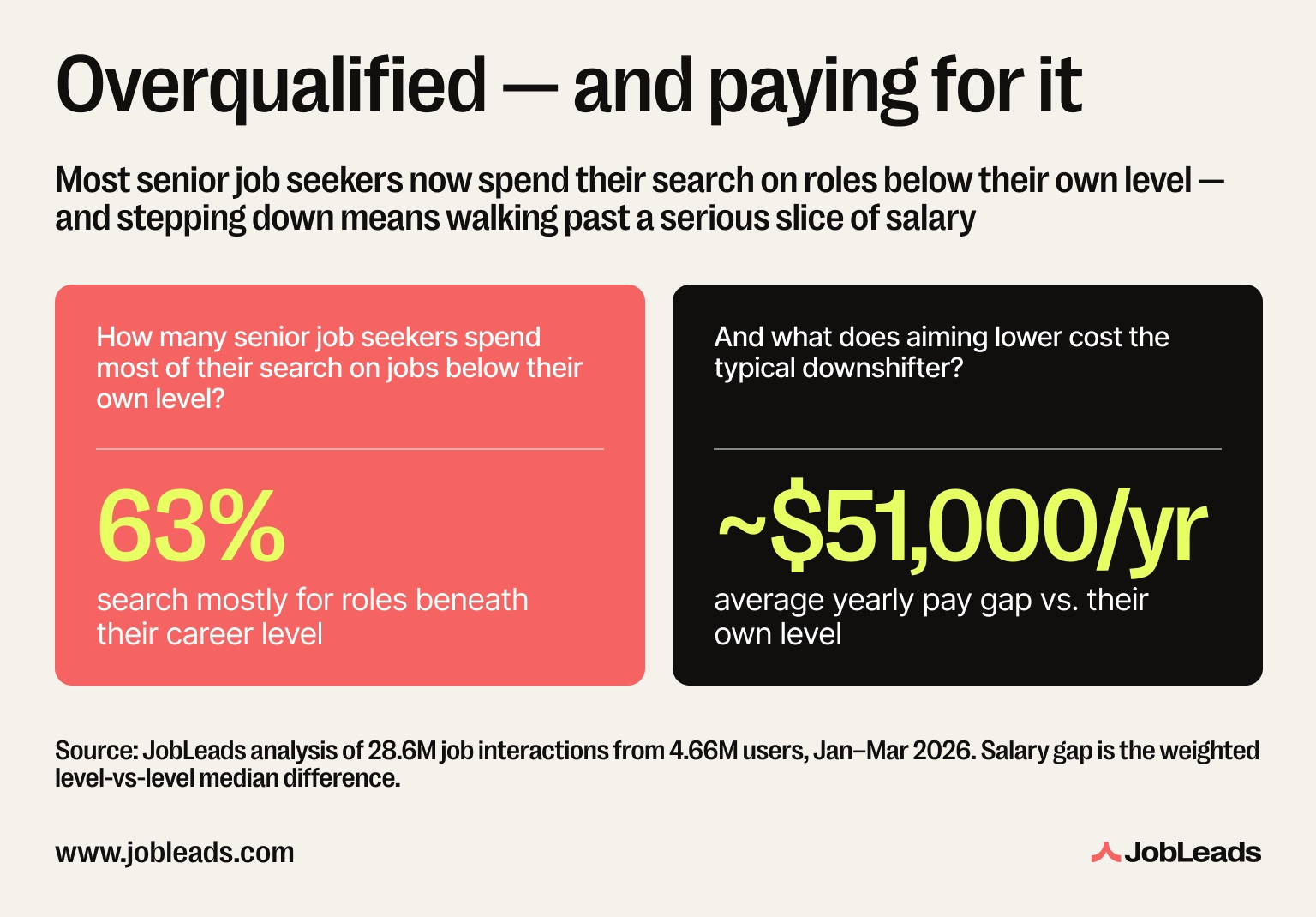
JobLeads analyzed more than 28 million job interactions, comparing each job seeker's own career level against the level of the jobs they engage with. Among US senior job seekers, 63% spent most of their search on roles below their own level–in other words, applying to jobs they're overqualified for.
As senior openings thin out and searches stretch longer, the career ladder is increasingly running one way–down.
Let's dive into the data:
Being overqualified for a job means the candidate's experience or seniority sits above what the role asks for. And in 2026, that's increasingly where senior candidates spend their search.
Senior workers are struggling to find positions that match their level of skill and experience. And this leads to 63% of senior job seekers spending most of their job search on roles they're overqualified for.
And the cost is not small: there is more to lose than growth, career development, or a shiny new title. According to JobLeads' data, the lower-level roles a candidate pursues pay, on average, about $51,000 a year less than roles at their own level. Over a two-year stretch in lower-level roles, that approaches six figures in forgone earnings.
The reason isn't hard to locate: there simply aren't many senior jobs to apply to. Senior-level roles make up roughly 14% of US postings, according to Indeed, while mid-level accounts for 40%, and entry-level 46%. Experienced candidates are competing for a narrow band of openings. With layoffs impacting about 823 people in the US daily in 2026 (Trueup) and an average job search taking as long as 5 months (United Way NCA), downleveling is a natural response to the state of the job market.
Is there movement in the opposite direction, i.e. candidates applying to higher-level roles en masse?
Not really.
Roughly 86% of Specialist clicks land on jobs of the same level or lower, and only about 14% reach above. What little reach-up exists is short-range: around 7% of clicks go to Team Leader roles and 3% to Head of Department. About 2.5% of clicks go to higher-level Project Management roles. The Vice President and Managing Director together account for barely 2% of clicks.
Climbing the career ladder is harder than ever. The movement for job seekers is mostly horizontal–changing employers, industries, and roles without landing on a higher level. Growing as a professional horizontally is becoming the default direction of travel.
And a popular alternative, it seems, is to move down a level.
The intuitive assumption is that downleveling is a junior or mid-career problem, something people do while establishing themselves, and grow out of. But the data points the other way.
Downleveling is lowest at the entry management level, where 52% of Project Managers search mostly below their own level. It rises through Team Leader (59%) and holds roughly flat at Head of Department (57%). Then it breaks: 75% at Vice President, and 79% at Managing Director. Nearly four in five of the most senior job seekers spend most of their search on roles below their level.
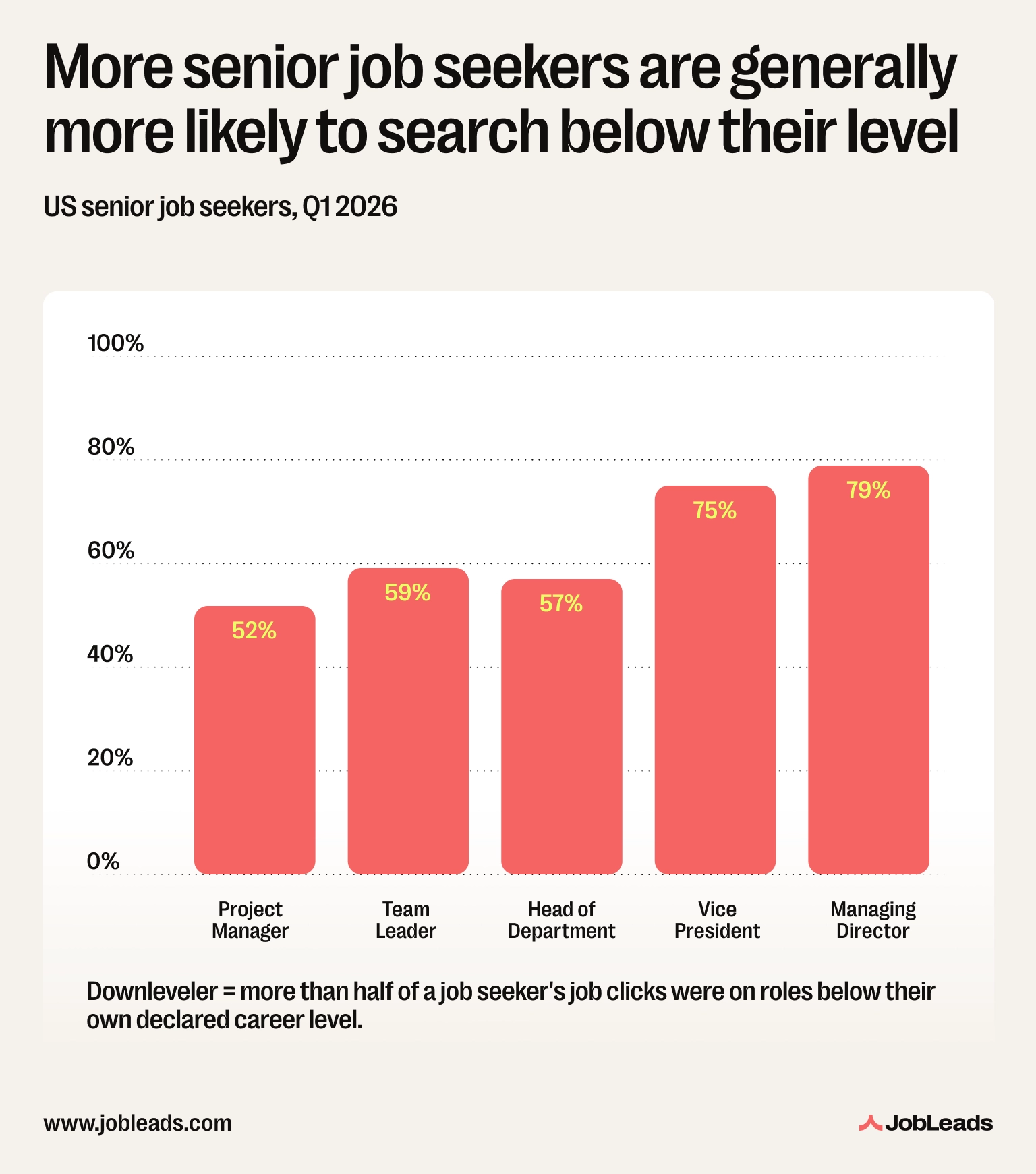
The higher the level, the fewer jobs exist, and the requirements become hardest to meet. Things get even more complicated considering that as many as 45% of senior management positions are filled through internal hiring rather than publishing a job ad (JobLeads' research).
Downleveling is not a single-industry quirk: it's not just tech after the layoffs or media. In fact, every industry shows a majority of senior job seekers searching below their own level.
The range is narrow. Human Resources (74.4%) and Bio, Pharmacology & Health (74.2%) sit at the top, effectively tied. IT & Technology (73%), Finance (71%), Consulting (71%) and Legal (70%) cluster just behind. Sales, Engineering and Marketing & Media land in the high sixties. Last but not least, Management & Operations is at 62%.
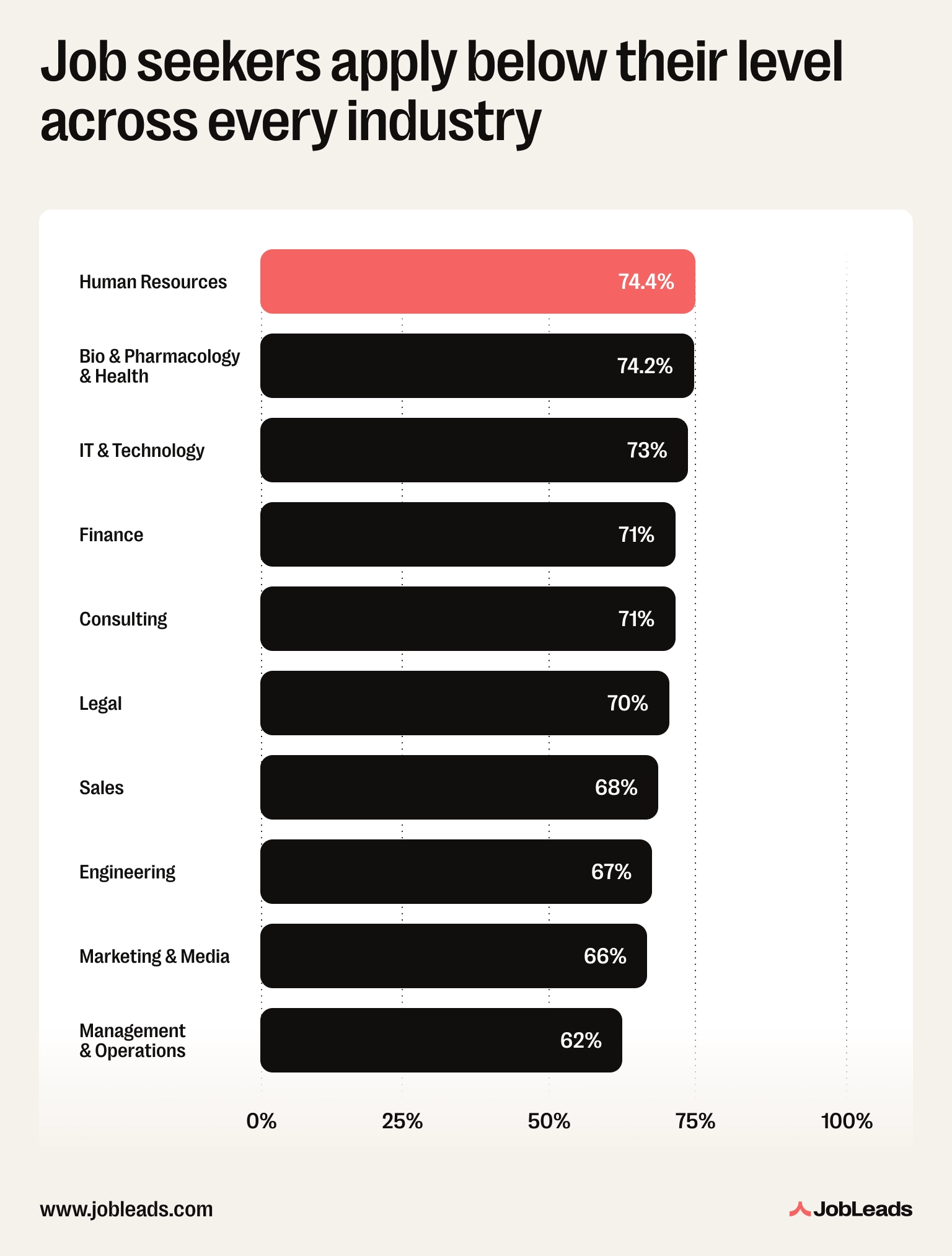
The bottom 62% is an instructive number. Management & Operations carries more management-track roles than any other category on the platform, which means senior job seekers have more at-level openings to find. It has the lowest downleveling rate precisely because it has the most senior opportunities available.
So, whatever is pushing experienced job seekers downward is not something happening inside one industry but a feature of today's labor market as a whole.
At first glance, it might seem that downleveling is the problem of those out of work. Unemployed people take what they can get, even if their searches have to point downward. The data doesn't support that reading.
According to the data, losing a job makes downleveling somewhat more likely, but doesn't cause it.
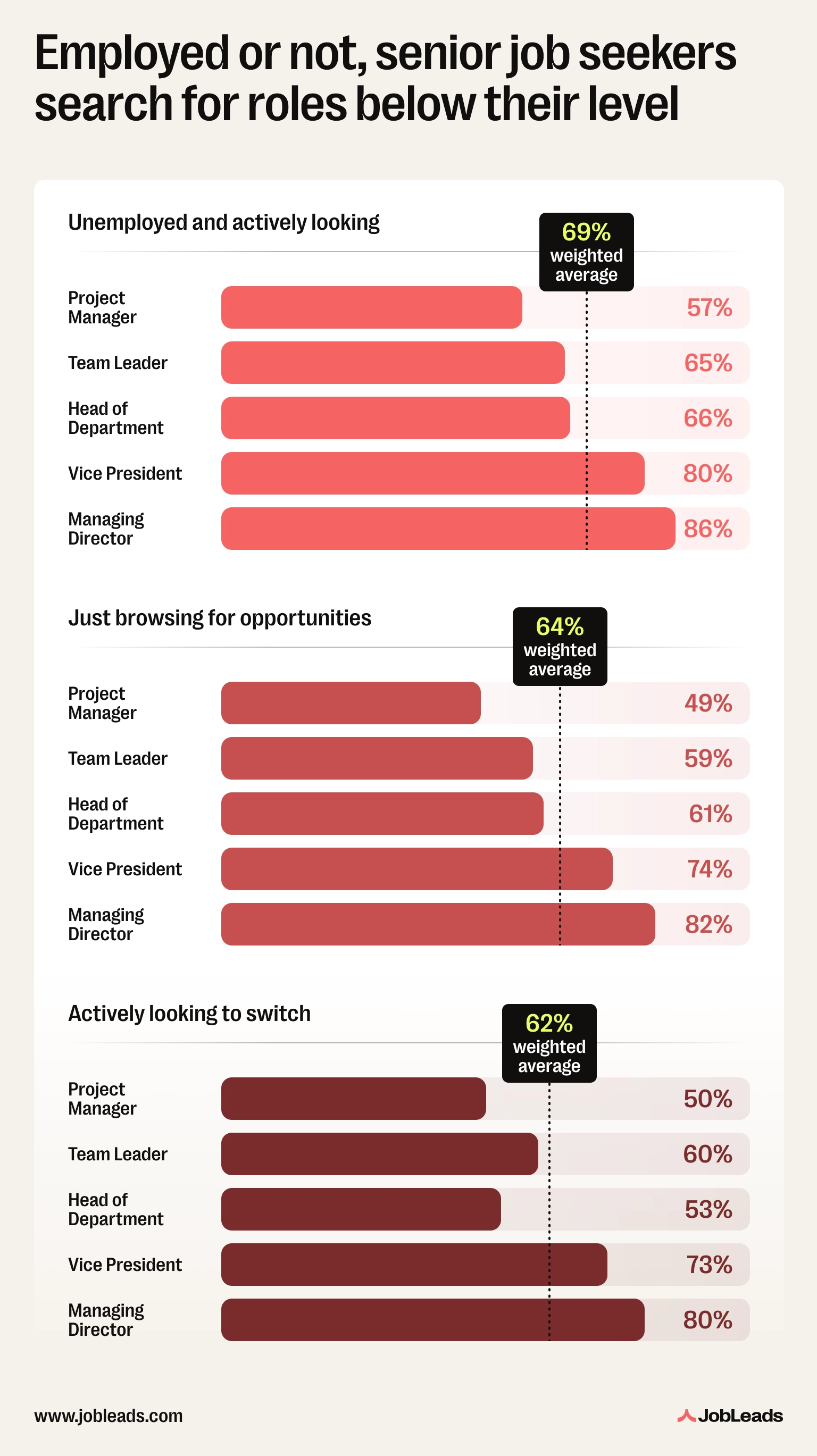
Among senior job seekers who declared their employment status, downleveling is highest for those unemployed and actively looking, at roughly 69%. But those still in a job aren't far behind at roughly 63%, including people who described themselves as only casually browsing for opportunities. At Managing Director level the two groups nearly converge: 86% of unemployed senior job seekers downlevel, and 82% of those just browsing do the same.
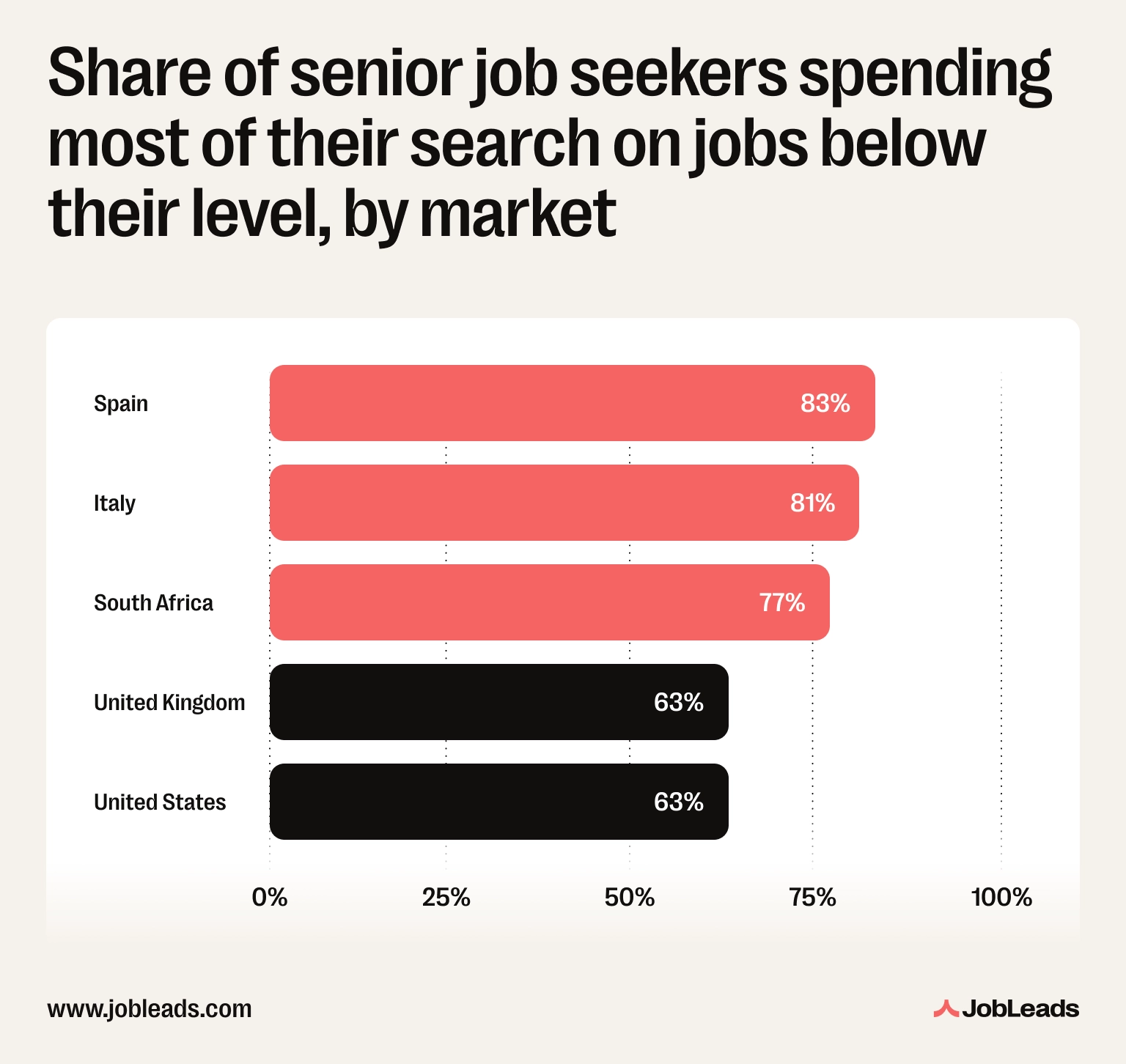
The tendency to downlevel is not just a US story, either. To test whether this is a structural issue, JobLeads applied the same analysis to five more markets.
As it turned out, downleveling is not just a feature of the American labor market. Spain records the highest share at 83%, followed by Italy (81%) and South Africa (77%), with the UK and US tied at 63%.
Downleveling isn't automatically a mistake. It's a decision that you need to weigh carefully. Four things worth settling first:
There is a line between using a transition to escape a bad current role and moving deliberately toward what you actually want next. And if a lower-level role genuinely is the target and a strategic step in your career, that's a reasonable thing to pursue.
JobLeads data puts the average cost of downleveling at about $51,000 a year. Over two years, that approaches six figures. Of course, averages don't tell individual stories. Agree with yourself on the number you are ready to accept and try to learn what companies can offer you as soon as possible to avoid surprises at the offer stage.
When a recruiter uses the word, it is often a soft rejection meaning they have concerns that you'll be bored, expensive, or gone as soon as something better appears. Unfortunately, it can also function as coded language for age bias, with candidates told they're overqualified if they are, for example, over 50. Anticipate the objection and prepare your response.
HR practitioners advise acknowledging the seniority gap directly and then explaining why it can benefit the employer. Don't leave it unexplained at the interview.
Downleveling is becoming the norm among experienced job seekers: 63% of US senior job seekers spend most of their search below their own level, rising to 79% at Managing Director. It is also not confined to people out of work, and those still employed downlevel at roughly 63%, barely behind the 69% among the unemployed.
These patterns point less to individual choices and more to a structural job market issue and senior tier that has become too small to absorb the people qualified for it. Which is why the decision worth making deliberately isn't whether to aim lower, but how much lower, and for how long.
This analysis draws on 28.6 million job interactions from 4.66 million JobLeads users active between 1 January and 31 March 2026. The United States is the primary market, with Spain, Italy, South Africa and the United Kingdom used for comparison.
Salary figures are structural gaps, not individual outcomes: for each level JobLeads takes the median employer-reported salary band, and the ~$51,000 figure is the weighted average gap between each downleveler's own level median and the Specialist-level median. It reflects the pay difference between levels, not any individual's realized pay cut.
Limitations: JobLeads observes clicks and applications, not hires, offers or salary negotiations, so this describes search behavior rather than employment outcomes; and it is not direct evidence that any individual ended up in a lower-level role. Career levels are self-declared and treated as fixed for the quarter. Employment-status findings use the 14% of users who declared an employment status at onboarding. Industry figures count a job seeker once per industry they interacted with, so users appear in more than one and the figures do not sum.
The data, findings and graphics in this report may be reproduced freely for non-commercial purposes, including news coverage and editorial commentary. We ask only that you credit JobLeads and link back to this page, so readers can see the methodology. Journalists who need additional cuts of the data, the underlying figures behind any chart, or expert comment can contact us at press@jobleads.com.

Digital PR & Content Marketing Manager at JobLeads
Maryia leads digital PR and outreach at JobLeads. Her work has earned coverage in Fast Company, AOL, Forbes, Fortune, Quartz, and ZDnet—and she specialises in building the systems that make that happen at scale.
Job Market TrendsJobLeads study on 811K job postings and 245K professionals reveals the differences in workers' salary expectations and wages offered by employers.
 Job Market Trends
JobLeads analyzed 1.2 million entry-level job listings to find what skills employers request most. Learn what entry-level jobs actually require, pay, and offer.
 Job Market Trends
JobLeads analyzed 55M US job ads. The more buzzwords and clichés a listing uses, the less it pays–nearly 18% below clean postings.