In this economy, leaving your job might feel too risky. And if that's the only reason you stay, that's job hugging, not choice.
And staying is not automatically a mistake. The real question is whether you're making a conscious choice or quietly drifting.
In a JobLeads survey, only 17% said they were truly happy with their current employer. Moreover, about 41% said they're having more bad days than good, or are openly hoping to quit.
This means you're not alone and there are a lot of people staying put without actually wanting to be there.
Key takeaways
Job hugging is fear-driven staying, and it's common as 85% of workers admit they've done it at least once (Monster)
JobLeads survey found that only 17% are truly happy with their current employer
Staying can be rational short-term but it becomes costly when it turns into unexamined drift
The MetLife Study found that while 77% of employees intend to stay with their employer, over 56% are staying out of necessity rather than genuine commitment
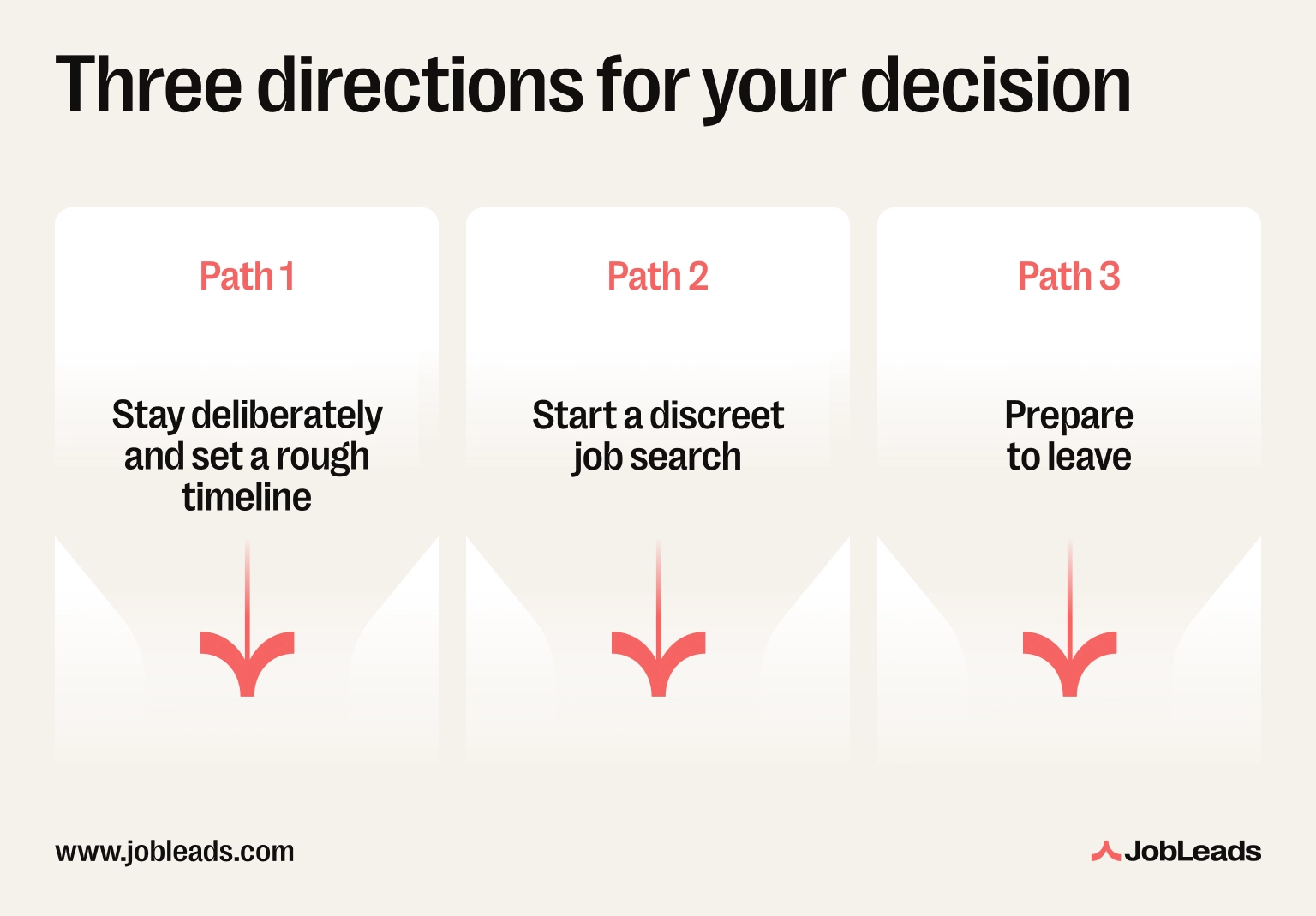
You have three paths forward: stay deliberately, start a discreet search, or prepare to leave
The term is new but the behavior has been around for a while now.
Korn Ferry coined the phrase in 2025. As hiring cooled and voluntary quits dropped from their Great Resignation peak, employees started holding onto their jobs for dear life. It caught on because it put a name to a phenomenon of staying not out of satisfaction, but out of fear.
Be careful with that definition. Not everyone who stays in an imperfect job is job hugging.
If you're building toward something in your current role, learning, advancing, banking savings for a planned move, you're not hugging–you're strategizing.
Job hugging is the version where the job has stopped working for you or there's a toxic workplace,or you’re struggling with a bad boss, yet leaving feels too risky to attempt. So you stay.
The difference comes down to one word: examination.
Deliberate staying
Job hugging (drift)
Why you're staying
A reason you can say out loud
"It's just safer"
Timeline
You have one, even a rough one
Indefinite
Review date
You check in with yourself
You avoid the question
Feeling
Grounded, even if not thrilled
Quiet dread on Sunday nights
A quick self-test: could you explain to a friend, in one sentence, why staying is the right call for you right now? If yes, you've made a choice. If the honest answer is "I don't want to think about it," that's a drift.
Fear-based staying is more common than most people admit at work. A JobLeads survey found only 17% of professionals are truly happy with their current employer. And separately, the MetLife study found only about 18% plan to stay because they truly want to–31% say a primary reason for staying is that the uncertain labor market makes it too risky to leave.
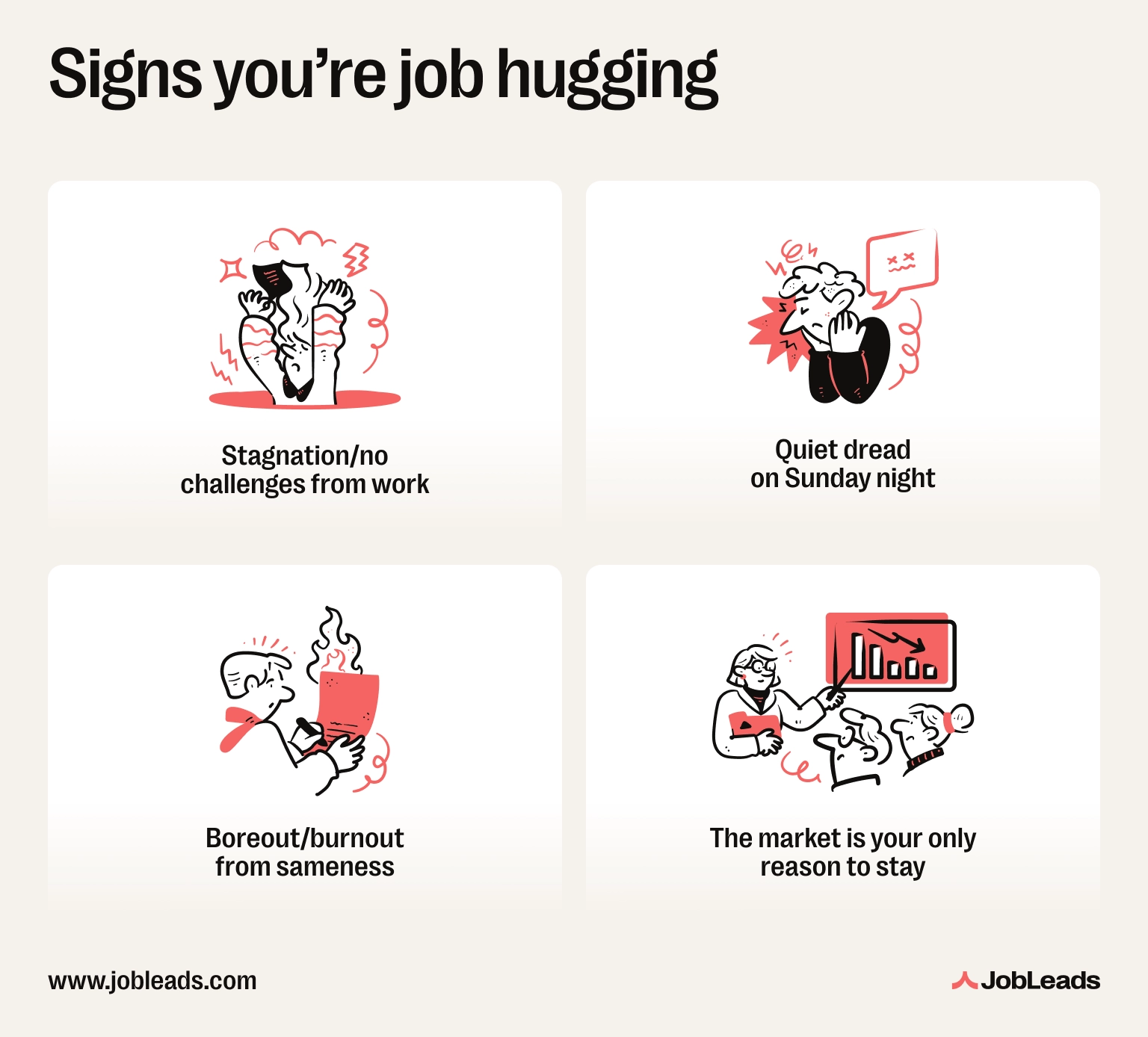
How do you know if it's you? The classic signs it's time to leave your job overlap heavily with the signs you're job hugging:
Stagnation: you can't remember the last time you learned something new or took on work that stretched you
Quiet dread: you're not miserable enough to quit, but Sunday evenings have a weight to them
Burnout from sameness: not the overwork kind, the erosion that comes from doing the same thing without change or recognition. In the Monster survey, workers named burnout from lack of change among the top risks of job hugging.
The market is your only reason: when someone asks why you stay, your answer is about the economy, not the job. It's not paranoia as a JobLeads poll found that about 49% of professionals said a mass layoff at their company felt likely or possible within six months.
One caveat before you spiral: ticking a box here doesn't mean you must quit. These signs mean it's time to run the decision, not hand in your notice.
Read more: If you're wrestling with the bigger question itself, our guide on should I quit my job walks through it properly.
Let's be honest about something the job hugging trend coverage often skips. Sometimes hugging your job is exactly the right call.
Quitting is never the default. Staying makes sense when:
You need financial security: if your emergency fund is thin or you're the sole earner, stability is not cowardice. It's math. It's also the single biggest fear job seekers name. In a JobLeads LinkedIn poll, 61% said financial survival was their biggest fear about an unemployment gap.
The golden handcuffs are real: unvested equity, a bonus that pays out in four months, a pension milestone, if you're staying for money, say so, to yourself, with a date attached.
Your industry is genuinely frozen: market timing matters, and waiting out a cold stretch in your sector can be strategic.
Life is full elsewhere: caring for a parent, a new baby, a health issue, a predictable job that funds a demanding season of life is doing its job.
And don't let headlines make the decision for you. You may have seen claims that staying now pays better than switching. That didn't last long as by June 2026 wage growth for job switchers was back ahead of job stayers, at 4.1% versus 3.4% (Federal Reserve Bank of Atlanta). The relationship flips over time and varies by industry and role level.
Translation: decide based on your situation, not this quarter's chart.
Here's the framework that separates conscious choice from drift. Career coaches frame the core question this way: the key is figuring out which risk feels bigger, staying stuck or making a move.
There are three paths forward. Three directions you can move between as circumstances change.
Staying is a legitimate choice. But make it a choice, with three components:
A reason you can state in one sentence ("I'm staying until my equity vests in March" or "I need 12 more months of savings")
A timeline, even a rough one
A review date when you'll ask the question again
That last one is the difference between strategy and drift. A useful habit some coaches suggest: check in with yourself roughly every 90 days. Treat that as a suggestion, not a rule, the point is that the decision has an expiry date, after which you re-decide.
While you stay, keep growing where you are: volunteer for a stretch project, keep your skills current, keep your network warm. A deliberate stayer treats the job as a base, not a bunker.
This is the middle path, and for most job huggers it's the most useful one. You don't quit. You don't even commit to leaving. You simply start gathering information and sending applications while employed.
A discreet job search strategy lowers the exact risk that's keeping you frozen. You find out what the market actually looks like for someone with your skills, instead of guessing from headlines. And if the answer is "not much out there right now," you've lost nothing, you're back on Path 1, with better information and a clearer conscience.
When JobLeads asked professionals whether it's time to go if a job they once loved starts to drain them, the top answer wasn't "get out now." Over 60% said "yes, but plan the exit first." That's the whole philosophy of this path in one poll.
Sometimes the review comes back with a clear answer: the role is actively harming you, your health, your skills, your confidence, and the risk of staying now outweighs the risk of moving.
Even then, "prepare" is the operative word. Build the runway before you jump:
Set a savings target that covers a realistic search period
Update your resume and LinkedIn before you need them
Line up references while relationships are warm
Set a departure window, not an impulsive exit date
Leaving with a plan is not the same as fleeing. And when the time actually comes to hand in your notice, how you quit matters too as references outlast the job.
Job hugging isn't a character flaw, and it isn't automatically a mistake. It's the default. The thing that happens when nobody makes an active decision.
So–make one.
Stay deliberately, with a reason you can say out loud and a date to revisit it. Start a discreet search, quietly, so the risk that's freezing you gets replaced with actual information. Or prepare to leave, on your terms, with a runway built before you jump. All three are legitimate. The only wrong answer is staying because deciding felt harder than not deciding.
Whichever path you're on right now, put a date on your calendar. Not to force a change, just to force a check-in. That single habit is the difference between a job you're choosing and a job that's choosing you.
Ready to see what's out there without the risk?
Browse open roles quietly and sign up to JobLeads to get matched with a better fit.
Beata creates content that puts job seekers first. From practical blog advice to first-hand research studies, her writing is designed to give people the clarity and confidence to find the role they deserve.
Frequently asked questions
Not automatically. Staying for financial security, market timing, or life circumstances can be entirely rational. Job hugging becomes a problem when fear keeps you in an unsatisfying role without a deliberate reason, a timeline, or an exit plan.
Korn Ferry introduced the phrase in 2025 to describe employees clinging to their roles amid a cooling job market. It emerged as a kind of mirror image of the Great Resignation–instead of quitting in waves, workers were holding on tight.
There's no fixed number, and anyone who gives you one is guessing. A more useful measure is whether you're still making progress on your stated reason for staying. One practical rule of thumb: review the decision roughly every 90 days. If a year has passed and you've made no progress toward your timeline, no savings built, no skills added, no search started, you've likely drifted from strategy into complacency. That's your cue to run the three-path decision again.
Quiet quitting is about doing the minimum at a job you're still actively working–pulling back effort while staying employed. Job hugging is about staying in the job itself, often even when you're unhappy, because leaving feels too risky.
Yes. Multiple recent surveys show the trend holding steady or growing, tied directly to hiring pace and voluntary quit rates. As long as hiring stays cautious, expect it to stay common.
Job hopping sits at the other end of the spectrum. It's about moving between roles relatively frequently to chase pay, title, or opportunity.
In aggregate, yes–quit rates have fallen well below their Great Resignation peak, and job-hopping frequency has slowed accordingly. But "replacing" doesn't mean job hopping disappeared: the average calculation has just shifted from "what can I gain by moving" to "what do I risk by moving."



 Career Development
