
 Job Market Trends
July 31, 2026
The 6-Figure Jobs Most Seekers Overlook [Study]
JobLeads analyzed over 53 million active postings globally to find which industries, countries, and roles have the most 6 figure salaries jobs.


Volkswagen is preparing one of the biggest restructurings in its history. Squeezed by a sales slump in China and rising costs, the carmaker has planned cutting up to 140,000 jobs. Workers are expected to confront CEO Oliver Blume over the project at staff assemblies in late August 2026, and it is not yet finalized at the time of writing.
But what kind of jobs are actually on the line? Has Volkswagen been hiring for outdated skills and now pays the consequences?
To find out, we analyzed more than 100,000 job ads from six major automakers over 24 months–Volkswagen, Tesla, BMW, Mercedes-Benz, GM and Toyota. This article focuses on the findings from the US and Germany. Compared with its rivals, Volkswagen's roles say a lot about where the automotive industry is heading.
If a company is about to shed tens of thousands of jobs, one would expect its hiring to have already dried up. Volkswagen's job ads show the opposite.
In the year before the cuts were announced, VW advertised 18% more jobs in Germany (from roughly 1,025 to 1,214 distinct roles) and 22% more in the US. And it wasn't alone: for example, BMW's German postings climbed even faster. Across the industry, the appetite to hire was still there.
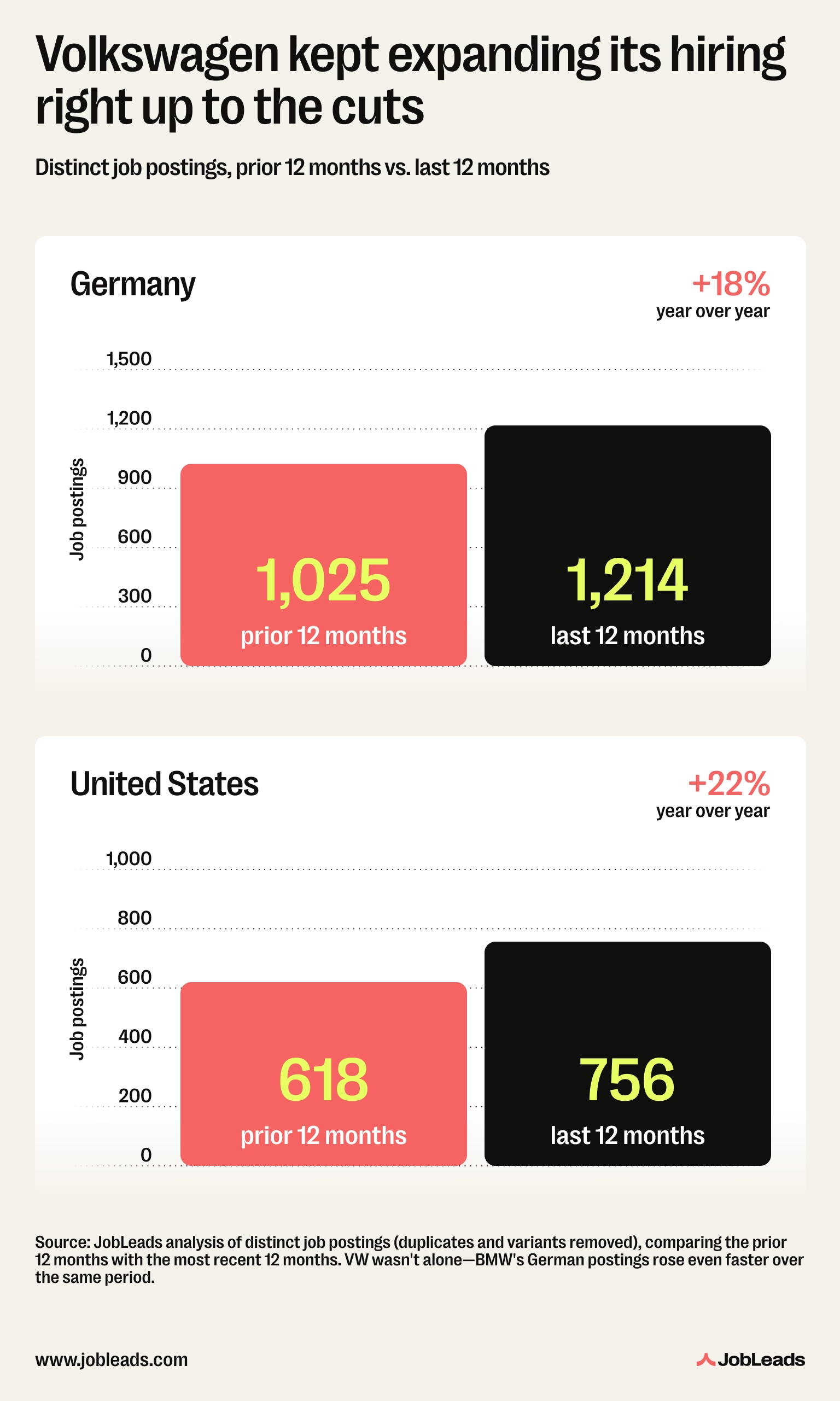
That sits awkwardly against the bigger picture. Germany's car sector lost nearly 50,000 jobs in 2025, according to the industry association VDA. So how can both be true? Job ads capture hiring activity (the roles a company is chasing right now), not its total headcount. A company can trim staff in one area while still recruiting in another.
That's exactly what makes the timing striking. Right up to the announcement, Volkswagen was advertising like a company leaning in, not one about to cut up to 140,000 jobs. Its job ads showed no slowdown or possible hiring freeze, and then came the news about one of the largest restructurings in its history. Whatever forced the decision, this wasn't a company that had already quietly stopped hiring.
By looking at the data, an educated guess can be made that the jobs on the line are not exactly lower-paid ones.
At first glance, VW might look like a budget payer: its overall median advertised salary in Germany sits well below Tesla's. But that gap is misleading. German automakers advertise far more trainee and entry-level roles than Tesla does, and those postings drag the raw numbers down.
Compare the same jobs–engineering to engineering, IT to IT–and the picture changes. Excluding trainees, VW pays on par with Tesla in Germany. And the pay is even higher in IT: a median of €62,000 versus Tesla's €56,000, while matching it in production at €50,000.
The US makes the point even more clearly. There, trainee postings in automotive are rare, so raw and like-for-like pay line up. And VW advertises the highest engineering salary of all six automakers, a median of $95,800. Tesla still leads on software pay, but VW's roles sit in the competitive middle-to-top of the market.
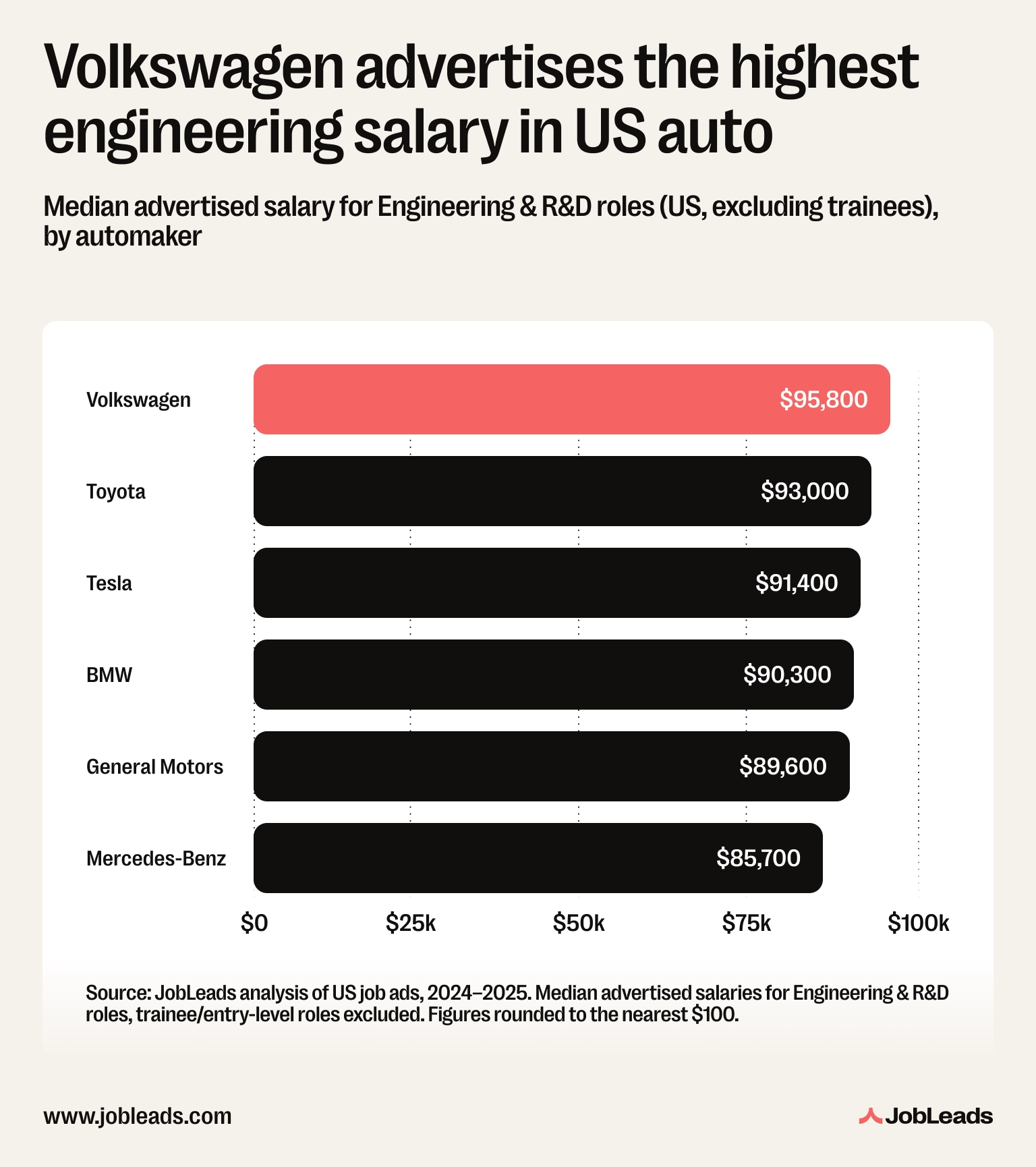
The jobs on the line aren't expendable or low-cost. They're the kind of well-paid, skilled positions employers usually compete to fill.
Where Volkswagen most clearly parts ways with Tesla is in what kind of flexibility its employees get.
In Germany, 51% of VW's ads offer hybrid or remote work–the most of any traditional automaker, and streets ahead of Mercedes-Benz (8%). In the US, VW is nearly as flexible at 42%, behind only General Motors. Tesla sits at the opposite extreme, staying at 97-99% on-site in both markets.
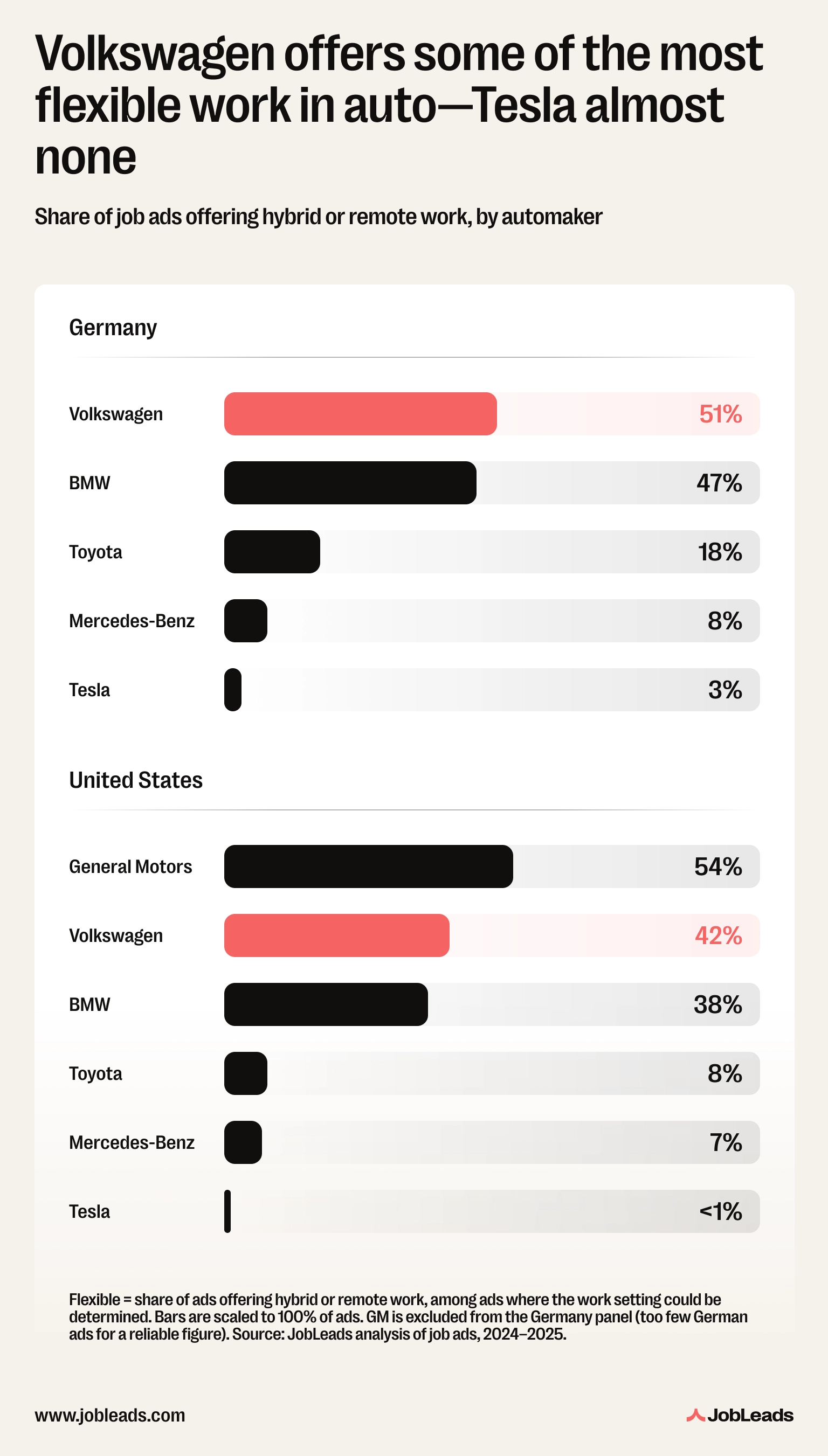
That gap isn't only about the type of work. Tesla's roles lean heavily toward manufacturing and factory engineering, which has to happen on-site–but it's also company policy. In 2022, Elon Musk told staff that anyone wanting remote work "must be in the office for a minimum of 40 hours per week or depart Tesla," adding that this was "less than we ask of factory workers."
The result is two opposing bets on the modern workplace. Legacy makers like VW increasingly compete for talent on flexibility, Tesla competes on pay and perks while holding the line on presence. For the workers whose VW roles are now at risk, that flexibility may be one of the hardest things to replace.
There's a comfortable story about the car industry: the legacy German makers are the old world, and something like Tesla is the future. The skills in their job ads don't bear that out.
In fact, Volkswagen asks for the same core skills as everyone else. Communication tops its list, appearing in about a quarter of its skilled German ads, and followed by analytical thinking (17%) and teamwork (15%). It's the very same mix that leads at Tesla, BMW and Mercedes-Benz.
That shared core is what punctures the "old-school" cliché. VW lists analytical thinking nearly twice as often as Tesla (17% versus 10%), and Python shows up in its ads in both Germany and the US, while it doesn't crack Tesla's most-requested skills in Germany at all. Tesla's German postings lean instead on communication, problem-solving and hands-on production.

The bigger point is transferability. Because VW recruits for the same core skills as its competitors, the people whose roles are now at risk are also the ones the rivals are trying to hire. The experience doesn't expire with the job.
Put together, the picture is not one of a company weighed down by outdated, overpaid jobs. The roles in Volkswagen are well-paid, flexible, and built on the exact skills its rivals are competing to hire.
That reframes the story from a company problem into an industry one. If these jobs are this competitive, the real question is where their people go next, and whether the rest of the auto industry can absorb them.
Will the cuts, once finalized, actually fall on these competitive roles, or on something else entirely? Will flexibility survive as automakers chase costs, or is hybrid work the next thing to go? And as the industry bets on electric drivetrains and software, will demand shift fast enough to rehire the very people being let go today?
The job ads can't answer those yet. But they make one thing clear: the challenge facing Volkswagen's workers isn't that their skills are obsolete. It's that, for now, there are too few seats for them.
This analysis draws on more than 100,000 ads from six automakers (Volkswagen, Tesla, BMW, Mercedes-Benz, GM and Toyota); this article analyzes the German and US subsets (~64,000 ads). Only manufacturing entities are included, and shares are based on distinct roles. Salaries are advertised medians, capped at the 95th percentile and shown in local currency, compared only within the same country and job function, with trainees excluded. Skills, benefits and work setting are AI-extracted from ad text. Roughly one in five ads are duplicates or variants (the rate varies by company); all counts in this article use distinct roles, with duplicates removed.
Limitations: These figures describe the jobs companies advertise, not actual headcount, hires or layoffs. AI-extracted skill comparisons are indicative, not exact. Tesla's ads left our feed after around May 2026, so we report no hiring trend for it.
The data, findings and graphics in this report may be reproduced freely for non-commercial purposes, including news coverage and editorial commentary. We ask only that you credit JobLeads and link back to this page so readers can see the full methodology. Journalists who need additional cuts of the data, the figures behind any chart, or expert comment can contact us at press@jobleads.com.

Digital PR & Content Marketing Manager at JobLeads
Maryia leads digital PR and outreach at JobLeads. Her work has earned coverage in Fast Company, AOL, Forbes, Fortune, Quartz, and ZDnet—and she specialises in building the systems that make that happen at scale.
Job Market TrendsJobLeads analyzed over 53 million active postings globally to find which industries, countries, and roles have the most 6 figure salaries jobs.
 Job Market Trends
JobLeads study on 811K job postings and 245K professionals reveals the differences in workers' salary expectations and wages offered by employers.
 Job Market Trends
AI skills are now required everywhere. We analyzed 110K job postings to understand what that means for salaries, career paths, and remote work opportunities.