
 Job Interviews
June 26, 2026
Remote Interview Tips: How to Ace Your Virtual Interview
Nail your next video call with our remote interview tips for candidates and recruiters. Learn how to prepare, what to say, and what mistakes to avoid.


You're outside the office 15 minutes before the interview holding a half-finished iced latte in your hand. Then you remember the viral TikTok. Could this cup cost you the job?
Short answer–probably not. But bringing interview coffee is a gamble on one person's taste. Most recruiters care far more about whether you're on time, focused and ready to answer.
This guide covers what recruiters really think about the iced coffee interview debate, the coffee cup test, coffee chat interviews and whether you should drink coffee before an interview at all.
The debate kicked off with a TikTok from Caitlin Wehniainen, a corporate recruiter with 16 years of Fortune 500 experience. Gen Z candidates who show up with iced coffee, she said, look "a little too casual." To her, it suggests the interview is just one stop on a list of errands.
The video racked up more than 25K likes and 6K comments as of today. Soon the iced coffee interview debate spilled onto LinkedIn, Reddit and the evening news.
Here's the part most of the coverage skipped–the recruiting world didn't line up behind her. Even Wehniainen later clarified that she never meant an iced coffee should decide whether someone gets the job.
Ashley Daugherty, market manager at Randstad Professional, put it plainly: "An iced coffee tells an interviewer very little about whether someone can do the job." Eric Turney, president of The Monterey Company, agreed: "I'm not going to pass on a great candidate over a Starbucks cup."
Others are more cautious. Megan Slabinski, a district president at Robert Half, said "an iced coffee alone may not make or break an interview." Still, she wouldn't recommend bringing one.
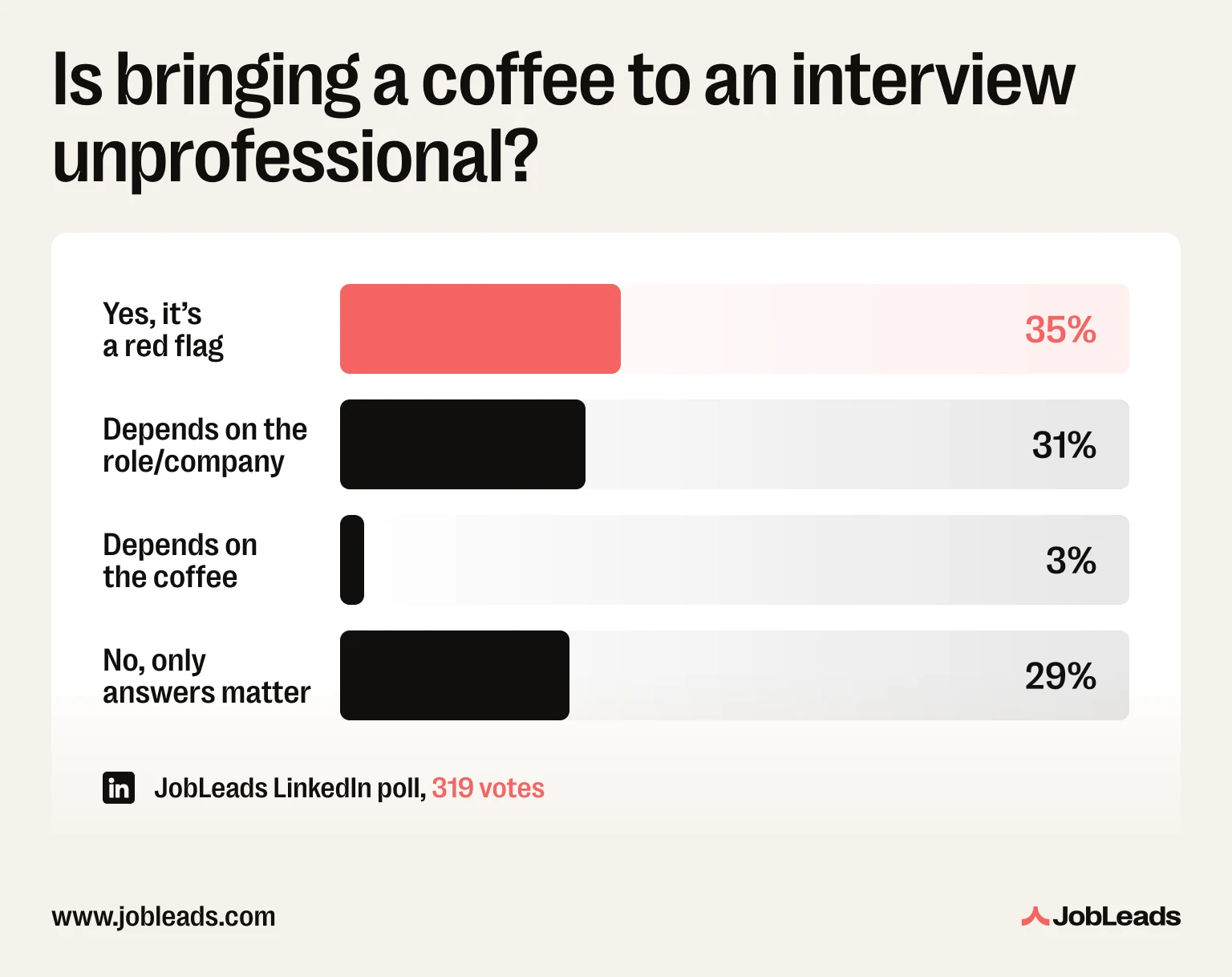
When JobLeads ran a survey, the result was a near-perfect split. About 35% said it's a red flag and about 29% said that only the answers matter.
So–if the experts can't agree on interview coffee, what's a nervous candidate supposed to do?
Stop looking for a universal rule. Look at your specific situation instead.
Not inherently. But bringing coffee to an interview does carry two kinds of risk, and only one of them is in your hands.
The first is practical. Etiquette expert Diane Gottsman says a drink in hand "signals both a distraction, a level of comfort and casualness." Picture it–a sweating plastic cup, a wet handshake and nowhere to set down your drink.
The second is subjective. One hiring manager reads your cup as casual. Another doesn't notice it at all. And you can't know in advance which one you'll meet.
Personally, I don't find it rude. I think this story really highlights the double standards we sometimes hold people to. For many, being caffeinated (sometimes a little too much) goes hand in hand with the hustle corporate culture—there are coffee breaks, coffee chats, paper cups in meetings, and whole-team coffee orders on busy days. This is also often visible in the media when portraying offices and workers. So the mental connection many make is that in the corporate world, coffee is everywhere.
Nathan Putsey – Talent Acquisition Manager at JobLeads
That's not a judgment about you. It's a judgment about them–you just happen to be holding the evidence.
Pro-tip
If having a drink during the interview calms you down and makes you more confident, let the interviewer know. Say that the drink is your way to keep the nerves down and they will likely be more understanding.
First impressions form fast. A Princeton study found that people judge traits like trustworthiness in about 100 milliseconds of seeing a face. And in a Robert Half survey of 300 hiring managers, nearly 32% said they form a first impression within five minutes of an in-person interview.
Anything in your hands is part of that snapshot. That's why the small stuff feels so loaded. But a snapshot isn't a verdict. Your answers, your examples and the questions you ask in an interview carry far more weight over the 45 minutes.
I've conducted hundreds of interviews (..) and I've never once rejected a candidate for bringing coffee into an interview. However, I have rejected people who act like they don't belong in the room. If you're interviewing in person, bring your coffee, but don't let it become a prop you nervously play with.
Rami Sneineh – Owner & Co-President, Insurance Navy
Read more: For real-life examples of interviews that went wrong (and what saved them), see the roundup of job interview mistakes.
This is where interview coffee gets most contested. The good news is that a few simple rules take most of the risk out of it.
Use this quick check before you walk in:
Right
Wrong
The second scenario is the real problem–and it has nothing to do with coffee. In fact, about 38% of US hiring managers say that lateness is the single biggest turnoff (Resume Genius). A coffee run that makes you late is a far bigger risk than the cup itself.
Pro-tip
If you're mid-coffee when you arrive, finish it outside and find a bin in the lobby. You get the caffeine, skip the gamble and walk in ready for the handshake.
Yes, if you want it. When the interviewer offers you coffee or water, it's hospitality, not a trap.
Accepting an offered drink is a completely different situation from bringing your own interview coffee. Many employers offer drinks to every candidate as routine, which rather undermines the idea that a beverage is unprofessional in itself.
Declining politely is just as fine. A simple "I'm okay, thank you" works.
The coffee cup test is an informal test some hiring managers use. At the end of the interview, they watch whether you offer to take your empty cup back to the kitchen.
The best-known version of the coffee test interview comes from Trent Innes, former managing director of software company Xero Australia. He'd walk candidates to the office kitchen for a drink, then watch what they did with the cup afterwards. To him, a "wash your coffee cup" attitude says a lot about culture fit.
Is that a fair way to judge a candidate? Debatable.
But the fix costs you nothing. When the interview wraps up, ask "Where should I put this?" It reads as considerate whether or not anyone is scoring it.
Right
Wrong
A coffee interview is an informal interview over coffee, usually in a café rather than an office. You'll usually meet one of three ways:
Many of these meetings are part of the hidden job market, where roles get filled through networking and referrals before they're ever posted.
Don't confuse a coffee interview with bringing a coffee to an interview–here, the drink is part of the plan. But the relaxed setting doesn't mean a relaxed interview. The questions are the same. The stakes are the same. Your preparation should be too. Have your elevator pitch for the job interview ready, because "So, tell me about yourself" often comes before the drinks do.
If the interviewer suggested meeting over coffee, order the coffee. Declining a drink in a coffee shop makes the setting awkward.
A few small adjustments help:
Who pays for a coffee interview? Usually the person who asked for the meeting. If you invited someone for an informational interview, offer to pay–you're the one asking for their time.
Pro-tip
Keep your phone out of sight. In a busy café, full attention is what makes you stand out.
Yes. This is the most relaxed of all the interview coffee scenarios. When it comes to drinks, the standard advice is simple–keep it nearby but out of the spotlight.
A mug on your desk is normal. What to avoid is the drink becoming an on-camera event:
On camera, every movement is magnified. The bar isn't "no drink." It's "no distraction."
If you are doing a remote interview, sip away, just make sure your cup is not in front of your face. And do not chug in the middle of your answer–that comes off as rude. At the end of the day, we hire people for their skills, not their caffeine preferences.
Alex Kovalenko – Lead IT Recruiter, Kovasys IT Recruitment
Read more: For remote interview tips that cover your setup, lighting and camera, see our full guide.
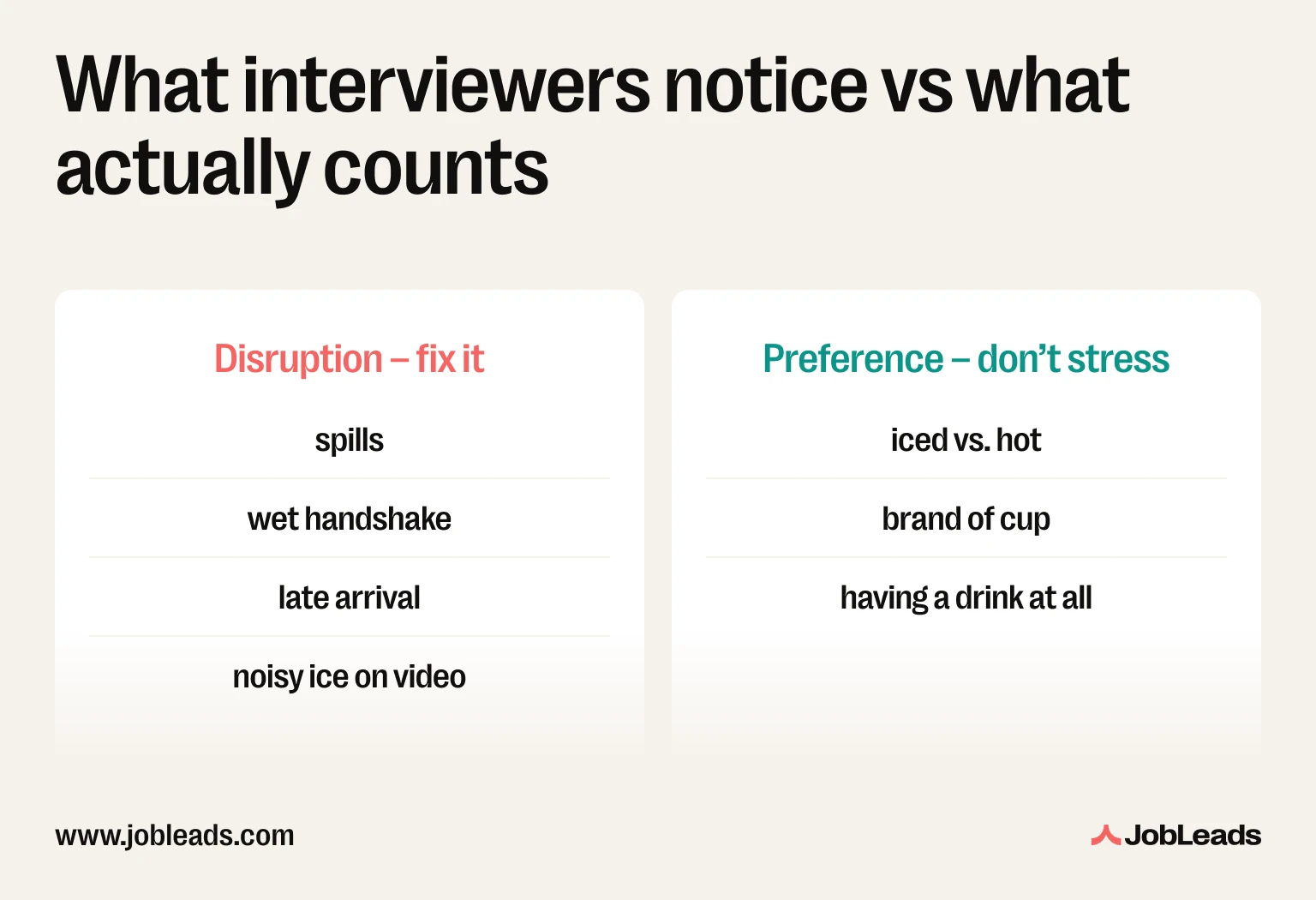
Across every interview coffee situation, one distinction does the real work. Here's how to tell the difference.
| Actual disruption | Personal preference | |
|---|---|---|
| Examples | Spills, a wet handshake, constant sipping, arriving late from a coffee run | "Iced coffee looks casual," "a cup signals low effort" |
| In your control? | Yes, fully | No, it depends on who's across the table |
| Worth worrying about? | Yes, and easy to prevent | Not beyond reading the setting |
Disruptions are legitimate concerns. They pull attention away from the conversation, which is the one thing both you and the recruiter came for.
Preferences are a different animal. In a Psychological Science study, Uhlmann and Cohen found that evaluators redefined what counts as merit to justify the candidate they already favored. When the criteria were set in advance, the bias disappeared.
Real-world hiring shows the same pattern. Sociologist Lauren Rivera interviewed 120 hiring decision-makers at elite US firms and found that shared tastes and lifestyles often weighed as heavily as skills. In other words, "the coffee seemed unprofessional" can be a costume that personal taste wears.
As Daugherty put it: "It isn't really about coffee. It's about who gets to define 'professional.'"
Interview coffee is a much smaller deal than the internet makes it look. Be on time, keep your hands free for the handshake and deal with the cup like an adult.
Then put your energy where it pays off. When JobLeads asked job seekers about the biggest mistake that cost them an opportunity, about 45% said underselling themselves in the interview. Nobody said "the coffee."
And if an employer would reject a strong candidate over a beverage, that tells you how they make decisions–which is useful information too.
JobLeads helps you get to the interview stage in the first place. You'll find roles matched to your experience and a free resume review from career experts.

Content & Insight Writer
Beata creates content that puts job seekers first. From practical blog advice to first-hand research studies, her writing is designed to give people the clarity and confidence to find the role they deserve.
Job InterviewsNail your next video call with our remote interview tips for candidates and recruiters. Learn how to prepare, what to say, and what mistakes to avoid.
 Job Interviews
Explore 5 real-life bad interviews, learn valuable lessons, and gain tips on handling tough situations with professionalism and self-respect in your job search.
 Job Search
Explore the importance of culture fit and its role in a successful job search. Discover how to assess company values and find the right workplace for your career success.