A resume uploaded to a job board carries essential information like a person's name, contact details, work history, and more. One could assume that information reaches only potential employers. Often, it doesn't.
None of this is job seekers' fault. Job hunting can be a stressful and vulnerable moment when attention is understandably elsewhere, not on data privacy. Knowing where one's personal data actually goes can make it easier to job search on informed terms.
To understand how job seekers feel and behave around job-search privacy, JobLeads surveyed over 1,000 professionals across three LinkedIn polls and analyzed anonymized job search activity from more than 115,000 active US job seekers on its platform.
Key takeaways
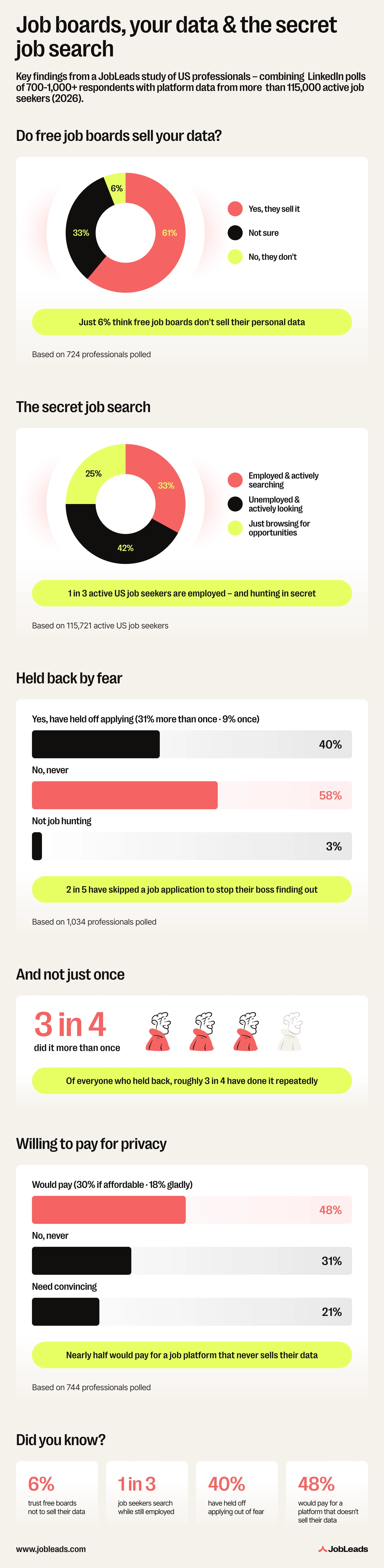
Just 6% of professionals think free job boards don't sell their personal data
1 in 3 active US job searchers on JobLeads who declared their employment status are employed and hunting in secret
2 in 5 professionals (40%) have held off applying for a job to prevent their current boss from finding out
Roughly 3 in 4 people who've held back applying have done it more than once
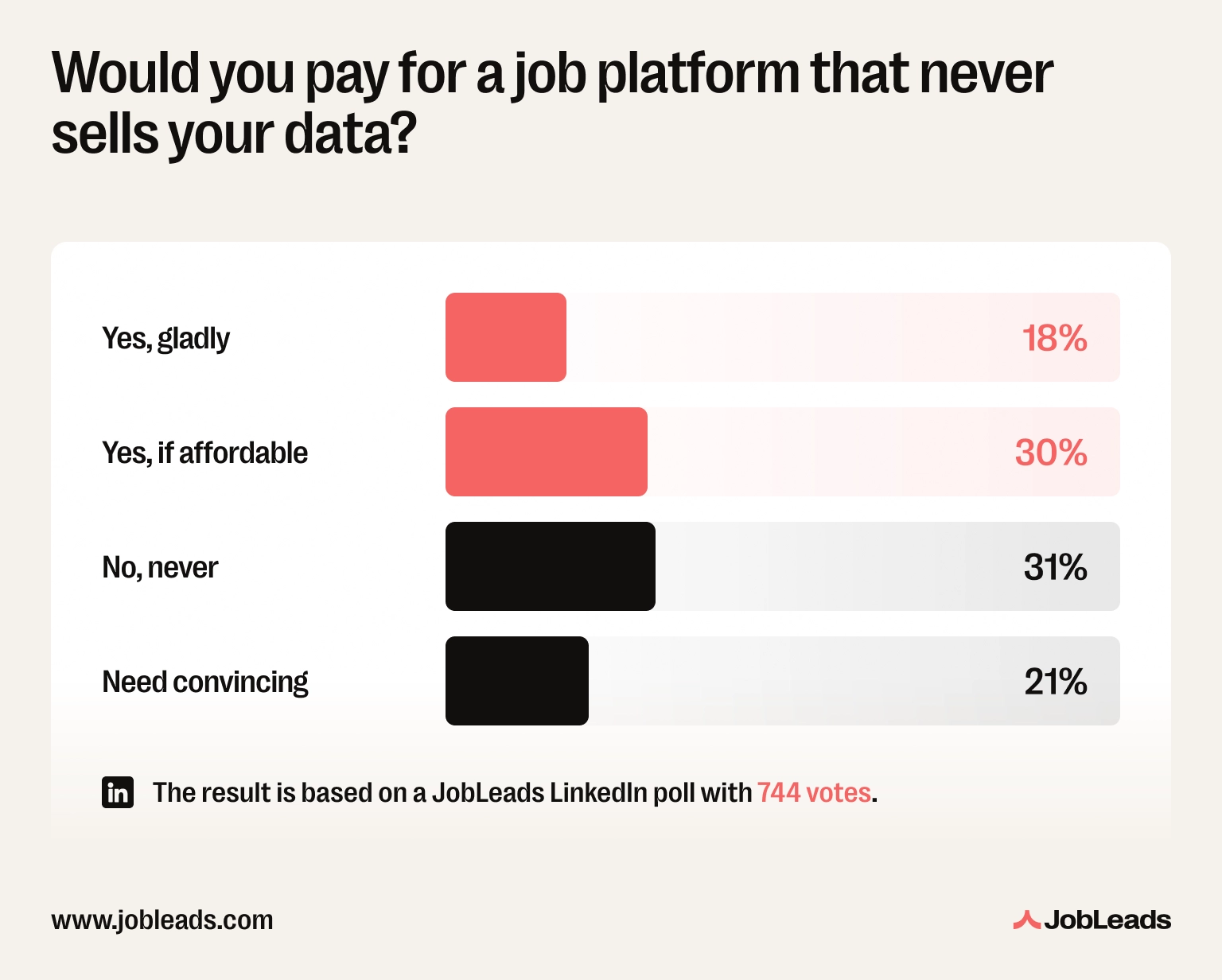
Nearly half (48%) would pay for a job platform that never sells their data
Job seekers seem to overwhelmingly agree that by registering on a free job board, the personal data they input (from resumes to contact information) can be shared with third parties.
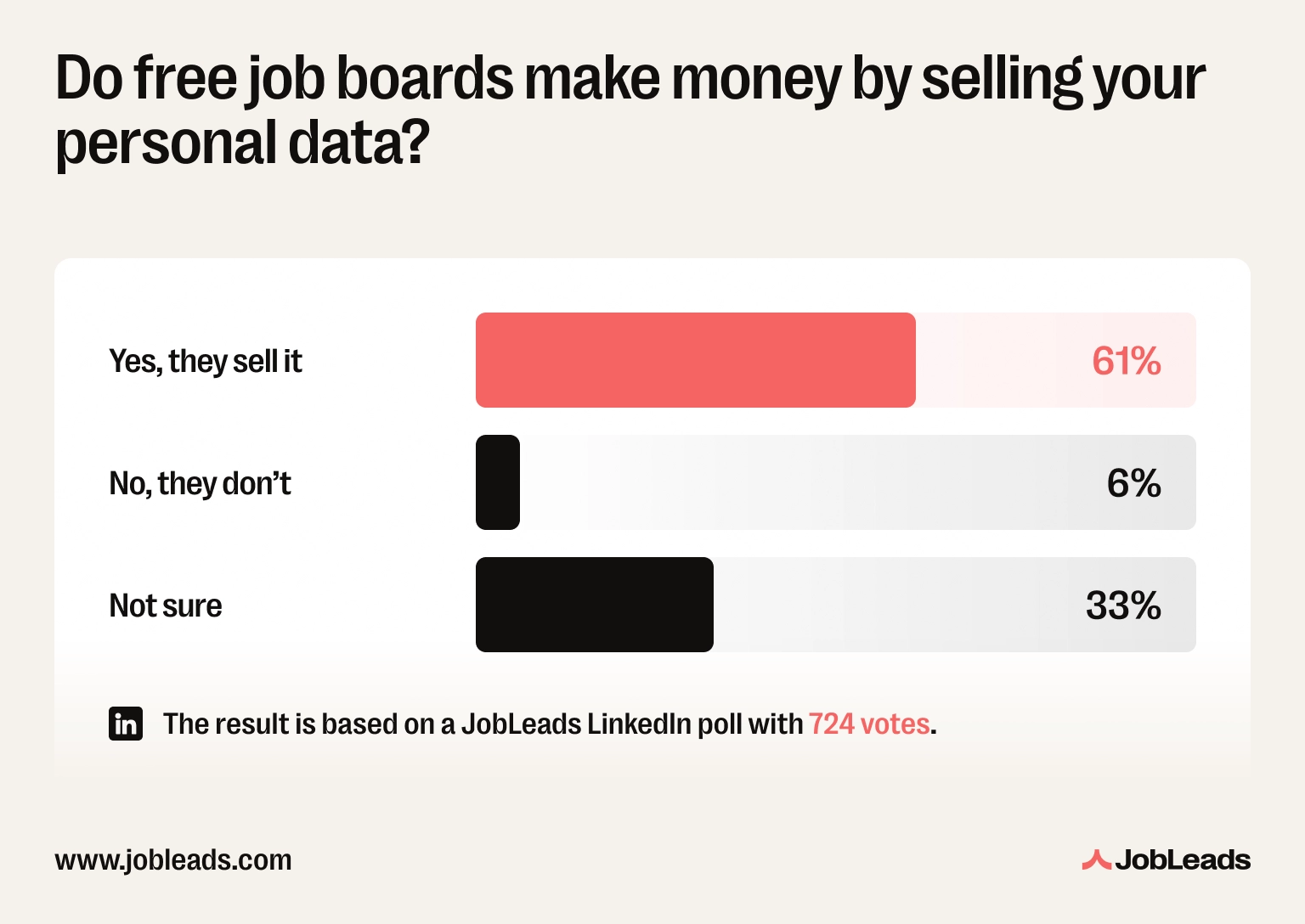
A poll conducted by JobLeads in June 2026 showed that only 6% of respondents share the opinion that free job boards don't make money by selling personal user data. And 61% agree that free job boards sell their information, while 33% are not sure.
The majority is not wrong. A study done by Incogni has found that about 90% of job boards sell user data. What gets shared usually includes things like job seekers' resumes and cover letters, contact details and identity information, sensitive employment attributes (e.g., disability or veteran status), or on-site browsing and tracking data. That's one of the ways job boards that are completely free for job seekers make money.
Who has the biggest interest in purchasing this data? The most common categories of buyers include the so-called "affiliates and business partners" (as often described in privacy policies), marketers, advertising networks, third-party data brokers, and employers. As per Incogni, only 7% of users are worried about their data being shared, while 37% believe that it only goes to potential employers.
Job seekers often look for new opportunities in secret. In the dataset studied, one in three job seekers (33%) are currently employed but looking for a new role.
While data sold to third parties is a privacy risk for anyone, it's the "secret searchers" that are in the most vulnerable position. They don't know whether they will end up with an offer or not, and whether they will have to leave their current job any time soon. So, even the fact of registering on a job board is already something they would most likely prefer not to share.
But their personal data does get shared with multiple third parties, from advertising agencies who would like to target relevant ads at them to employers.
And what if their current employer is one of the data buyers?
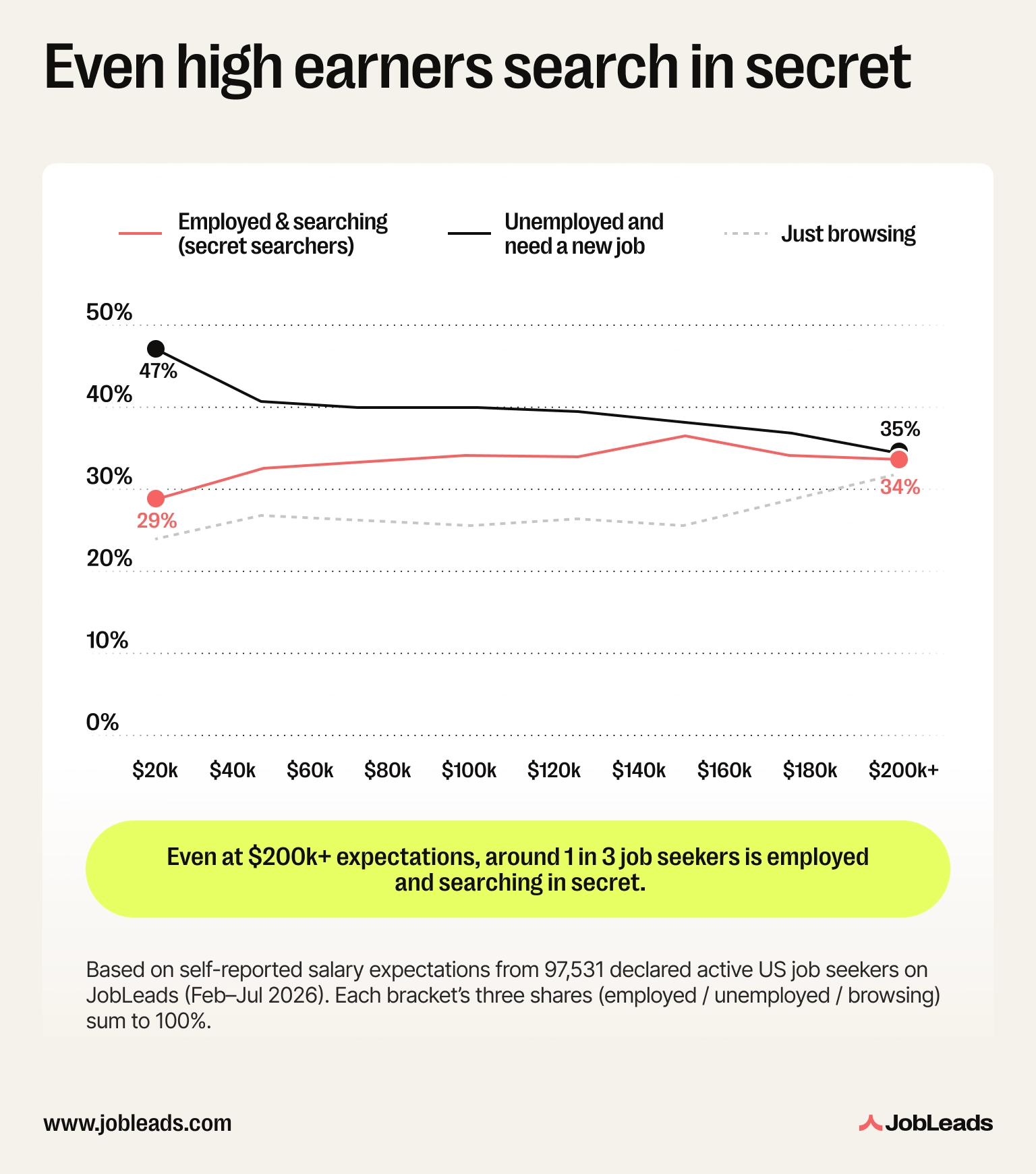
Searching for a job without your employer knowing isn't confined to one end of the pay scale. Across salary levels, the share of job seekers who are employed and quietly looking holds steady at roughly a third.
At entry-level salary expectations ($20k+), the unemployed dominate, outnumbering employed searchers nearly 2-to-1 (47% vs 29%). From $40k upward, though, employed "secret searchers" settle in at around a third of every bracket, right up through $125k+ (38% vs 37%) and $200k+ (35% vs 34%), where the two groups are effectively neck-and-neck. The unemployed's early lead narrows as pay rises; the secret searchers' share never really drops.
The likely reason is what happens at each end of the ladder.
The lower brackets are full of high-turnover roles like entry-level sales, support, internships, so it's natural that the unemployed outnumber the employed there. Higher up, people move far more deliberately. They tend to line up a serious offer before making any move, which is exactly why so many keep the job search quiet.
Ricardo Meneses – Data Analyst, JobLeads
So, even among the people with the most to lose from an exposed job hunt, roughly 1 in 3 is looking while still employed. For them, a job board quietly selling their data carries the highest stakes of all.
It seems that many job seekers share a similar gut feeling. A whopping 40% have not applied for a new job because they were afraid their employer would find out. And 3 in 4 of them have done it multiple times.
That's 40% of respondents who have given up a chance to improve their work situation–a shot at a better salary, more growth, or a non-toxic work environment.
Given that most free job boards do share job seekers' personal data with interested third parties, including employers, the chances of this fear coming true are higher. A company might buy a list of registered job seekers in a specific area because they want to target their online advertising campaigns, and accidentally find out that their three managers are actively looking for new roles. That's an awkward situation to find oneself in.
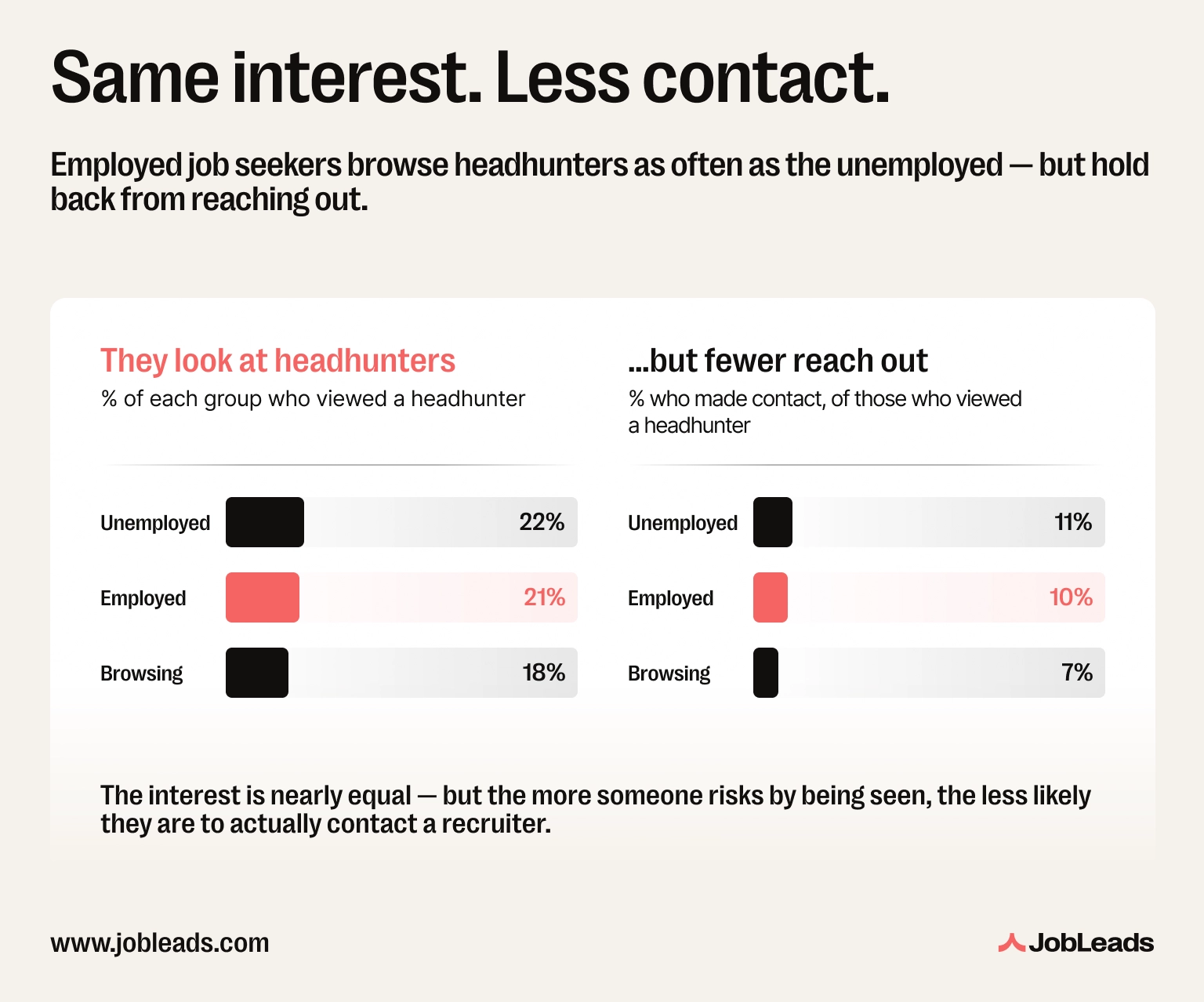
And this isn't just a hypothetical worry. The same hesitation shows up in how employed people actually behave on the job hunt. The analysis of job seekers' interactions with headhunters on JobLeads showed that employed searchers browse headhunter profiles at nearly the same rate as unemployed ones (21% vs 22%).
But people already employed are less likely to take the next step and actually reach out: of those who viewed a headhunter, 10% of employed searchers made contact, versus 11% of the unemployed. The gap is small and consistent across roughly 18,500 headhunter views. So, employed searchers look just as much but hold back at the point of contact.
In other words, employed job seekers look just as much, but pull back at the exact moment that requires putting their name in front of a recruiter. The interest is there, but the fear of being seen holds them back.
And of course, some employers who discover their employees are job searching will shrug it off and move on, because in the end, every employee is free to decide when to look for a new job.
However, there is always a possibility of resentment arising. And, as the employer is in a position of power over a job seeker's salary and working conditions, that's friction no employed job seeker wants to invite.
This is a cautionary tale for anyone selling or buying job seekers' data. As many as 48% would pay for a job board that guarantees never selling their data (30% if affordable, 18% with any price tag), while only 31% said they would never pay for something like this.
Job boards that get funded by job seekers (e.g., those that require a subscription or a one-time payment to use) don't need to sell user data simply because they already have a way to fund their operations. Job boards free for job seekers, on the other hand, have to find other ways to make income. Most of the time it includes charging companies for posting roles, promoting job ads to attract more clicks and applications, and selling user data to third parties.
As mentioned, on job boards free for job seekers, someone else is paying the board's bills. And that single fact shapes everything about how these platforms treat user information. Unless the job seeker is the paying customer, their profile, resume, and their on-site behavior become the product being sold, packaged, or rented out.
In practice, "free" job boards tend to monetize user data in three overlapping ways.
First, they charge companies to post and promote roles. Much of it happens through something known as programmatic recruitment advertising, where job ads are targeted and priced based on who's likely to click, using the profiles and behavior job seekers hand over.
Second, they run ad targeting on the platform itself, matching advertisers to users by role, seniority, location, and salary band.
Third (and most directly) they share or license user data to third parties. These include the "affiliates and business partners" vaguely named in privacy policies, marketers, advertising networks, and data brokers.
There's an important catch in how "data selling" is defined. Under the California Consumer Privacy Act (CCPA), the benchmark used by Incogni in its audit, a "sale" isn't just handing over a spreadsheet for cash. It's disclosing personal information to another business or third party for any valuable consideration, including sharing data for targeted advertising and marketing.
That's why a platform can technically claim it "doesn't sell your data" while still passing it around the ad-tech ecosystem, and why Incogni concluded that roughly 90% of the job platforms it studied sell user data by that standard.
Here's the part worth underlining: being employer-funded doesn't make a board safe for job seekers. In fact, the opposite tends to be true.
The platforms Incogni flagged as the most privacy-damaging include:
Indeed shares user data with employers, affiliates, and marketers, and processes application data through AI tools to generate candidate summaries. (Indeed Employer Guide)
LinkedIn goes a step further, reportedly tracking even non-members who visit its pages for targeted advertising. In 2024 it was fined €310 million in Ireland by EU regulators over its targeted-advertising practices. (Data Protection Commission in Ireland)
Monster received one of the worst privacy scores in Incogni's study. It openly discloses that it sells data (by the CCPA definition) and shares it with vaguely defined "affiliates and business partners." (Monster Privacy Policy)
Glassdoor shares data with advertising partners and ad exchanges and pulls in extra information from third-party data providers. It has previously attached real names and job titles to profiles users thought were anonymous. (Forrester)
ZipRecruiter, also among the worst-scoring, suffered a 2018 data breach that exposed users' names and email addresses. (The Register)
Predictably, they are all free for job seekers to use, precisely because their revenue comes from the employer and advertiser side. The convenience of a no-cost account is paid for with the data users upload.
By contrast, when the job seeker is the one paying, whether through a subscription or one-time fee, the incentive flips. The platform already has a way to fund its operations, so there's no need to monetize people's resumes on the side.
Job boards paid by job seekers are a different business model with a different relationship to your data: you're the customer, not the inventory.
This study combines two data sources. First, three single-select LinkedIn polls run by JobLeads in June 2026: on whether free job boards sell user data (724 votes), whether people have held off applying to avoid their boss finding out (1,034 votes), and whether they'd pay for a platform that never sells their data (744 votes). Second, anonymized first-party data from active US job seekers on JobLeads from February to July 2026, covering employment status (115,721 users). A further 1.23M active US users did not declare a status and are excluded – declared users are ~9% of active users. The data also included headhunter engagement: 114,562 declared-active users, of whom 23,784 viewed a headhunter and 2,379 made contact; the employed-vs-unemployed comparison covered 18,516 views; and self-declared salary expectations (97,531 users).
"Secret searchers" are users who are employed and actively searching. Findings on how job boards handle data, including the ~90% figure and platform examples, come from a 2026 Incogni study of nine platforms, cited here rather than conducted by JobLeads.
Limitations: The LinkedIn polls use a self-selected, opt-in audience with no probability sampling or weighting, so they describe those who voted, not the workforce as a whole. Each poll was answered by a different crowd (724-1,034 votes). Poll results measure belief (e.g. 61% think boards sell data), not verified company practice. The platform figures reflect JobLeads' user base. Behavioral patterns are correlational, not causal: employed searchers contacting headhunters slightly less often is consistent with confidentiality concerns but doesn't prove them. Both datasets are 2026 US snapshots and may differ by region and over time.
Feel free to share the findings, statistics, and graphics from this study for editorial and non-commercial purposes. All we ask is that you credit JobLeads with a link back to this page, so readers can see the full methodology and context. Any third-party findings referenced here (such as those from Incogni) should be attributed to their original source. For questions, additional data, or interview requests, contact press@jobleads.com.
Digital PR & Content Marketing Manager at JobLeads
Maryia leads digital PR and outreach at JobLeads. Her work has earned coverage in Fast Company, AOL, Forbes, Fortune, Quartz, and ZDnet—and she specialises in building the systems that make that happen at scale.
Frequently asked questions
It depends on who's paying. Job boards that charge job seekers (via a subscription or one-time fees) are funded directly by their users. Boards that are free for job seekers earn money on the other side of the marketplace, mainly by charging employers to post and promote roles, running programmatic recruitment ads, and, in many cases, sharing or selling user data to advertisers, data brokers, and other third parties. According to a 2026 Incogni study, around 90% of the job platforms it reviewed sell user data under the CCPA's definition of a "sale."
It depends on the platform. Your resume contains the kind of information (e.g., name, contact details, work history) that many free job boards share or sell to third parties, so it's worth checking before you upload. A few habits help: read how the site's privacy policy describes data "sharing" and "sale," use any "Do Not Sell or Share My Personal Information" opt-out, avoid posting sensitive details you don't need to, and delete old profiles you no longer use. Platforms funded by job seekers rather than by advertising generally have less incentive to pass your data around.
No. JobLeads is funded by job seekers' subscriptions, not by advertising or data brokering, so it has no need to sell users' personal information to third parties the way many free job boards do. The data people share is used to power the service they signed up for, including connecting with vetted headhunters and employers, rather than being sold on to advertisers or data brokers.
In most cases, yes, at least in the US. There's no federal law that outright bans selling personal data. Instead, it's regulated state by state: California's CCPA/CPRA and similar laws in states like Virginia, Colorado, and Texas allow companies to sell or share data as long as they disclose it in their privacy policy and let users opt out. So, when a job board sells your data, it's usually operating legally, provided it follows those rules. The picture is stricter in the EU and UK, where the GDPR requires a clear lawful basis (often consent) before personal data can be shared or sold, making the practice far more limited.
Usually not just for selling it. Under California's CCPA, individuals can generally only sue when a company's negligence leads to a data breach and not when it lawfully sells or shares data it disclosed in its privacy policy. For improper data selling, the more realistic route is filing a complaint with a regulator, such as the California Privacy Protection Agency, your state attorney general, or the FTC, rather than a personal lawsuit. You can also exercise your rights directly: request that a company stop selling your data, delete it, or tell you what it holds. In the EU or UK, you can lodge a complaint with your national data protection authority, which can investigate and fine companies under the GDPR.





 Job Market Trends