
 Resume
May 12, 2026
How To Optimize Resume for ATS & Pass Resume Screening
Learn how ATS works and what to prioritize. Follow the steps to optimize resume for ATS to make sure your CV wins over the algorithm and the recruiter.


You have tailored your resume, listed your experience, and hit submit.
Then–nothing. No callback, no rejection, just silence.
The sad reality is that your resume probably never made it to a human. Keep in mind that nearly all Fortune 500 companies (about 98%) now run every application through an applicant tracking system before a recruiter ever opens it (Jobscan). And the number one reason a qualified resume gets filtered out at that stage is missing keywords.
The good news is that this is one of the most fixable problems in your entire job search. So, let's learn how to spot the right keywords for ATS resume screening in any job description and place them so your resume reads naturally.
Resume keywords are the specific words and phrases–job titles, skills, tools, certifications, and qualifications–that an employer expects to see in a strong application for a given role.
In short, ATS-friendly keywords for your resume are simply the ones that mirror the employer's own job description language–word for word, wherever it's honest to do so.
There are two broad types of keywords:
Both matter, but in the battle of soft skills vs hard skills, the latter ones tend to carry more weight with ATS scoring, since they're easier for the software to match exactly against the job posting text.
In fact, a study found that language models correctly identified named technical terms like "Python" or "Java" with about 76% accuracy, compared to roughly 40% for short, ambiguous soft-skill phrases like "passionate". This is the same exact-match challenge ATS keyword scanning runs into (SkillSpan, Zhang et al.)
A few more ATS keywords examples worth knowing:
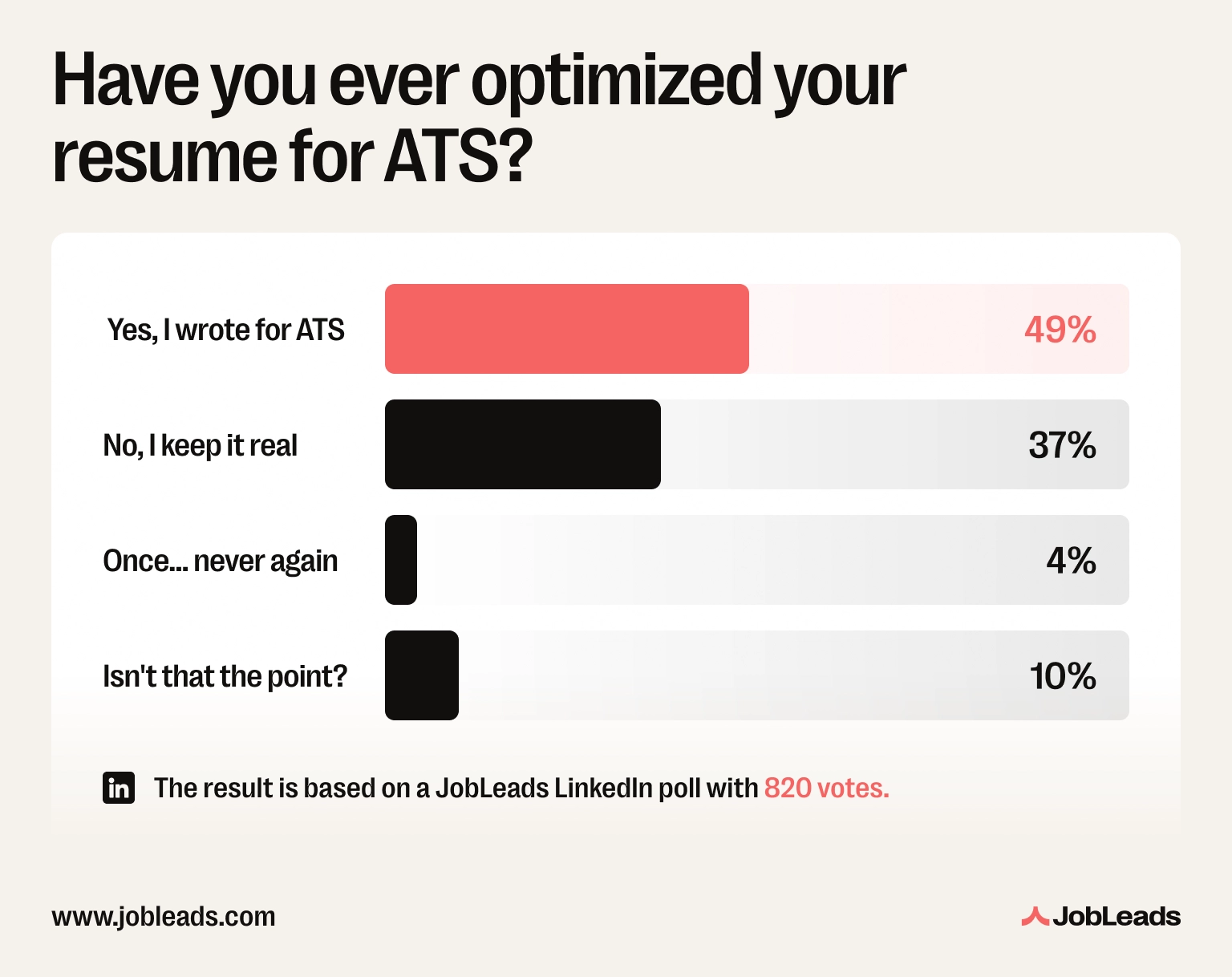
This isn't a small formatting detail, and job seekers already sense it. In a JobLeads poll, about 49% of professionals said they've written their resume specifically for ATS, while roughly 37% said they still prioritize writing it naturally. That near-even split shows how much uncertainty there still is around how much optimization is actually necessary.
Third-party data backs this up too: Jobscan found that about 76% of companies filter and rank candidates by skills first–before education, job title matches, or years of experience. If your keywords don't match, you're invisible–regardless of how strong your actual experience is.
Most systems follow the same three steps:
Keep in mind that keyword parsing isn't limited to the file you upload. Some ATS platforms also cross-reference your LinkedIn profile, so mirror your top resume keywords in your LinkedIn headline and skills section too–not just the document itself.
Did you know…
Even after your resume clears the ATS, it doesn't get much more time with a human. ResumeGo found that about 81% of recruiters spend less than a minute on their first read of a resume. This is exactly why your strongest keywords need to be visible immediately.
Finding the right keywords is only half the job. You also need to place them so the ATS can find them–and so a human recruiter still enjoys reading your resume afterward. Here's the three-step process.
This is the fastest way to find the right ATS keywords. In a JobLeads poll, about 59% of job seekers admitted to applying to a job without reading the description at least once. If you're not reading closely, you're not catching the keywords either.
So, before you tailor a single bullet point, decode the job posting line by line and pull out every recurring skill, tool, and qualification. Three sections matter most:
Example of a job posting excerpt with keywords highlighted:
"We're looking for a Product Manager with experience in Agile/Scrum, stakeholder management, and product roadmap planning. You'll run A/B testing, define OKRs, and collaborate cross-functionally using Jira."
Every bolded phrase above is a candidate keyword, job title, methodology, tool, and outcome-based skill all in one short paragraph.
Keywords vs. buzzwords: what to avoid
A keyword is specific and verifiable ("Salesforce," "financial reporting," "Python"). A buzzword is vague and unprovable ("go-getter," "team player," "hardworking"). ATS software gives little to no weight to buzzwords, and recruiters actively roll their eyes at them. If you can't point to a project or result that proves the word, leave it out.
This step is about sorting terms so both the software and a human recruiter can find them fast. Once you have your list, sort each keyword into one of two buckets:
| Keyword type | Where it belongs | Example |
|---|---|---|
| Tool/software | Skills section | Salesforce, Tableau, Jira |
| Certification | Skills section (or header) | PMP, CPA, AWS Certified |
| Methodology | Experience bullet | "Led sprint planning using Agile/Scrum methodology" |
| Measurable outcome | Experience bullet | "Grew qualified pipeline by 40% through targeted lead generation" |
✅ Right: "Managed a $1.2M sales pipeline using Salesforce CRM, exceeding quarterly quota by 22%." It works because the keyword ("Salesforce CRM") sits inside a specific, quantified accomplishment.
❌ Wrong: "Skills: Salesforce, sales, CRM, pipeline, negotiation, closing, results-driven, team player, hardworking, quota, leadership, sales, growth." It fails because this is keyword stuffing–a wall of disconnected terms with no context, which reads as spam to both ATS and recruiters.
A single, one-size-fits-all resume will always underperform a version tailored to each posting. That doesn't mean rewriting your whole resume every time. It means swapping keywords and emphasis to match what each specific employer is asking for.
Job seekers are split roughly down the middle on this. A JobLeads survey found that about 44% of candidates only update their resume when they have to, while about 42% tailor it before every application. If you're in the first group, this is the one habit worth changing that will pay off immediately.
Example of the same candidate, two tailored bullets:
Same underlying achievement, two different keyword emphases–retention versus revenue growth–depending on what the job posting prioritizes.
You might also be wondering how many keywords you should actually include. There's no fixed number.
Instead, match the density of the posting itself: if a skill or tool appears multiple times in the job description, it should appear at least once in your skills section and once more in an experience bullet. Repeating your top three to five most important keywords two to three times across the resume is a reasonable target but don't go beyond that.
Once your keywords are in place, run through our full ATS resume optimization checklist to make sure formatting doesn't undo your work.
Keywords aren't universal–they shift by role, industry, and even by how a company names its own positions. A "Customer Success Manager," "Client Relationship Manager," and "Account Manager" can all describe nearly identical work.
Below is a resume keywords list broken out by job title, covering eight roles with strong search demand. Treat these as a foundation–always cross-check against the actual posting you're applying to.
Searching for product manager resume keywords for ATS? Here's what recruiters and ATS software both expect to see:
Common ATS keywords for a sales resume include:
The best DevOps resume keywords for ATS systems cover:
Common ATS keywords for a software engineer resume include:
The core ATS keywords for a data analyst resume (and its close cousins) tend to include:
Keywords for an accountant resume under ATS screening typically include:
ATS keywords for an administrative assistant resume typically include:
ATS keywords for a content writer resume include:
Getting past the ATS comes down to a three-step habit:
Keep your own running ATS keywords list for the roles you're targeting, and update it every time a new posting uses language you haven't seen before. It takes a few extra minutes per application but it helps your resume reach a recruiter.

Content & Insight Writer
Beata creates content that puts job seekers first. From practical blog advice to first-hand research studies, her writing is designed to give people the clarity and confidence to find the role they deserve.
ResumeLearn how ATS works and what to prioritize. Follow the steps to optimize resume for ATS to make sure your CV wins over the algorithm and the recruiter.
 Resume
Applicant Tracking Systems (ATS) - your job-hunting BFF! We rip apart the myths, show you how to optimize your resume, and boost your chances with smart tips.
 Resume
Learn the key differences between soft and hard skills. Discover how to highlight them in your resume and cover letter to impress recruiters and secure job interviews.