
 Resume
August 24, 2026
How Long Should a Resume Be? Ideal Length by Experience
How long should a resume be? Learn how many pages a resume should be for an entry-level position vs for someone with over 10 years of experience.


"Keep your resume to one page" is one of the most repeated rules in job hunting, passed around in career advice, recruiter videos and the resume templates job seekers download every day.
But–
Do people actually follow this advice?
JobLeads analyzed 1.8 million anonymized resumes uploaded to its free Resume Review between July and September 2026–one per job seeker. The country comparisons below cover the 15 countries with the most uploads, 1.4 million resumes in total, or 78% of the sample. They show an interesting pattern that doesn't always follow common resume advice and greatly depends on where you live.
Resume advice is rarely nuanced and often delivered as a single number–and the number depends on who's giving it. US guides push the one-page resume–MIT tells students to keep to one page unless they have an advanced degree or 10+ years of experience. UK guidance points higher: the University of Sheffield tells job seekers that two sides of A4 is the norm.
And there are more local rules to what makes a good resume. For example, a German Lebenslauf has traditionally carried a photograph (the exact detail US guidance warns against including), and a Japanese rirekisho is less a resume than a standardized form, with a fixed layout, a chest-up photo and a date of birth.
JobLeads took 1.8 million real, anonymized resumes and measured how long they are. Below is a table of resume statistics by country.
| Country | Resumes analyzed | 1 page | 2 pages | 3+ pages | Average pages |
|---|---|---|---|---|---|
| South Africa | 107,976 | 32% | 30% | 38% | 2.66 |
| Colombia* | 62,283 | 35% | 27% | 39% | 2.51 |
| United States | 306,760 | 34% | 40% | 27% | 2.12 |
| United Kingdom | 119,909 | 33% | 39% | 28% | 2.12 |
| Canada | 48,720 | 34% | 43% | 23% | 2.02 |
| Italy | 62,127 | 43% | 35% | 22% | 1.95 |
| India | 211,178 | 41% | 39% | 21% | 1.93 |
| United Arab Emirates | 48,261 | 41% | 41% | 18% | 1.90 |
| Mexico | 43,023 | 50% | 33% | 18% | 1.82 |
| Chile | 60,710 | 52% | 31% | 18% | 1.80 |
| Philippines | 82,940 | 56% | 28% | 16% | 1.71 |
| Pakistan | 44,139 | 54% | 31% | 15% | 1.70 |
| Spain | 101,050 | 73% | 19% | 7% | 1.39 |
| Argentina | 59,689 | 75% | 18% | 7% | 1.37 |
| France | 67,589 | 82% | 14% | 4% | 1.25 |
The 15 countries with the most resumes, July-September 2026, one resume per job seeker. Country is where the job seeker registered. Averages exclude uploads over ten pages. Percentages are rounded and may not sum to 100%.
*Colombia's 3+ figure is inflated: 9% of Colombian uploads run past ten pages, against under 1% elsewhere, which suggests several documents saved into one file. Read that row with caution.
What counts as a complete, professional application document is often a local custom. Length is simply the most visible of those customs, and the one job seekers ask about most.
The one-page rule is probably the most repeated piece of resume advice in the US, and it describes a minority of American resumes: just 34% fit on a single page. The UK (33%) and South Africa (32%) are lower still, with Canada level with the US at 34%. But British job seekers were never told to write one page–UK guidance points at two sides of A4, and British resumes follow it.
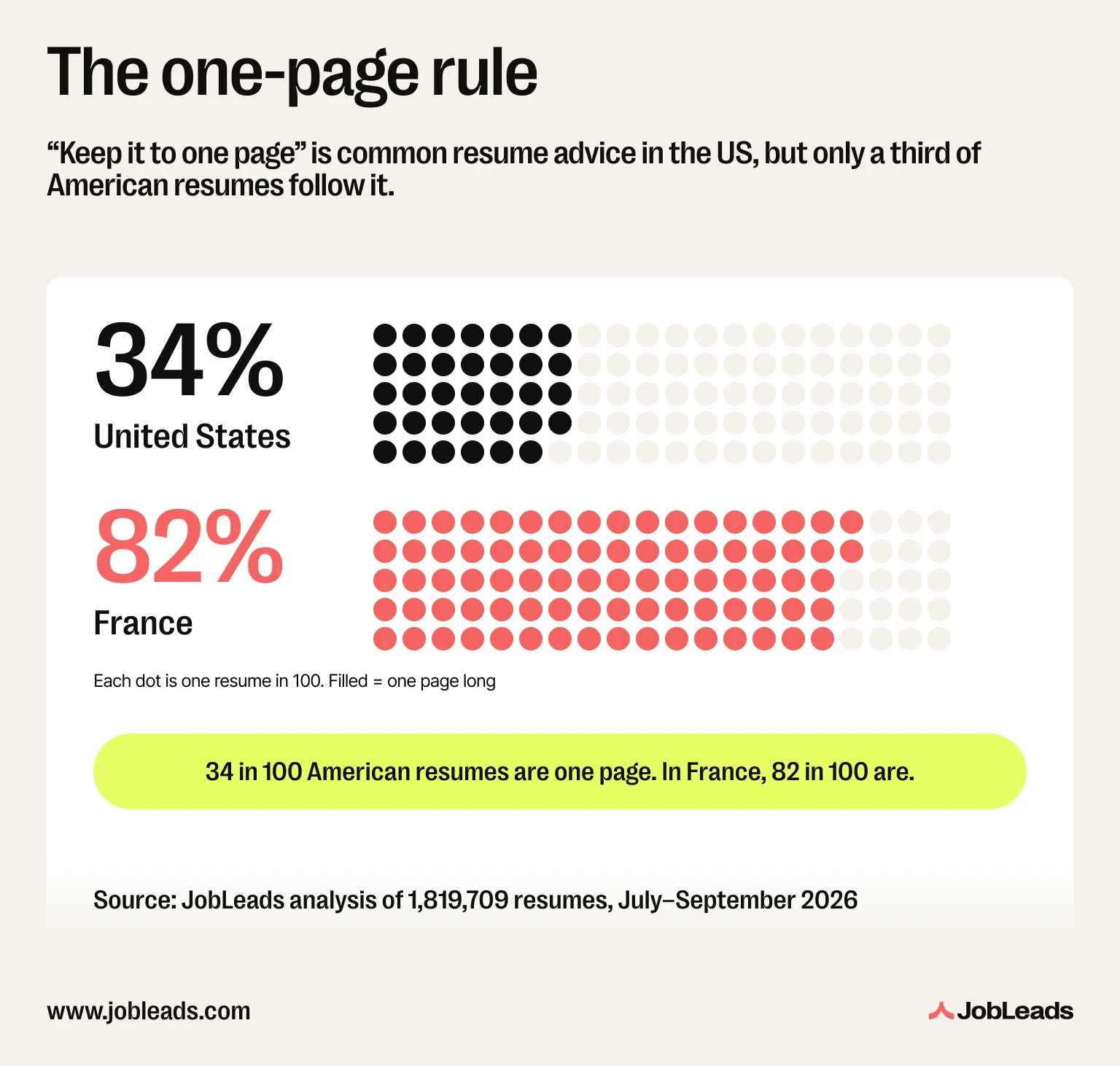
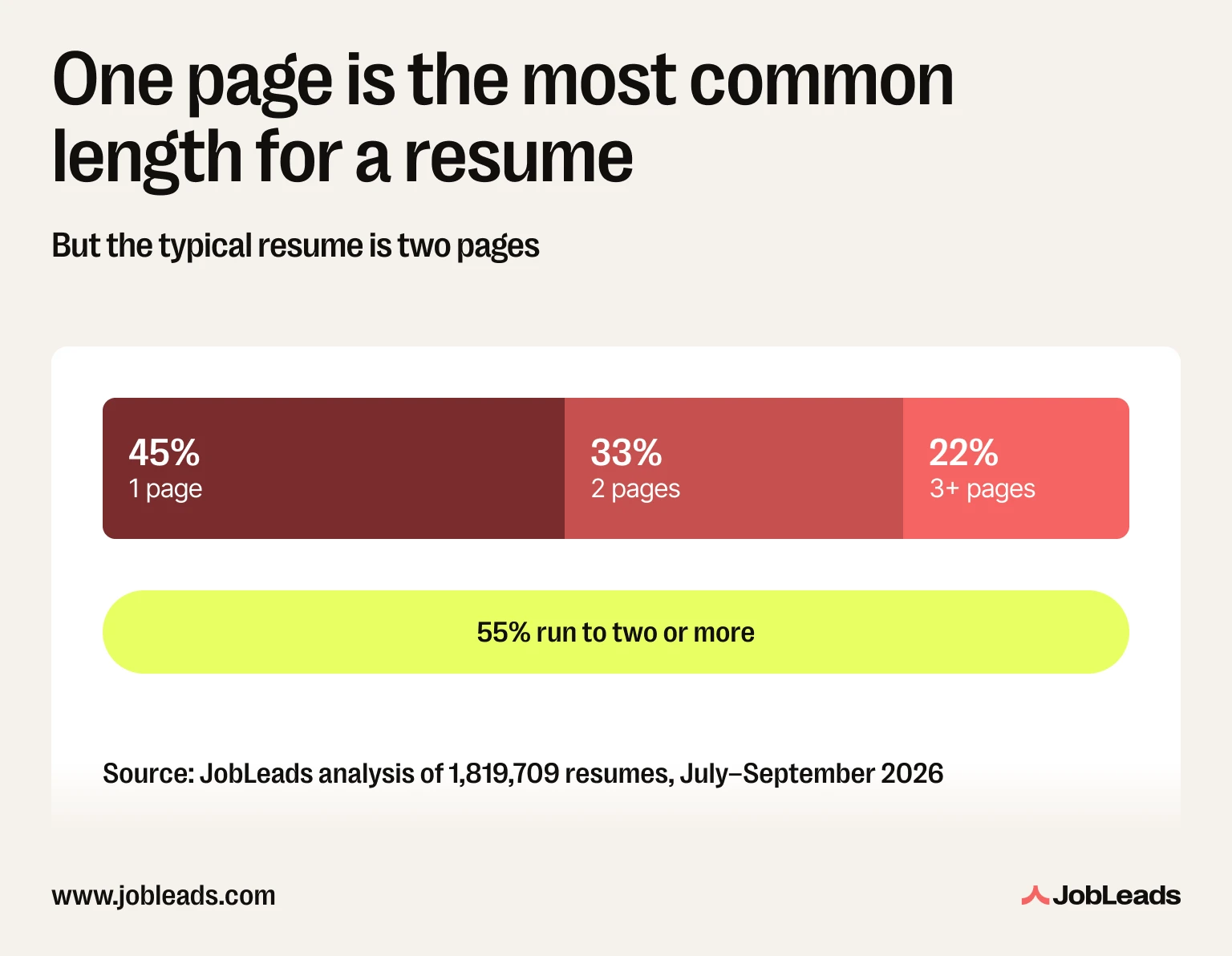
The countries that genuinely keep to one page include France at 82%, Argentina at 75%, and Spain at 73%. The one-page rule appears to be a very accurate description of French behavior and a poor description of the US job seeker. Worldwide, 45% of resumes are one page, and the global average resume length is two pages.
TL;DR:
Read more: Should a resume be one page, really? Check JobLeads' resume length guidelines.
One page might be a tight space to fit one's whole career story on. But what happens when two pages, a commonly recognized "ceiling" for resume length, are not enough either?
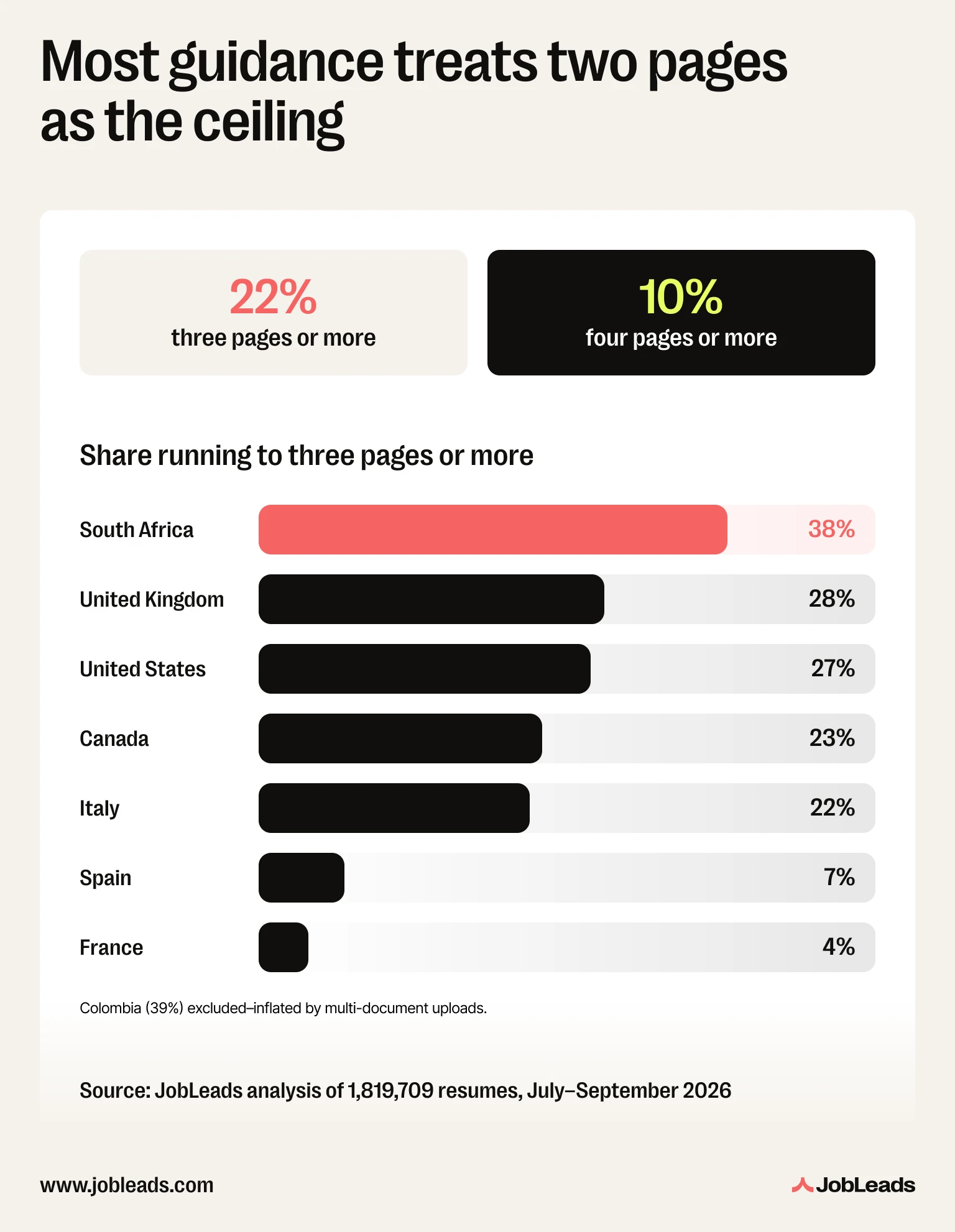
More than one in five resumes (22%) run to three pages or more, and about 10% reach four or more. The long resume is a local habit too: 38% of South African resumes run past two pages, 28% of British and 27% of American ones, against 4% in France.
Colombia is higher still at 39%, but it sits outside the ranking: 9% of Colombian uploads run past ten pages, against under 1% everywhere else, which points to several documents saved into one file rather than longer resumes.
TL;DR:
Should experienced candidates shrink the education section on their resumes? After all, is it still relevant when one has 10+ years of experience?
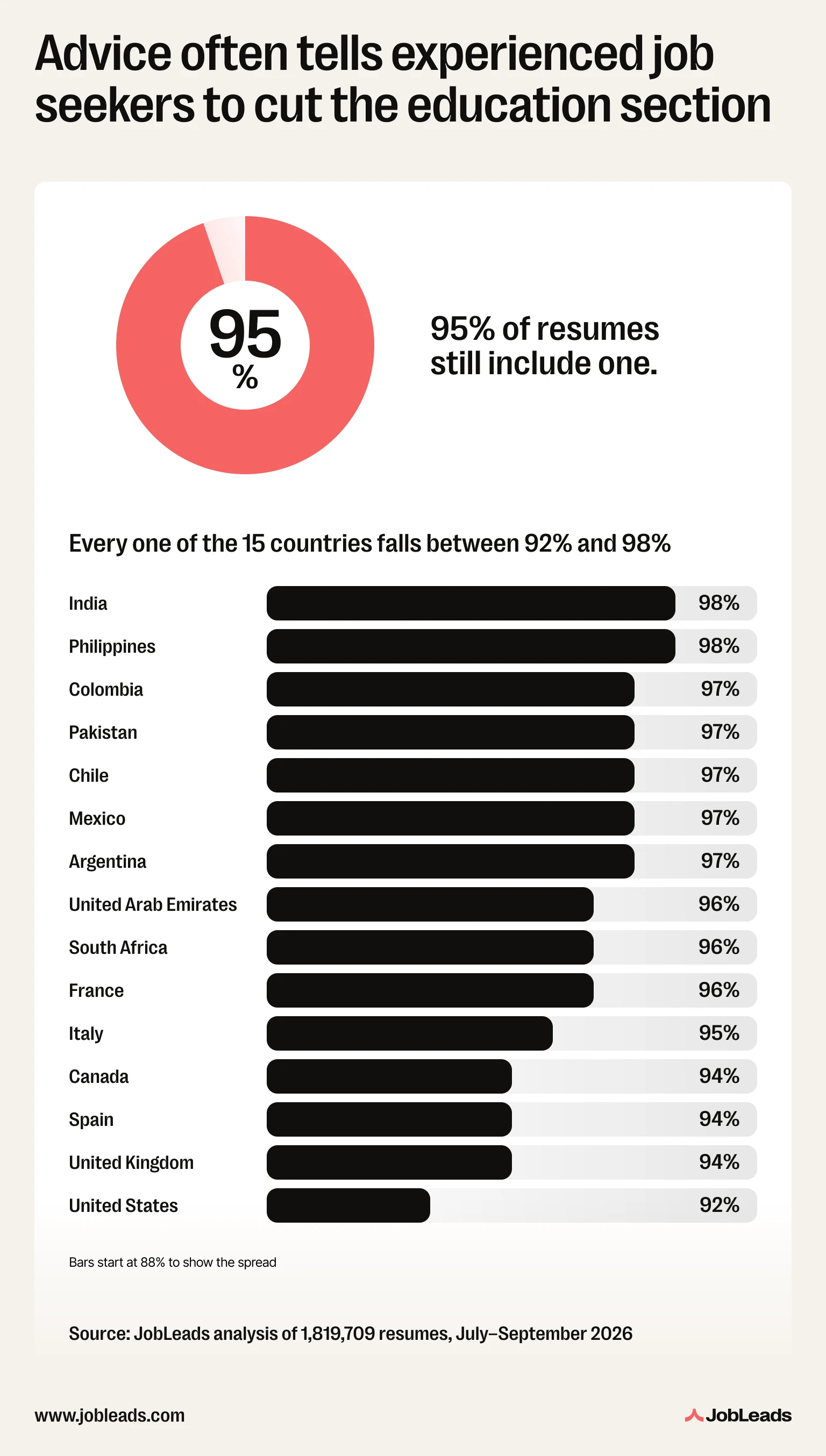
Almost nobody removes it entirely: 95% of resumes still include one. The US and UK are the likeliest to leave education off, at 92% and 94% inclusion, and length isn't the reason. South Africa writes the longest resumes of the 15 countries, at 2.66 pages, and still includes education 96% of the time. The share barely moves between one-page and longer resumes either. At the other end, Indian resumes include education 98% of the time.
TL;DR:
In many markets, two pages is the single most common length. In Canada 43% of resumes run to exactly two pages, in the US 40% and in the UK 39%, the largest group in each country.
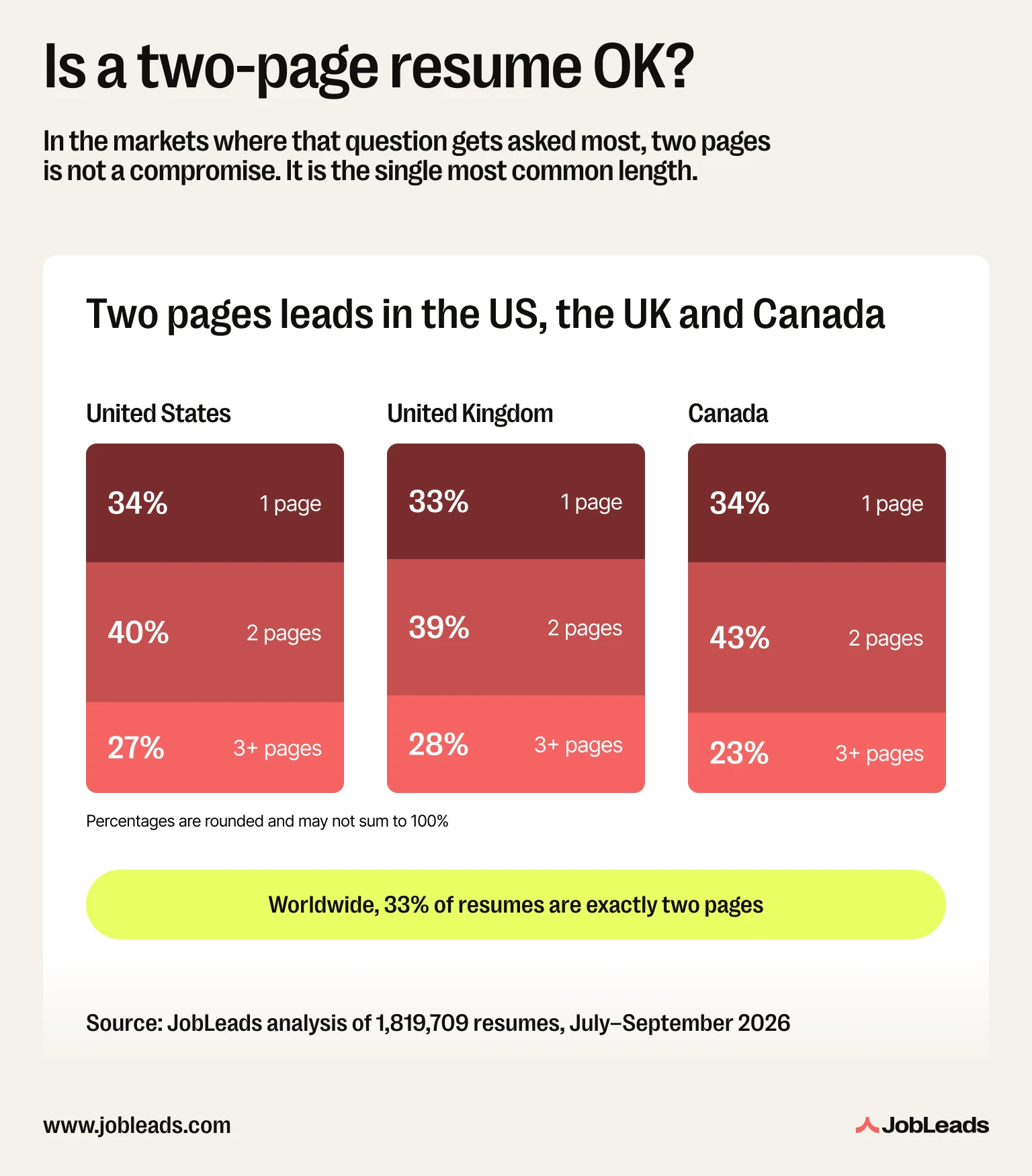
The three distributions are close to identical, which is what a real convention looks like rather than a coincidence: US and UK resumes both average 2.12 pages, Canadian ones 2.02. A two-page resume in these markets seems to be the default, whether recruiters like it or not.
TL;DR:
It would be tidy if resume length tracked language families, but according to the research, it doesn't. Resumes written in Italian are one page 43% of the time and the ones in German 42%, both far closer to the English-language length (38% one page) than to the French one (75% one page).
The Spanish language sits in between at 58% one page, and that average hides a split: Spain at 73% and Argentina at 75%, but Mexico at 50%. A 25-point gap between two countries writing in the same language shows the convention is national, not linguistic. What a resume looks like is set by the destination country, not by the words on it.
TL;DR:
Resume length differs sharply by country. One page is the most common single length worldwide, but the typical resume is two pages. And in the US, UK and Canada, two pages is the most common length outright.
What the data can't tell you is which length works to get you hired for a specific position. So, take it with a grain of salt and try to find the best balance to package your own, unique career story into a written document.
Put your experience into a resume that fits the market you're applying to.
What JobLeads looked at. Every resume uploaded to JobLeads' free Resume Review between 1 July and 30 September 2026, 1,819,709 in total. Each resume was completely anonymized.
How the counting was done. One resume per person, their most recent upload, so nobody counts twice. Page count comes from the automatic check that runs on every upload; JobLeads counted pages, not words. Files with an unreadable page count (0.3%) were excluded.
Country is where the job seeker was located when they registered, not their nationality, and not necessarily where they're applying. The 15 countries shown account for 78% of all resumes.
Very long files. About 1% of uploads run past ten pages and are unlikely to be a single resume. Analysts left them out of the averages; including them, the global average rises from 2.0 to 2.2 pages. They do still count in the "three pages or more" shares, which is why Colombia needs care–9% of its uploads exceed ten pages, against under 1% elsewhere.
What this data can't tell you:
Prepared by JobLeads' business intelligence team, data as of October 2026.
Everyone is welcome to use the data and graphics on this page, in full or in part, for editorial and non-commercial purposes. We only ask that you credit JobLeads and link back to this page so readers can see the full study and how it was put together.
For additional figures, country-level breakdowns or an interview, contact press@jobleads.com.

Digital PR & Content Marketing Manager at JobLeads
Maryia leads digital PR and outreach at JobLeads. Her work has earned coverage in Fast Company, AOL, Forbes, Fortune, Quartz, and ZDnet—and she specialises in building the systems that make that happen at scale.
ResumeHow long should a resume be? Learn how many pages a resume should be for an entry-level position vs for someone with over 10 years of experience.
 Resume
Check out the step-by-step guide to writing a career change resume. Learn how to write the summary, present your skills, and what format to use.
 Resume
Compare the 10 best resume review services in 2026. Check out the ratings, pricing, and expert picks to help you land more interviews.