
 Career Development
August 10, 2026
Remote Onboarding Process: Guide, Checklist & Best Practices
Check out the full remote onboarding guide to learn what to prepare. Also, check out the employer checklist and best practices that boost retention.


JobLeads asked professionals on LinkedIn how they'd react if their boss bragged about high turnover, saying "we keep only the best." A whopping 84% called it a red flag–not a flex.
If you ever felt your stomach drop upon hearing that phrase in a meeting, that's your instinct screaming.
A toxic boss isn't just "difficult" or "intense." Plenty of demanding managers push their teams hard and still earn respect. The difference is a consistent pattern that damages your work, your confidence, or both.
And the self-doubt that comes with it is often part of the problem.
Here's how to deal with a toxic boss.
A toxic boss is a manager whose behavior consistently undermines your ability to do your job. It also affects your confidence and your wellbeing.
Importantly, high standards and toxicity can look similar from the outside, but the difference is in pattern and harm, not a single interaction.
Often what looks like a personality quirk is actually one of several signs of poor management–and sometimes it's not the manager at all, but the wider culture fit that's actually wrong.
| High standards | Toxic boss |
|---|---|
| Consistent expectations, feedback tied to outcomes, criticism given privately, transparently, and aimed at the work. | Expectations that shift after the fact, criticism aimed at you personally, and feedback used as a control tactic rather than a way to help you improve. |
Here's what those toxic boss traits actually look like day to day. Some of these bad boss characteristics are obvious the first week, others are subtle signs of a toxic boss that are easy to miss at first, because on their own, they just look like normal management.
A toxic boss reviews or approves work that doesn't need it. They can't delegate without hovering and often treat your autonomy as a risk instead of a sign of trust. This is one of the most common bad supervisor traits, and it's what most people picture first when they think of a toxic, micromanaging boss. Nothing you do is ever quite "done" until they've put their hands on it.
Your ideas become "their" ideas in front of leadership. Their mistakes become "a team problem" the moment something goes wrong. This is one of the most common bad boss qualities in online discussions of incompetent bosses. That's because it directly breaks the basic deal of having a manager: they're supposed to advocate for you, not use you as cover.
Constructive feedback happens in private and focuses on the work. Public correction is rarely about fixing the problem faster and much more often about control through humiliation. When it turns into a consistent pattern, it starts to look less like tough management and more like bullying.
Read more: Check out this guide on handling workplace bullies if your situation is starting to feel intimidating.
When you deal with a toxic boss, rewards and consequences depend on who you are, not what you did. Favoritism is one of the most-cited signs of a toxic manager because it's rarely subtle once you're looking for it.
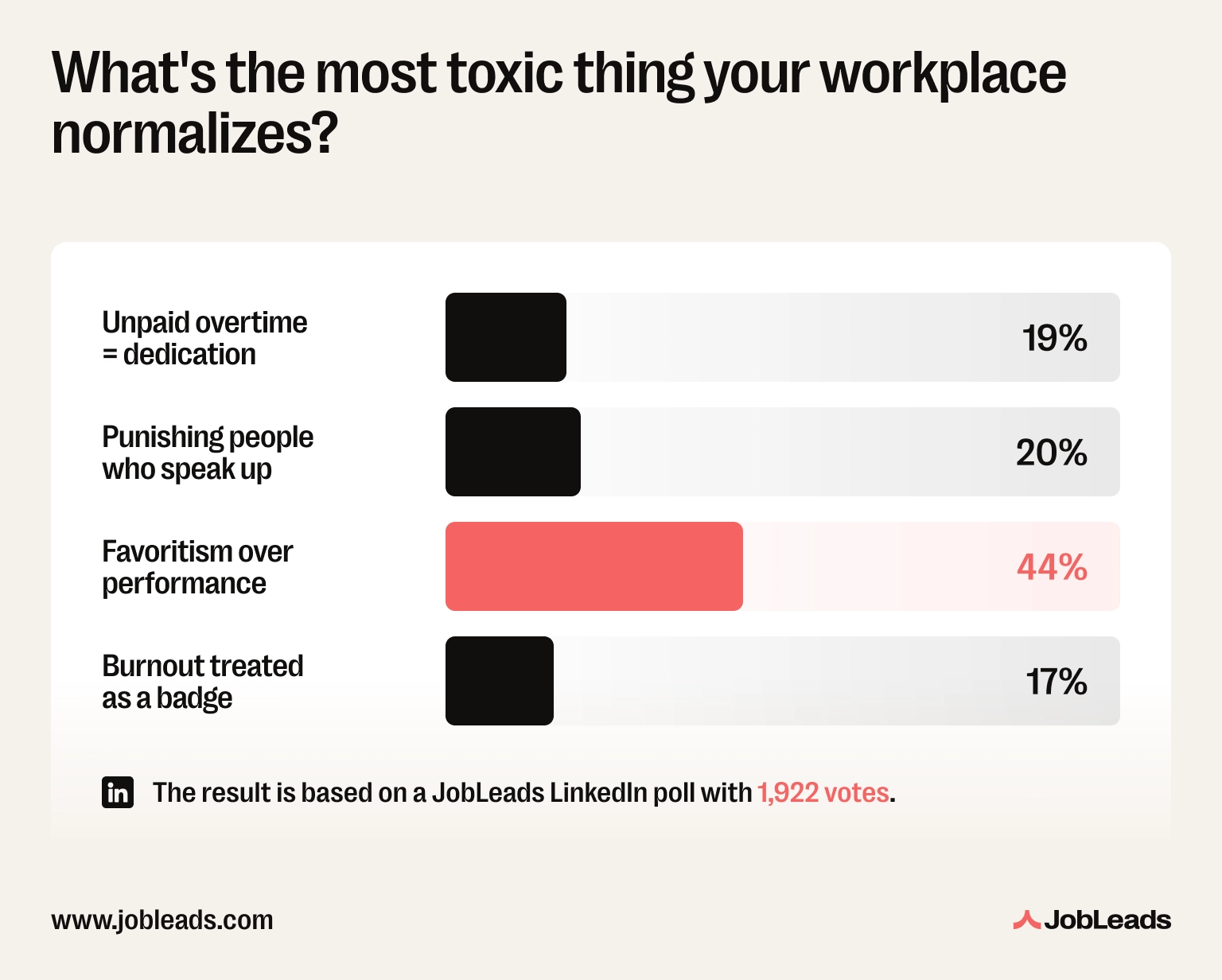
In the JobLeads poll, favoritism over performance was the single most-selected answer (44%) when professionals were asked what toxic behavior their workplace normalizes. So, if two people make the same mistake and only one gets a talking-to, that's not a coincidence.
The goalposts move after you've already delivered. "That's not what I asked for" becomes a recurring pattern instead of a one-off miscommunication. This is one of the toxic boss behaviors that's hardest to prove in the moment, because each instance looks like a small misunderstanding. It's only the pattern that makes it impossible to actually succeed.
Messages sent at 9 p.m. are treated as urgent by default. A "quick question" on a Saturday morning isn't actually quick–it's an expectation that you're still reachable, even though you're off the clock. There's no real boundary between your job and the rest of your life, and pushing back on that gets read as a lack of commitment rather than a reasonable boundary.
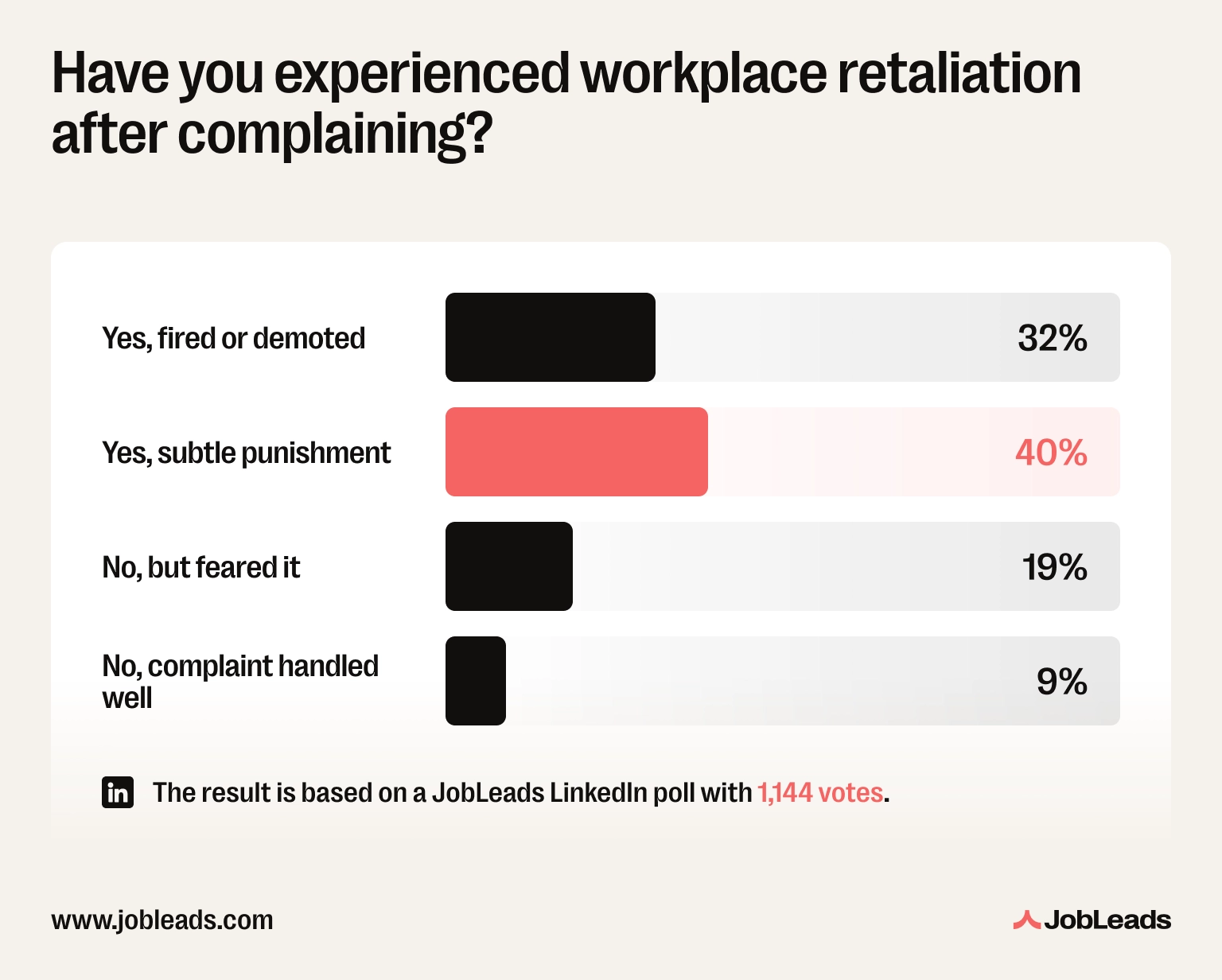
Raising a legitimate concern gets you labeled "difficult" instead of heard. This isn't a rare outcome. In fact, JobLeads found that 40% of professionals said they'd faced subtle punishment after complaining at work, and another 32% said they were fired or demoted. Only 9% said their complaint was handled well. That gap between the policy on paper and what actually happens is exactly why documentation matters so much later in this guide.
This is one of the clearest signs of toxic leadership: the team is compliant, not engaged. Psychological safety collapses, so people hide mistakes instead of flagging them early, because flagging them has never gone well. A boss who runs the team on fear usually finds out about problems only once they're too big to fix quietly.
Feedback exists only to criticize, never to help you improve. There's no advocacy for promotions or new opportunities. A JobLeads poll found that 36% of professionals never get regular performance feedback and are "always guessing" and just 17% said their manager gives them refreshingly direct, regular feedback. That gap is one of the most common traits of bad managers: feedback technically exists, but growth never actually happens. If your manager only talks to you about your performance once a year, growth was never really the point.
What gets one person praised gets another person reprimanded for the exact same behavior. Push back on a decision in a meeting and it's "great, direct feedback" from one team member and "not being a team player" from someone else. The behavior didn't change, the difference was only in who did it.
These aren't just bad days that fade once you clock out. Working under a toxic boss has measurable effects on your health, your performance, and how you show up in every job after this one. That's not because you're overly sensitive, but because a strained relationship with the person who controls your day-to-day work is one of the most consistently studied sources of workplace stress there is. Here's what the research actually shows.
This isn't a vague claim. The APA's Work in America survey found that employees who describe their workplace as toxic are more than three times as likely to report harm to their mental health (52%) as those in a healthy workplace (15%).
The same survey found 77% of U.S. workers reported experiencing work-related stress in the past month, and 57% reported negative effects from it. These included anxiety and low mood tied directly to the working relationship, not the job itself.
Chronic stress from a toxic reporting relationship compounds faster than ordinary workload-driven burnout, because there's no natural finish line. A hard project ends–you finish it, recover, and move on. A boss who undermines you every day doesn't end that way. So, the pressure resets every morning before you've even opened your laptop.
This lines up with what the World Health Organization describes as occupational burnout. That's not just tiredness, but a specific mix of exhaustion, growing cynicism about the job, and a real drop in how effective you feel doing it. The difference with toxic-boss burnout specifically–compared to workload burnout–is that fewer hours or a lighter project load won't fix it.
Constant, inconsistent, or public criticism teaches you to doubt your own judgment. And that doubt doesn't stay at the office. People who've worked for a toxic supervisor often second-guess decisions in their next role, too. That's the opposite of the resilience a good manager should be building in you.
This is counterintuitive, but well documented. A BMC Psychology study on abusive supervision found that it significantly increased workplace rudeness among employees, which in turn escalated into service sabotage.
This is ironic as it's the opposite of what fear-based management is usually trying to achieve. Employees with strong personal work ethics were less likely to retaliate this way, but the underlying pressure was still there.
The damage outlasts the job. People who've had a toxic boss are more likely to walk into their next workplace already braced for it, second-guessing red flags that might be nothing. Or missing real ones because they've become numb to the pattern.
Did you know that…
Gallup's State of the American Manager research found that one in two employees have left a job at some point in their career specifically to get away from a manager. People don't just quit companies–they quit relationships with the person they report to.
Now, what can you actually do about it, especially if quitting isn't an option right now? Here's how to handle a toxic boss day to day, and how to start actually dealing with a toxic boss instead of just enduring it.
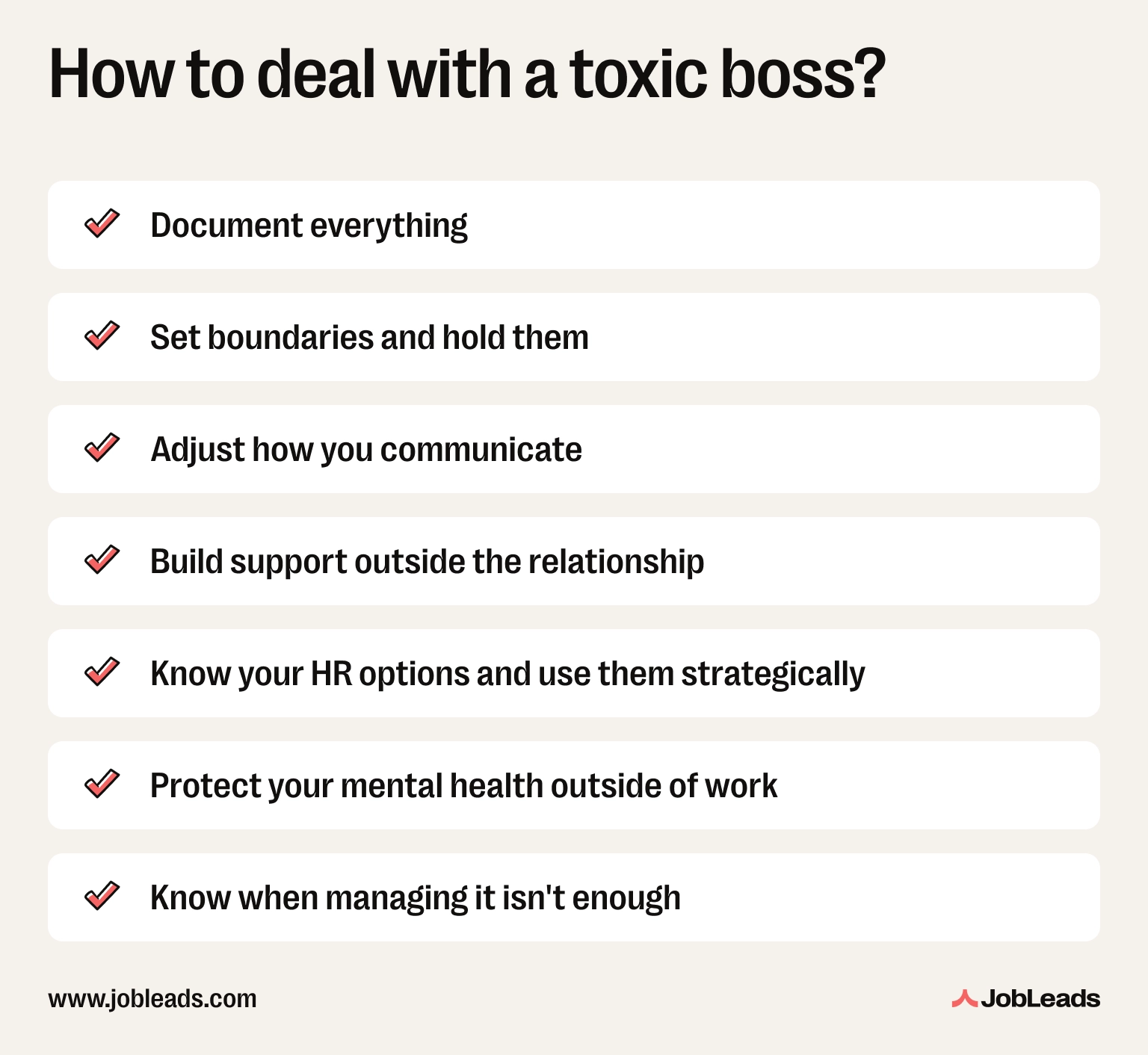
Log dates, specific incidents, exact wording where you can remember it, and anyone who witnessed it. You may never need this file. But if you ever do escalate, transfer, or leave and need to explain why, a dated record beats your memory every time.
For example, Tom started keeping a simple note on his phone after every meeting where his manager changed a deadline retroactively–just the date and a one-line summary. Six months later, when he requested a transfer, that log was the difference between "I have a difficult manager" and a pattern HR could actually act on.
Decide your own response-time expectations for messages outside working hours, what meeting prep you will and won't do unpaid, and what you'll take on without pushback. The first time you hold a boundary will feel uncomfortable. The tenth time will just be a new norm.
Put things in writing after verbal conversations–a short "confirming what we discussed" email closes the door on shifting expectations later. Ask clarifying questions to pin down vague requests before you start the work. This is a practical answer to how to manage a toxic boss day-to-day, without waiting for them to change first–and it's really an emotional intelligence skill more than a confrontation one.
Peers, mentors, or a professional network can reality-check your experience and cut through the isolation a toxic dynamic creates. Working for a toxic boss in isolation is exactly what erodes your resilience fastest. It's much harder to convince yourself you're overreacting when someone else who knows the situation says, plainly, that you're not.
If you're wondering how to talk to HR about a toxic boss, or how to report a toxic boss more formally, the answer is the same either way: bring your documentation, not just your frustration. Frame the issue in terms of team or business impact where you can–missed deadlines, turnover, project risk–because HR's job is to protect the company, and that framing gets a concern taken seriously faster than "my boss is mean."
Also, set realistic expectations. Retaliation has been the single most-filed category of charge with the EEOC for more than a decade, and it made up 56% of all charges filed in FY2023. There's rarely a fast way to get rid of a toxic boss, but a well-documented, strategically escalated complaint is the closest thing to one. So, put your feelings aside and escalate deliberately, with a paper trail.
Build in a real decompression routine and use therapy or an Employee Assistance Program if you have access to one. Also, importantly, keep work Slack or email off your personal phone where you can. None of this fixes the boss. But it keeps the boss from being the only thing you think about after 6 p.m.
Pro-tip
If you're not sure whether something is genuinely toxic or just a bad week, track it for about a month before deciding. A pattern will answer all your doubts.
Some situations, like harassment, safety issues, or anything actively damaging your health, aren't things you should just "cope" with using better boundaries. If you've tried the steps above and nothing has changed, that's a different decision than managing a difficult personality.
Read more: If you've tried all of the above and you're still weighing leaving a toxic boss altogether, check out this guide on should I quit my job. Also, learn the proper etiquette to quit your job gracefully.
None of the 10 signs above prove anything on their own–a missed deadline, one off day, one uncomfortable meeting. What actually proves it is the pattern: the same behavior repeating, week after week, no matter what you change on your end. That's the line between a boss who's simply hard to work for and one who's genuinely toxic.
Bottom line–
You don't have to choose between "put up with it" and "quit tomorrow." Documenting what's happening, setting real boundaries, building support outside the relationship, and knowing when to escalate to HR are all legitimate middle steps. In fact, most people use several of them before they ever get close to leaving.
If you do eventually reach that point, remember that's not a failure on your part. Your relationship with your manager is one of the biggest single factors in whether a job actually works for you. So walking away from a bad one is often the fastest way back to feeling normal at work again.

Content & Insight Writer
Beata creates content that puts job seekers first. From practical blog advice to first-hand research studies, her writing is designed to give people the clarity and confidence to find the role they deserve.
Career DevelopmentCheck out the full remote onboarding guide to learn what to prepare. Also, check out the employer checklist and best practices that boost retention.
 Career Development
Should I quit my job? Here's how to know when it's the right call–from anxiety and burnout to starting a business or going back to school.
 Career Development
Discover the pros and cons of working from home. Learn how employees and employers benefit from remote work and the challenges they encounter.