 Resume
August 24, 2026
How Long Should a Resume Be? Ideal Length by Experience
How long should a resume be? Learn how many pages a resume should be for an entry-level position vs for someone with over 10 years of experience.

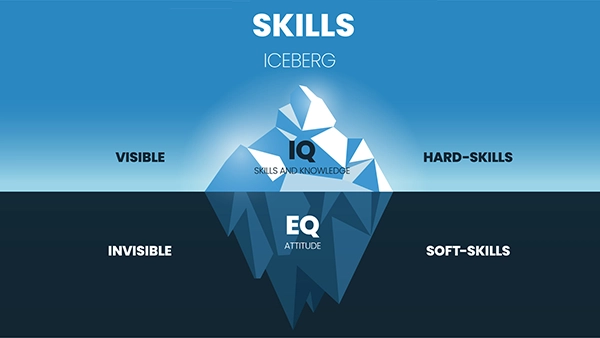
Soft skills and hard skills. You’ve probably heard of them, but perhaps you’re not quite sure of the difference, or how that matters to your job search.
Well, they do matter. Much more than you think.
Understanding the difference, and learning how to showcase them effectively in your resume and cover letter, is the key to landing that interview.
Because without them, you’re just another unappreciated printout on the recruiter’s desk, waiting to be filed in the shredder.
And we don’t want that.
So let’s dive in and demystify what the dynamic duo of soft and hard skills are, and how each plays a unique role in your professional success.
Hard skills are the tangible, teachable abilities that you can quantify and measure. Unlike soft skills, they’re objective and easily proved. They're like the bricks that construct the foundation of your professional expertise.
Examples include proficiency in a particular technical skill, or expertise such as project management, team leadership, data analysis, or training delivery. In roles where communication and clarity are crucial, some professionals also rely on an AI presentation maker to visually showcase complex projects, results, or case studies, complementing their technical skills. These are provable abilities that you’ve undertaken in your career, regardless of how well you did them.
Here are some you’re likely to see in different job descriptions:
Hard Skills Example 1: Data Scientist
Hard Skills Example 2: Senior Marketing Manager
Hard Skills Example 3: Project Manager
Now, let's talk about the actually not-so-invisible glue that holds your career aspirations together – soft skills. These are the interpersonal, emotional, and social intelligence qualities that make you a great team player, an effective communicator, and an adaptable professional.
Soft skills encompass things like communication, teamwork, problem-solving, adaptability, and leadership.
Compared to hard skills, soft skills are harder to quantify. Which is why they’re considered more subjective. They're often demonstrated through your behavior, attitude, and approach to work.
Unlike hard skills, those around you can perceive your soft skill abilities differently (you may think you need to improve your time management skills, but your former colleagues may say you were always on time – if not a few minutes early – for meetings and generally hit your deadlines).
Let’s take a look at some examples:
Soft Skills Example 1: Team Leader
Soft Skills Example 2: Accountant
Soft Skills Example 3: Graphic Designer
Now for the big question: how to incorporate those hard skills and soft skills quickly and relevantly in your resume and cover letter to grab the hiring manager’s attention?
Great question! And of course, we’ve got the answer.
Check out the specific examples and tips below to help you weave your skills into your resume and cover letter like a pro.
Let’s start with your resume.
Hard skills, rather than soft skills, are better suited to your resume. While you can certainly include a sprinkling of soft skills in the summary section, your resume should be primarily dedicated to hard skills.
That’s because at this first stage filtering, recruiters and ATS typically look for these tangible, quantifiable skills that are essential to doing the job. You can be a great communicator (soft skill), but if you don’t have project management experience and that’s what they need, then you’re not going to be able to do the job.
On the other hand, over in your cover letter, your soft skills can help to differentiate you from other applicants with a similar professional background and hard skills. We’ll get to cover letter shortly.
There are two ways to incorporate hard skills in your resume. We recommend including a key skills box under your resume summary. This box contains important hard skill keywords that recruiters and applicant tracking systems (ATS) look for when considering your application. It also makes it very easy for you to tweak your resume for specific job applications, increasing your match rate for that role.
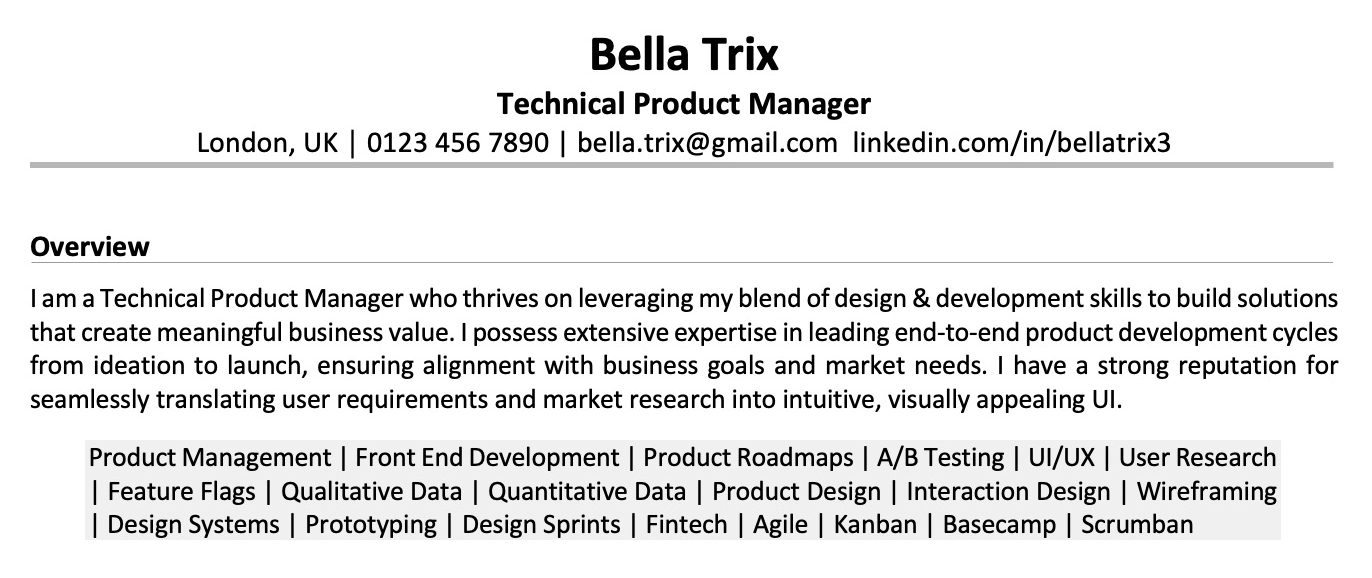
As well as a key skills box, ensure the most prominent hard skills for your job type are sprinkled authentically throughout your resume. That way, the recruiter won’t think you’ve tweaked the key skills box to get their attention, without actually having the required abilities.
With keywords, it’s important to be specific and avoid generic terms. Instead of saying, "proficient in Microsoft Office," specify "advanced proficiency in Excel for data analysis and reporting." Tip: Don’t forget to use the English spelling in your target market (e.g. UK English, US English). Otherwise, the ATS in particular may miss this keyword. Here’s how the above job seeker incorporated important keywords in her resume from the job she was applying for. The include ‘product development lifecycle’, brand guidelines’, ‘branded treatments’, and ‘React’:
Now it’s your turn. Ensure that your summary, key skills box, and job descriptions include the major hard skills that are important for the types of job you’re applying for.
If you’re not sure what these are, we recommend doing an online search for similar job descriptions. Identify the most common hard skills and ensure these are incorporated wherever relevant to your own experience. Or use an AI tool such as ChatGPT to identify these for you.
Next, we’ll look at how to showcase both hard and soft skills in your cover letter.
While resumes are the best place for hard skills, your cover letter is your opportunity to share insights into your key soft skills that are relevant to that job and company. They also give clues as to what you’re like to work with.
Companies often mention soft skills in their job descriptions, usually in the essential or desirable requirements section. For example:
Qualifications:
Let’s see how Rhonda Williams, an experienced accountant, incorporated the most relevant soft skills in this job description in the narrative of her career:
Read more: Check out JobLeads analysis of entry level job requirements to see what emplyers are really looking for.
Dear Hiring Manager,
Accountant (Level 3)
I am writing to express my interest in the Accountant (Level 3) position at Wellington Inc. With over 10 years of experience as an accountant and a proven track record in financial analysis in fast-paced environments, I am confident in my ability to contribute effectively to your team.
My meticulous attention to detail has been a cornerstone of my success in previous roles. I consistently ensure accuracy in financial reporting, conduct thorough audits, and identify discrepancies with precision. This commitment to detail not only guarantees the integrity of financial records but also contributes to informed decision-making.
Efficient time management, communication skills, and ability to build relationships have been key assets throughout my career. In my most recent position at RetroGuild, I successfully managed multiple deadlines for monthly financial reporting, tax filings, and audit preparations. My ability to prioritize tasks and meet tight deadlines has allowed me to deliver high-quality work consistently.
Per your requirements, analytical thinking and the ability to manage conflict are additional strengths I bring to the table. I have a demonstrated ability to analyze financial data, identify trends, and provide valuable insights for strategic planning, particularly when navigating the competing interests of different business units. My analytical skills have played a pivotal role in optimizing budgetary processes and improving overall financial efficiency.
I am eager to bring my expertise to Wellington Inc, contributing to the continued success of your financial team. I look forward to the opportunity to discuss how my skills align with the needs of your organization in more detail.
Please find attached my resume for your consideration. Thank you for your time. I look forward to hearing from you regarding next steps.
Yours faithfully,
Rhonda Wiliams
As you can see, it’s fairly easy to incorporate the relevant soft skills into your cover letter once you have a template. Simply tweak these for specific opportunities, aiming to match their phrasing wherever possible (so the human eye and ATS can detect a closer match). Ensure that the anecdote or example you’re giving matches the specific keyword.
You’ll notice that Rhonda Williams has also pointed out the most important hard skill keywords again, too. Although these are covered in her resume, it packs a double whammy when they’re also referenced in your cover letter.
Wherever possible, link your soft skills to specific successful outcomes, for example solving a complex problem or improving a process.
Dear Hiring Manager,
Accountant (Level 3)
I am writing to express my interest in the Accountant (Level 3) position at Wellington Inc. With over 10 years of experience as an accountant and a proven track record in financial analysis in fast-paced environments, I am confident in my ability to contribute effectively to your team.
My meticulous attention to detail has been a cornerstone of my success in previous roles. I consistently ensure accuracy in financial reporting, conduct thorough audits, and identify discrepancies with precision. This commitment to detail not only guarantees the integrity of financial records but also contributes to informed decision-making.
Efficient time management, communication skills, and ability to build relationships have been key assets throughout my career. In my most recent position at RetroGuild, I successfully managed multiple deadlines for monthly financial reporting, tax filings, and audit preparations. My ability to prioritize tasks and meet tight deadlines has allowed me to deliver high-quality work consistently.
Per your requirements, analytical thinking and the ability to manage conflict are additional strengths I bring to the table. I have a demonstrated ability to analyze financial data, identify trends, and provide valuable insights for strategic planning, particularly when navigating the competing interests of different business units. My analytical skills have played a pivotal role in optimizing budgetary processes and improving overall financial efficiency.
I am eager to bring my expertise to Wellington Inc, contributing to the continued success of your financial team. I look forward to the opportunity to discuss how my skills align with the needs of your organization in more detail.
Please find attached my resume for your consideration. Thank you for your time. I look forward to hearing from you regarding next steps.
Yours faithfully,
Rhonda Wiliams
Once you get the hang of it, spotting relevant hard skills and soft skills in job descriptions (and incorporating these in your resume and cover letter) becomes a breeze.
While it may seem like a small thing, in actual fact including hard skills and soft skills in your job application can make the difference between your resume being seen, or landing in the rejection pile.
Remember, the goal is not just to get the job, but to find the right fit where your skills and the company's culture align. So go ahead, polish those soft and hard skills, and let your unique professional brilliance shine through!
For more insights, tips and strategies related to this topic, be sure to read our other articles: 5 Successful Upskilling Strategies for Career Pivoting & 6 Effective Methods to Learn and Upskill While Sleeping & What is Emotional Intelligence & How Can EQ Boost Your Career

Co-Founder and Managing Director
Jan Hendrik von Ahlen is the co-founder of JobLeads, a career platform built exclusively for job seekers. He co-founded JobLeads with Christian von Ahlen and Martin Schmidt in 2007 with a clear mission: to give candidates the tools, insights, and support they need to take control of their job search. Under his leadership, JobLeads has grown into a subscription-funded platform serving 20 million users across 40+ countries, with AI-powered job matching, a 40,000+ headhunter network, and end-to-end career support.
ResumeHow long should a resume be? Learn how many pages a resume should be for an entry-level position vs for someone with over 10 years of experience.
 Resume
Check out the step-by-step guide to writing a career change resume. Learn how to write the summary, present your skills, and what format to use.
 Resume
The 8 most common resume mistakes to avoid, from generic resumes to ATS keyword mismatches. Learn exactly how to fix each one before you apply.