
 Job Search
June 10, 2026
Tips From Recruiters: 9 Things That Actually Get You Hired
Get recruiter tips straight from the source. From tailoring your resume to following up after interviews, here’s what hiring managers actually want to see.


Studies estimate that around 70% of jobs never get posted. This means that companies might be hiring for your dream job right this moment but if it’s not publicly posted, you won’t know about it.
Nowadays, we have job boards, LinkedIn, and AI recruiting tools. Yet, the hidden job market is still relevant when searching for a job. That’s because available tools optimize for posted roles, not the unposted demand.
Good news is that headhunters are the gateway to unadvertised roles.
The hidden job market refers to job opportunities that are not publicly advertised through job boards or open postings. These positions get filled through internal mobility, headhunter pipelines, employee referral-based hiring, and other informal hiring methods. Employers often use this market to limit the risks related to hiring and to fill unadvertised roles quicker.
Here are the main findings from our research:
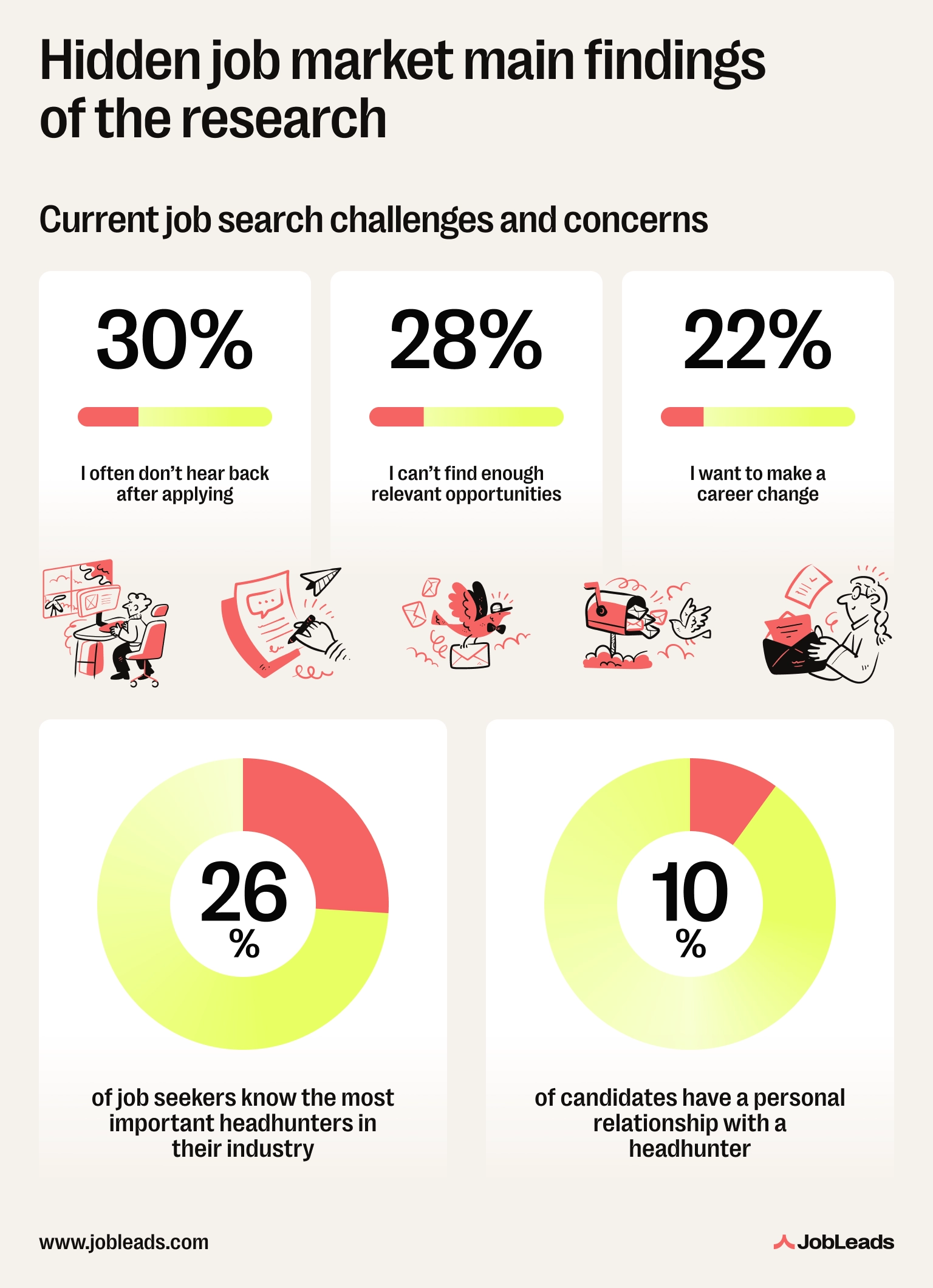
Silence after submitting an application is the number one challenge that candidates face. And it has a real psychological impact. When you don’t receive any response, you don’t know if your profile was even reviewed. This can seriously undermine your confidence and motivation.
The second most common challenge 28% of job seekers face is the inability to find enough relevant opportunities. This suggests a mismatch between available roles and the candidate’s skillset.
Meanwhile, 22% of job seekers want a career change and it's faced with its own kind of challenges. Career switchers face higher rejection rates, making it even harder for them to find the right opportunity.
Despite the major influence that headhunters have on the hiring decisions, most job seekers are unfamiliar with the key players in their industry. This limits their access to the hidden job market, which is even more worrying as that’s where many senior or specialized roles are filled without being posted publicly.
Less than 10% of job seekers are in regular contact with a headhunter, which demonstrates that this path to finding the hidden positions is still not common. And that’s a shame as candidates who build such relationships often benefit from tailored role recommendations and direct feedback.
Now–
How do companies use the hidden job market to fill in positions?
Answering this is more complicated than it might seem. That’s because it all depends on factors like the industry, size of the company, role seniority, and more. So, let’s discuss what the data shows us.
Starting from internal hiring, this phenomenon is more notable in larger companies than it is in smaller businesses. This method of hiring accounts for around 17% of hires at organizations with over 5,000 employees.
Moreover, more senior roles, like middle and senior management, get filled by internal candidates most frequently.
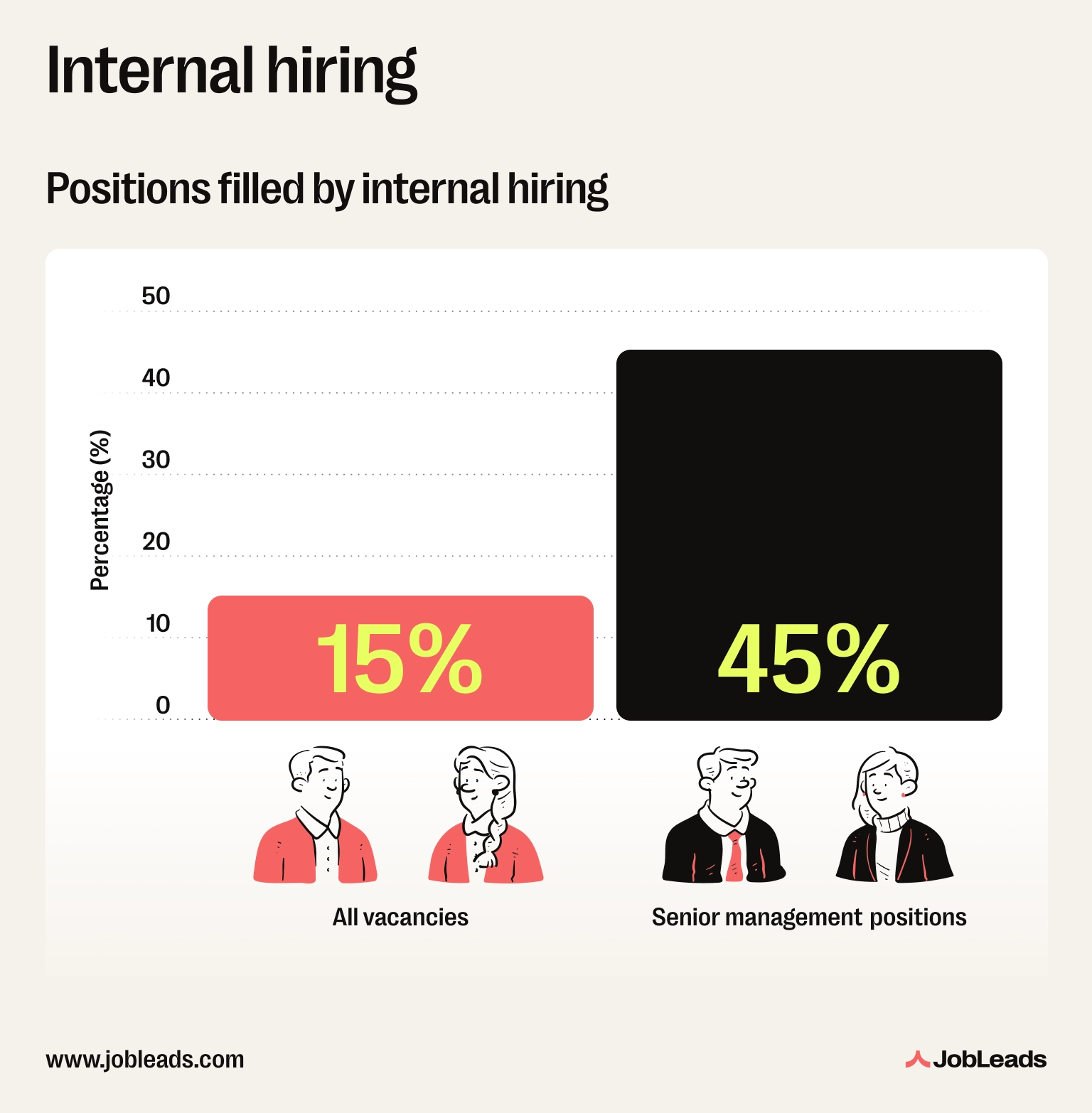
For all vacancies, there is a median of 15% of vacancies being filled in by internal candidates.
This number jumps to 45% when we look at internal promotions to senior management positions.
The second main method of hidden job market hiring is referrals. Data shows that IT services and computer software are two areas where the employee is most likely to get hired through a referral.
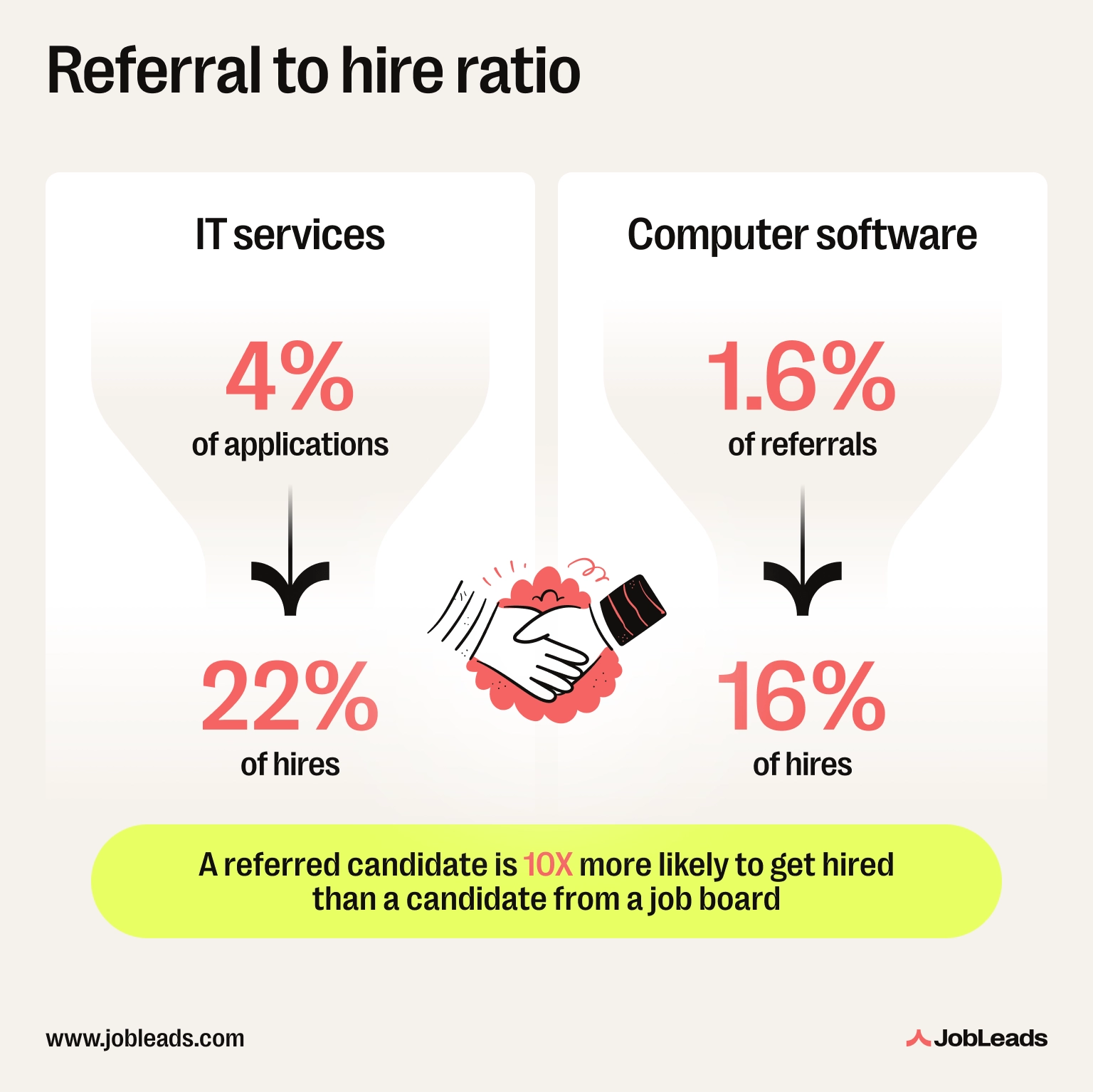
Respectively, around 4% of applications lead to over 22% of hires in IT services and 1.6% of referrals lead to 16% of hires for computer software.
Direct sourcing uses the companies’ talent pool including previous submissions and applications from its current staff for hiring. This strategy accounts for 26% of hires from 13% of applications in total.
When we break it down, you can see that computer software accounts for less than 3% of applications but gets nearly 16% of hires. Similarly, financial services show almost 10% of hires from just over 1% of applications.
Compared to LinkedIn and other job boards that get 61% of applications on publicly available job postings and have 42% of hires, this might seem like a lot.
But–
When you look at it in perspective, you’ll see that a referred candidate is 10 times more likely to get hired than a candidate from a job board.
A few reasons for this include:
Legal job posting requirements in different countries impact the hidden job market but they don’t limit it. Internal job posting is generally legal in the US, Canada, and European Union.
In the US, there is no country-wide federal rule that forces employers to publicly advertise vacancies. A few common exceptions where posting is required include federal contractions and federal government hiring, and PERM labor certification–where an employer sponsoring a foreign professional for a green card must run public recruitment to prove no qualified US worker is available. Candidates considering that route should factor in the timeline for employer-sponsored labor certification, which can stretch well over a year. And internal hiring is legal if it complies with anti-discrimination laws that apply to recruitment and promotion decisions.
The hidden job market in Canada is ruled by provincial laws but, in general, employers don’t have to publicly post jobs. The only rules that companies posting positions need to comply with are human rights and anti-discrimination rules.
Similarly, the EU doesn’t have any rules forcing employers to publicly advertise vacancies. However, companies need to comply with EU equal treatment rules and EU sex equality rules.
On top of policies, there are also some cultural norms worth mentioning, especially when it comes to referrals. These norms come from how society views relationships and reputation.
For example, in many Asian and high-context cultures referrals are closely tied to personal credibility. This means that recommending someone is seen as a reflection of the referrer’s judgment and social standing. As a result, people are more cautious and only give referrals to candidates they strongly trust.
By contrast, Australia, the US, and many of the Western European countries reflect a more individualist culture. Here, referrals are typically more transactional with organisations that encourage referrals through clear incentives like bonuses. While trust still matters here, the social risk of making a referral is generally lower.
Now, let’s explore effective strategies on how you can find hidden jobs.
With the data that we’ve seen, it’s clear that accessing the hidden job market is important when you’re searching for a job. So, here are the best hidden job market strategies you can use.
Let’s face it, headhunters are the most direct route to hidden job market roles. Yet, only 26% of job seekers know the most important headhunters in their industry.
This has got to change.
But it’s important to note that headhunters are usually hired by companies to fill positions that require specific or high-level skills. These positions include, for instance, cybersecurity architects and senior product managers.
To identify candidates, headhunters use tools that scan large databases and public profiles, like LinkedIn and CV databases, using search criteria that combine job titles, skills, seniority, and more. Then, they rank the candidates on how closely the profiles match the role requirements.
So, here are a few tips for finding headhunters and getting AI recruitment tools’ attention:
The best strategy for this is to start by auditing your existing connections. This includes talking to your friends, family, former colleagues, or even people you went to university with. Ask them what their workplace is like and mention that you’re looking for a job in a specific position.
Over 84% of companies offer referral programs where the employee referring you will get monetary compensation. So, when your friend recommends you, it’s a win-win for both of you.
But how to ask for a referral without being awkward?
You should be specific about what you want and do the work for them. So, make the message clear and include all the elements they will need for your referral. Also, respect their reputation by signalling that you like what they do and you want the referral only if they feel comfortable with giving you one.
The two big no’s include being pushy and putting any pressure on the person. This can discourage them from referring to you.
Here’s a copy-paste template you could use:
Referral message template
Hi [name],
We met through [context]. I noticed that you’re working at [company] and I’m actually applying for [role].
If you’re comfortable, would you be open to a referral or pointing me to the right person to speak with? I’d really appreciate it.
Once they agree to a referral, provide them with:
And remember about the multiplier effect. Each connection you have expands your reach when it comes to companies. So, speak to as many people as you can from your circle to have the best chances at a referral.
Read more: Learn all you need to know about the application tracking system (ATS) before applying for your next job.
A recent survey found that around 85% of jobs are filled via some type of networking. This includes LinkedIn engagement, industry events, and more.
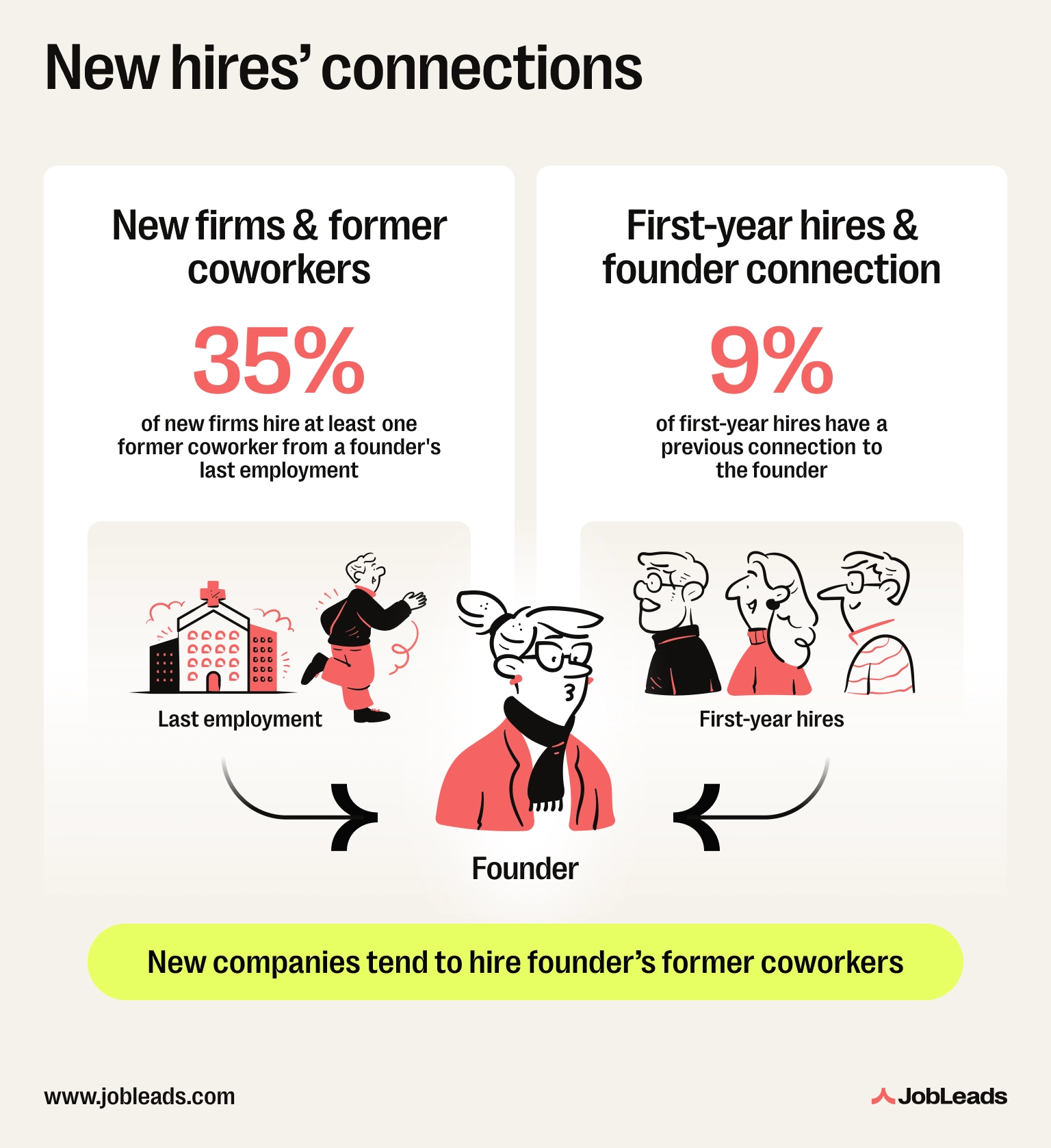
And if your connection is in a senior role in the company, that’s a win for you. In fact, more than 35% of new firms hire at least one former coworker from the founder’s last employment which accounted for over 9% of first-year hires having a previous connection to the founder.
If you prefer in-person networking, a great tip would be to attend some industry events and conferences.
The biggest networking events include Web Summit for technology, Slush for investment, and Startup Grind Global for startups.
Other industry-specific gatherings worth mentioning are the Mint AI Summit, Excelerate Finance Fest, and South Summit.
These are the main events but your industry definitely also has smaller gatherings, most likely even in your area, so you should search for them to boost your reach.
Another hidden market strategy for networking is to follow thought leaders on LinkedIn and interact with them. This includes reacting or commenting on their posts and sending them a personalized message when you spot an area you can connect over.
Read more: Discover the best job search strategies to improve your chances of landing your dream position.
This point is all about contacting hiring managers directly through LinkedIn or email. If you want to build relationships before applying, you should consider writing messages to the relevant professionals in your field, but make sure not to annoy the recruiter. Here are a few things that work and a few things you should avoid when doing cold outreach as a job seeker.
What works when contacting recruiters:
What annoys recruiters:
Cold outreach works only if you personalize your message to every recruiter you want to contact. Mention the job you’d like to apply for and skills you’d bring to the company. It’s all about standing out from the competition, so make sure you show them what makes you different to the rest of the applications.
Nathan Putsey – Talent Acquisition Manager at JobLeads
Recruiters on Reddit also mention:
Recruiters get tons of repeat messages that don’t stand out. You might try reaching out with a thoughtful question or mention something specific about the company.
Reddit user
And one person created a template for job seekers writing to recruiters:
Hi Recruiter, I'm (insert name) and I have X years' experience with ABC technology. I'm open to new opportunities in [city] or remote and I'm targeting [salary].
This would save so much time and a good recruiter will respond with relevant info or a referral.
Reddit user
Read more: Check out the top tips from recruiters that help you during the job search.
Generally speaking, the hidden job market is shrinking but not disappearing. It’s still important, companies still see many benefits, and this method is more effective for job seekers. Informal hiring methods are especially relevant for senior and niche roles where it’s difficult to find the right match for the company.
Compared with a decade ago, there are more roles advertised publicly now. That’s largely because of the compliance requirements, employer branding efforts, and AI recruitment tools available.
Do you want to find the right match for yourself?
JobLeads gives you access to high-quality opportunities tailored to your preferences. The platform provides headhunter-matching and expert career guidance from building your resume all the way to winning the interviews. So, why not trust the professionals with finding your next job opportunity?
For this study, we collected answers from 43,175 respondents through a proprietary JobLeads survey. The survey was administered online to JobLeads website visitors. All responses were reviewed before analysis. Findings in this report are derived from JobLeads’ internal data as well as high-quality outside sources.

Content & Insight Writer
Beata creates content that puts job seekers first. From practical blog advice to first-hand research studies, her writing is designed to give people the clarity and confidence to find the role they deserve.
Job SearchGet recruiter tips straight from the source. From tailoring your resume to following up after interviews, here’s what hiring managers actually want to see.
 Job Search
Struggling with job applications? Discover how to decode job descriptions and tailor your resume to boost your chances of landing an interview.
 Job Search
Unlock job search success with clear personal branding, effective networking, adaptability, strategic time management, and resilience. Learn the secrets of top job seekers.